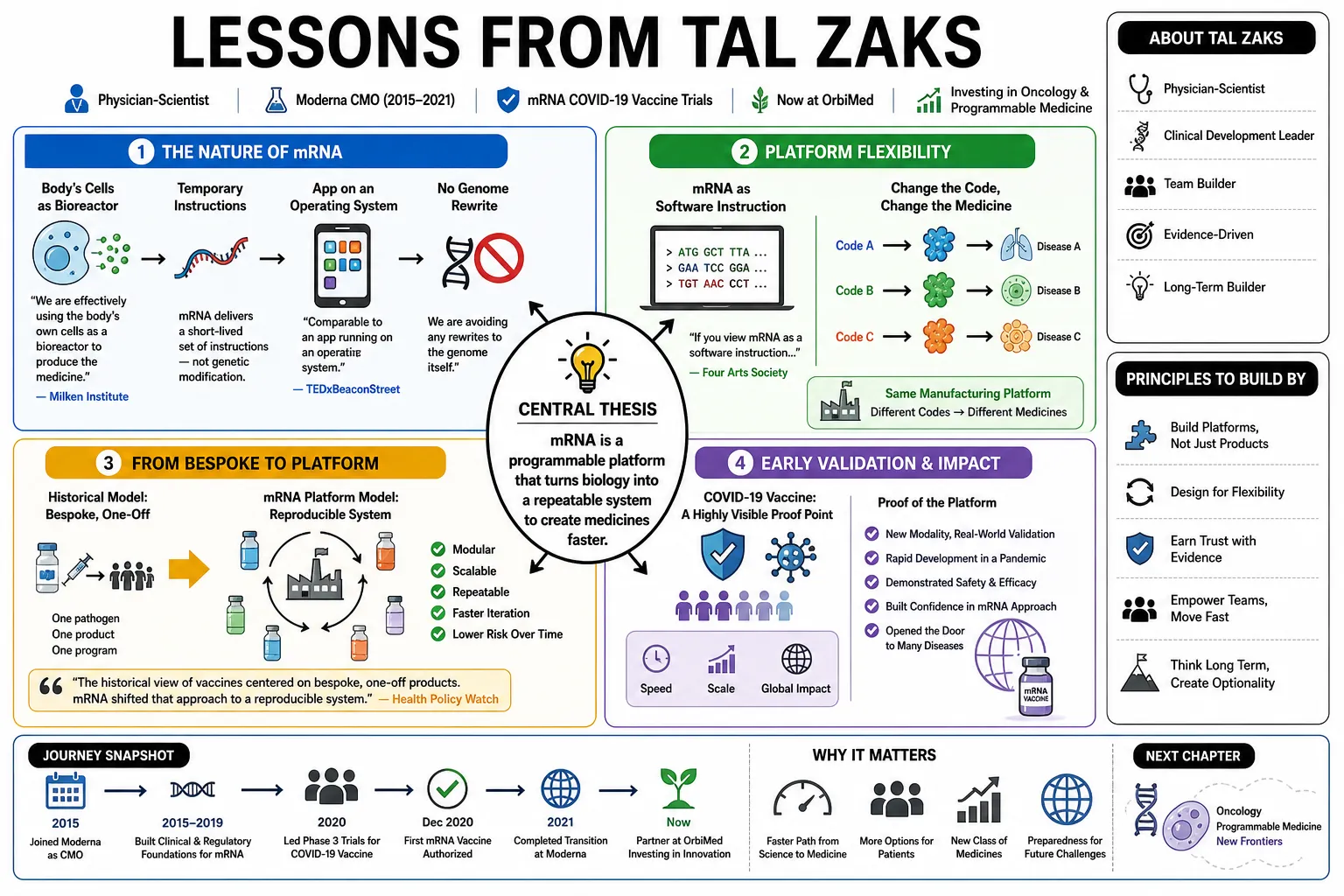
Lessons from Tal Zaks
Tal Zaks is a physician-scientist who served as Moderna's Chief Medical Officer from 2015 to 2021, overseeing clinical development for the company's mRNA platform and its Phase 3 COVID-19 vaccine trials. He is now a partner at OrbiMed, investing in early-stage oncology and programmable medicine startups.
Part 1: The mRNA Platform Model
- On the nature of mRNA: "We are effectively using the body's own cells as a bioreactor to produce the medicine." — Source: Milken Institute
- On platform flexibility: "If you view mRNA as a software instruction, you can change the genetic code to address an entirely different disease without altering the fundamental manufacturing process." — Source: Four Arts Society
- On bespoke versus platform models: "The historical view of vaccines centered on bespoke, one-off products. MRNA shifted that approach to a reproducible system." — Source: Health Policy Watch
- On Software Analogies in Biology: Zaks described mRNA as the software of life: a way to deliver instructions so the body can make proteins for vaccines or therapeutics, without treating the molecule as a permanent rewrite of DNA. — Reference: Nature Inside View interview with Tal Zaks
- On Early Validation: Four Arts summarized Zaks's Moderna lecture as tracing the COVID vaccine from a broad preclinical company, through the 2015-2019 clinical pipeline, to the platform's first major proof of concept. — Reference: Four Arts lecture description for Tal Zaks
- On targeting the undruggable: "By using the cell's own machinery, we can access intracellular targets that traditional small molecules or biologics simply cannot reach." — Source: PMWC International
- On transient mechanics: "The beauty of mRNA is its transience. It delivers the message, produces the necessary protein, and then naturally degrades without permanently altering the cell." — Source: PolitiFact
- On manufacturing scale: "Once the underlying platform is established, scaling up production becomes an engineering problem rather than a basic science mystery." — Source: Milken Institute
- On biological predictability: "With a platform approach, the biology becomes more predictable with each new iteration, significantly reducing the technology risk over time." — Source: The Motley Fool
Part 2: Speed and Pandemic Response
- On the 63-day timeline: "Going from genetic sequence to a human trial in roughly two months was the direct result of years spent optimizing the manufacturing platform." — Source: Murdoch Children's Research Institute
- On pandemic readiness: "You don't build the fire engine while the house is burning. Our ability to respond to COVID-19 was dictated by the infrastructure we built between 2015 and 2019." — Source: Four Arts Society
- On parallel processing: "We had to take financial risks to compress the timeline, running manufacturing scale-up in parallel with early clinical trials before we even had the final data." — Source: Axios
- On operational intensity: "During the early days of the pandemic response, the emotional commitment required superhuman hours from the entire team." — Source: Wave
- On Decision-Making Under Pressure: In Health Policy Watch, Zaks explained how Moderna's mRNA process used smaller, faster bioreactors and prior vaccine work, making speed a manufacturing and platform question rather than only a management slogan. — Reference: Health Policy Watch interview with Tal Zaks
- On the advantage of sequence-based design: "Because we only needed the virus's genetic code, we never had to wait for physical samples of the pathogen to begin designing the vaccine." — Source: Milken Institute
- On scaling a workforce: "Growing an organization exponentially during a global lockdown required an immense degree of trust and decentralized authority." — Source: Axios
- On setting dose levels quickly: "The early phase data gave us just enough signal on safety and immunogenicity to make a rapid, educated bet on the final dose for the Phase 3 trial." — Source: Gingrich 360
- On Platform Responsibility: Four Arts framed Moderna's COVID vaccine as the first proof of concept for a new mRNA platform and one of the most impactful medicines of its generation, which explains the weight placed on the program. — Reference: Four Arts lecture description for Tal Zaks
Part 3: Clinical Trial Design and Rigor
- On endpoint selection: "A trial must be designed to answer the most pressing clinical question unequivocally. Ambiguity in endpoints is the enemy of regulatory approval." — Source: The Conference Forum
- On diversity in enrollment: "If a medicine is meant for the global population, the clinical trial demographics must reflect that reality to ensure broad public trust and scientific accuracy." — Source: Axios
- On statistical power: "You cannot shortcut the math. A trial must be sufficiently powered to detect a meaningful difference, even if it requires massive patient numbers." — Source: Newt's World
- On commercial viability: "Moving from a scientific proof of concept to a sustainable business hinges largely on navigating the logistics of a Phase 3 trial." — Source: PMWC International
- On adaptive trial designs: "When dealing with a novel pathogen, the ability to adapt trial protocols based on emerging epidemiological data is a necessary survival skill." — Source: Health Policy Watch
- On balancing speed and safety: "Speed in trial enrollment cannot come at the expense of meticulous safety monitoring. The latter secures long-term viability." — Source: Milken Institute
- On Safety Oversight: The Invest Like the Best episode notes an extended discussion of unprecedented vaccine safety measures, public trust, and the challenge of turning a platform breakthrough into a medicine people would accept. — Reference: Apple Podcasts listing for Invest Like the Best with Tal Zaks
- On managing clinical operations: "The actual administration of a massive global trial is a logistical puzzle that demands as much innovation as the underlying biochemistry." — Source: Axios
- On Reading Early Data: Zaks told Health Policy Watch that Moderna studied multiple dose levels in phase 1 and looked at neutralizing-antibody activity against convalescent plasma, using early signals as guidance rather than as a substitute for efficacy proof. — Reference: Health Policy Watch interview with Tal Zaks
Part 4: Bridging Science and Medicine
- On the physician-scientist mandate: "The goal is to translate cellular insights into measurable patient outcomes rather than simply understanding biology in a vacuum." — Source: Wave
- On Translating Mechanisms: Zaks's Nature interview moves from the biological idea of mRNA to practical delivery, disease selection, dose, immunogenicity, and manufacturing, showing why a mechanism has to become a usable medicine. — Reference: Nature Inside View interview with Tal Zaks
- On multidisciplinary integration: "Modern drug development requires speaking the languages of molecular biology and applied mathematics simultaneously." — Source: Milken Institute
- On patient-centric focus: "Every scientific decision must eventually be measured against whether it meaningfully alters the trajectory of a patient's disease." — Source: NIH
- On the Academic-Industry Divide: In Business of Biotech, Zaks contrasted academic incentives with his attraction to teamwork and doing something in the world, a useful lens on why translational medicine pulled him into industry. — Reference: Business of Biotech interview with Tal Zaks
- On clinical intuition: "Data is paramount, but a physician's intuition about disease progression often guides where we choose to look for that data." — Source: Wave
- On mathematical applications in biology: "Applying rigorous quantitative models to biological systems moves drug discovery from an art to an engineering discipline." — Source: Milken Institute
- On defining medical need: "Innovation should be directed toward areas where the current standard of care leaves a profound vacuum of hope for patients." — Source: PMWC International
- On the Evolution of Therapeutics: Nature described Moderna's work as a new class of mRNA medicines spanning vaccines, immuno-oncology, rare disease, and cardiovascular programs, with shared building blocks across candidates. — Reference: Nature Inside View interview with Tal Zaks
Part 5: Biotech Leadership and Culture
- On mission alignment: "When the team is aligned around a patient-driven mission, the endurance required to overcome inevitable setbacks naturally follows." — Source: Wave
- On Embracing Truth: Zaks told Business of Biotech that his early NIH years involved failed cancer-vaccine and immunology hypotheses, and that the value came from extracting scientific depth from what did not work. — Reference: Business of Biotech interview with Tal Zaks
- On Team-Based Leadership: Zaks's Business of Biotech story emphasizes teamwork over single-author academic credit, making collaborative execution a recurring theme in how he moved from training into biotech building. — Reference: Business of Biotech interview with Tal Zaks
- On Navigating Early Failures: Zaks said his first years at the National Cancer Institute were marked by failure, including a cancer-vaccine effort that proved why the approach did not work, which became part of his operating philosophy. — Reference: Business of Biotech interview with Tal Zaks
- On talent density: "The hardest problems in medicine can only be solved by assembling teams that possess deep domain expertise alongside extreme cognitive flexibility." — Source: Deep Genomics
- On continuous learning: "In an industry defined by the unknown, the most valuable asset a leader can possess is a willingness to continuously update their mental models." — Source: Wave
- On cross-functional friction: "Healthy friction between the research and clinical teams is necessary to forge a product that actually works in the real world." — Source: Milken Institute
- On maintaining focus: "It is easy for a platform company to become distracted by endless possibilities. Discipline requires saying no to good ideas to execute on the great ones." — Source: The Motley Fool
- On the Role of the CMO: Advancing RNA frames Zaks's later work around moving from Moderna's CMO during the pandemic to building Exsilio, keeping clinical development, company formation, and mRNA execution tightly connected. — Reference: Advancing RNA episode page for Tal Zaks
Part 6: Navigating Risk and Investment
- On evaluating value paths: "Investors need to see a defined path detailing how a scientific breakthrough will demonstrate clinical viability and ultimately reach the market." — Source: OrbiMed
- On separating risks: "You have to isolate biological risk and execution risk. Stacking them in one program drops the probability of success to near zero." — Source: The Motley Fool
- On financing innovation: "Capital is the oxygen of biotech. Securing it requires translating complex scientific potential into a language that financial markets can underwrite." — Source: Globes
- On Platform Valuation: Invest Like the Best frames Zaks's perspective around Moderna's mRNA platform, the venture-scale challenge of turning scientific breakthroughs into medicines, and the investment logic behind biotech platforms. — Reference: Colossus episode page for Invest Like the Best with Tal Zaks
- On the valley of death: "Many brilliant molecules die because companies fail to secure the capital required to bridge the gap between animal models and human efficacy." — Source: Fierce Biotech
- On venture capital's role: "The best investors provide pattern recognition built from watching hundreds of companies succeed and fail, alongside capital." — Source: OrbiMed
- On timing the market: "Sometimes the science is ready before the market is. Surviving that timing mismatch requires patient, conviction-driven capital." — Source: Globes
- On managing runway: "In early-stage biotech, time is your enemy. Every decision must be optimized to generate value-creating data before the cash runway ends." — Source: The Pharma Letter
- On strategic partnerships: "Partnering with large pharma can validate a platform and provide non-dilutive capital. It requires careful negotiation to retain the core technology rights." — Source: Teva Pharmaceuticals
- On evaluating founders: "When assessing a startup, I look for founders who possess an unshakable belief in their science coupled with the humility to adapt when the data proves them wrong." — Source: OrbiMed
Part 7: The Future of Personalized Oncology
- On the Complexity of Cancer: In his PMWC interview, Zaks argued that personalized cancer vaccines depend on neoepitopes, sequencing and bioinformatics tools, T-cell biology, and careful clinical context rather than a generic vaccine story. — Reference: PMWC interview with Tal Zaks
- On neoantigens: "The key to unlocking cancer immunotherapy is identifying the specific neoantigens that flag a tumor as foreign to the patient's own immune system." — Source: PMWC International
- On individualized vaccines: "We are moving toward a paradigm where the therapeutic is manufactured specifically for the mutational profile of a single patient's tumor." — Source: The Conference Forum
- On the role of sequencing: "Next-generation sequencing is the foundational tool that allows us to read the tumor's blueprint and design an mRNA countermeasure." — Source: Delfi Diagnostics
- On combination therapies: "Personalized cancer vaccines will likely reach their highest potential in combination with checkpoint inhibitors that take the brakes off the immune system." — Source: The Conference Forum
- On manufacturing bottlenecks: "The challenge of personalized oncology has shifted from biology to the logistical hurdle of manufacturing a custom drug in weeks rather than months." — Source: PMWC International
- On immune memory: "The ultimate goal of a cancer vaccine is establishing durable immunological memory to prevent recurrence, alongside initial tumor regression." — Source: The Conference Forum
- On AI in drug discovery: "Machine learning is becoming a major differentiator in predicting which tumor mutations will actually generate a strong immune response." — Source: Deep Genomics
- On the Evolution of Standard of Care: Zaks's PMWC discussion points to tumor sequencing, HLA binding, mutation burden, and adjuvant melanoma trial design as the practical path for personalized cancer vaccines to change care. — Reference: PMWC interview with Tal Zaks
- On programmable genomic medicines: "Beyond mRNA, the frontier is using programmable tools to edit large segments of DNA to cure underlying genetic defects." — Source: Fierce Biotech
Part 8: Public Trust and Communication
- On the necessity of transparency: "When you are moving at pandemic speed, public transparency regarding side effects and efficacy data is the only currency that buys trust." — Source: Axios
- On combating misinformation: "We must repeatedly clarify that mRNA is a temporary instruction manual. It does not enter the nucleus and it cannot alter a person's DNA." — Source: Verificat
- On scientific literacy: "The pandemic highlighted an urgent need for the scientific community to become better at explaining complex biology to the general public." — Source: Milken Institute
- On Managing Expectations: The 3 Takeaways episode frames Zaks's public communication around mRNA safety, emerging cancer treatments, AI in drug development, and the need to explain scientific uncertainty without overpromising. — Reference: 3 Takeaways episode with Tal Zaks
- On the responsibility of the physician: "As a physician, you are trained to translate clinical jargon into terms a patient can understand. Scaling that to a global population is challenging but necessary." — Source: Wave
- On the speed of information: "Misinformation scales faster than peer-reviewed data. Industry leaders must be proactive rather than reactive in their public communications." — Source: PolitiFact
- On the politicization of science: "When medicine becomes entangled with politics, the focus must relentlessly return to the objective reality of the clinical trial data." — Source: Axios
- On communicating risk: "We have to be honest that no medical intervention is entirely without risk. We must contextualize that risk against the danger of the disease itself." — Source: Newt's World
- On the legacy of the pandemic response: "The rapid development of the vaccine was a triumph of science, yet its ultimate success depended entirely on the public's willingness to roll up their sleeves." — Source: Four Arts Society
- On the future of scientific dialogue: "We need to build platforms for continuous, open dialogue between scientists and the public long before the next crisis hits." — Source: Milken Institute