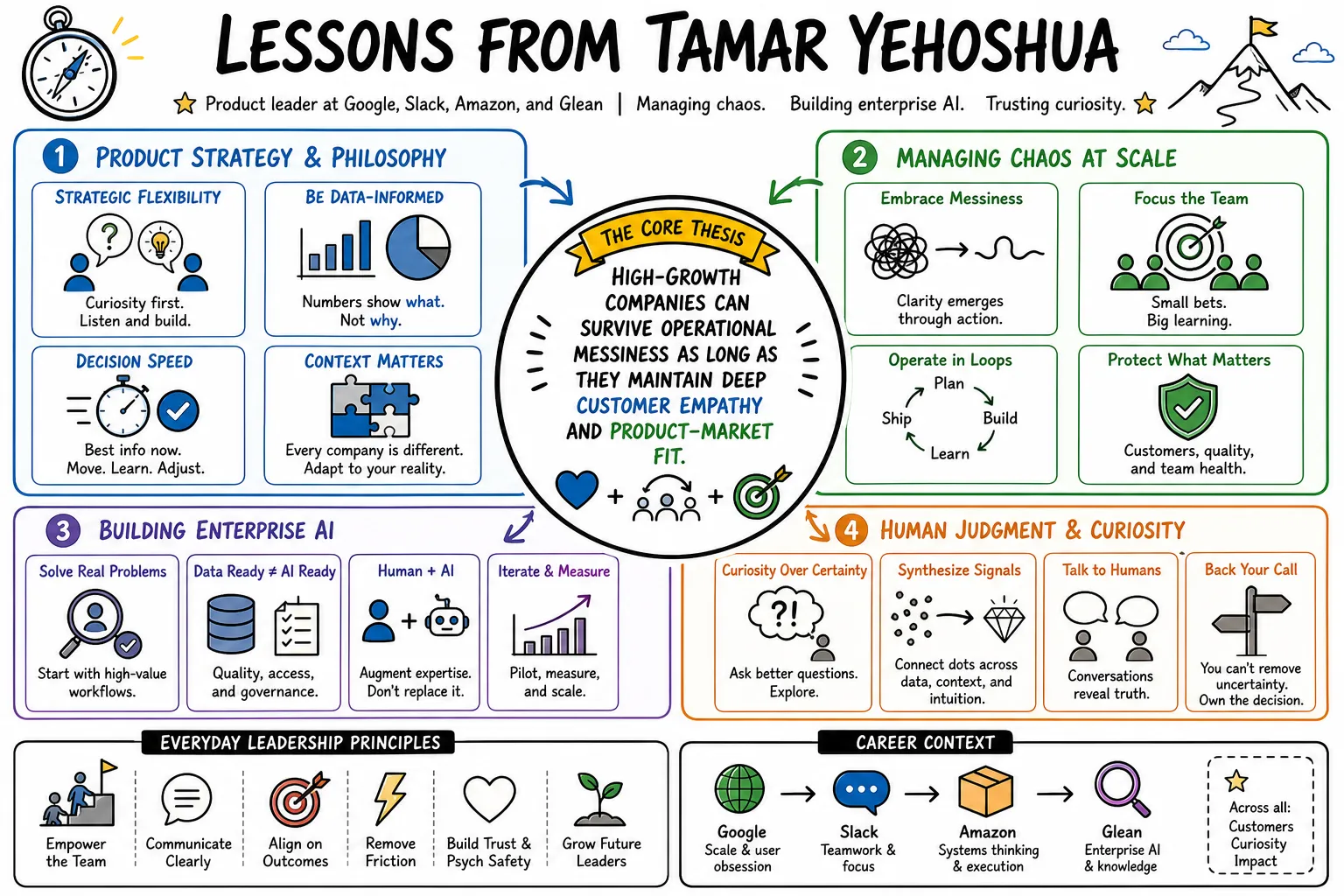
Lessons from Tamar Yehoshua
Tamar Yehoshua is a product executive who has run engineering and design at Google, Slack, Amazon, and Glean. She argues that high-growth companies can survive operational messiness as long as they maintain deep customer empathy and product-market fit. This collection gathers her advice on managing that internal chaos, building enterprise AI, and knowing when to trust human curiosity over hard data.
Part 1: Product Strategy and Philosophy
- On strategic flexibility: "You don't always need a fully baked strategy when you walk into the room; you need the curiosity to listen to customers and build from there." — Source: McKinsey on Building Products
- On the limitations of data: "Be data-informed, not data-driven. Quantitative metrics tell you what is happening at scale, but they rarely tell you why it is happening." — Source: McKinsey on Building Products
- On decision-making speed: "Decisions should be made with the best available information at the time, recognizing that waiting for perfect data often means moving too slowly." — Source: Lenny's Podcast
- On organizational context: "Every company operates differently. What works in Amazon's highly structured environment may completely fail in a design-led culture like Slack." — Source: Lenny's Podcast
- On simplicity: "The most effective product strategies are usually the ones that can be communicated clearly to the entire company without needing a glossary." — Source: Product Thinking Podcast
- On balancing intuition and metrics: "While Google and Amazon heavily index on data, places like Slack show the value of product craft and deep obsession with the details." — Source: Lenny's Podcast
- On continuous learning: "The role of a product manager is an ongoing exercise in discovery. If you think you know all the answers, you have stopped paying attention." — Source: McKinsey on Building Products
- On competitive advantage: "Your biggest advantage isn't always having the best technology; often, it is having a better understanding of the human motivations driving your users." — Source: Liminary Podcast Review
- On long-term vision: "Product leaders must distinguish between solving an immediate user frustration and building toward a fundamental shift in how work gets done." — Source: SaaStr Podcast
- On over-engineering: "Avoid the trap of building complex solutions for simple problems. Start with utility and expand only when the customer behavior demands it." — Source: Product Thinking Podcast
Part 2: Understanding the Customer
- On qualitative insights: "You have to dig deep into what drives users rather than focusing only on abstract data points on a dashboard." — Source: Lenny's Podcast
- On human motivation: "My background in psychology helps me recognize that building software is ultimately about understanding how humans think, feel, and behave." — Source: Liminary Podcast Review
- On customer discovery: "You should spend a significant portion of your time talking directly to the people who use your product, especially the ones who struggle with it." — Source: McKinsey on Building Products
- On false signals: "A feature might get high engagement initially because it is new, not because it is actually solving a persistent customer problem." — Source: SaaStr Podcast
- On empathy at scale: "As a company grows, it becomes harder to maintain a direct line to the customer. You have to actively build systems to keep that empathy alive." — Source: Product Thinking Podcast
- On solving real needs: "Success comes from accurately identifying what the customer is trying to accomplish, rather than just delivering the feature they asked for." — Source: Lenny's Podcast
- On internal usage: "At Slack, we were our own most demanding customers. Using the product heavily internally forces you to feel the friction before your users do." — Source: SaaStr Podcast
- On identifying pain points: "Often, the most valuable product improvements come from observing where users develop awkward workarounds." — Source: McKinsey on Building Products
- On early feedback: "Bringing customers into the development process early prevents you from spending months building something nobody wants." — Source: Product Thinking Podcast
- On shifting demands: "The post-pandemic work world changed how people interact with software. You have to be willing to discard old assumptions when the environment shifts." — Source: Equivalent to Magic Podcast
Part 3: Navigating Organizational Chaos
- On operational perfection: "You don't need to be a perfectly well-run company to win. If you have strong product-market fit, you can survive a lot of internal messiness." — Source: Lenny's Podcast
- On hyper-growth realities: "During periods of massive growth, things will break. Your job is not to prevent all fires, but to figure out which fires actually matter." — Source: SaaStr Podcast
- On choosing environments: "Instead of just chasing well-run companies, look for environments that align with your personal strengths and tolerance for ambiguity." — Source: Lenny's Podcast
- On managing alignment: "Keeping teams aligned when a company scales 10x requires constant repetition of the core goals. You will feel like a broken record." — Source: SaaStr Podcast
- On process vs. outcomes: "Process should serve the outcome. The moment process becomes the goal itself, you start losing speed and innovation." — Source: Product Thinking Podcast
- On organizational friction: "Some friction is healthy because it forces teams to debate the hard trade-offs instead of defaulting to the easiest technical solution." — Source: Liminary Podcast Review
- On adapting to change: "The structures that get you to your first million in revenue will almost certainly break before you reach your first billion." — Source: SaaStr Podcast
- On maintaining focus: "When everything feels chaotic, the most stabilizing force you can offer your team is a clear, unwavering focus on the customer." — Source: Lenny's Podcast
- On prioritization under pressure: "Chaos forces you to be ruthless about prioritization. You learn very quickly that you cannot do everything at once." — Source: McKinsey on Building Products
- On scaling communication: "As the organization grows, casual hallway alignment stops working. You have to institute deliberate rhythms for sharing context." — Source: SaaStr Podcast
Part 4: AI and the Future of Enterprise
- On pragmatic AI: "Embrace AI for utility. Focus on practical applications like extracting action items or summarizing feedback, rather than just chasing the hype." — Source: McKinsey on Building Products
- On RAG (Retrieval-Augmented Generation): "For enterprise tools to be useful, AI must retrieve the right internal context. Generic intelligence is not enough for specific company workflows." — Source: Product Thinking Podcast
- On security and trust: "In enterprise search and productivity, security, privacy, and compliance are foundational. You cannot bolt them on after the fact." — Source: Product Thinking Podcast
- On reimagining workflows: "Leaders need to bridge the gap between using AI for incremental improvements and using it to radically reimagine how work is done." — Source: Lenny's Podcast
- On the AI learning curve: "The teams that will win in the AI era are those willing to experiment constantly, recognizing that the technology is shifting under their feet." — Source: McKinsey on Building Products
- On enterprise adoption: "Companies don't want AI for the sake of AI. They want tools that make their employees visibly more effective with less friction." — Source: Glean Company Blog
- On cross-functional AI building: "Adopting new technologies like AI requires pairing builders with non-builders to ensure the solutions are grounded in real user workflows." — Source: Practical Intelligence Substack
- On managing AI expectations: "Product managers must act as the translation layer between what AI can actually do today and what executives hope it can do." — Source: Product Thinking Podcast
- On future productivity: "The ultimate promise of enterprise AI is removing the busywork of finding information, so people can focus on actual problem-solving." — Source: Equivalent to Magic Podcast
Part 5: Leadership and Cross-Functional Dynamics
- On engineering partnerships: "Building strong, trusting partnerships with engineering is arguably the most critical relationship a product manager must cultivate." — Source: Practical Intelligence Substack
- On diverse perspectives: "You get better products when you bring sales, marketing, and support into the product development conversation early on." — Source: Practical Intelligence Substack
- On learning from different leaders: "Working under Jeff Bezos and Stewart Butterfield taught me that there are vastly different, yet highly successful, ways to lead an organization." — Source: Lenny's Podcast
- On setting context: "A leader's primary job is not to make every decision, but to set the context so clearly that the team can make the right decisions independently." — Source: SaaStr Podcast
- On resolving conflicts: "When cross-functional teams disagree, the resolution usually lies in returning to the core user problem we are trying to solve." — Source: Product Thinking Podcast
- On empowering teams: "You have to trust the people closest to the work. Top-down mandates rarely produce the best product design." — Source: Liminary Podcast Review
- On managing growth phases: "Leading a team through a 10x growth phase means you have to constantly rebuild your own management style to fit the new scale." — Source: SaaStr Podcast
- On transparency: "Being honest with your team about the challenges the company faces builds the resilience needed to get through difficult transitions." — Source: Lenny's Podcast
- On psychological safety: "Engineers and designers do their best work when they feel safe proposing ideas that might fail." — Source: McKinsey on Building Products
Part 6: Metrics and Measuring Success
- On vanity metrics: "Beware of choosing the wrong North Star. Metrics should reflect actual value and utility, not just surface-level engagement." — Source: McKinsey on Building Products
- On defining success: "Before you ship a feature, the team must agree on what success looks like quantitatively and qualitatively." — Source: Product Thinking Podcast
- On unintended consequences: "Optimizing heavily for a single metric often degrades the overall user experience elsewhere in the product." — Source: Lenny's Podcast
- On measuring utility: "In enterprise software, a successful feature is one that saves the user time or prevents an error, even if it doesn't increase time-in-app." — Source: SaaStr Podcast
- On qualitative balance: "If your dashboard says the product is succeeding but your customer support queue is full of angry tickets, the dashboard is wrong." — Source: McKinsey on Building Products
- On evaluating AI: "Measuring the success of AI tools requires looking beyond accuracy to gauge whether the output actually accelerated the user's workflow." — Source: Product Thinking Podcast
- On leading vs. lagging indicators: "Revenue is a lagging indicator. Product teams need to identify the leading indicators of user habit formation." — Source: SaaStr Podcast
- On data interpretation: "Data doesn't make decisions; people do. The numbers only provide the landscape; judgment determines the path forward." — Source: Practical Intelligence Substack
- On shifting metrics: "As your product strategy evolves, your core metrics must evolve with it. A metric that was useful in the early days can become a constraint later." — Source: Lenny's Podcast
Part 7: Career Growth and Personal Impact
- On career advancement: "Focus on impact, not just titles. The best way to advance your career is to crush it in your current role." — Source: Lenny's Podcast
- On present focus: "Solve real problems where you are right now, rather than fixating entirely on a hypothetical five-year plan." — Source: Lenny's Podcast
- On adapting to culture: "Success in your career often depends on how quickly you can unlearn the operating models of your past companies and adapt to the current one." — Source: Liminary Podcast Review
- On taking risks: "Career growth happens when you take roles that push you slightly beyond what you already know how to do." — Source: Practical Intelligence Substack
- On broad experience: "Working across Search, Identity, and Privacy at Google gave me a foundational understanding of how disparate systems connect." — Source: Lenny's Podcast
- On leaving a legacy: "Your legacy as a product leader is rarely a specific feature; it is the quality of the team you built and the culture you instilled." — Source: SaaStr Podcast
- On continuous self-education: "To stay relevant in technology, you have to read, talk to builders, and maintain a genuine curiosity about how new things work." — Source: McKinsey on Building Products
- On dealing with failure: "Not every product will land. The distinguishing factor in a successful career is how quickly you analyze the failure and apply the lesson." — Source: Product Thinking Podcast
- On mentoring others: "One of the most rewarding aspects of senior leadership is helping younger product managers develop their own frameworks for decision-making." — Source: Practical Intelligence Substack
Part 8: Craft, Quality, and Execution
- On the details: "At Slack, I learned that obsessing over the micro-interactions is not wasted time; it is exactly what creates a loyal user base." — Source: Lenny's Podcast
- On balancing speed and quality: "Moving fast is essential, but it should never come at the expense of shipping broken experiences that erode user trust." — Source: SaaStr Podcast
- On design leadership: "Product managers must partner deeply with design. A product that functions well but feels clumsy will ultimately lose to one that feels seamless." — Source: Equivalent to Magic Podcast
- On technical debt: "You have to systematically pay down technical and design debt, or eventually the product becomes too fragile to iterate upon." — Source: Product Thinking Podcast
- On enterprise expectations: "Building for the enterprise does not excuse poor design. Employees now expect their work tools to be as intuitive as their consumer apps." — Source: McKinsey on Building Products
- On execution over ideas: "Everyone has ideas. What separates great product organizations is their ability to execute those ideas reliably at scale." — Source: Lenny's Podcast
- On the definition of done: "Shipping the code is only the first step. A feature is not done until you have measured its impact and iterated based on feedback." — Source: Practical Intelligence Substack
- On simplicity in execution: "It takes significantly more effort to build a simple interface than a complex one, but that effort pays off in lower support costs and higher adoption." — Source: SaaStr Podcast
- On setting standards: "As a leader, the quality of what you allow out the door sets the standard for the entire organization." — Source: Lenny's Podcast