Lessons from Tarek Mansour
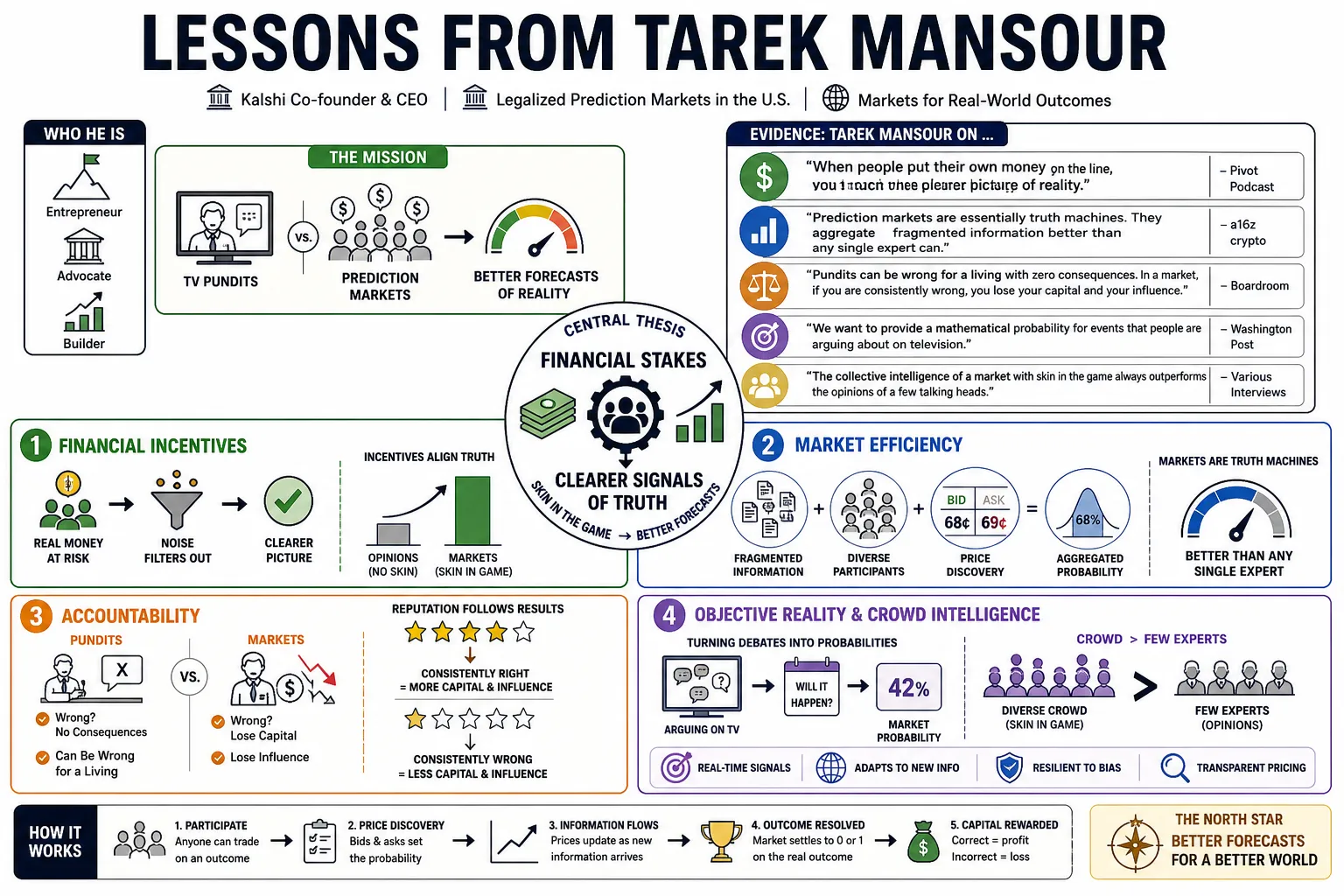
Tarek Mansour is the co-founder and CEO of Kalshi, a regulated exchange where people trade on the outcomes of real-world events. He drove the effort to legalize prediction markets in the U.S., arguing that financial stakes produce better forecasts than TV pundits. This profile collects his views on regulation, media accountability, and how markets price uncertainty.
Part 1: Prediction Markets and Truth
- On Financial Incentives: "When people put their own money on the line, the noise filters out and you get a much clearer picture of reality." — Source: Pivot Podcast
- On Market Efficiency: "Prediction markets are essentially truth machines. They aggregate fragmented information better than any single expert can." — Source: a16z crypto
- On Accountability: "Pundits can be wrong for a living with zero consequences. In a market, if you are consistently wrong, you lose your capital and your influence." — Source: Boardroom
- On Objective Reality: "We want to provide a mathematical probability for events that people are arguing about on television." — Source: Washington Post
- On Crowd Intelligence: "The collective intelligence of a market with skin in the game always outpaces the smartest person in the room without skin in the game." — Source: No Priors
- On Bias: In Cheeky Pint, Mansour argues that prediction markets are more unbiased by party dynamics than partisan coalitions or legacy preference cascades, because the market has to keep converging toward the real odds instead of the most flattering narrative. — Reference: Cheeky Pint transcript on prediction markets being more unbiased by party dynamics and better at showing real odds
- On Price Discovery: "The price of a contract on Kalshi isn't just a number; it is a real-time consensus of global sentiment." — Source: a16z crypto
- On Echo Chambers: "Markets pop echo chambers because they force you to interact with the opposing view financially." — Source: Pivot Podcast
- On Measuring Uncertainty: "Uncertainty used to be something you just had to endure. Now, it is something you can measure and trade." — Source: Boardroom
- On Information Velocity: "News breaks, and within seconds, our markets adjust. It is the fastest form of information digestion in the world." — Source: Washington Post
Part 2: Navigating the Regulatory Labyrinth
- On Working with the CFTC: "We didn't want to skirt the rules. We spent years working directly with the CFTC to ensure these markets were regulated as financial instruments." — Source: a16z crypto
- On Institutional Trust: "If you want everyday Americans to use a platform, you have to operate within the U.S. regulatory framework. Offshore wasn't an option." — Source: Pivot Podcast
- On Legal Battles: In Cheeky Pint, Mansour says suing the CFTC became a no-other-option decision after repeated election-market delays, because Kalshi believed the law constrained the regulator too, not just the company it oversees. — Reference: Cheeky Pint transcript on the lawsuit becoming a no-other-option move after repeated election-market blocks
- On Compliance as a Moat: "The years we spent getting regulated were painful, but that compliance is now our biggest competitive advantage." — Source: No Priors
- On Financial Classification: "Event contracts are derivatives. They belong under the purview of financial regulators, not gaming commissions." — Source: Bloomberg
- On Patience: "Building a regulated exchange requires a tolerance for bureaucratic timelines that most software engineers simply do not have." — Source: a16z crypto
- On Consumer Protection: "Regulation isn't just red tape; it is the mechanism that ensures users get paid when they are right." — Source: Boardroom
- On the FTX Fallout: "The collapse of offshore crypto exchanges proved exactly why we spent years getting CFTC approval in the United States." — Source: a16z crypto
- On Defining Markets: "We had to educate regulators that asking 'Will the Fed raise rates?' is a valid financial hedge, not a game of chance." — Source: Washington Post
- On State vs. Federal Rules: "Operating a federally regulated exchange means we answer to a unified standard, though state-level pushback still happens." — Source: Bloomberg
Part 3: Media, Punditry, and the Value of Forecasting
- On the 24-Hour News Cycle: "The news is built to generate outrage. Prediction markets are built to generate accuracy." — Source: Pivot Podcast
- On Headlines vs. Probabilities: "A headline might say a bill is certain to pass, but if the market prices it at 30%, you know the headline is wrong." — Source: Boardroom
- On Replacing Polls: "Traditional polling is a lagging indicator based on what people say. Markets are a leading indicator based on what people do." — Source: Washington Post
- On Media Integration: "Eventually, every news article will have a live ticker showing the probability of the event it is reporting on." — Source: a16z crypto
- On Pundit Accountability: In Cheeky Pint, Mansour argues commentators still matter, but the healthier model is to pair opinion with a live market forecast so audiences can distinguish personal interpretation from the underlying odds. — Reference: Cheeky Pint transcript on commentators showing market forecasts alongside their opinions
- On Narrative Collapse: "Markets are agnostic to narratives. They only care about what is actually going to resolve as true." — Source: No Priors
- On Attention Economics: "Media monetizes your attention. We monetize your ability to correctly interpret the world." — Source: Pivot Podcast
- On the Death of Hot Takes: "A hot take is worthless if you aren't willing to buy the contract at the price you claim it is worth." — Source: Boardroom
- On Polling Biases: "People lie to pollsters all the time because it costs them nothing. They don't lie to their brokerage accounts." — Source: Washington Post
Part 4: Building Kalshi and Early Struggles
- On the Initial Vision: "We looked at traditional finance and realized there was no direct way to trade on the events that actually impact our lives." — Source: a16z crypto
- On Co-Founder Dynamics: In the Cheeky Pint conversation, Lopes Lara says she and Mansour came from the same MIT math-and-computer-science background but balance each other through different temperaments, with her optimism offsetting his trader-style paranoia. — Reference: Cheeky Pint transcript on the founders sharing an MIT background but balancing optimism and paranoia
- On Raising Capital: "Pitching Kalshi was incredibly hard at first because investors didn't know if we were a fintech company, a media company, or illegal." — Source: No Priors
- On the Name Kalshi: "In Arabic, 'Kalshi' means 'everything.' That is the goal, to build a market for everything." — Source: Boardroom
- On Leaving Wall Street: "I was at Citadel and realized the tools used by elite hedge funds to manage risk should be available to retail users." — Source: Pivot Podcast
- On Early Product Iteration: Cheeky Pint describes Kalshi's product evolving from broker-led distribution into a rapidly growing direct consumer business across its app and website, with Mansour saying the direct channel has since outpaced intermediary volume. — Reference: Cheeky Pint transcript on Kalshi Direct outpacing broker distribution as the consumer product matured
- On Hiring: "We recruit people who are comfortable with ambiguity and have a high tolerance for regulatory friction." — Source: No Priors
- On Technical Architecture: "Building an exchange from scratch means you are dealing with matching engines and latency from day one. There are no shortcuts." — Source: a16z crypto
- On Perseverance: "There were dozens of moments where it looked like the regulatory hurdle was insurmountable. We just refused to stop." — Source: Washington Post
Part 5: Event Contracts as an Asset Class
- On Financial Primitives: "Event contracts are the purest form of a derivative. You are isolating a specific risk and trading it directly." — Source: a16z crypto
- On Market Correlation: "Most stocks move together based on macroeconomic factors. Event contracts are entirely uncorrelated assets." — Source: Boardroom
- On Simplicity: "Instead of buying oil futures to bet on a pipeline, you can just buy a contract on whether the pipeline gets approved." — Source: Pivot Podcast
- On Resolving Contracts: In Cheeky Pint, Mansour says politically sensitive markets should make trade data as public as possible so anyone can audit what happened, reflecting his broader view that event-market trust depends on transparent, inspectable records. — Reference: Cheeky Pint transcript on making trade data public so anyone can audit it
- On Liquidity: "The hardest part of creating a new asset class is bootstrapping liquidity so that prices accurately reflect probability." — Source: No Priors
- On Retail Access: "Historically, bespoke event-driven trades were only done over-the-counter by investment banks. We standardized them for retail." — Source: Washington Post
- On Market Structure: "We built Kalshi so that the limit order book functions exactly like an equities exchange." — Source: a16z crypto
- On Binary Outcomes: "The beauty of a yes/no contract is that it forces a definitive resolution. There is no gray area at expiry." — Source: Boardroom
- On the Breadth of Markets: "We want to offer markets on everything from Supreme Court decisions to the number of hurricanes in a season." — Source: Bloomberg
Part 6: Addressing the Gambling Stigma
- On the Definition of Gambling: "If trading on the outcome of a future event is gambling, then buying a stock based on an earnings report is also gambling." — Source: Pivot Podcast
- On Structural Differences: "Gambling is designed with a house edge where you are mathematically guaranteed to lose over time. Kalshi is a peer-to-peer exchange." — Source: a16z crypto
- On Utility: "You can't hedge your mortgage rate going up by betting on a football game. You can hedge it on Kalshi." — Source: Washington Post
- On Moral Panic: In Cheeky Pint, Mansour draws hard boundaries around markets on war, terrorism, assassination, and similar harms, arguing that being pro-market does not mean listing every morally fraught contract people can imagine. — Reference: Cheeky Pint transcript on refusing markets tied to war, terrorism, assassination, and similar harms
- On Transparency: "Sports betting obscures the true odds through point spreads and vigs. We just show you the exact probability." — Source: Boardroom
- On Capital Allocation: "Financial markets exist to allocate capital efficiently based on risk. That is what we are doing with world events." — Source: No Priors
- On Critics: "The people who complain most loudly about prediction markets are usually the pundits whose jobs are threatened by accurate data." — Source: Pivot Podcast
- On Agency: "We believe individuals are smart enough to manage their own risk and express their own views financially." — Source: a16z crypto
- On Categorization: "We fought hard to be regulated by the CFTC precisely because what we are building is finance, not a casino." — Source: Bloomberg
Part 7: Risk Hedging for Everyday People
- On Democratizing Finance: "A farmer can hedge against bad weather using futures. A normal person should be able to hedge against inflation using Kalshi." — Source: Washington Post
- On Practical Use Cases: "If you are worried about student loan forgiveness being struck down, you can buy a contract that pays out if it is." — Source: a16z crypto
- On Economic Anxiety: "We allow people to purchase financial insurance against the macroeconomic events that keep them up at night." — Source: Boardroom
- On Supply Chain Hedging: "Small businesses can use event contracts to hedge against shipping delays or commodity shortages without needing a prime broker." — Source: Pivot Podcast
- On Labor Strikes: In Kalshi's founder profile, Mansour explains that traditional institutions were already seeking exposure to or hedges against major real-world events like Brexit, which is why Kalshi set out to make event-risk hedging more direct and accessible. — Reference: Kalshi founder profile on institutions already hedging major event risk and Kalshi making that exposure more direct
- On Tail Risk: "Everyday life is full of tail risks that insurance won't cover but prediction markets can price." — Source: No Priors
- On Empowering Retail: "Wall Street has always had bespoke derivatives for their niche risks. We are bringing that capability to the retail level." — Source: Bloomberg
- On Inflation: "When inflation prints were highly volatile, our markets were one of the only ways individuals could directly hedge CPI announcements." — Source: a16z crypto
- On Real Estate: "You can use contracts on federal interest rate decisions to effectively hedge your upcoming mortgage refinancing." — Source: Boardroom
- On Financial Independence: "Hedging isn't just for billionaires. It is a fundamental tool for managing personal financial stability." — Source: Washington Post
Part 8: The Future of Uncertainty
- On the NYSE of Events: In Cheeky Pint, Mansour says the founding ambition was to build the next-generation New York Stock Exchange in the US: a credible, regulated market for event contracts rather than an offshore workaround. — Reference: Cheeky Pint transcript on wanting to build the next-generation New York Stock Exchange in a regulated US setting
- On Global Expansion: "Right now we are focused on the U.S., but political and economic uncertainty is a global phenomenon." — Source: a16z crypto
- On API Integration: "In the future, automated systems will trade on Kalshi to dynamically hedge corporate risk in real-time." — Source: No Priors
- On Mainstream Adoption: "Trading on events will eventually be as normalized as trading Apple stock or Bitcoin." — Source: Pivot Podcast
- On Data Value: "The historical data generated by our markets will become the gold standard for researching how humans perceive probability." — Source: Boardroom
- On Crypto Integration: "Allowing stablecoin deposits bridges the gap between traditional regulatory frameworks and modern financial rails." — Source: a16z crypto
- On Cultural Impact: "We want to shift the cultural conversation from what people think will happen to what the odds are that it happens." — Source: Washington Post
- On Competitors: "The competition validates the market. The difference is that we chose the hard path of federal regulation." — Source: Bloomberg
- On Legacy: In Cheeky Pint, Mansour frames the long-run ambition as building one of the world's biggest derivatives exchanges and a new information layer that helps people see real odds more clearly in a polarized media environment. — Reference: Cheeky Pint transcript on building the biggest derivatives exchange in the world and a new information layer for real odds