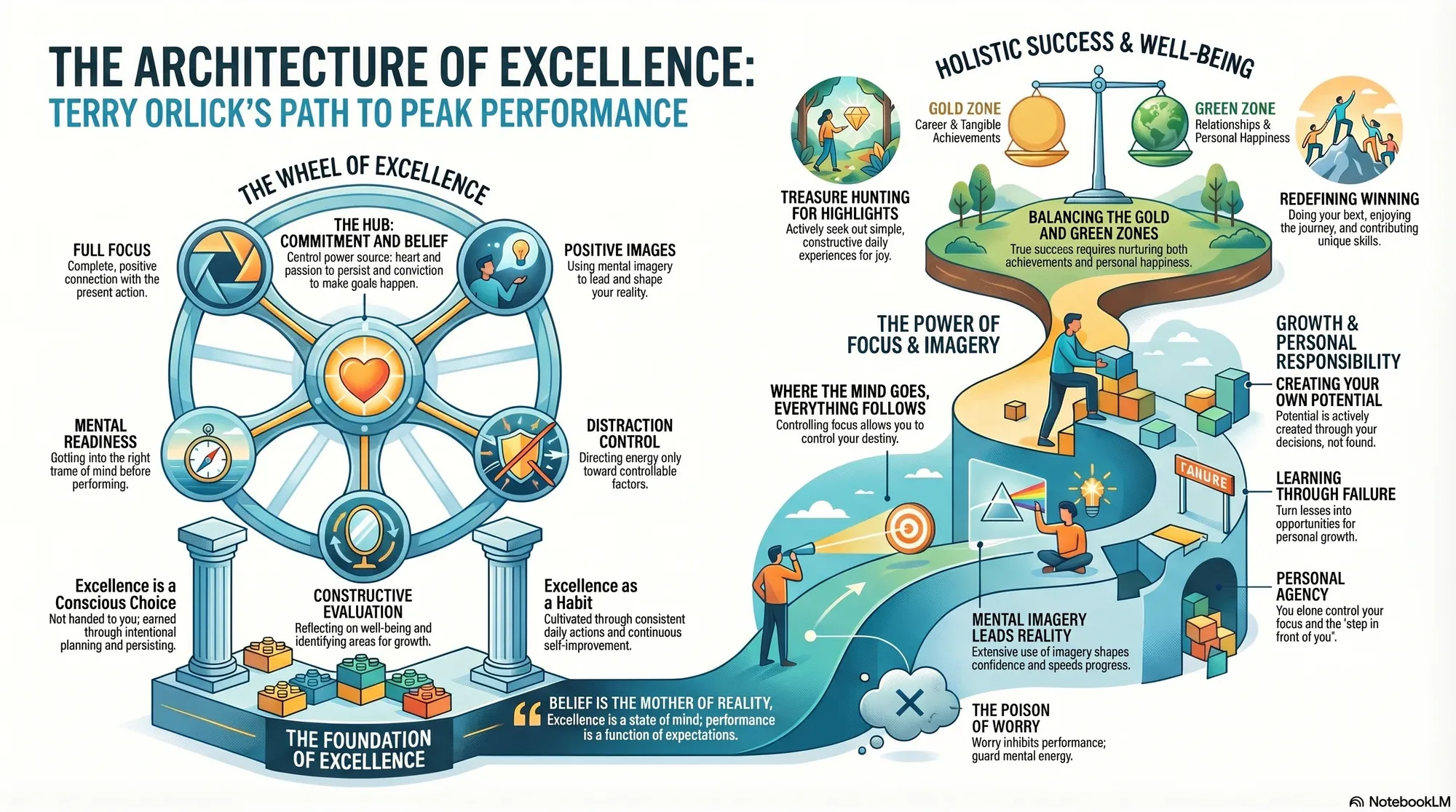
Terry Orlick is a sport psychologist and author of In Pursuit of Excellence. These lessons are drawn from a published interview and from sentences attributed to them in articles. — Fully Connected Focus: Interview with Terry Orlick, by Brittany Glynn, Journal of Excellence, Issue 15 (interview of March 23, 2010).
In a 2010 interview in the Journal of Excellence, Orlick said: "I think a connected focus makes all the difference in all parts of your life". — Fully Connected Focus: Interview with Terry Orlick, by Brittany Glynn, Journal of Excellence, Issue 15 (interview of March 23, 2010).
In a 2010 interview in the Journal of Excellence, Orlick said: "If you’re connected you learn more. You experience more. You perform better. You feel better". — Fully Connected Focus: Interview with Terry Orlick, by Brittany Glynn, Journal of Excellence, Issue 15 (interview of March 23, 2010).
In a 2010 interview in the Journal of Excellence, Orlick said: "If you’re just skimming through life on the surface you are not embracing life’s opportunities". — Fully Connected Focus: Interview with Terry Orlick, by Brittany Glynn, Journal of Excellence, Issue 15 (interview of March 23, 2010).
In a 2010 interview in the Journal of Excellence, Orlick said: "A negative, disconnected focus or non focus, does just the opposite. It creates barriers to learning, barriers within performances and barriers within relationships". — Fully Connected Focus: Interview with Terry Orlick, by Brittany Glynn, Journal of Excellence, Issue 15 (interview of March 23, 2010).
In a 2010 interview in the Journal of Excellence, Orlick said: "I think everyone can learn to fully connect". — Fully Connected Focus: Interview with Terry Orlick, by Brittany Glynn, Journal of Excellence, Issue 15 (interview of March 23, 2010).
In a 2010 interview in the Journal of Excellence, Orlick said: "I think it is absolutely a skill". — Fully Connected Focus: Interview with Terry Orlick, by Brittany Glynn, Journal of Excellence, Issue 15 (interview of March 23, 2010).
In a 2010 interview in the Journal of Excellence, Orlick said: "connected focus is a freedom thing". — Fully Connected Focus: Interview with Terry Orlick, by Brittany Glynn, Journal of Excellence, Issue 15 (interview of March 23, 2010).
In a 2010 interview in the Journal of Excellence, Orlick said: "It is never a forced thing. If you try to force the performance or force the pure connection you lose it". — Fully Connected Focus: Interview with Terry Orlick, by Brittany Glynn, Journal of Excellence, Issue 15 (interview of March 23, 2010).
In a 2010 interview in the Journal of Excellence, Orlick said: "freeing yourself to be fully there wherever you are". — Fully Connected Focus: Interview with Terry Orlick, by Brittany Glynn, Journal of Excellence, Issue 15 (interview of March 23, 2010).
As quoted by students in the Journal of Excellence, Orlick said: "Learn from every experience, every opportunity, every challenge, every day. Act on those lessons. This is the path to personal excellence". — Lessons Learned: In Pursuit of Excellence, Journal of Excellence, Issue 16.
As quoted in a 1970s Champion magazine article, Orlick said: "It’s more for those who have already made a decision to pursue excellence, to be good in a discipline. They want to do it without sacrificing the rest of their lives". — Orlick's book aims at self-help, Champion magazine, Canadian Sport History (about 1978).
As quoted in a 1970s Champion magazine article, Orlick said: "You can’t control the past no matter how hard you try. You have to accept that fact and get on with the present which you may be able to control". — Orlick's book aims at self-help, Champion magazine, Canadian Sport History (about 1978).
In the book Psyched: Inner Views of Winning, co-written with John Partington, Orlick wrote: "Their total commitment to excellence, and their persistence in developing and refining their own formula of mental and physical skills, can serve as a model to any of us interested in greater achievement". — PSYCHED: Inner Views of Winning, Terry Orlick and John Partington, Zone of Excellence.
In the book Psyched: Inner Views of Winning, co-written with John Partington, Orlick wrote: "The most common and probably the most important element of success was quality training". — PSYCHED: Inner Views of Winning, Terry Orlick and John Partington, Zone of Excellence.
In the book Psyched: Inner Views of Winning, co-written with John Partington, Orlick wrote: "The best athletes don't just go through the motions in training". — PSYCHED: Inner Views of Winning, Terry Orlick and John Partington, Zone of Excellence.
In the book Psyched: Inner Views of Winning, co-written with John Partington, Orlick wrote: "They approach training runs or go through routines in practice as if it was the competition". — PSYCHED: Inner Views of Winning, Terry Orlick and John Partington, Zone of Excellence.
In the book Psyched: Inner Views of Winning, co-written with John Partington, Orlick wrote: "All the best athletes have very well-developed mental imagery skills and use them on a daily basis". — PSYCHED: Inner Views of Winning, Terry Orlick and John Partington, Zone of Excellence.
In the book Psyched: Inner Views of Winning, co-written with John Partington, Orlick wrote: "great athletes did not begin their sports careers with all of these success elements". — PSYCHED: Inner Views of Winning, Terry Orlick and John Partington, Zone of Excellence.
In the book Psyched: Inner Views of Winning, co-written with John Partington, Orlick wrote: "These success elements are developed and refined through practice. Without practice these skills will not be learned, and without persistent use they may be forgotten". — PSYCHED: Inner Views of Winning, Terry Orlick and John Partington, Zone of Excellence.
In the book Psyched: Inner Views of Winning, co-written with John Partington, Orlick wrote: "Many of these highly successful athletes felt that they could have reached the top much earlier if they had worked on strengthening their mental skills earlier in their careers". — PSYCHED: Inner Views of Winning, Terry Orlick and John Partington, Zone of Excellence.
In the book Psyched: Inner Views of Winning, co-written with John Partington, Orlick wrote: "Creating an atmosphere of mutual trust, mutual respect, and a genuine concern for individual athletes, appears to be a necessary requirement". — PSYCHED: Inner Views of Winning, Terry Orlick and John Partington, Zone of Excellence.