Lessons from Theo Epstein
Theo Epstein built the rosters that ended historic championship droughts for the Boston Red Sox and Chicago Cubs. Though his early career helped popularize data-heavy front offices, he eventually shifted his focus to character and clubhouse chemistry. This profile collects his practical thoughts on team building, management, and the limits of data.
Part 1: The Evolution of Evaluation
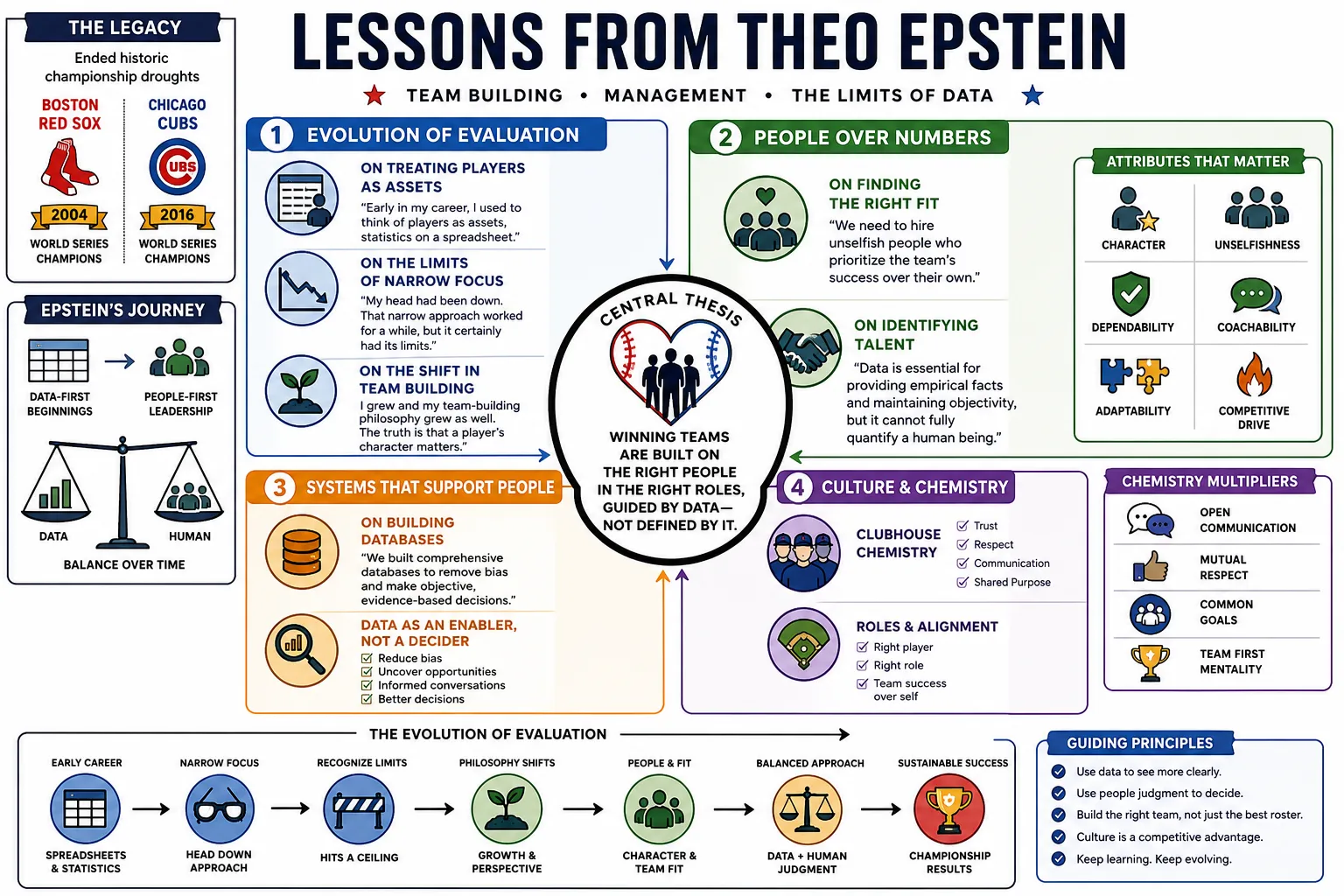
- On Treating Players As Assets: "Early in my career, I used to think of players as assets, statistics on a spreadsheet." — Source: [Yale Class Day Speech]
- On The Limits Of Narrow Focus: "My head had been down. That narrow approach worked for a while, but it certainly had its limits." — Source: [Yale Class Day Speech]
- On The Shift In Team Building: "I grew and my team-building philosophy grew as well. The truth is that a player's character matters." — Source: [Yale Class Day Speech]
- On Finding The Right Fit: "We need to hire unselfish people who prioritize the team’s success over their own." — Source: [Forbes]
- On Identifying Talent: "Data is essential for providing empirical facts and maintaining objectivity, but it cannot fully quantify a human being." — Source: [Sports Illustrated]
- On Building Databases: "We built comprehensive databases to remove bias and make objective, evidence-based decisions early on." — Source: [MLB.com]
- On The Person Versus The Player: "We shifted the focus in draft rooms to spend more time discussing the person rather than the player." — Source: [Chicago Tribune]
- On Asking The Right Questions: "We probe for how a candidate handles failure and adversity before evaluating their swing." — Source: [Boston Globe]
- On The Connective Tissue Of A Team: "Character is the connective tissue that allows a talented roster to become a cohesive, winning team." — Source: [Forbes]
Part 2: Character and the Human Element
- On What Truly Matters: "The heartbeat matters. Fears and aspirations matter. The player's impact on others matters. The tone he sets matters." — Source: [Yale Class Day Speech]
- On Human Needs: "A player's ability to connect with teammates and the organization is a human need and a differentiator in performance." — Source: [The Ringer]
- On Handling Adversity: "We always ask scouts to give three examples of how the player handled adversity on the field." — Source: [ESPN]
- On Off-Field Challenges: "Just as importantly, we want three examples of how the player handled adversity off the field." — Source: [ESPN]
- On Hidden Behavior: "We want to know how he treats people when no one is looking." — Source: [Chicago Tribune]
- On Treating Enemies: "We ask how he treats people he doesn't necessarily have to treat well, or those who have been unfair to him." — Source: [Chicago Tribune]
- On Assessing Reputation: "What do his friends say about him? And maybe more importantly, what do his enemies say about him?" — Source: [Boston Globe]
- On Uncovering Drive: "Our ultimate goal in scouting the human element is figuring out what makes them tick." — Source: [Sports Illustrated]
- On Achieving Remarkable Things: "Teams that achieve remarkable things are those where players don't want to let each other down and are actively lifting each other up." — Source: [The Ringer]
Part 3: Institutionalizing Empathy
- On Building Successful Organizations: "To me, a big part of how to build a successful organization is connection. You have to institutionalize empathy." — Source: [Forbes]
- On Collective Ownership: "You have to make sure everyone has collective ownership of that vision and buys in." — Source: [Forbes]
- On Defining Success: "I wanted to define my success as a leader by whether every single person who worked with me knew what we were trying to accomplish." — Source: [MLB.com]
- On Acknowledging Contributions: "Every person must feel they had contributed something to it and understood how their work moved us closer to that vision." — Source: [MLB.com]
- On Recognizing Sacrifices: "It’s vital that everyone understands how the sacrifices they made actively contributed to the ultimate goal." — Source: [ESPN]
- On Organizational Harmony: "When every member of the organization feels heard and valued, it creates a powerful competitive advantage." — Source: [The Ringer]
- On Emotional Intelligence: "We place a high premium on emotional intelligence, both in the front office and in the clubhouse." — Source: [CBS News]
- On Shared Purpose: "A shared purpose is what carries a team through the grueling marathon of a baseball season." — Source: [Sports Illustrated]
- On Continuous Connection: "Institutionalized empathy isn't a one-time initiative; it requires constant maintenance and genuine care." — Source: [Chicago Tribune]
- On The Power Of Belonging: "If we can be better than anyone else with how we treat our players and the relationships we develop, we put them in positions to succeed." — Source: [Fox Sports]
Part 4: Transparency and Communication
- On The Power Of Transparency: "Something as simple as transparency is really scalable because it quickly impacts the culture." — Source: [Forbes]
- On The Amplifying Effect: "If upper management is really transparent with everyone, that has this amplifying effect." — Source: [Forbes]
- On Attracting The Right People: "When you operate transparently, you tend to attract players who operate that way, on the same wavelength." — Source: [CBS News]
- On Radical Honesty With Players: "It started with trying to be really transparent with the players... it creates an environment of trust." — Source: [CBS News]
- On The Ease Of The Truth: "The more you do that, it's kind of like a drug. You realize it's just easier when you're transparent." — Source: [CBS News]
- On Avoiding Coverups: "You don't have to worry about remembering your lies or your slants or your coverups." — Source: [CBS News]
- On Open Communication: "Open communication allows team members to fully buy into the collective vision." — Source: [Boston Globe]
- On Clear Direction: "Transparency isn't just about sharing bad news; it's about providing absolute clarity on where the organization is headed." — Source: [The Ringer]
- On Aligned Wavelengths: "We want coaches, players, and fans all operating on the exact same wavelength through honest dialogue." — Source: [ESPN]
Part 5: Leadership and Delegation
- On The Essence Of Leadership: "The essence of good leadership is the ability to delegate well." — Source: [MLB.com]
- On Permitting Autonomy: "You have to be very good at setting something up and permitting people to do their jobs." — Source: [MLB.com]
- On Hiring Capable People: "The formula is simple: hire the most capable people you can find, and then get out of their way." — Source: [Sports Illustrated]
- On Creating The Right Environment: "My job is to create the environment necessary for our experts to excel." — Source: [ESPN]
- On Checking Ego: "To lead effectively over a long period, you have to be willing to let others take the credit." — Source: [The Ringer]
- On Empowering Staff: "Empowerment means trusting your scouts and analysts to make the calls they were hired to make." — Source: [Chicago Tribune]
- On Long-Term Security: "Putting collective interests ahead of our own provides better long-term security and leadership." — Source: [Forbes]
- On Setting The Tone: "A leader sets the tone not by micromanaging, but by demonstrating the values of the organization every single day." — Source: [Boston Globe]
- On Adapting To Change: "Effective leadership requires a willingness to evolve your own philosophy as the industry changes around you." — Source: [Baseball Prospectus]
- On Leaving A Legacy: "True leadership is building a system that continues to thrive long after you've left the building." — Source: [CBS News]
Part 6: Navigating Adversity
- On The Inevitability Of The Rain Delay: "In life, you will inevitably face your own 'rain delay' moments—unexpected setbacks when things go wrong." — Source: [Yale Class Day Speech]
- On Choosing Connection Over Isolation: "When life feels unfair, you have to decide whether to isolate yourself in blame or remain shoulder to shoulder with your peers." — Source: [Yale Class Day Speech]
- On The Heads Up Approach: "I encourage everyone to go through their careers with their heads up, embracing empathy." — Source: [Yale Class Day Speech]
- On Rejecting Individual Interests: "Players who protect their individual interests during a crisis ultimately harm the collective goal." — Source: [Forbes]
- On Performing Under Pressure: "During Game 7 of the World Series, I witnessed our players choosing to support one another rather than retreating into their own heads." — Source: [Yale Class Day Speech]
- On Overcoming Curses: "You don't break a curse by focusing on the history; you break it by executing the next pitch." — Source: [The Ringer]
- On Systemic Resilience: "We want to draft players who have a demonstrated history of bouncing back from failure." — Source: [Baseball Prospectus]
- On Embracing The Struggle: "The struggle is a necessary component of the eventual triumph; you can't bypass the hard parts." — Source: [ESPN]
- On Maintaining Perspective: "When things look their bleakest, that's precisely when a team's true character is revealed." — Source: [Sports Illustrated]
Part 7: Organizational Lifecycles
- On The Ten-Year Rule: "There is a 10-year shelf life for baseball executives in one organization." — Source: [Sportsnet]
- On The Need For Change: "After a decade, both the individual and the team invariably benefit from a change." — Source: [Sportsnet]
- On Organizational Stagnation: "After so much time together, an organization needs a fresh perspective to avoid complacency." — Source: [Chicago Tribune]
- On Personal Rebirth: "Stepping away after a long tenure provides the executive with a rebirth and the energy that comes with a new challenge." — Source: [Forbes]
- On Avoiding Long-Term Traps: "I did not want to commit to long-term decisions that I wouldn't be around to see through." — Source: [ESPN]
- On Recognizing The End: "You have to be self-aware enough to know when your voice is no longer the one the organization needs to hear." — Source: [The Ringer]
- On Fresh Energy: "A new leader brings a necessary infusion of fresh energy that can revitalize an entire front office." — Source: [Boston Globe]
- On Stepping Down At The Top: "It’s often better to leave a year too early than a year too late." — Source: [CBS News]
- On The Toll Of The Job: "The immense weight of expectations and the daily grind of a long season take a compounding toll over the years." — Source: [Sports Illustrated]
- On Building Sustainable Models: "The ultimate goal is to build an engine that runs smoothly regardless of who is in the driver's seat." — Source: [Baseball Prospectus]
Part 8: Analytics and the Future of the Game
- On Unintended Consequences: "Executives like me who used analytics to optimize performance have unwittingly had a negative impact on the aesthetic value of the game." — Source: [Oilers Nation]
- On The Entertainment Value Of Sports: "The relentless pursuit of efficiency has sometimes come at the cost of the entertainment value of the game." — Source: [Oilers Nation]
- On The Strikeout Epidemic: "Clearly, the strikeout rates are a bit out of control, and we need to find a way to get more action in the game." — Source: [The Ringer]
- On Getting The Ball In Play: "We must incentivize putting the ball in play more often to restore the game's dynamic nature." — Source: [MLB.com]
- On Showcasing Athleticism: "We need to allow players to show their athleticism more and more." — Source: [Sports Illustrated]
- On Serving The Fans: "At the end of the day, we have a responsibility to give the fans more of what they want to see." — Source: [ESPN]
- On The Balance Of Math And Art: "Analytics has been a major driver of change, but we must balance data-driven decisions with the art and soul of the sport." — Source: [Baseball Prospectus]
- On Rule Changes: "Experimentation with rules like the pitch timer is necessary for helping MLB continue to grow its national appeal." — Source: [Knowledge At Wharton]
- On The Next Frontier: "If we can't find the next technological breakthrough, our edge will come from how we connect with the players as human beings." — Source: [Fox Sports]