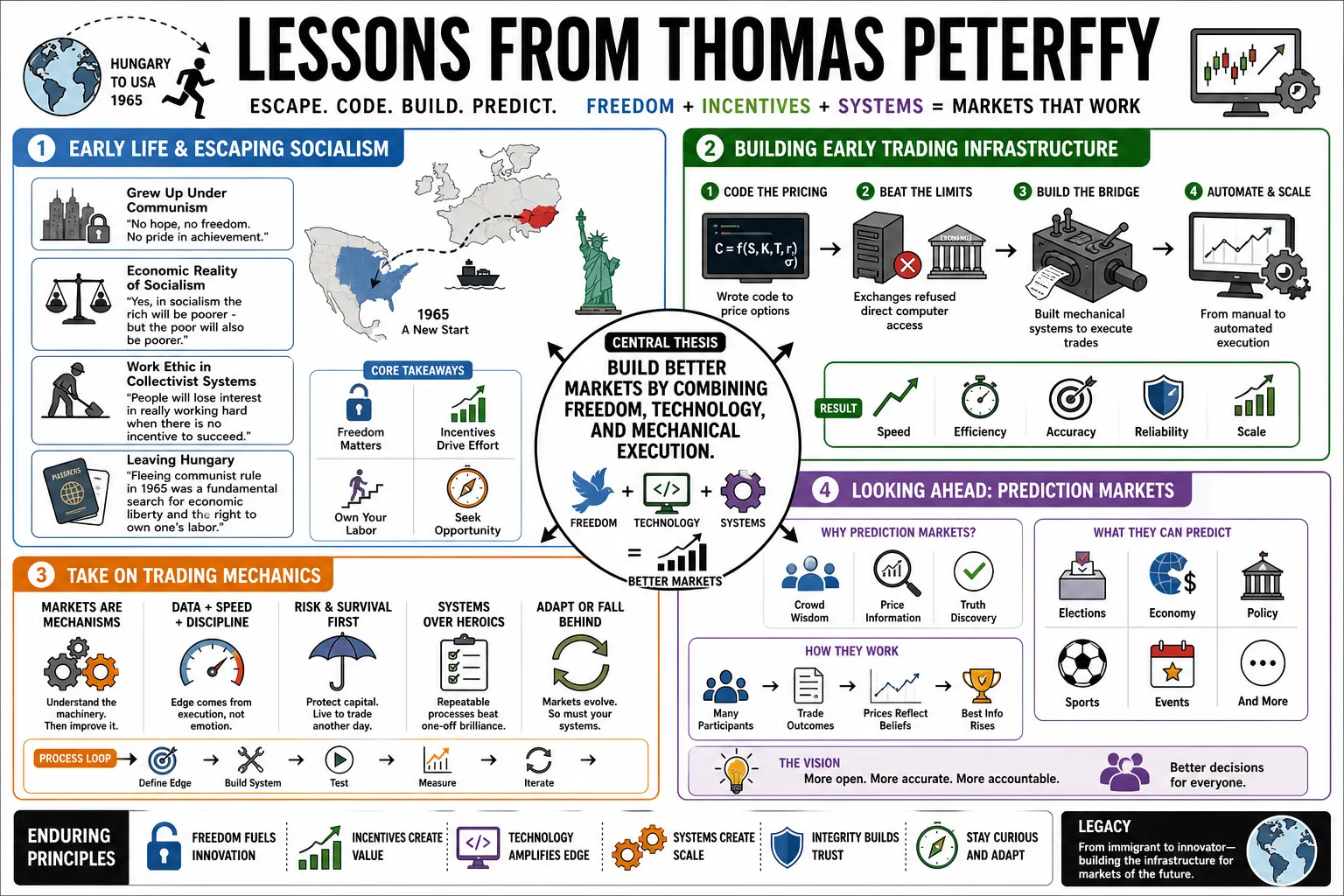
Lessons from Thomas Peterffy
Thomas Peterffy founded Interactive Brokers and brought early algorithmic trading to financial markets. After emigrating from Hungary to the US, he wrote code to price options and built mechanical systems to execute trades when exchanges refused direct computer access. This collection covers how he built that early infrastructure, his take on trading mechanics, and his recent focus on prediction markets.
Part 1: Early Life and Escaping Socialism
- On Growing Up Under Communism: "I grew up in a socialist country. And I have seen what that does to people. There is no hope, no freedom. No pride in achievement." — Source: AZ Quotes
- On the Economic Reality of Socialism: "Yes, in socialism the rich will be poorer - but the poor will also be poorer." — Source: QuotesGram
- On Work Ethic in Collectivist Systems: "People will lose interest in really working hard and creating jobs when there is no incentive to succeed." — Source: QuotesGram
- On Leaving Hungary: "Fleeing communist rule in 1965 was a fundamental search for economic liberty and the right to own one's labor." — Source: Forbes
- On the Attraction of Socialist Ideas: "While socialism may seem attractive to a superficial observer, the historical and practical reality is that it fails to function." — Source: Quora
- On Defending Capitalism: "America's wealth comes from the efforts of individuals striving for success, and dismantling that engine hurts the most vulnerable." — Source: YourStory
- On the American Dream: "The United States represents a unique environment where anyone willing to study and work relentlessly can achieve unprecedented outcomes." — Source: Museum of American Finance
- On Political Activism: "Business leaders must actively use their resources and voices to warn the public about the dangers of reverting to socialist policies." — Source: Catholic.org
- On Capital Flight: "If anti-capitalist policies gain too much traction in the US, investors will inevitably seek geographic diversification to regions friendly to private enterprise." — Source: Forbes
Part 2: Finding Footing in America
- On Arriving Penniless: "Starting in the United States with absolutely nothing forces a level of resourcefulness that cannot be learned in a classroom." — Source: Founders Podcast
- On Early Careers: "Working as an architectural draftsman provided a steady foundation, but the real breakthrough came from teaching myself computer programming in my spare time." — Source: Wikipedia
- On Identifying Inefficiencies: "I had an extremely boring time doing 20 to 30 trades a day while everyone was talking about baseball or basketball. So I stood there fantasizing about a device that could do the same thing I was doing." — Source: YourStory
- On Purchasing a Seat on the Amex: "Buying a seat on the American Stock Exchange in 1977 was the first major risk taken to transition from a programmer to a market maker." — Source: Museum of American Finance
- On the Floor Trading Culture: "The traditional trading floor was dominated by loud, instinct-driven crowds, which presented an obvious opportunity for someone armed with logic and mathematics." — Source: Boyar Value Group
- On Combining Skills: "The intersection of computer programming and options trading was entirely vacant in the 1970s, creating a massive first-mover advantage." — Source: Institutional Investor
- On Self-Education: "If you're willing to study hard and work hard, the world is your oyster." — Source: 6am Success
- On the Value of Mathematics: "Understanding probability and continuous bid-offer pricing provided a structural edge over traders relying on gut feeling." — Source: SIFMA
- On Early Options Pricing: "Writing code to calculate fair option prices in the late 1970s effectively meant developing a precursor to the Black-Scholes model in isolation." — Source: Substack
Part 3: The Origins of Automation
- On Bringing Computers to the Floor: "Introducing a tablet computer to the trading floor in 1983 faced massive resistance from the old guard who feared technological displacement." — Source: Museum of American Finance
- On Human vs Machine Intelligence: "Some traders still think that a computer could not trade as well as they can." — Source: YourStory
- On Continuous Pricing: "Disseminating continuous bid and offer prices via computer models transformed market making from a guessing game into a predictable science." — Source: Interactive Brokers
- On the Predictability of Markets: "Algorithms strip away the emotional volatility of human trading, replacing panic and greed with mathematical certainty." — Source: Traders Magazine
- On the Inevitability of Code: "From the moment computers could calculate option prices faster than the human brain, the eventual digitization of all global finance was guaranteed." — Source: Founders Podcast
- On Early Electronic Infrastructure: "By 1986, creating a fully integrated, automated market-making system for stocks, options, and futures was no longer a theoretical exercise but a daily operational reality." — Source: Museum of American Finance
- On the Skepticism of Peers: "Floor traders initially laughed at the idea of using handheld devices, failing to realize the technology would eventually render their entire profession obsolete." — Source: Institutional Investor
- On Managing Success: "In my view success in business is all about management and deployment of the appropriate technology." — Source: Interactive Brokers
- On Overcoming Exchange Resistance: "Exchanges fought automation every step of the way to protect manual market makers, forcing technological innovators to be extremely creative with compliance." — Source: Traders Magazine
Part 4: The Cyborg and Early Algorithmic Trading
- On the Nasdaq Keyboard Rule: "When Nasdaq regulators insisted that all orders be entered manually via a keyboard, the solution was not to compromise, but to engineer around the rule." — Source: Traders Magazine
- On Building the Robot: "To comply with manual entry rules, his team built a mechanical robot with rubber-tipped fingers that physically typed algorithmically generated orders onto a terminal." — Source: Economic Times
- On the Sound of Innovation: "The mechanical trading robot was so fast that the continuous typing sounded like a machine gun firing on the trading desk." — Source: Shamus Young
- On Regulatory Workarounds: "The cyborg robot proved that when technological progress collides with archaic regulations, engineering will always find a creative, compliant loophole." — Source: Reddit
- On the First Algorithmic Trades: "These early hybrid systems laid the absolute groundwork for what would become the multi-trillion dollar high-frequency trading industry." — Source: Business Insider
- On Speed as an Edge: "Being able to execute trades based on computer calculations faster than any human could read a screen established a permanent competitive moat." — Source: Traders Magazine
- On Institutional Friction: "The pushback against the automated typing machine highlighted how deeply threatened traditional finance was by pure computational speed." — Source: CT Public
- On True Compliance: "It is entirely possible to follow the exact letter of the law while completely subverting the outdated spirit of it through superior technology." — Source: Traders Magazine
- On the Automation Bottleneck: "The relentless pursuit of removing the human bottleneck from order execution eventually earned him the title of the father of algorithmic trading." — Source: SIFMA
Part 5: Building Timber Hill and Interactive Brokers
- On the Purpose of Timber Hill: "Timber Hill was created as a proprietary laboratory to test the extreme limits of electronic trading efficiency." — Source: MarketsWiki
- On Transitioning to Brokerage: "As high-speed competition inevitably compressed the margins of market-making, the logical pivot was to sell the underlying execution infrastructure to the public." — Source: Forbes
- On Democratizing Access: "Interactive Brokers was founded in 1993 on the premise that professional retail traders deserve the exact same direct-market access tools as Wall Street insiders." — Source: Interactive Brokers
- On Software Over Finance: "Despite running a massive financial institution, the core identity of the firm has always been that of a software engineering company." — Source: Institutional Investor
- On Low-Cost Execution: "The ultimate goal of a brokerage should be to relentlessly lower the cost of trading through aggressive, uncompromising automation." — Source: Interactive Brokers
- On Global Connectivity: "Expanding electronic operations to over 170 market destinations globally was a necessary step in creating a truly borderless financial infrastructure." — Source: Interactive Brokers
- On the Role of Management: "As CEO until 2019, the primary directive was always to ensure that the technology stack remained decades ahead of legacy banking competitors." — Source: Forbes
- On Corporate Culture: "An uncompromising, engineering-first culture is the only way to survive the razor-thin margins of modern electronic trading." — Source: Forbes
- On Sustained Growth: "Interactive Brokers' steady rise to become a global powerhouse proves that long-term value is built on systemic efficiency, not flashy marketing." — Source: Interactive Brokers
- On Leadership Succession: "Promoting a former software developer to the role of CEO reinforced the reality that the firm's lifeblood is code, not traditional finance." — Source: MarketsWiki
Part 6: Philosophy on Business and Success
- On Maintaining Integrity: "Never bend the rules. You bend the rules a little bit and then it's a slippery slope." — Source: AZ Quotes
- On Front Running: "The only way to make money reliably on Wall Street is by front running... Short term front running is often called 'illegal'. Long term front running is often called 'investing'." — Source: Interactive Brokers
- On Learning from History: "It seems like people don't learn from the past." — Source: QuotesGram
- On the Importance of Incentives: "Take away their incentive with badmouthing success and you take away the wealth that helps us take care of the needy." — Source: QuotesGram
- On Self-Identification: "Even at the pinnacle of global finance, it is far more accurate and grounded to view oneself primarily as a computer programmer." — Source: Institutional Investor
- On the Necessity of Hard Work: "There are no shortcuts in building complex systems; unparalleled success is the lagging indicator of decades of relentless focus." — Source: Founders Podcast
- On Wealth Creation: "True economic value is only generated when someone figures out a way to do something faster, cheaper, and more reliably than the status quo." — Source: Boyar Value Group
- On Ignoring the Noise: "While others on the floor were distracted by sports and gossip, the real edge was found in quiet, intense observation of systemic flaws." — Source: YourStory
- On Adapting to Margin Compression: "When your proprietary edge decays due to competition, you must be willing to cannibalize your own business model to survive." — Source: FIA
- On Long-Term Vision: "Building a multi-generational firm requires ignoring quarter-to-quarter Wall Street expectations in favor of massive, slow-burn technological investments." — Source: Mustachian Post
Part 7: Critiques of High-Frequency Trading and Market Structure
- On the Speed Arms Race: "The modern obsession with shaving microseconds off high-frequency trades has reached a point where it provides absolutely no social value." — Source: Business Insider
- On Structural Fragility: "While highly automated markets are incredibly efficient under normal conditions, they are dangerously prone to breaking down during periods of severe crisis." — Source: Quora
- On the Necessity of Human Oversight: "We can never be fully certain that algorithms will not go off the deep end, meaning human intervention is still a mandatory safeguard." — Source: Traders Magazine
- On Systemic Risk: "Financial institutions must build multiple layers of redundant software controls to prevent runaway algorithms from causing flash crashes." — Source: Traders Magazine
- On Regulatory Gaps: "Regulators are consistently decades behind the technology, creating environments where market structure is dictated by the fastest computers rather than careful policy." — Source: ModernIR
- On Managing Position Risk: "Even the most sophisticated algorithms cannot intuitively grasp macroeconomic tail-risks; managing catastrophic position risk remains a deeply human function." — Source: Traders Magazine
- On the Evolution of HFT: "The high-frequency trading industry eventually morphed from providing essential liquidity into extracting rent via proximity and latency arbitrage." — Source: Business Insider
- On Shifting Roles: "As algorithms take over execution, the human role permanently shifts upstream to strategy development and financial analysis." — Source: Traders Magazine
- On Leveling the Playing Field: "The only way to combat the predatory nature of latency arbitrage is to provide retail investors with routing tools that mask their intentions from HFT algorithms." — Source: Interactive Brokers
- On Market Efficiency: Peterffy's market-efficiency case is better supported as a technology-and-execution point: Forbes describes how he pushed trading from open outcry toward handhelds, algorithms, and Interactive Brokers, whose systems scan venues and can split orders to seek the best available price. — Reference: Forbes profile on Peterffy's electronic-trading systems and Interactive Brokers order routing
Part 8: Prediction Markets and the Future of Finance
- On the Utility of Prediction Markets: "The true value of prediction markets lies not in speculative betting, but in providing actionable, probabilistic data on vital economic indicators." — Source: Quasa
- On Information Discovery: "Financial markets have always aggregated dispersed knowledge; prediction markets are the most direct form of that mechanism." — Source: TradingView
- On Institutional Adoption: "Prediction contracts forecasting inflation, GDP, and climate events will eventually become standard hedging instruments for major institutional portfolios." — Source: Benzinga
- On Controversial Regulations: "Attempting to ban insider trading in prediction markets is counterproductive; letting experts trade freely ensures assets reach their correct prices much faster." — Source: John Lothian News
- On Integration with Brokerages: "Integrating venues like Kalshi and ForecastEx into traditional brokerage accounts is necessary to professionalize the prediction industry." — Source: Finance Magnates
- On Navigating Uncertainty: "In an era dominated by rapid AI advancements, prediction markets serve as the most reliable consensus gauge for complex societal questions." — Source: AdvisorHub
- On the Superiority of Market Data: "A liquid prediction market provides vastly more accurate forecasting than traditional economic polling or punditry ever could." — Source: TradingView
- On Turning Expectations into Data: "By forcing participants to put capital on the line, prediction markets successfully convert vague societal expectations into hard, measurable probabilities." — Source: AdvisorHub
- On the Future of Trading: "The final evolution of finance will be about using decentralized market mechanisms to accurately map out future events." — Source: Bloomberg