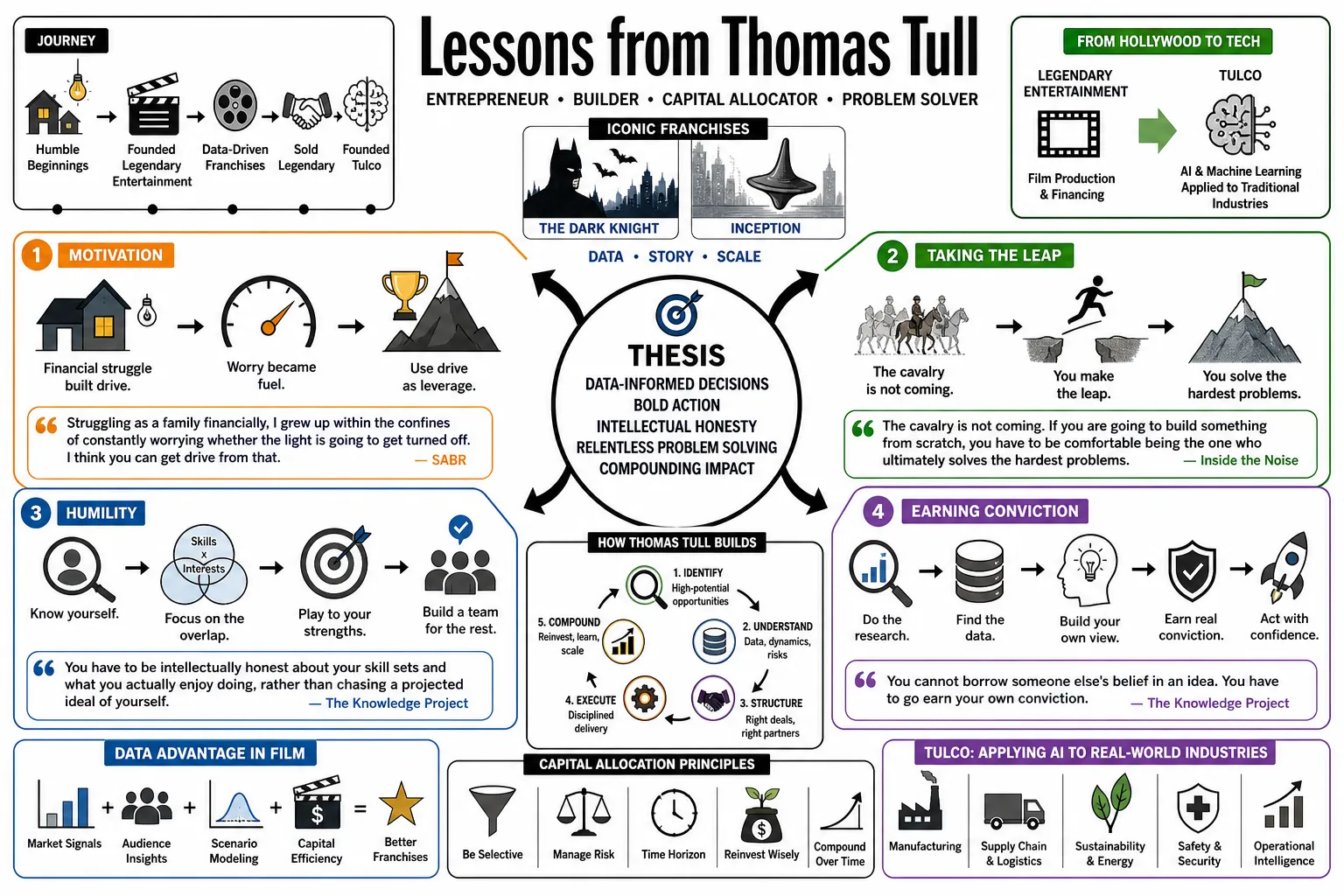
Thomas Tull founded Legendary Entertainment, where he used a data-driven approach to finance and co-produce film franchises like The Dark Knight and Inception. After selling the company, he launched Tulco, a holding firm that applies artificial intelligence and machine learning to traditional industries. This profile outlines his specific approaches to building businesses, allocating capital, and solving complex problems across Hollywood and the tech sector.
Part 1: Entrepreneurship and Building Companies
- On Motivation: "Struggling as a family financially, I grew up within the confines of constantly worrying whether the light is going to get turned off. I think you can get drive from that." — Source: SABR
- On Taking the Leap: "The cavalry is not coming. If you are going to build something from scratch, you have to be comfortable being the one who ultimately solves the hardest problems." — Source: Inside the Noise
- On Humility: "You have to be intellectually honest about your skill sets and what you actually enjoy doing, rather than chasing a projected ideal of yourself." — Source: The Knowledge Project
- On Earning Conviction: "You cannot borrow someone else's belief in an idea. You have to earn your conviction through relentless homework and fact-based analysis." — Source: Lex Fridman Podcast
- On Constraints: "I think constraints and almost like a desperation and deadlines are catalysts for creativity." — Source: Just Learning
- On Early Struggles: Tull did not enter Hollywood through the usual studio path: after college he started with a chain of laundromats and car-repair centers, then built Tax Services of America into hundreds of Jackson Hewitt tax-preparation locations before moving into private equity and film finance. — Reference: Los Angeles Business Journal profile on Tull's laundromat, car-repair, and Tax Services of America path
- On Career Shifts: "I initially thought I wanted to be a lawyer, but I quickly realized my temperament was suited for building businesses. You have to adapt when the reality of a profession does not match your assumptions." — Source: The Knowledge Project
- On Building Value: "Value is created when you can identify an inefficiency in a traditional market and have the operational patience to fix it." — Source: Founder's Field Guide
- On Persistence: "There were many times early on when it seemed like the logical choice was to quit. The differentiating factor is simply refusing to let the light go out." — Source: GaryVee Podcast
- On The Regret of Inaction: "The only thing worse than failing at something you care about is looking back and realizing you never even had the courage to try." — Source: GaryVee Podcast
Part 2: The Business of Filmmaking
- On Audience Alignment: "The only guiding principle you can use is to make something that you want to see." — Source: AZ Quotes
- On Childhood Passions: "I have had the absolute privilege of making movies that I loved when I was a kid and loved my whole life." — Source: AZ Quotes
- On Core Ingredients: "If you don't have a great director and a great script, if you don't have that foundation, it's hard to pull off." — Source: Just Learning
- On Data in Hollywood: "When we started Legendary, we realized that the marketing side of the film business was ripe for a highly analytical approach." — Source: Lex Fridman Podcast
- On Fan Culture: "You cannot manufacture authenticity. If you do not respect the underlying mythology of a comic or a franchise, the core fans will reject you immediately." — Source: The Knowledge Project
- On Studio Partnerships: "We avoided building a distribution apparatus from scratch. We partnered with the best and focused our capital strictly on production and intellectual property." — Source: Lex Fridman Podcast
- On Creative Risks: "A movie like Inception does not happen if you only look at historical comparisons. You occasionally have to bet entirely on the singular vision of a filmmaker." — Source: Founder's Field Guide
- On Production Honesty: "It would be disingenuous to say we're producing a film if we just got on a moving train. We prefer to be involved from the ground floor." — Source: AZ Quotes
- On The Theatrical Experience: "There is still a profound difference between watching something at home and experiencing a massive event movie in a crowded theater." — Source: The Knowledge Project
- On Franchise Building: "You have to treat intellectual property with a sense of stewardship. You are borrowing it from the fans for a period of time." — Source: Lex Fridman Podcast
Part 3: Applied Artificial Intelligence
- On The Reality of AI: "Artificial intelligence is highly advanced math applied to massive datasets. It only functions if the underlying data is structured properly." — Source: The Knowledge Project
- On Traditional Industries: "The greatest opportunities for machine learning are often found in unglamorous, traditional industries like insurance and logistics." — Source: Founder's Field Guide
- On AI Implementation: "You cannot simply sprinkle AI onto a bad business model and expect it to become a good one. It has to solve a specific operational bottleneck." — Source: Lex Fridman Podcast
- On National Security: "Maintaining a technological edge in quantum computing, artificial intelligence, and biotechnology is fundamentally a matter of national defense." — Source: Lex Fridman Podcast
- On The Speed of Change: "The velocity of technological advancement means that incumbent businesses have less time than ever to adapt before they are displaced." — Source: The Knowledge Project
- On Hype vs. Utility: "We look for companies that are using technology to generate cash flow and solve real problems, rather than chasing the current venture capital trend." — Source: Founder's Field Guide
- On Engineering Talent: "The hardest part of building a tech holding company is attracting the very top tier of engineering talent to work on problems outside of traditional tech sectors." — Source: Lex Fridman Podcast
- On Quantum Computing: "Quantum is more than a faster computer; it is a completely different paradigm that will render current cryptographic and logistical models obsolete." — Source: Lex Fridman Podcast
- On The Tech Ecosystem: "We invest in technology that acts as infrastructure for the future economy, picking the picks and shovels of the next decade." — Source: GaryVee Podcast
- On Future Interfaces: "How humans interact with machines is changing rapidly. The interface will become less about screens and more about ambient, predictive intelligence." — Source: The Knowledge Project
Part 4: Data and Analytics
- On The Limits of Data: "Data cannot write a script or direct a movie. It can tell you how to sell it, but it cannot create the soul of the product." — Source: Lex Fridman Podcast
- On Audience Segmentation: "Historically, Hollywood marketed to four broad quadrants. We realized through data that there are thousands of micro-communities you can speak to directly." — Source: Founder's Field Guide
- On Predictive Modeling: "If you can accurately predict customer churn in an insurance business using analytics, you instantly change the valuation multiple of that company." — Source: The Knowledge Project
- On Information Overload: "The challenge is no longer acquiring data. The challenge is filtering the noise so executives can actually make a decision." — Source: Lex Fridman Podcast
- On Operational Efficiency: "When we look at a potential acquisition, the first thing we analyze is how much friction exists in their daily operations that could be smoothed out with better analytics." — Source: Founder's Field Guide
- On Forecasting Models: "Building an accurate predictive model requires massive amounts of clean historical data. If the input data is flawed, the most sophisticated algorithm will still output bad decisions." — Source: Lex Fridman Podcast
- On Testing Hypotheses: "You have to be willing to let the data prove you wrong. If your ego is tied to the initial hypothesis, you will misinterpret the numbers." — Source: The Knowledge Project
- On Legacy Systems: "Many massive companies are running on technology stacks that are decades old. Ripping those out and replacing them with modern data pipelines unlocks massive value." — Source: Founder's Field Guide
- On Quantitative Marketing: "We stopped buying television ads based on gut feeling and started treating film marketing like a highly optimized digital performance campaign." — Source: Lex Fridman Podcast
Part 5: Leadership and Management
- On Hiring: "I want to hire people who have a chip on their shoulder and something to prove, but who are also self-aware enough to know what they do not know." — Source: The Knowledge Project
- On Organizational Culture: "Culture is not what you write on the wall; it is how you behave when a project fails and the pressure is on." — Source: GaryVee Podcast
- On Delegation: "At a certain scale, you have to transition from being the person who does the work to being the person who edits and guides the work of others." — Source: Founder's Field Guide
- On Managing Creatives: "You have to give brilliant creatives a wide berth, but you also have to clearly define the box they are playing in financially." — Source: Lex Fridman Podcast
- On Decision Velocity: "A good decision made today is better than a perfect decision made next week. In business, speed is a defensible moat." — Source: The Knowledge Project
- On Handling Adversity: "The best leaders I have been around do not panic. They absorb the stress so their team can focus on executing the solution." — Source: Lex Fridman Podcast
- On Intellectual Honesty: "You have to foster an environment where the most junior analyst can tell the CEO that the math does not work, and the CEO will actually listen." — Source: Founder's Field Guide
- On Strategic Focus: "It is very easy to get distracted by shiny objects. Leadership is often about saying no to ninety-nine good ideas to execute on the one great one." — Source: GaryVee Podcast
- On Lifelong Learning: "The moment you think you have the industry completely figured out is the moment you are about to be disrupted. You must remain a student." — Source: Hamilton College Commencement
Part 6: Investment and Capital Allocation
- On Structural Advantages: "We look for businesses that have a structural advantage, whether it is a regulatory moat, a massive dataset, or a unique distribution channel." — Source: Founder's Field Guide
- On Patience in Investing: "Capital is a commodity. What you are really providing as an investor is the strategic patience to let a complex business plan unfold." — Source: Lex Fridman Podcast
- On The Defense Sector: "Investing in national security technologies requires a completely different mindset than consumer software. The timelines are longer, but the stakes are existential." — Source: Lex Fridman Podcast
- On Valuation: "I try not to get caught up in market euphoria. If the fundamental unit economics do not make sense, the macro narrative does not matter." — Source: The Knowledge Project
- On Asymmetric Risk: "We look for scenarios where the downside is capped by hard assets or recurring revenue, but the upside is unbound if the technology scales." — Source: Founder's Field Guide
- On Partnering with Founders: "When I invest, I am evaluating the founder's resilience just as much as their product. I need to know they will not fold when things get hard." — Source: GaryVee Podcast
- On The Role of Holding Companies: "By using a holding company structure, we avoid the artificial timelines of a traditional venture fund and can hold assets for decades if we choose." — Source: Founder's Field Guide
- On Macro Trends: "You cannot invest purely based on macroeconomics, but you must be aware of the geopolitical winds, especially when dealing with advanced technologies." — Source: The Knowledge Project
- On Capital Efficiency: "The best businesses we see have a natural operating advantage, where each marginal unit of revenue costs less to generate than the last." — Source: Lex Fridman Podcast
Part 7: Sports, Music, and Passions
- On The Steelers Culture: "The Pittsburgh Steelers operate with a level of consistency, loyalty, and quiet excellence that I try to emulate in my own businesses." — Source: Lex Fridman Podcast
- On Sports as a Business: "Owning a piece of a sports franchise is unique because the asset has deep emotional resonance with the community; you are a steward of a civic institution." — Source: Mike Rowe Podcast
- On Playing Guitar: "Music is the ultimate reset for me. When you are playing guitar with a band, you have to be entirely present in that moment." — Source: Inside the Noise
- On The Rolling Stones: "Being able to open for bands like the Rolling Stones is surreal. It reminds you to appreciate the journey and the absurd places life can take you." — Source: Lex Fridman Podcast
- On Baseball History: "Baseball is the only sport where the history and the statistics are almost as important as the live game itself. It is a game of narratives." — Source: SABR
- On The Discipline of Music: "You cannot buy your way into being a good musician. It requires thousands of hours of repetitive, unglamorous practice." — Source: Inside the Noise
- On Creative Outlets: "Everyone needs a pursuit that has nothing to do with their primary career, something where the only metric of success is personal fulfillment." — Source: The Knowledge Project
- On Team Dynamics: "A great band functions exactly like a great executive team. You have to listen to each other, know when to step back, and know when to take the solo." — Source: Inside the Noise
- On Fandom: "Being a fan keeps you grounded. It reminds you what it feels like to be on the receiving end of a product, completely invested in the outcome." — Source: Lex Fridman Podcast
Part 8: Philosophy and Resilience
- On The Inner Compass: "You have to listen to your inner compass and define success on your own terms, rather than living for the expectations of others." — Source: Hamilton College Commencement
- On Citizenship: "Prioritize being a good citizen and a good person. At the end of it all, that is a core measure of whether you actually succeeded." — Source: Hamilton College Commencement
- On The Dignity of Work: "We need to re-establish the dignity of vocational work and manufacturing in this country. A four-year degree is not a requirement to build a meaningful life." — Source: Mike Rowe Podcast
- On Reading and Curiosity: "Following your intellectual curiosity, reading widely across disciplines, is the best way to synthesize new ideas that others miss." — Source: The Knowledge Project
- On Avoiding Cynicism: "It is very easy to become cynical when you see how the sausage is made, whether in Hollywood or finance. Maintaining a sense of wonder is a choice." — Source: Lex Fridman Podcast
- On Time Management: "Time is the only asset that scales inversely. As you gain more resources, you have to become increasingly ruthless about how you spend your hours." — Source: GaryVee Podcast
- On Legacy: "You do not write your own legacy; you simply do the work. The work is what endures after the headlines fade." — Source: Founder's Field Guide
- On Fear of Failure: "If you are not occasionally terrified by the scale of what you are attempting, you are probably playing it too safe." — Source: The Knowledge Project
- On Gratitude: "When I reflect on the path from a laundromat to producing Batman and investing in quantum physics, the prevailing emotion has to be profound gratitude." — Source: Lex Fridman Podcast