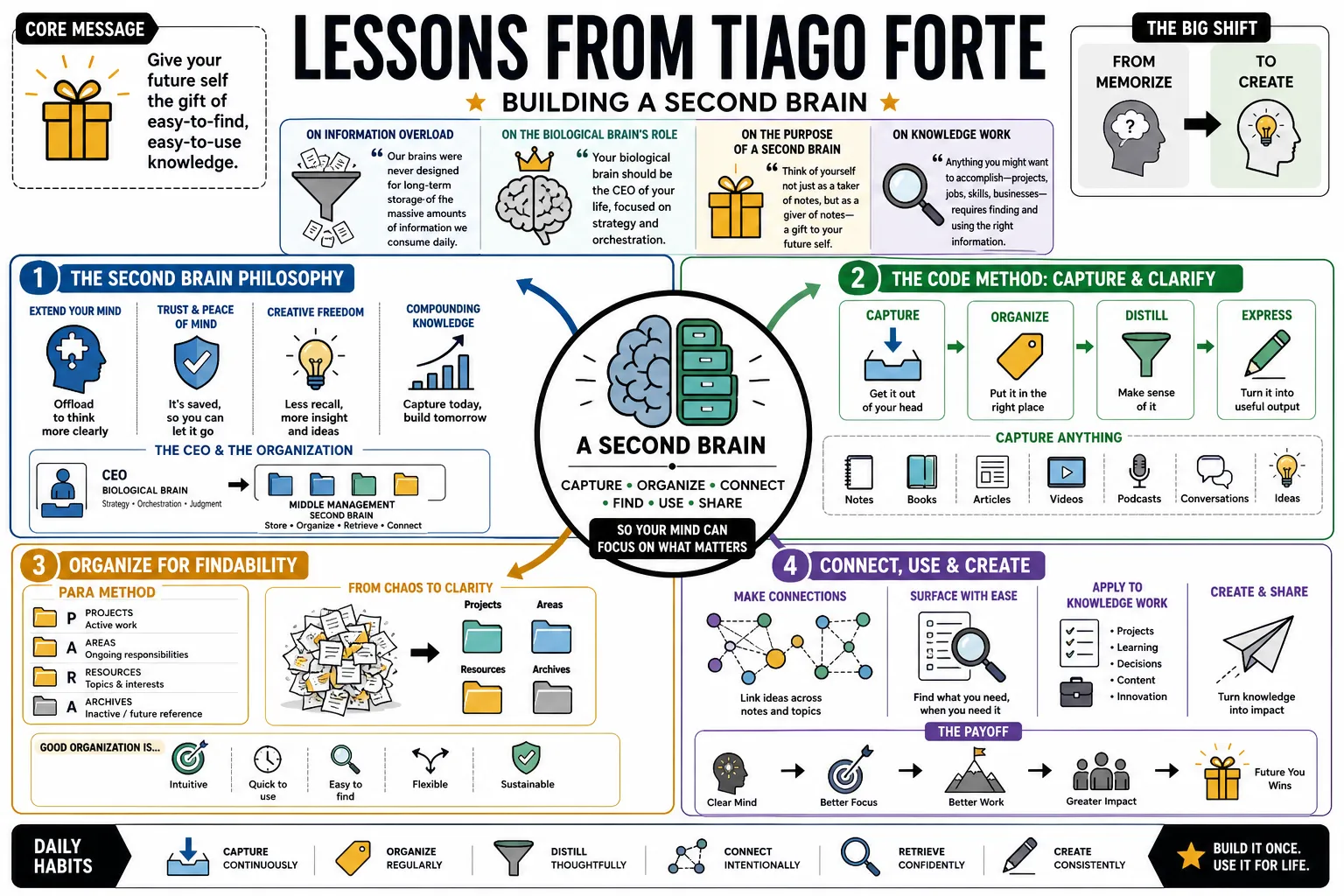
Lessons from Tiago Forte
Productivity expert and author Tiago Forte created "Building a Second Brain," a practical system for managing personal knowledge. He teaches people to organize their digital information so they can stop trying to memorize details and focus on creative work instead. This profile breaks down his core frameworks for note-taking and project organization.
Part 1: The Second Brain Philosophy
- On the Purpose of a Second Brain: "Think of yourself not just as a taker of notes, but as a giver of notes—you are giving your future self the gift of knowledge that is easy to find and understand." — Source: [Goodreads]
- On Information Overload: "Our brains were never designed for long-term storage of the massive amounts of information we consume daily. They are designed for thinking." — Source: [Clearer Thinking]
- On the Biological Brain's Role: "Your biological brain should be the CEO of your life, focused on strategy and orchestration, while your Second Brain handles the middle management of storing and retrieving information." — Source: [Ali Abdaal Podcast]
- On Knowledge Work: "Anything you might want to accomplish—executing a project at work, getting a new job, learning a new skill, starting a business—requires finding and putting to use the right information." — Source: [Forte Labs]
- On Cognitive Relief: "Offloading the job of remembering to an external system frees up your mental energy for higher-level tasks like critical thinking and decision-making." — Source: [Building a Second Brain Podcast]
- On Having Ideas: "Your mind is for having ideas, not holding them. A Second Brain is where you hold them." — Source: [Ryan Delaney]
- On Building Blocks: "For modern, professional notetaking, a note is a 'knowledge building block'—a discrete unit of information interpreted through your unique perspective and stored outside your head." — Source: [Medium]
- On the Value of an External Mind: "The value of a Second Brain is that it acts as a reliable extension of your biological memory, unaffected by fatigue or stress." — Source: [Tiago Forte YouTube]
- On Trusting Your System: "If you don't trust your system, your brain will refuse to let go of the information, defeating the entire purpose of writing it down." — Source: [Toby Sinclair]
- On Self-Expression: "The more you outsource and delegate the jobs of capturing, organizing, and distilling to technology, the more time and energy you'll have available for the self-expression that only you can do." — Source: [Building a Second Brain]
Part 2: Capturing Ideas
- On the Capture Habit: "Never let a good idea slip away. By capturing thoughts in a trusted place instantly, you clear your mental space for new ideas." — Source: [Swyx]
- On Selective Capturing: "Save only the most important information that resonates with you, rather than trying to save everything." — Source: [BookFave]
- On Intuition: "When deciding what to capture, follow your intuition. If a piece of information surprises you or sparks a reaction, it belongs in your Second Brain." — Source: [Forte Labs]
- On the Cost of Hoarding: "Capturing everything is just as bad as capturing nothing. It creates a digital landfill instead of a curated garden." — Source: [Medium]
- On Open Loops: "Uncaptured ideas become open loops in your mind, draining your focus and creating low-level anxiety until they are written down." — Source: [Thomas J. Frank]
- On Frictionless Capture: "Your capture tools must be ubiquitous and frictionless. The moment there is resistance to writing an idea down, you will stop doing it." — Source: [Tiago Forte YouTube]
- On Context: "When capturing a note, always include a brief note to your future self explaining why this information was important in the first place." — Source: [Glasp]
- On Media Consumption: "Read with a highlighter in hand, whether physical or digital. You should never consume non-fiction without a mechanism to capture the best parts." — Source: [Ali Abdaal Podcast]
- On Resonant Ideas: "We are constantly bombarded by information. Your job is to build a filter that only lets the most resonant ideas pass through into your permanent notes." — Source: [Clearer Thinking]
Part 3: Organizing for Action
- On Actionability: "Instead of organizing ideas according to where they come from, I recommend organizing them according to where they are going." — Source: [Medium]
- On the Flaw of Categories: "Organizing by broad topics or categories fails because it disconnected information from the context in which it will be used." — Source: [Forte Labs]
- On Active Projects: "The best way to organize your notes is to organize for action, according to the active projects you are working on right now." — Source: [Toby Sinclair]
- On Utility over Perfection: "The true test of whether a piece of knowledge is valuable is not whether it is perfectly organized and neatly labeled, but whether it can have an impact on someone or something that matters to you." — Source: [Glasp]
- On Finding Things: "You are always trying to place a note or file not only where it will be useful, but where it will be useful the soonest." — Source: [Medium]
- On Digital Hoarding: "We often organize information as if we are archivists preparing for a museum exhibit, rather than practitioners trying to get work done today." — Source: [Clearer Thinking]
- On Flexibility: "A good organizational system must be dynamic. It should morph and adapt as your priorities change, rather than forcing you into a rigid hierarchy." — Source: [Swyx]
- On Simplification: "If your organizational system is as complex as your life, then the demands of maintaining it will end up robbing you of the time and energy you need to live that life." — Source: [Thomas J. Frank]
- On Tagging vs. Folders: "While tags have their place, folders tied to specific projects create clear, physical boundaries that force you to decide what an item is actually for." — Source: [Building a Second Brain Podcast]
- On Maintenance: "Your system should require almost zero maintenance. If you are spending hours organizing your notes, you are avoiding the actual work of creating." — Source: [Ryan Delaney]
Part 4: The PARA Method
- On the PARA Acronym: "P.A.R.A. stands for Projects — Areas — Resources — Archives, the four top-level categories that encompass every type of information you might encounter in your work and life." — Source: [Glasp]
- On Defining Projects: "A project is a series of tasks linked to a goal, with a deadline. It must have a clear beginning and end." — Source: [Forte Labs]
- On Defining Areas: "An area of responsibility is a sphere of activity with a standard to be maintained over time, like your health, finances, or a direct report." — Source: [Medium]
- On Projects vs. Areas: "Confusing projects with areas is a primary cause of burnout. You cannot 'finish' health, but you can finish running a 5K." — Source: [Thomas J. Frank]
- On Defining Resources: "Resources are topics or interests of ongoing usefulness. They are the reference materials you collect for future, undefined projects." — Source: [Toby Sinclair]
- On the Importance of Archives: "Archives are for completed projects, inactive areas, and resources you no longer need. They keep your active workspace uncluttered without losing the data." — Source: [Clearer Thinking]
- On Moving Information: "Information in PARA is constantly flowing. A resource might become a project, and a completed project moves to the archives. It is a living ecosystem." — Source: [Tiago Forte YouTube]
- On Universal Application: "The strength of PARA is that it is tool-agnostic. You can use the exact same four folders in your notes app, your computer's file system, and your cloud storage." — Source: [Ali Abdaal Podcast]
- On Getting Organized: "The promise of PARA is that it changes 'getting organized' from a herculean, never-ending endeavor into a straightforward task to get over with so you can move on to more important work." — Source: [Medium]
Part 5: Distilling Knowledge
- On Progressive Summarization: "Progressive summarization is the process of highlighting a note in layers—first bolding the key points, then highlighting the bold text—so you can grasp its meaning in seconds." — Source: [Forte Labs]
- On Future Readability: "When you distill a note, you are designing it for your future self, who will be impatient, tired, and looking for immediate answers." — Source: [Clearer Thinking]
- On Editing: "As you distill your ideas, they naturally improve, because when you drop the merely good parts, the great parts can shine more brightly." — Source: [BookFave]
- On Courage in Distillation: "To be clear, it takes skill and courage to let the details fall away. We naturally want to keep everything, but keeping everything means hiding the best things." — Source: [Goodreads]
- On Executive Summaries: "At the highest level of distillation, you should be able to write a one-paragraph executive summary at the top of your note in your own words." — Source: [Swyx]
- On Highlighting Traps: "Highlighting a physical book is useless if those highlights remain trapped on the page. Distillation only matters if the information is centralized and searchable." — Source: [Ali Abdaal Podcast]
- On Information Compression: "Think of distillation as data compression for the mind. You want the maximum amount of insight delivered in the minimum number of words." — Source: [Ryan Delaney]
- On Unintentional Memorization: "Through the act of progressively summarizing a note, you inevitably end up internalizing the material without ever having to sit down and force yourself to study it." — Source: [Toby Sinclair]
- On the Danger of Over-Distilling: "Don't summarize notes you aren't currently using. Distill information just-in-time, as it becomes relevant to a specific, active project." — Source: [Building a Second Brain Podcast]
Part 6: Expressing and Creating
- On Creative Output: "It is when you begin expressing your ideas and turning your knowledge into action that life really begins to change." — Source: [BookFave]
- On Remixing: "Great work is rarely created from scratch; it is a remix of gathered ideas and inspirations." — Source: [Ali Abdaal Podcast]
- On the Blank Page: "If you are starting your creative work staring at a blank page, you have already failed. You should be starting with a wealth of curated notes." — Source: [Forte Labs]
- On Intermediate Packets: "Break your work down into 'intermediate packets'—small, reusable chunks of work like a single paragraph, a diagram, or a list of brainstormed ideas." — Source: [Clearer Thinking]
- On Reusability: "By creating work in modular packets, you can recycle them for future projects, compounding your creative output over time." — Source: [Medium]
- On Output as the Goal: "Taking notes is not the goal. Reading books is not the goal. The goal is what you produce and share with the world." — Source: [Swyx]
- On Shipping: "Make work visible. Finish working sessions with a tangible deliverable. This makes it easier to pick up where you left off and provides a sense of progress." — Source: [Tiago Forte YouTube]
- On Sharing Imperfect Work: "Don't wait until a project is completely finished to share it. Share your intermediate packets to get feedback early and course-correct." — Source: [Toby Sinclair]
- On the Input-Output Balance: "If you are consuming ten times more information than you are producing, your system is out of balance. Output must be the priority." — Source: [Ryan Delaney]
- On the Definition of a Creator: "A creator is simply someone who has built a reliable system for translating their inputs into valuable outputs on a consistent basis." — Source: [Glasp]
Part 7: Rethinking Productivity
- On Hustle Culture: "Productivity has developed a bad rap as being synonymous with hustle culture, endless busyness, and grinding through tasks you hate." — Source: [Building a Second Brain Podcast]
- On True Productivity: "True productivity is not about doing more things. It is about your ability to take a vision in your head and manifest it in the real world." — Source: [Clearer Thinking]
- On Efficiency: "Efficiency is minimizing wasted time, effort, and energy so you can focus on what truly matters, not squeezing more tasks into an hour." — Source: [Tiago Forte YouTube]
- On Systems over Willpower: "Rather than relying on willpower or hacks, a productive person relies on a trusted system that provides the confidence to handle whatever life throws at them." — Source: [Forte Labs]
- On Identifying Bottlenecks: "Don't chase new tools. Identify what is actually holding you back—whether it’s a lack of information, a lack of clear vision, or a workflow issue." — Source: [Ali Abdaal Podcast]
- On the Annual Review: "The annual review is not just a productivity exercise; it is a vital tool for ensuring that your daily actions are actually aligned with your long-term values." — Source: [Tiago Forte YouTube]
- On Managing Energy: "You cannot manage time, you can only manage your energy and attention. A good system protects your attention from the trivial." — Source: [Swyx]
- On Over-Optimization: "Tweaking your productivity system is often a sophisticated form of procrastination. Once it works, stop tweaking and start creating." — Source: [Thomas J. Frank]
- On Peace of Mind: "The ultimate metric for your productivity system is not how many tasks you check off, but the level of peace of mind you feel at the end of the day." — Source: [Medium]
Part 8: Building a Digital Workflow
- On the CODE Framework: "C.O.D.E. stands for Capture, Organize, Distill, and Express—it is the universal workflow for moving information from an external source into a finished creative product." — Source: [Toby Sinclair]
- On Tool Agnosticism: "The methodology matters far more than the app. A Second Brain can be built in Evernote, Notion, Apple Notes, or Obsidian, as long as the principles are sound." — Source: [Clearer Thinking]
- On Searchability: "Rely heavily on the search bar. While folders provide structure, search is the ultimate safety net that ensures nothing is ever truly lost." — Source: [Forte Labs]
- On Switching Apps: "Constantly migrating from one notes app to another destroys the compounding value of your knowledge base. Pick a solid tool and commit to it." — Source: [Ali Abdaal Podcast]
- On Digital Defaults: "Customize your digital environment to serve you. Turn off notifications, simplify your home screen, and remove friction from the tools you use most." — Source: [Ryan Delaney]
- On Version Control: "Keep old drafts. Storage is practically free, and you never know when an idea cut from one project will become the centerpiece of the next." — Source: [Building a Second Brain Podcast]
- On Reading Workflows: "Use read-it-later apps to separate the discovery of content from the consumption of content. This prevents you from getting derailed by interesting but irrelevant articles during the workday." — Source: [Glasp]
- On Cross-Pollination: "A digital system allows disparate ideas to collide. When notes from a biology book sit next to notes on business strategy, entirely new insights are formed." — Source: [BookFave]
- On the Lifelong Journey: "Building a Second Brain is not a weekend project. It is a lifelong habit of interacting with information purposefully, and it will evolve as you do." — Source: [Tiago Forte YouTube]