Tido Carriero is an engineering and product executive who scaled technical organizations at Facebook, Dropbox, and Segment before co-founding the intent-based marketing platform Koala. He is widely cited for his philosophy of hiring for the "slope" of a candidate's potential rather than their current experience level, and for practical frameworks that align engineering efforts with go-to-market teams. This profile catalogs his specific advice on organizational design, cross-functional collaboration, and career development during periods of rapid startup growth.
Part 1: Hiring and Talent Evaluation
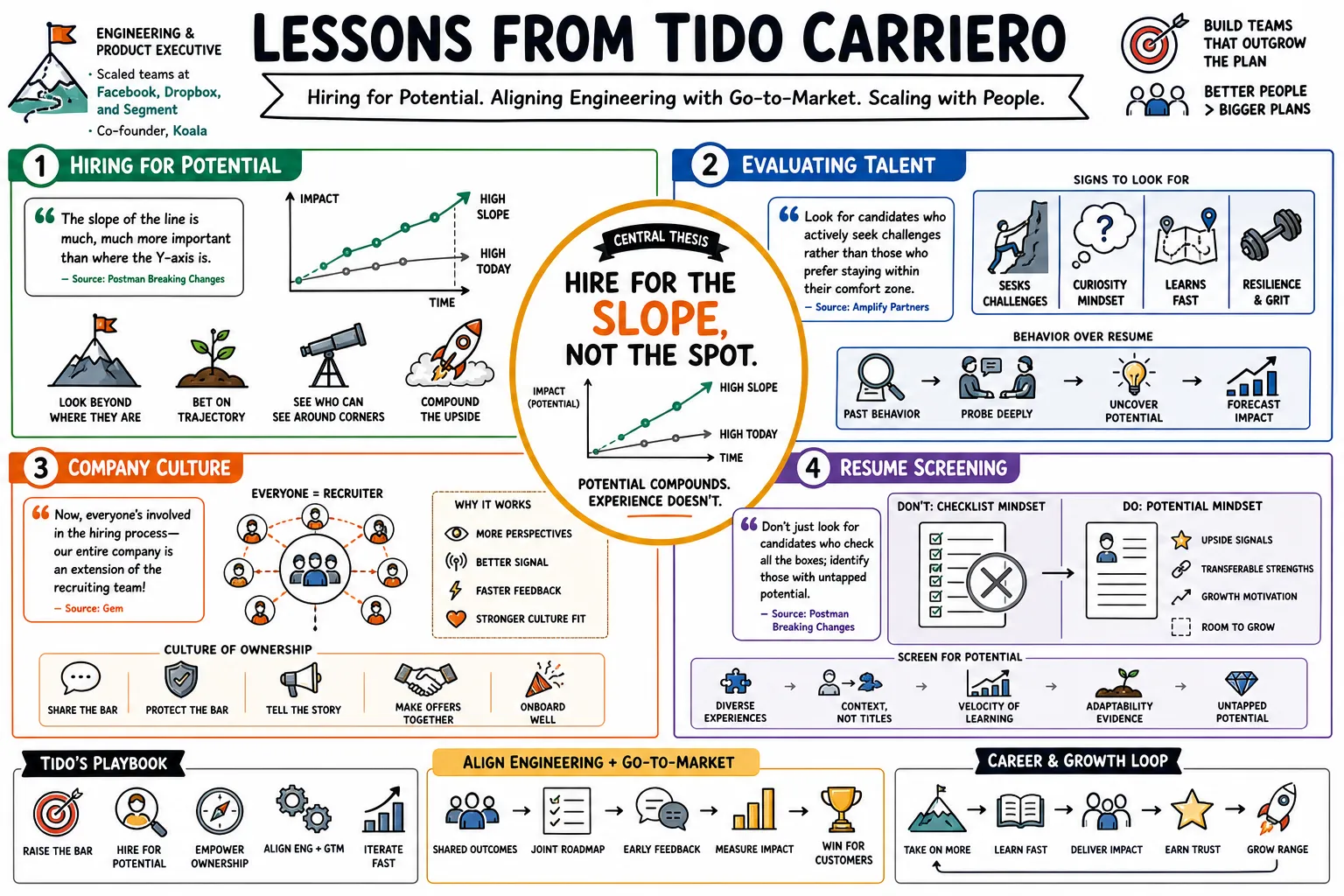
- On Hiring for Potential: "The slope of the line is much, much more important than where the Y-axis is." — Source: Postman Breaking Changes
- On Evaluating Talent: "Look for candidates who actively seek challenges rather than those who prefer staying within their comfort zone." — Source: Amplify Partners
- On Company Culture: "Now, everyone's involved in the hiring process—our entire company is an extension of the recruiting team!" — Source: Gem
- On Resume Screening: "Don't just look for candidates who check all the boxes; identify those with untapped potential." — Source: Postman Breaking Changes
- On Market Inefficiencies: "Hiring for potential over polished credentials allows you to exploit an inefficiency in the job market." — Source: Amplify Partners
- On Entry Points: "Companies should create specific ramps or entry points for high-potential individuals, even if they aren't immediately suited for a traditional role." — Source: First Round Review
- On Interviewing: "Use behavioral interviews to dig deep into a candidate's journey and understand their rate of growth." — Source: Postman Breaking Changes
- On Assessing Growth: "When assessing candidates, focus intensely on how they have evolved and adapted in their previous roles." — Source: SimpleLeadership Podcast
- On Job Kits: In a Hatchways job-kit guide, Carriero, Jean-Denis Greze, and Jaclyn Ling recommend defining the role, must-haves, interview slate, rubrics, sample technical exercises, and candidate communication before running the hiring process. — Reference: Hatchways job-kit guide on role definition, interview slates, rubrics, and candidate communication
- On Hiring Responsibility: "Building a strong team requires an engineering culture where everyone takes responsibility for the company's hiring values." — Source: First Round Review
Part 2: Team Growth and Scaling
- On Hypergrowth: "Leading through hypergrowth requires continuously adapting your processes so they don't break under new scale." — Source: Postman Breaking Changes
- On Process Implementation: "Introduce lightweight frameworks and processes just-in-time, allowing them to grow alongside the team." — Source: First Round Review
- On Rigidity: "Avoid imposing rigid structures too early; a simple product review meeting is often enough at the beginning." — Source: First Round Review
- On Managing Ambiguity: "Create clear goal-setting and accountability structures, like bi-weekly sprint check-ins, to manage ambiguity during rapid growth." — Source: First Round Review
- On Scaling Engineering: "The transition from early startup to a scaled organization fundamentally changes how engineering teams must communicate." — Source: ELC Annual 2023
- On Tooling: "Building internal tools often reveals the limitations of in-house stacks compared to dedicated third-party solutions." — Source: Pendo Product Love Podcast
- On Transitioning Roles: "Moving from an individual contributor to a manager requires a complete shift in how you measure personal productivity." — Source: OsoHQ
- On Manager of Managers: "When you become a manager of managers, your primary output becomes the clarity and alignment you provide to your leaders." — Source: Medium
- On Early Stage Growth: "Starting a growth team from scratch requires balancing quick experiments with the stability of the core platform." — Source: AllThingsD
- On Maintaining Speed: "To maintain velocity as you scale, you have to constantly re-evaluate and remove organizational friction points." — Source: First Round Review
Part 3: Organizational Design and Structure
- On Organizational Clarity: "Your top priority as an engineering leader is creating absolute clarity for your teams regarding their goals and boundaries." — Source: First Round Review
- On Structuring Teams: "Organize product and engineering teams in ways that minimize cross-team dependencies and allow for autonomous execution." — Source: Postman Breaking Changes
- On Re-architecting: "Re-architecting a platform is incredibly challenging and should only be undertaken when the current system fundamentally limits business growth." — Source: First Round Review
- On Internal Data: "Respecting customer privacy requires absolute visibility into what data your company is collecting and how it's being used internally." — Source: CMSWire
- On the Development Factory: "The software development factory has, in a sense, collapsed, and we are trying to reassemble these parts for modern needs." — Source: Futunn
- On Cross-Functional Trust: "Trust between engineering, product, and sales is built through shared context and transparent planning." — Source: ELC Annual 2023
- On Iteration: "Iterate based on customer milestones before deciding to drastically scale up the team size for a new product line." — Source: First Round Review
- On Multi-Product Strategy: "Going multi-product requires a deliberate organizational shift; you can't just run it as a side project of the core team." — Source: First Round Review
- On Corporate Needs: "Maturing a consumer product for the enterprise means prioritizing administrative controls, reporting, and data visibility." — Source: Diversity Network
Part 4: Product-Engineering Alignment
- On Shared Goals: "Product and engineering must share the exact same top-level metrics to avoid misaligned incentives." — Source: Pendo Product Love Podcast
- On Feature Requests: "Consolidate dozens of disparate product gap reports into a few major, high-impact themes, such as platform extensibility." — Source: a16z Podcast
- On Collaboration: "The best products emerge when engineers are brought into the customer discovery process early, not just handed a spec." — Source: First Round Review
- On Strategic Roadmaps: "Instead of arguing over feature requests quarter-by-quarter, zoom out to a multi-year strategy to align the roadmap." — Source: ELC Annual 2023
- On Product Reviews: "Use product reviews not just as a gatekeeping mechanism, but as a way to cross-pollinate ideas across different engineering pods." — Source: First Round Review
- On Technical Debt: "Address technical debt by framing it in terms of product velocity and reliability, rather than purely engineering hygiene." — Source: First Round Review
- On Minimum Viable Products: "An MVP should test the core hypothesis of the business, not just be a stripped-down version of the final design." — Source: Pendo Product Love Podcast
- On User Empathy: "Engineers build better solutions when they directly observe users struggling with the current product." — Source: First Round Review
- On Product Scope: "Narrowing down engineering priorities by focusing on a clearly defined ideal customer profile prevents feature bloat." — Source: a16z Podcast
Part 5: The Sales-Product Tension
- On Healthy Tension: "A healthy tension between go-to-market and product/engineering teams is a sign of a fast-growing, ambitious company." — Source: ELC Annual 2023
- On Selling Value: "Salespeople should sell on value, not just a laundry list of features, to prevent the product roadmap from becoming entirely reactive." — Source: a16z Podcast
- On One-Off Requests: "Getting bogged down by one-off sales requests grinds product progress to a halt and derails the long-term vision." — Source: Simplecast
- On Annual Planning: "Cross-functional annual planning sessions are critical for aligning the engineering roadmap with high-level revenue goals." — Source: a16z Podcast
- On Assuming Positive Intent: "When disagreements arise between sales and engineering, it is vital to assume positive intent rather than malice." — Source: SimpleLeadership Podcast
- On Strategic Alignment: "You have to view each other as partners rather than adversaries to turn organizational friction into a catalyst for growth." — Source: ELC Annual 2023
- On Feature Roadmaps: "Sales needs predictability from the product roadmap, but product needs breathing room from sales to innovate." — Source: a16z Podcast
- On Managing Friction: "The cycle of sales wanting more features and product wanting less distraction can be solved by defining a strict enterprise ICP." — Source: a16z Podcast
- On Growth Catalysts: "Turning the sales-product tension into a productive partnership is a key secret to scaling successfully." — Source: ELC Annual 2023
Part 6: Product Strategy and Ideation
- On The Magic Forest Framework: "Categorize product ideas into Seeds, Saplings, and Trees to apply the appropriate level of resources and expectations to each." — Source: First Round Review
- On Seeds: "Treat early-stage prototypes and hypotheses as 'Seeds' that require Series A thinking and high tolerance for failure." — Source: First Round Review
- On Saplings: "When a product has proven product-market fit, it becomes a 'Sapling' ready for dedicated scaling resources." — Source: First Round Review
- On Trees and Roots: "Your core, established products are the 'Trees and Roots' that provide the stability necessary to fund new experimentation." — Source: First Round Review
- On Pricing Opportunities: "Constantly re-evaluate your pricing model; missing pricing opportunities can leave significant revenue on the table during hypergrowth." — Source: a16z Podcast
- On Hybrid Development: "A hybrid product development approach allows you to balance top-down strategic bets with bottom-up engineering innovation." — Source: First Round Review
- On Building Tools: "Building internal data stacks often teaches you exactly what the market actually needs in a commercial product." — Source: Pendo Product Love Podcast
- On Customer Pain: "Don't build features just because a competitor has them; build them because they uniquely solve your customer's pain point." — Source: Pendo Product Love Podcast
- On Innovation Constraints: "Constraints are necessary for innovation; without a tight focus on the ICP, product development becomes chaotic." — Source: a16z Podcast
Part 7: Career Fulfillment and Development
- On The 3-Pillar Framework: "Evaluate new career opportunities by ensuring they provide a giant leap forward across three specific pillars." — Source: OsoHQ
- On Skill Matching: "First, ask yourself: 'Does my puzzle piece fit?' Make sure there is a strong match for your existing skillsets." — Source: Gyan
- On the Inverted T-Shape: "Develop an 'Inverted T-Shape' skill profile—deep expertise in one area, complemented by a broad understanding of related disciplines." — Source: Gyan
- On Evolutionary Steps: "Ensure the role is an evolutionary step forward that builds upon your past experience while pushing you toward long-term goals." — Source: OsoHQ
- On Mentorship: "Actively seek out mentors who have already navigated the scale and complexity you are currently facing." — Source: Medium
- On Transitioning to the C-Suite: "Moving to the C-suite requires letting go of day-to-day tactical execution and focusing entirely on organizational leverage." — Source: OsoHQ
- On Playing to Strengths: "Success in a leadership role requires leaning heavily into your strengths rather than obsessively trying to fix every weakness." — Source: Gyan
- On Choosing Companies: "Join a company where your specific technical background directly solves their biggest existential challenge." — Source: OsoHQ
- On Continuous Learning: "The most successful engineering leaders view their career as a continuous process of rebuilding their own operating system." — Source: SimpleLeadership Podcast
- On Taking Risks: "Don't be afraid to take roles that feel slightly too big for you; that is where the most rapid growth happens." — Source: First Round Review
Part 8: Intent-Based Go-To-Market and Data
- On Product-Led Growth: "Product-led growth is fundamentally changing how engineering and go-to-market teams must collaborate to capture revenue." — Source: Omniscient Digital
- On Intent Data: "Leveraging intent-based data allows sales teams to engage prospects exactly when they are experiencing the problem you solve." — Source: CRV
- On Marketing Tools: "Modern go-to-market teams require tools that instantly surface high-intent signals from the noise of website traffic." — Source: Omniscient Digital
- On B2B Sales: Carriero frames Koala 2.0 as AI for sales engagement: sales teams combine product usage, website engagement, CRM, and other signal sources so reps wake up to warmer leads, synthesized context, and more relevant outbound messages. — Reference: Carriero LinkedIn post on Koala 2.0, signal sources, AI lead research, and contextual outbound
- On First-Party Data: "First-party signals are infinitely more valuable than third-party data when determining a prospect's true buying intent." — Source: Paramark
- On Bridging GTM and Data: "Engineering must provide the infrastructure that allows sales teams to access product usage data in real time." — Source: Omniscient Digital
- On Modern SDRs: "Sales development reps are becoming more like data analysts, relying on behavioral triggers rather than static lists." — Source: Simplecast
- On AI and Pricing: In a Monetizing AI discussion, Carriero says AI pricing creates wide uncertainty around license fees versus usage and argues that teams should design billing, pricing data, entitlements, and metrics so the model can change quickly. — Reference: Monetizing AI post and transcript on AI pricing uncertainty, entitlements, metrics, and changeable pricing architecture
- On Customer Privacy: "Balancing deep intent tracking with stringent customer privacy requires a sophisticated and transparent data architecture." — Source: CMSWire