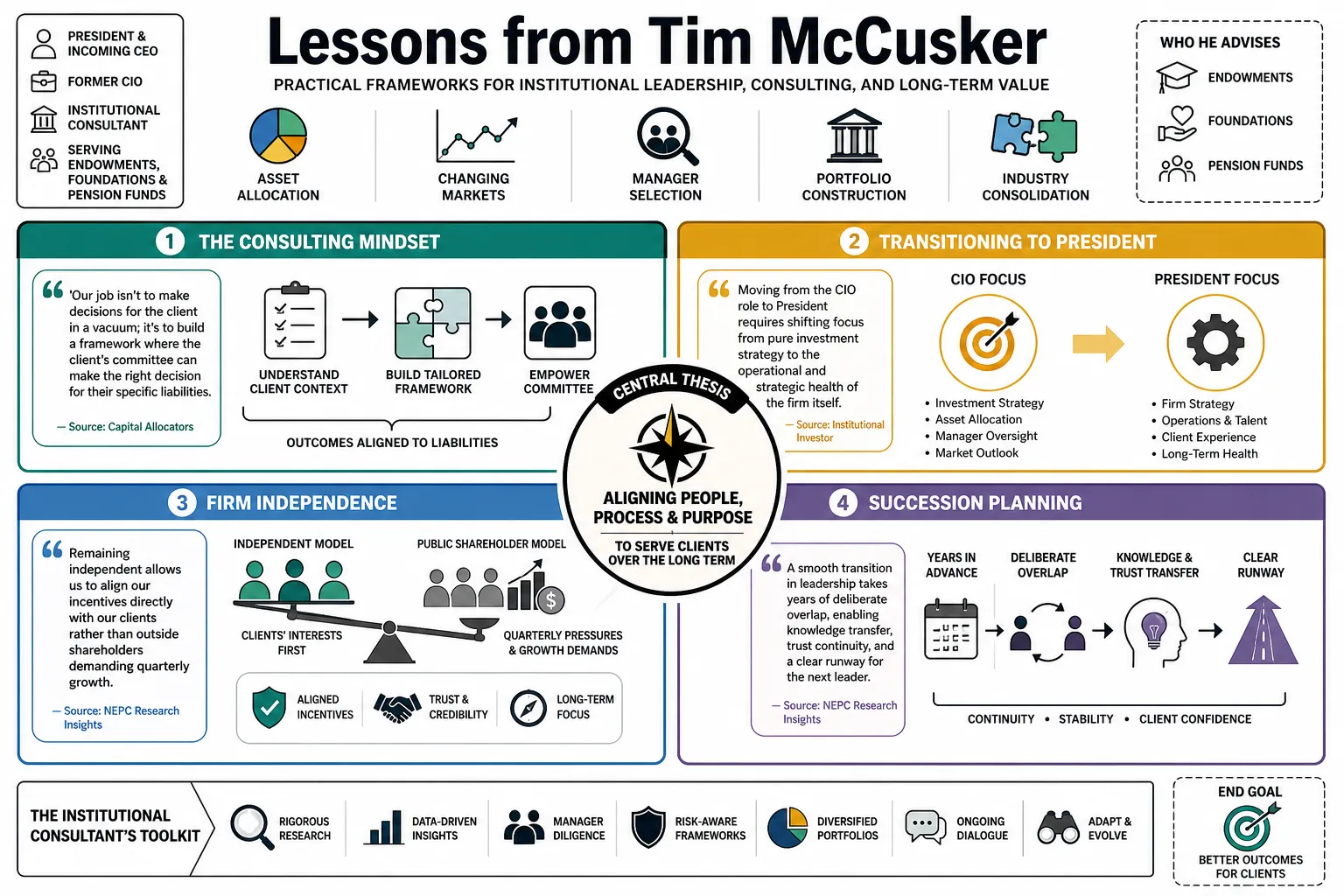
Lessons from Tim McCusker
Tim McCusker is the President and incoming CEO of NEPC, where he previously served as Chief Investment Officer. As an institutional consultant, he advises endowments, foundations, and pension funds on asset allocation across changing markets. This profile breaks down his practical frameworks for selecting managers, building portfolios, and dealing with industry consolidation.
Part 1: The CIO Role & Institutional Leadership
- On The Consulting Mindset: "Our job isn't to make decisions for the client in a vacuum; it's to build a framework where the client’s committee can make the right decision for their specific liabilities." — Source: Capital Allocators
- On Transitioning to President: "Moving from the CIO role to President requires shifting focus from pure investment strategy to the operational and strategic health of the firm itself." — Source: Institutional Investor
- On Firm Independence: "Remaining independent allows us to align our incentives directly with our clients rather than outside shareholders demanding quarterly growth." — Source: NEPC Research Insights
- On Succession Planning: "A smooth transition in leadership takes years of deliberate overlap, ensuring clients feel continuity rather than disruption." — Source: Institutional Investor
- On Customization: "There is no single model portfolio that works for every institution. The constraints, spending needs, and risk tolerances dictate entirely different asset paths." — Source: Capital Allocators
- On Balancing Creativity and Consistency: "You need a disciplined, repeatable process to avoid behavioral mistakes, but you also need enough creativity to recognize when market regimes have fundamentally shifted." — Source: Capital Allocators
- On Managing Expectations: "The most difficult conversation is telling a committee that their return target is no longer mathematically probable without taking on unacceptable levels of risk." — Source: 6 Meridian Investor Summit
- On Intellectual Honesty: "We have to be willing to grade our own past advice critically. If an allocation thesis failed, the research team must dissect why before moving on." — Source: Capital Allocators
- On Institutional Governance: "The best investment strategy will fail if the governance structure of the committee cannot support it during periods of drawdown." — Source: NEPC Research Insights
Part 2: Asset Allocation & Portfolio Construction
- On Asset Allocation Frameworks: "Strategic asset allocation drives the vast majority of long-term outcomes; tactical shifts are merely adjustments at the margin." — Source: NEPC 2026 Market Outlook
- On Global Diversification: "Home country bias is comfortable, but mathematically suboptimal over multi-decade horizons." — Source: NEPC 2026 Market Outlook
- On Non-U.S. Equities: "The valuation gap between U.S. and international markets has reached historic extremes, creating a compelling forward-looking return case outside the U.S." — Source: Pensions & Investments
- On the Role of the U.S. Dollar: "Currency exposure can overwhelm underlying asset returns in the short term, making dollar dynamics a critical input in international allocations." — Source: Pensions & Investments
- On Fixed Income Functionality: "Bonds must serve a specific purpose—whether it is capital preservation, liquidity generation, or yield—and you cannot optimize for all three simultaneously." — Source: 6 Meridian Investor Summit
- On Inflation Protection: "Institutions learned recently that standard portfolios are highly vulnerable to unexpected inflation, necessitating structural allocations to real assets." — Source: NEPC Research Insights
- On Rebalancing Strategies: "Mechanical rebalancing forces you to buy what hurts and sell what feels good, which is exactly why it works." — Source: Capital Allocators
- On Illiquidity Premiums: "You should only lock up capital if the expected premium compensates you not just for the illiquidity, but for the loss of optionality during a crisis." — Source: NEPC Research Insights
- On Strategic vs. Tactical Shifts: "We prefer to make meaningful, high-conviction shifts rarely rather than constantly churning the portfolio with small, low-conviction tactical moves." — Source: Capital Allocators
- On Portfolio Resilience: "A resilient portfolio doesn't mean it won't experience losses; it means it has the liquidity and structure to recover without forcing fire sales." — Source: NEPC 2026 Market Outlook
Part 3: Crisis Management & Market Volatility
- On Advising Through COVID-19: "The priority was less about finding the perfect trade and more about frequent, transparent communication to keep clients from abandoning their long-term plans." — Source: Capital Allocators
- On Communication During Drawdowns: "In a crisis, the frequency of updates matters almost as much as the content. Silence allows panic to fill the void." — Source: Capital Allocators
- On Avoiding Behavioral Mistakes: "The most permanent damage to an institutional portfolio happens when a committee sells at the bottom to stop the pain, permanently impairing compounding." — Source: NEPC Research Insights
- On Liquidity Management in Crises: "You only know if your liquidity budget was accurate when the market freezes. If you have to sell your best assets to meet capital calls, you failed the stress test." — Source: 6 Meridian Investor Summit
- On Stress Testing: "Historical scenarios are useful, but future crises rarely mirror past ones exactly. We stress test for economic environments, not just historical replays." — Source: NEPC 2026 Market Outlook
- On Market Timing: "Attempting to time the bottom of a market crash requires you to be right twice—when you sell and when you buy back in. Few can do that consistently." — Source: Capital Allocators
- On Anchoring Bias: "Committees often anchor to previous high-water marks, making it difficult for them to accept the reality of a new market regime." — Source: NEPC Research Insights
- On Opportunities in Distress: "Volatility creates dislocation. If you have the governance structure to act quickly, crises offer the best entry points for distressed strategies." — Source: Capital Allocators
- On Post-Crisis Debriefs: "The most valuable exercise after a period of volatility is documenting what broke in your decision-making process while the memory is still fresh." — Source: NEPC Research Insights
Part 4: Due Diligence & Manager Selection
- On Evaluating Manager Skill: "We are looking for a repeatable edge. If a manager cannot clearly articulate why they won on a trade, it was likely luck, not skill." — Source: Capital Allocators
- On Conviction in Underperformance: "If you hire an active manager, you must be prepared for them to underperform the benchmark. If you fire them at the first sign of cyclical underperformance, you destroy alpha." — Source: Capital Allocators
- On Quantitative vs. Qualitative Analysis: "The numbers get you in the room, but the qualitative assessment of the team's culture and alignment keeps you invested." — Source: NEPC Research Insights
- On Manager Alignment: "We look closely at how the economics of a firm are distributed. If the next generation of talent isn't getting equity, they will eventually leave." — Source: Capital Allocators
- On Capacity Constraints: "A great strategy can be ruined by too much AUM. We prefer managers who prioritize performance over asset gathering." — Source: NEPC Research Insights
- On Differentiating Alpha from Beta: "In a bull market, many managers disguise levered beta as alpha. True alpha is only revealed when beta turns negative." — Source: 6 Meridian Investor Summit
- On Meeting Preparation: "The best manager meetings happen when the analyst has done enough primary research to ask questions the manager hasn't been asked a hundred times before." — Source: Capital Allocators
- On the Importance of Culture: "You can have the best analytical models in the world, but a toxic firm culture will inevitably bleed into the investment results." — Source: NEPC Research Insights
- On Terminating a Manager: "We rarely fire a manager strictly for performance. We fire them when there is style drift, organizational turnover, or a breakdown in their stated process." — Source: Capital Allocators
Part 5: Artificial Intelligence & Market Concentration
- On AI's Impact on Markets: "Artificial intelligence is driving a structural shift in corporate productivity that public markets are struggling to price accurately." — Source: Pensions & Investments
- On the Magnificent Seven: "The heavy concentration of returns in a handful of mega-cap tech stocks forces allocators to rethink traditional passive equity exposure." — Source: NEPC 2026 Market Outlook
- On Concentration Risk: "When five stocks dictate the direction of the broader index, a supposedly diversified U.S. equity portfolio starts behaving like a sector fund." — Source: Pensions & Investments
- On Technological Disruption: "We evaluate not just the creators of AI models, but the second-order beneficiaries who will use these tools to drastically cut operational costs." — Source: NEPC 2026 Market Outlook
- On Active Management in Concentrated Markets: "Extreme market concentration creates a difficult environment for active managers to outperform unless they are willing to take massive off-benchmark bets." — Source: NEPC Research Insights
- On AI in Investment Research: "We are integrating AI tools internally to parse vast amounts of unstructured data, allowing our analysts to focus on judgment rather than data aggregation." — Source: NEPC Research Insights
- On Evaluating Tech Exposure: "Institutions must look through their public and private portfolios to understand their aggregate exposure to the semiconductor and infrastructure supply chain." — Source: Pensions & Investments
- On the Hype Cycle: "There is always a gap between technological capability and commercial monetization. The market often prices in the capability without adjusting for the lag in adoption." — Source: 6 Meridian Investor Summit
- On Broadening Market Breadth: "Eventually, valuations will force capital to flow down the market cap spectrum, rewarding companies with solid fundamentals that were left behind in the AI rally." — Source: NEPC 2026 Market Outlook
Part 6: Private Markets & Alternative Investments
- On Private Equity Growth: "The maturation of private equity means it is no longer an alternative asset class; it is a core component of institutional growth strategies." — Source: NEPC Research Insights
- On Private Credit Expansion: "As banks retreat from middle-market lending, private credit has stepped in, offering institutional investors equity-like returns higher in the capital structure." — Source: Institutional Investor
- On Denominator Effects: "When public equities sell off, the denominator effect can paralyze a committee, preventing them from committing to new private funds at exactly the right time." — Source: Capital Allocators
- On Co-Investments: "Co-investing is highly attractive for fee reduction, but it requires a level of internal staff expertise and speed that many institutions underestimate." — Source: NEPC Research Insights
- On Manager Dispersion in Alternatives: "The gap between top-quartile and bottom-quartile performance in venture capital is massive. In private markets, manager selection is everything." — Source: 6 Meridian Investor Summit
- On Secondary Markets: "The secondary market has evolved from a place for distressed sellers to an active portfolio management tool for LPs seeking duration management." — Source: NEPC Research Insights
- On Hedge Fund Roles: "Hedge funds should not be viewed as a monolithic asset class. They are specific tools meant to provide uncorrelated absolute returns or downside mitigation." — Source: Capital Allocators
- On Real Assets: "Allocations to infrastructure and real estate provide crucial yield and inflation sensitivity that public markets cannot consistently replicate." — Source: NEPC Research Insights
- On Fee Structures: "We are constantly pushing for better alignment in fee structures. Carry should only be paid on realized returns over a hard hurdle." — Source: Institutional Investor
- On Vintage Year Diversification: "Trying to time private markets is futile. Consistent commitment pacing across vintage years is the only reliable way to build a mature private program." — Source: NEPC Research Insights
Part 7: The Future of Asset Management & Consolidation
- On Industry Consolidation: "The combination of fee compression and the need for massive technology investments is forcing mid-sized asset managers to either merge or fail." — Source: Capital Allocators
- On the Rise of OCIO: "Institutions are realizing that managing a complex portfolio with a quarterly meeting schedule is insufficient, driving the massive growth in the OCIO model." — Source: Institutional Investor
- On Scale vs. Niche Specialization: "The barbell effect is real. You either need to be a massive scale player providing cheap beta, or a highly specialized boutique delivering pure alpha. The middle is dangerous." — Source: Capital Allocators
- On Talent Retention After Mergers: "When two asset managers merge, the immediate risk is cultural clash and the departure of key investment talent. We monitor integration closely." — Source: Capital Allocators
- On Consultant Consolidation: "The consulting industry itself is consolidating because clients are demanding deeper expertise in private markets and ESG, which requires heavy infrastructure." — Source: Institutional Investor
- On the Evolution of Client Needs: "Clients no longer just want a quarterly performance report; they want real-time risk aggregation across public and private portfolios." — Source: NEPC Research Insights
- On Fee Compression: "The race to zero in passive fees is a win for clients, but it puts immense pressure on active managers to justify every basis point they charge." — Source: 6 Meridian Investor Summit
- On Technological Integration: "Asset managers who cannot provide seamless digital reporting and API integration with their clients' systems will be left behind." — Source: NEPC 2026 Market Outlook
- On Regulatory Pressures: "Increasing regulatory scrutiny, particularly around private market disclosures, is raising the barrier to entry for new emerging managers." — Source: Institutional Investor
Part 8: Building & Managing Investment Teams
- On Research Culture: "A strong research culture is built on the premise that the best idea wins, regardless of whether it comes from a first-year analyst or the CIO." — Source: Capital Allocators
- On Encouraging Debate: "If every investment committee meeting ends in unanimous agreement, your team is suffering from groupthink. Friction is necessary for good decisions." — Source: NEPC Research Insights
- On Cognitive Diversity: "Hiring people from identical academic and professional backgrounds guarantees blind spots. We actively recruit for cognitive diversity." — Source: Institutional Investor
- On Mentorship: "Apprenticeship is the only way to teach manager selection. You cannot learn how to read a room or assess character from a spreadsheet." — Source: Capital Allocators
- On Retaining Talent: "Top analysts stay because they are given a long leash to pursue deep-dive research and are recognized when their conviction pays off." — Source: NEPC Research Insights
- On Information Silos: "The biggest risk in a large research team is when the private credit team isn't talking to the public equity team. Macro insights must cross asset classes." — Source: Capital Allocators
- On Assessing Analyst Skill: "I evaluate analysts based on their ability to update their priors when presented with new, conflicting data." — Source: NEPC Research Insights
- On Team Compensation Structures: "Incentives must be aligned with long-term client outcomes, not short-term product sales or asset gathering." — Source: Institutional Investor
- On Remote vs. In-Person Collaboration: "While deep analytical work can happen anywhere, the spontaneous debates that shape our macroeconomic views happen most effectively in person." — Source: NEPC Research Insights
- On Adapting to Change: "As the firm grows, the leadership team must be willing to let go of legacy processes and empower the next generation of decision-makers." — Source: Institutional Investor