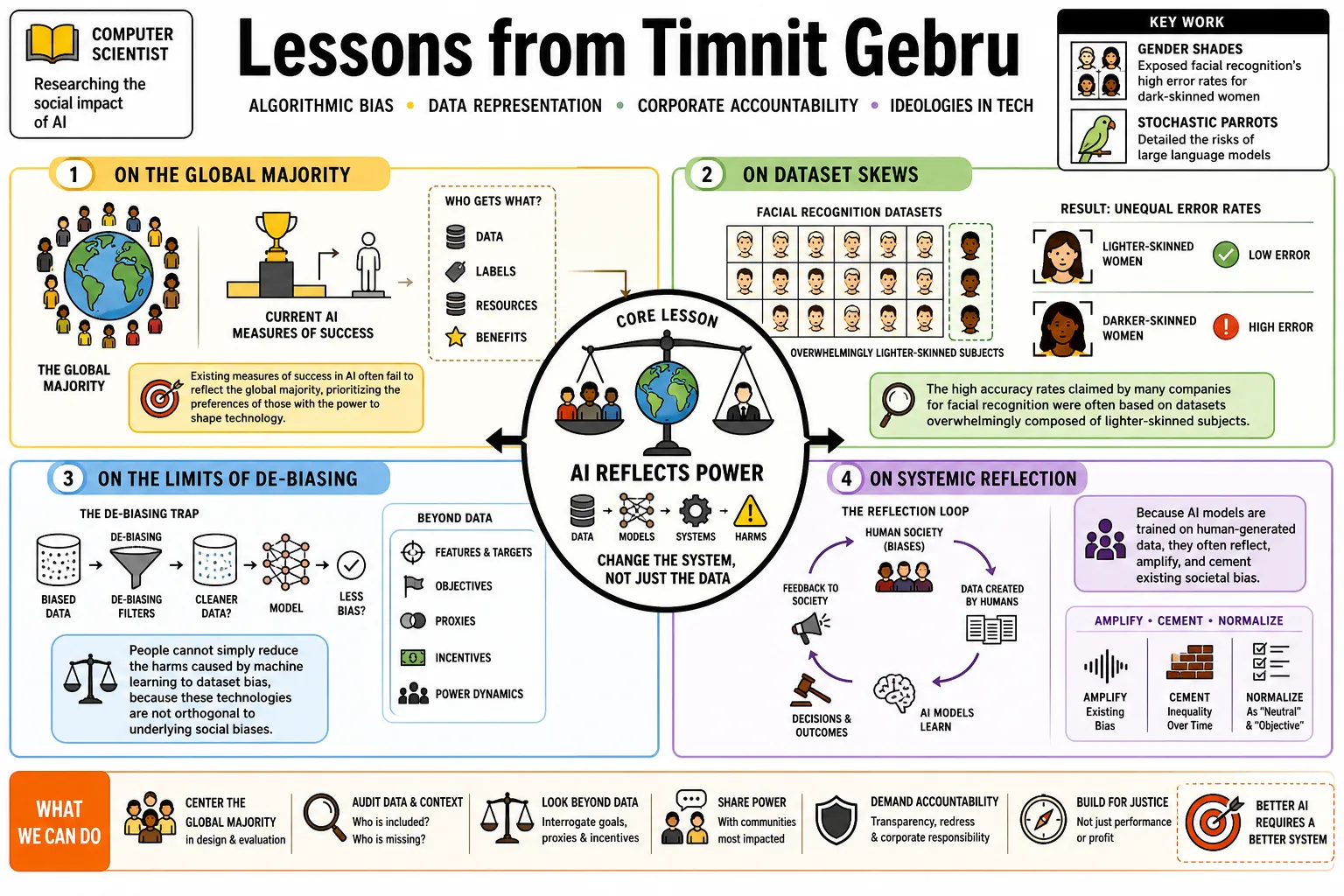
Lessons from Timnit Gebru
Computer scientist Timnit Gebru researches algorithmic bias and the social impact of artificial intelligence. She co-authored "Gender Shades," exposing facial recognition's high error rates for dark-skinned women, and "Stochastic Parrots," detailing the risks of large language models. This collection documents her statements on data representation, corporate accountability, and the ideologies driving modern tech.
Part 1: Algorithmic Bias and Representation
- On The Global Majority: "Existing measures of success in AI often fail to reflect the global majority, prioritizing the preferences of those with the power to shape technology." — Source: [MIT]
- On Dataset Skews: "The high accuracy rates claimed by many companies for facial recognition were often based on datasets overwhelmingly composed of lighter-skinned subjects." — Source: [Proceedings of Machine Learning Research]
- On The Limits of De-biasing: "People cannot simply reduce the harms caused by machine learning to dataset bias, because these technologies are not orthogonal to underlying social biases." — Source: [Y Combinator]
- On Systemic Reflection: "Because AI models are trained on human-generated data, they often reflect, amplify, and cement existing societal biases rather than correcting them." — Source: [The Gray Area: Is ethical AI possible?]
- On Intersectional Disparities: "In facial analysis, error rates for lighter-skinned men are often below 1%, while error rates for darker-skinned women can soar as high as 34.7%." — Source: [Fast.ai]
- On The Coded Gaze: "The priorities, preferences, and sometimes prejudices of those in power become embedded directly into algorithmic systems." — Source: [APA Online]
- On Datasheets for Datasets: "The field needs standardized, rigorous ways of identifying and documenting dataset skews to prevent harm before systems are deployed." — Source: [Cornell University]
- On Representation: "It is impossible to build technology that serves everyone if the people building it do not represent the communities it impacts." — Source: [Relativity]
- On Technical Fixes: "Technical solutions to bias are insufficient if the underlying institutions that create and deploy the AI are not fundamentally reformed." — Source: [NYU]
- On Measuring Success: "We must challenge what industry considers a successful AI model, particularly when that success only applies to a narrow demographic slice of the population." — Source: [Stanford University]
Part 2: The Myth of Objective AI
- On Sentience Claims: "A lot of people want to imagine the machine is sentient and that there are no humans involved. That's part of a concerted effort to hide what's going on." — Source: [Time]
- On Hiding Human Labor: "Framing AI as magical or objective serves to erase the massive amounts of human labor—often underpaid and precarious—required to train and maintain these systems." — Source: [Tech Won't Save Us]
- On Technological Determinism: "AI development is a series of active human choices, not an inevitable technological progression that we are powerless to shape." — Source: [The Guardian]
- On Agency: "It’s humans who decide whether all this should be done or not. We should remember that we have the agency to do that." — Source: [Wikiquote]
- On Unquestioned Innovation: "We must question the fundamental premise of AI tools—specifically, whether a particular technology should be developed or deployed at all, rather than assuming all innovation is inherently beneficial." — Source: [NYU]
- On AI as a Product: "AI isn’t a standard IT product; it is a complex socio-technical system that requires oversight and caution rather than blind faith." — Source: [Cybernews]
- On Naturalized Inequality: "This hasn't happened with other technologies in the past, so why would we expect this would happen in the future?" — Source: [Digital Democracies]
- On Problem Solving: "Before implementing AI, leadership should always ask: What's the simplest solution to our problem, and why is AI better than that?" — Source: [Daring to DAIR: Distributed AI Research with Timnit Gebru]
- On The Illusion of Neutrality: "Algorithms are not neutral arbiters of truth; they reflect the institutional goals and subjective decisions of their creators." — Source: [AI Weekly]
Part 3: The Dangers of "Stochastic Parrots"
- On Stochastic Parrots: "Contrary to how it may seem when we observe its output, a language model is a system for haphazardly stitching together sequences of linguistic forms it has observed in its vast training data." — Source: [Quote Investigator]
- On Lack of Meaning: "These models generate text according to probabilistic information about how words combine, but they do so without any reference to actual meaning." — Source: [Wikipedia]
- On Amplifying Bias: "Large language models risk amplifying the biases present in their massive, uncurated training datasets, reinforcing historical inequities at scale." — Source: [Substack]
- On Environmental Impact: "The race to build ever-larger models ignores the severe environmental cost and carbon footprint required to train and maintain them." — Source: [Public Infrastructure]
- On Misleading Coherence: "There is a profound danger in systems that mimic human coherence without possessing actual knowledge, as they can easily mislead users." — Source: [E-Discovery Team]
- On the Rush to Deploy: "The industry's rush to deploy AI without sufficient ethical safeguards creates a tension between profit motives and the public good." — Source: [Vertex AI Search]
- On Naming the Phenomenon: "I think the 'stochastic parrots' phrase is a good one, right? When you see a parrot repeating what humans are saying, you don't assume it understands." — Source: [Public Infrastructure]
- On Uncurated Data: "Feeding models vast amounts of internet text without careful curation ensures that they will inevitably regurgitate the internet's worst elements." — Source: [Digg]
- On Research Retraction: "The controversy over the stochastic parrots paper demonstrated how corporate interests can suppress critical academic inquiry when it threatens their product roadmap." — Source: [The Guardian]
- On the Illusion of Understanding: "When language models output seemingly intelligent text, humans naturally project meaning onto it, masking the model's fundamental lack of comprehension." — Source: [Quote Investigator]
Part 4: Big Tech and Profit Motives
- On The Gold Rush: "It feels like a gold rush. In fact, it is a gold rush. And a lot of the people who are making money are not the people actually in the midst of it." — Source: [The Guardian]
- On Corporate Self-Regulation: "I think it made it really clear that unless there is external pressure to do something different, companies are not just going to self-regulate." — Source: [The Guardian]
- On The Need for External Pressure: "We need regulation and we need something better than just a profit motive to guide the development of artificial intelligence." — Source: [The Guardian]
- On Dissent in Big Tech: "Big tech is consumed by a drive to develop AI and they don’t want someone like me who’s going to get in their way." — Source: [The Guardian]
- On Corporate Priorities: "The primary incentive for major technology companies is to maximize shareholder value, which frequently conflicts with the time and resources required for ethical AI research." — Source: [Stanford University]
- On Suppressing Criticism: "When companies silence their internal ethics teams, they send a clear message that critical research is only welcome when it aligns with public relations." — Source: [Time]
- On Concentration of Power: "The current trajectory of AI development centralizes immense power within a handful of Silicon Valley corporations, marginalizing alternative voices." — Source: [Daring to DAIR: Distributed AI Research with Timnit Gebru]
- On Public Accountability: "Without robust legal and regulatory frameworks, the public is forced to rely on the goodwill of corporations that are fundamentally designed to seek profit." — Source: [Medium]
- On the Firing Aftermath: "I was not in thinking mode. I was just in action mode, like: 'I need a lawyer and I need to get my story out; I wonder what’s happening to other people?'" — Source: [The Guardian]
Part 5: The "TESCREAL" Ideologies
- On the TESCREAL Bundle: "TESCREAL ideologies—from Transhumanism to Longtermism—form an interconnected, overlapping group that heavily influences Silicon Valley's vision of the future." — Source: [Truthdig]
- On Eugenics Roots: "The normative framework that motivates much of the goal to build AGI is rooted in the Anglo-American eugenics tradition of the twentieth century." — Source: [DAIR Institute]
- On Discriminatory Attitudes: "Many of the very same discriminatory attitudes that animated eugenicists in the past—racism, xenophobia, classism, ableism, and sexism—remain widespread within the movement to build AGI." — Source: [First Monday]
- On Distracting from Real Harm: "When someone talks about the 'existential risk' posed by artificial general intelligence, look under the hood. It is often a distraction from the immediate harms of algorithmic bias and labor exploitation." — Source: [DAIR Institute]
- On Ideological Influence: "It's really important for people to understand what this bundle of ideologies is, because it's become so hugely influential, and is shaping our world right now." — Source: [Truthout]
- On Effective Altruism: "Silicon Valley EA types are convincing themselves that the way in which they're exploiting people and causing harm is the best possible thing they can be doing in the world." — Source: [Effective Altruism Org]
- On Ineffective Altruism: "Some of my collaborators had the idea of creating an 'ineffective altruism' movement. Where one works on boring useless things like, I dunno, poverty. All this would be funny if this were a fringe thing." — Source: [Join Reboot]
- On Power Seeking: "These utopian ideologies often operate as power-seeking behavior dressed up as altruism, prioritizing a hypothetical distant future over marginalized groups living in the present." — Source: [Johannes Kleske]
- On Merging with Institutions: "I guess it was only a matter of time when the religion of effective altruism, worshipping so-called artificial general intelligence, merged with entrenched religious institutions." — Source: [Bluesky]
Part 6: Diversity and Institutional Racism
- On Being the Only One: "I grew tired of being the only Black person in a large pool of engineers. Researchers from marginalized backgrounds have to take a stand for our own people." — Source: [Infinite Family]
- On Building Support Networks: "I’ve learned that we need to have a network, we need to stand up for each other in order to survive in spaces that weren't built for us." — Source: [Sage Journals]
- On Creating Islands of Safety: "I wanted some amount of autonomy, some amount of ability to create a space for people in marginalized groups—an island of safety where our work could thrive." — Source: [Sage Journals]
- On the Message Sent by Firings: "Young women of color, I want them to know that these moments are necessary. What's painful to me is the message that this sends: if this is happening to me, what's happening to other people?" — Source: [Medium]
- On Structural Barriers: "We can talk about the ethics and fairness of AI all we want, but if our institutions don't allow for this kind of work to take place, then it won't." — Source: [Stanford University]
- On Exhaustion: "The constant battle to justify the importance of diversity and ethical oversight to leadership takes an immense toll on researchers of color within corporate environments." — Source: [Scribd]
- On Performative Diversity: "Companies frequently use diversity initiatives as public relations tools while simultaneously dismissing or penalizing the actual substantive work produced by Black researchers." — Source: [Engadget]
- On the Burden of Proof: "Marginalized researchers are routinely subjected to higher burdens of proof and harsher scrutiny when publishing critical work compared to their peers." — Source: [Washington Post]
- On Institutional Change: "At the end of the day, achieving equitable technology requires deep institutional and structural change, not merely token representation on engineering teams." — Source: [Stanford University]
Part 7: Labor Exploitation and Power Structures
- On Invisible Labor: "The creation of AI relies on an invisible underclass of data annotators and content moderators who are chronically underpaid and exposed to traumatic material." — Source: [Time]
- On the Global South: "AI systems are typically designed by and for a narrow demographic in the Global North, while disproportionately exploiting labor and extracting data from the Global South." — Source: [Public Infrastructure]
- On Hiding the Humans: "Portraying AI as autonomous and magical intentionally obscures the massive human labor infrastructure that actually makes these systems function." — Source: [Tech Won't Save Us]
- On Resource Extraction: "The current model of AI development closely mirrors historical resource extraction, taking data without consent and returning little value to the communities that generated it." — Source: [Racism and Technology Center]
- On Concentrating Wealth: "The financial gains from the AI 'gold rush' are overwhelmingly captured by executives and investors, not the workers performing the foundational data labor." — Source: [The Guardian]
- On Decentralizing Expertise: "We must actively work to fracture the concentration of power in Silicon Valley and build instead a decentralized and local base of technological expertise." — Source: [Stanford University]
- On Surveillance and Control: "We must oppose a technological future that is used for surveillance, warfare, and the centralization of power by Silicon Valley monopolies." — Source: [Dr. Timnit Gebru on the Smoke and Mirrors of AI Hype]
- On Rejecting Inevitability: "There is nothing inevitable about the current exploitative structure of the tech industry; it is the result of deliberate business models that can and should be challenged." — Source: [Digital Democracies]
- On Empowering Workers: "Protecting the public from harmful AI requires protecting the rights, wages, and working conditions of the laborers who build and maintain these datasets." — Source: [Tech Won't Save Us]
Part 8: Building Alternatives and Community-Centered AI
- On Rethinking Institutions: "If we had the opportunity to pursue this work from scratch, how would we want to build these institutions to ensure they actually serve the public?" — Source: [Stanford University]
- On Community Benefit: "If we want AI that genuinely benefits our communities, then we must critically ask what kind of processes and methodologies we should follow to get there." — Source: [Stanford University]
- On the Mission of DAIR: "The goal of independent research is to foster a technological future that serves our communities instead of one that centralizes power." — Source: [DAIR founder Timnit Gebru on potential harms of AI]
- On Independent Research: "For ethical AI research to truly flourish, it requires structural independence completely separated from the influence and financial incentives of large tech corporations." — Source: [Cybernews]
- On Centering the Margins: "We must encourage tech companies to consider all perspectives—especially those from marginalized groups—when designing products and services that shape society." — Source: [Quartz]
- On Local Expertise: "True technological equity means empowering local communities to govern and develop their own tools, rather than having solutions imposed from the outside." — Source: [Stanford University]
- On Reframing Innovation: "Innovation should be measured not by the scale of the model or the processing power used, but by the tangible positive impact the technology has on vulnerable populations." — Source: [DAIR Institute]
- On Collective Action: "Addressing systemic technological harms requires collective organizing and solidarity, rather than relying on the isolated efforts of individual researchers." — Source: [Public Infrastructure]
- On the Value of Slowness: "Building ethical, community-rooted technology requires moving slowly, gathering consensus, and respecting the time it takes to understand potential downstream consequences." — Source: [DAIR Institute]
- On a Better Future: "A different tech ecosystem is possible—one where human dignity and community well-being are prioritized over the relentless pursuit of scale and artificial general intelligence." — Source: [Truthout]