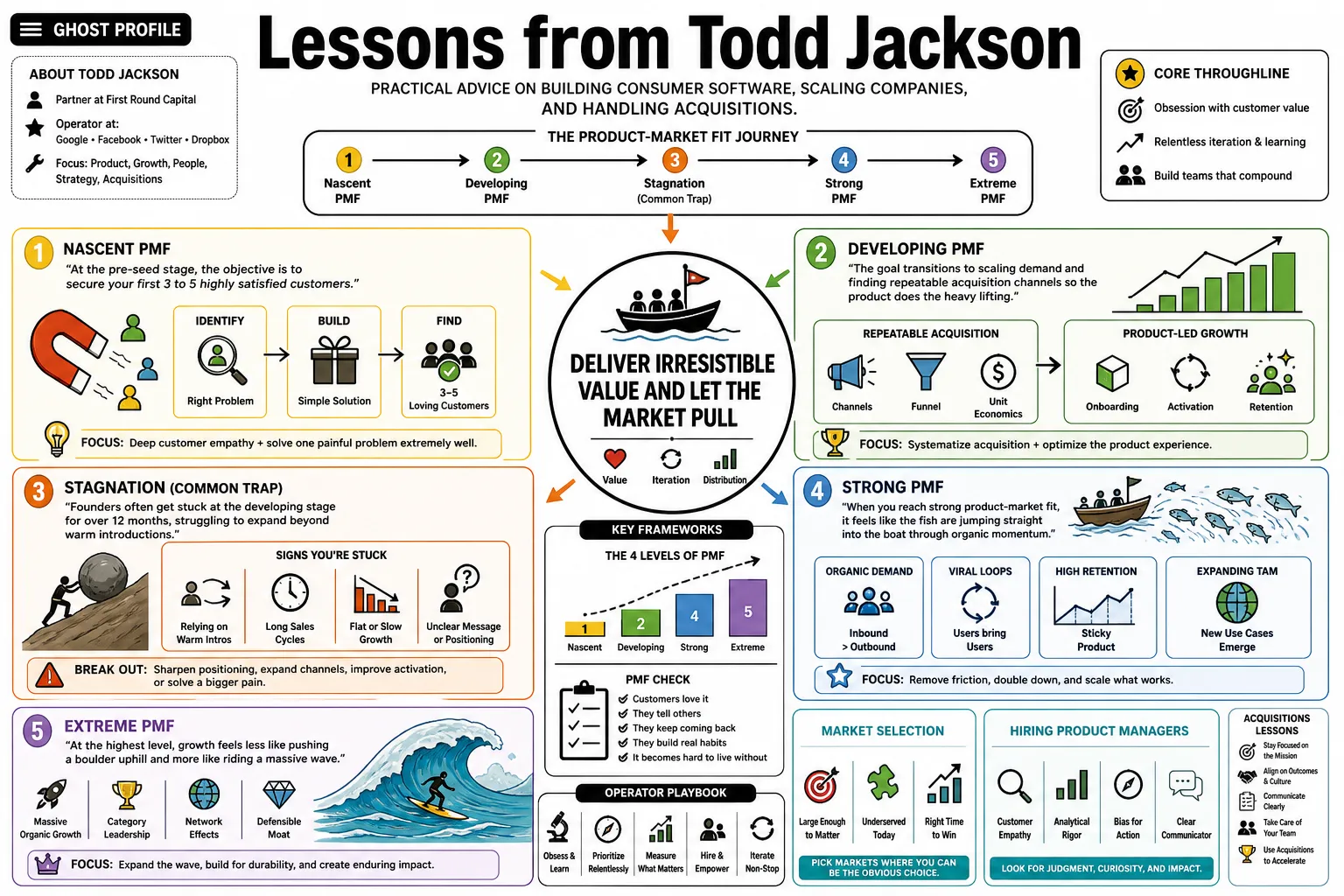
Lessons from Todd Jackson
Todd Jackson is a partner at First Round Capital who previously led product teams at Google, Facebook, Twitter, and Dropbox. Drawing from his time as an operator, this profile collects his practical advice on building consumer software, scaling companies, and handling acquisitions. It also outlines his frameworks for hiring product managers and defining the four levels of product-market fit.
Part 1: The Product-Market Fit Journey
- On Nascent PMF: "At the pre-seed stage, the objective is to secure your first 3 to 5 highly satisfied customers." — Source: [Lenny's Newsletter]
- On Developing PMF: "The goal transitions to scaling demand and finding repeatable acquisition channels so the product does the heavy lifting." — Source: [Lenny's Newsletter]
- On Stagnation: "Founders often get stuck at the developing stage for over 12 months, struggling to expand beyond warm introductions." — Source: [Lenny's Newsletter]
- On Strong PMF: "When you reach strong product-market fit, it feels like the fish are jumping straight into the boat through organic momentum." — Source: [Lenny's Newsletter]
- On Extreme PMF: "At the highest level, growth feels less like pushing a boulder uphill and more like riding a massive wave." — Source: [Lenny's Newsletter]
- On Market Selection: "The most important choice you make is the one before you get started: identifying the right market to go after." — Source: [First Round Review]
- On False Starts: "Many product managers turned founders dive straight into execution mode before validating if the market or problem is big enough." — Source: [First Round Review]
- On Avoiding Traps: "Don’t mistake the excitement of building a prototype for actual validation of the customer’s core problem." — Source: [First Round Review]
- On Assessing Demand: "You’ll know you understand the customer problem enough when you can predict 75% of what they will tell you." — Source: [First Round Review]
- On PMF Milestones: "Reaching a state of extreme product-market fit typically requires a mature organization with over 100 people and clear metrics." — Source: [Lenny's Newsletter]
Part 2: The Four Ps of Problem Solving
- On Troubleshooting: "When your startup is stuck, you must evaluate the Four Ps: Persona, Problem, Promise, and Product." — Source: [Lenny's Newsletter]
- On Persona: "Are you genuinely targeting the right customer, or are you forcing a solution onto a demographic that doesn't care?" — Source: [Lenny's Newsletter]
- On Problem: "You must ask yourself if the problem you are addressing is actually painful and significant enough to demand a solution." — Source: [Lenny's Newsletter]
- On Promise: "Your value proposition and marketing message must be clear and compelling enough to attract your target persona." — Source: [Lenny's Newsletter]
- On Product: "Your solution must effectively and reliably deliver on the promise you've made to the market." — Source: [Lenny's Newsletter]
- On Iteration: "By constantly iterating on the Four Ps, founders can identify which component is failing and pivot accordingly." — Source: [Lenny's Newsletter]
- On Alignment: "A misalignment between your promise and your product is a fast track to churning your early adopters." — Source: [Lenny's Newsletter]
- On Market Messaging: "If the product works but growth is stagnant, your promise or persona definition is likely the broken link." — Source: [Lenny's Newsletter]
- On Diagnostic Frameworks: "The Four Ps act as a diagnostic tool to move companies systematically from early experimentation to category leadership." — Source: [Lenny's Newsletter]
Part 3: Validating Startup Ideas
- On Functional Needs: "Does the idea address a clear functional need? This is usually the reason users will initially try your product." — Source: [First Round Review]
- On Emotional Needs: "Does it address an emotional need? This is why users will tell others about it, unlocking organic viral growth." — Source: [First Round Review]
- On Customer Insight: "Customers generally won't name their emotional needs; you have to probe on what they feel and translate that into a product." — Source: [First Round Review]
- On Market Size: "Target a billion-plus market. Ensure it is either currently large and underserved, or has the potential to become massive." — Source: [First Round Review]
- On Breakthrough UX: "Aim for a novel user experience that feels like magic; it is not strictly necessary, but it provides a massive advantage." — Source: [First Round Review]
- On Avoidable Mistakes: "Failing to map a high-level problem to the specific functional and emotional needs of customers leads to building nice-to-have products." — Source: [First Round Review]
- On The Recipe for Success: "Meeting functional and emotional needs in a massive market with a breakthrough UI is the ultimate recipe for a great company." — Source: [First Round Review]
- On Early Validation: "Even with a strong thesis, you must put in the legwork to deeply understand your customers by talking to hundreds of them." — Source: [First Round Review]
- On Beta Testing: "Iterating with a core beta community based on emotional and functional feedback can fuel massive organic word-of-mouth growth." — Source: [First Round Review]
- On Idea Attrition: "Your first or second idea might not be the winner. Be willing to scrap concepts if the market is too difficult to penetrate." — Source: [First Round Review]
Part 4: Product Quality and Discipline
- On Building Discipline: "Building high-quality products takes an incredible amount of behind-the-scenes discipline, especially as your team grows." — Source: [First Round Review]
- On Feature Bloat: "As the feature set expands, strategy drifts and the user experience degrades unless you aggressively maintain focus." — Source: [First Round Review]
- On Core Qualities: "Identify and obsessively focus on the two to three most important qualities of your product, such as speed, simplicity, and power." — Source: [First Round Review]
- On Simplicity: "A rigid point system for fonts and colors can force simplicity and prevent an interface from becoming too busy." — Source: [First Round Review]
- On Quality Control: "The best teams won't tolerate half-baked features; hold projects at the 11th hour if they compromise the core experience." — Source: [First Round Review]
- On Performance: "Speed is a feature. If internal development processes erode performance, you must be willing to halt everything to fix it." — Source: [First Round Review]
- On Feature Freezes: "A complete feature freeze can be a powerful, albeit extreme, way to get an entire organization rowing in the same direction." — Source: [First Round Review]
- On Technical Debt: "The tragedy of the commons happens when growing teams add features that slowly bog down the application's overall performance." — Source: [First Round Review]
- On UX Protection: "Every feature launch requires a staunch protector of the user experience; if you don't have one, that becomes your job." — Source: [First Round Review]
- On Rigorous Reviews: "UI review meetings should be rigorous, inspecting every page and pixel to ensure the product remains lightweight." — Source: [First Round Review]
Part 5: Hiring and Vetting Product Managers
- On Role Flexibility: "The PM role needs to be purposely flexible, sitting at the center of UX, technology, and business." — Source: [First Round Review]
- On The PM Persona: "There is no perfect PM; you must define the specific PM persona your company needs based on its current stage." — Source: [First Round Review]
- On PM Responsibilities: "A PM is essentially the CEO of their product, which means they must do a diverse set of things exceptionally well." — Source: [First Round Review]
- On Assessing Talent: "Look for candidates who can articulate what a winning product looks like, rally the team behind it, and iterate until it's right." — Source: [First Round Review]
- On Interviewing: "Avoid abstract brain teasers. Structure interviews to reveal a candidate's true potential and their ability to handle hard questions." — Source: [First Round Review]
- On Closing Candidates: "Closing a PM candidate is a final sales pitch where you must tap into their core reward centers." — Source: [First Round Review]
- On PM Motivation: "More than other disciplines, product managers tend to care most deeply about impact and autonomy." — Source: [First Round Review]
- On Developing PMs: "A product leader's responsibility extends beyond hiring to actively growing and mentoring their product managers." — Source: [First Round Review]
- On Cultural Fit: "High-quality PMs require a cultural alignment where they are trusted to make the call and drive the product vision." — Source: [First Round Review]
Part 6: Preparing for Acquisitions
- On Running a Process: "If you are considering an acquisition, run the process like fundraising: drive the timing and create competition." — Source: [First Round Review]
- On Managing Distractions: "Contain acquisition discussions to a tight, multi-week period so it doesn't distract the team from building." — Source: [First Round Review]
- On The Acquirer's Pitch: "Acquirers often pitch that you will drive their strategy, but be prepared for that narrative to shift." — Source: [First Round Review]
- On The Aftermath: "An acquisition sounds glamorous, but once acquired, your role is to work in service of the larger company." — Source: [First Round Review]
- On Shifting Priorities: "The strategy that went into the acquisition can change rapidly if the needs of the acquiring organization change." — Source: [First Round Review]
- On Team Separation: "Founding teams are often pulled in separate directions internally post-acquisition to solve different organizational problems." — Source: [First Round Review]
- On Making the Call: "Deciding to sell requires navigating the tension between a great outcome now and the regret of not going bigger." — Source: [First Round Review]
- On Board Alignment: "Lean on trusted investors and board members to help navigate the emotional and strategic complexities of selling." — Source: [First Round Review]
- On Long-Term Viability: "Selling can be the right choice if your startup's long-term viability is overly reliant on a platform owned by someone else." — Source: [First Round Review]
Part 7: Strategy and Scaling to IPO
- On The Pre-IPO Intensity: "The two to three years before an IPO are often more intense than being a early-stage founder." — Source: [First Round Review]
- On Losing Control: "As the company scales rapidly, you go from running things to things running you." — Source: [First Round Review]
- On Forecasting: "It is not enough to have a business model; public markets demand that you can predictably forecast your growth." — Source: [First Round Review]
- On Strategic Clarity: "You must deeply understand, refine, and articulate your product strategy and revenue model years before an IPO." — Source: [First Round Review]
- On Making Choices: "Strategy is not mystical; it is a simple set of key choices regarding where to play and how to win." — Source: [First Round Review]
- On Tough Trade-offs: "Scaling often requires shutting down popular but stagnant projects to focus entirely on the core business engine." — Source: [First Round Review]
- On Go-To-Market Alignment: "Your product strategy must tie clearly to your go-to-market playbook to create a highly efficient, predictable business." — Source: [First Round Review]
- On Internal Capabilities: "You must build management systems and organize your teams around the key pillars of your strategy." — Source: [First Round Review]
- On Turning the Ship: "Strategic pivots are incredibly difficult to pull off in a thousand-person company, which is why early alignment is critical." — Source: [First Round Review]
Part 8: The Mindset of an Investor
- On Shifting Roles: "Transitioning from an operator to an investor requires a dramatic mindset shift from playing on the field to coaching in the corner." — Source: [First Round Review]
- On Firm Selection: "When choosing to join a VC firm, seek out partners who are years ahead in their careers to short-circuit your learning cycle." — Source: [First Round Review]
- On Seed Stage Value: "Founders often discount the value of a seed-stage firm that can help prepare them for a true Series A process." — Source: [First Round Review]
- On Unwavering Support: "The best investors provide their unvarnished opinion, but always back it up with unwavering support." — Source: [First Round Review]
- On Founder Empathy: "Having first-hand knowledge of rough rides and shifting priorities allows an investor to coach founders with genuine empathy." — Source: [First Round Review]
- On Operational Support: "A strong VC operating team can drastically alter a startup's trajectory by assisting with marketing, positioning, and community building." — Source: [First Round Review]
- On Values Alignment: "Whether you are a founder raising money or an operator joining a fund, never compromise on a misalignment of values." — Source: [First Round Review]
- On Coaching: "Advising and angel investing are critical stepping stones to understanding the nuances of the coaching role." — Source: [First Round Review]
- On The Mentor Advantage: "At every career stage, you develop faster and learn more when you are surrounded by great mentors and teammates." — Source: [First Round Review]