Lessons from Tom Digan
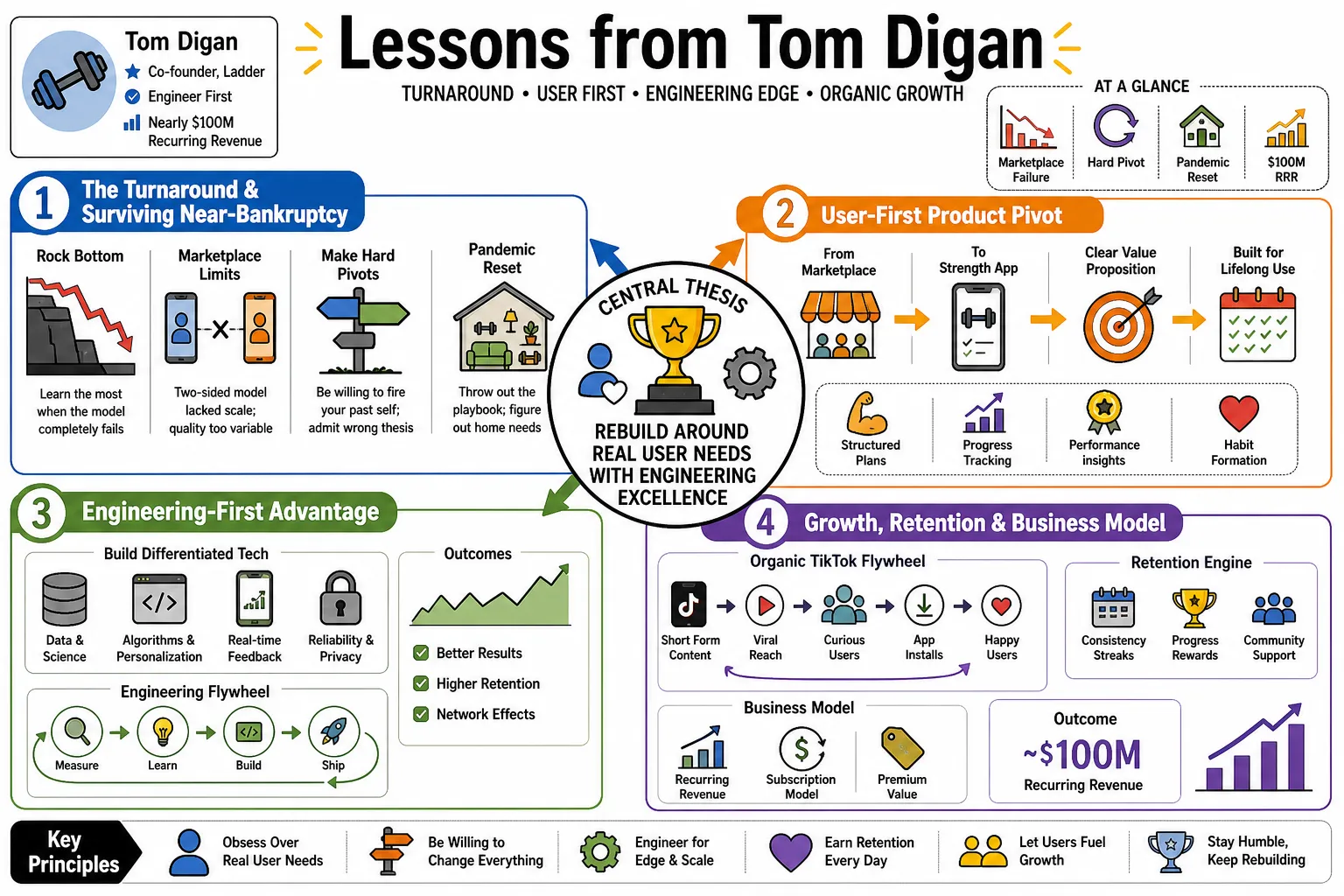
Tom Digan co-founded Ladder, turning a failing fitness marketplace into an engineering-first strength-training app. He pulled the company back from near-bankruptcy, relying on user reviews and organic TikTok growth to reach nearly $100 million in recurring revenue. This profile details his approach to product turnarounds, user retention, and building a modern fitness business.
Part 1: The Turnaround and Surviving Near-Bankruptcy
- On hitting rock bottom: "You learn the most about your business when the initial model completely fails and you have to rebuild from zero with the remaining cash." — Source: Invest Like the Best: Episode 454
- On the marketplace model: "We realized early on that the two-sided marketplace for fitness coaching lacked scale because the quality of the interaction was too variable." — Source: Invest Like the Best: Episode 454
- On making hard pivots: "Pivoting requires being willing to fire your past self and admit the original thesis was wrong." — Source: Invest Like the Best: Episode 454
- On surviving the pandemic: "When everything shut down, we had to throw out the playbook and figure out what people actually needed in their living rooms instead of what we wanted to sell them." — Source: Invest Like the Best: Episode 454
- On dealing with debt: "Managing corporate debt early on forces a level of financial discipline that most startups never have to learn until it is too late." — Source: Invest Like the Best: Episode 454
- On founder resilience: "The difference between bankruptcy and a turnaround is often the stubborn refusal to let the company die while you still have a few months of runway." — Source: Invest Like the Best: Episode 454
- On resetting the team: "A full reset sometimes requires changing the leadership structure to match the new reality of what the business actually is." — Source: Invest Like the Best: Episode 454
- On ignoring the noise: "When things are going badly, you have to stop reading industry news and start reading your own customer support tickets." — Source: Invest Like the Best: Episode 454
- On the value of constraints: "Near-bankruptcy is the ultimate constraint; it clarifies exactly which features are essential and which are vanity projects." — Source: Invest Like the Best: Episode 454
- On timing: "Sometimes you are building the right thing at the wrong time, and surviving long enough for the market to catch up is the entire job." — Source: Invest Like the Best: Episode 454
Part 2: Product-Market Fit and Customer Obsession
- On qualitative data: "We found product-market fit by manually reading thousands of App Store reviews to see exactly where users were frustrated." — Source: Invest Like the Best: Episode 454
- On defining the core user: "If you try to build a fitness app for everyone, you build a fitness app for no one. You have to pick a specific person and solve their exact problem." — Source: Ladder Founder Interviews
- On empirical design: "Being relentlessly empirical means you never guess what the user wants; you ship small tests, watch the behavior, and scale what actually sticks." — Source: Invest Like the Best: Episode 454
- On user onboarding: "The first three days of a user's experience dictate whether they will still be paying you six months later. You have to front-load the value." — Source: Ladder Founder Interviews
- On identifying friction: "Friction in a fitness app is the mental load required to figure out what workout to do next." — Source: Invest Like the Best: Episode 454
- On customer feedback loops: "The best feature ideas come from users trying to hack your product to do something it was never designed to do." — Source: Invest Like the Best: Episode 454
- On retention over acquisition: "Acquiring a user is a marketing problem. Keeping a user is a product problem, and it is the only one that actually matters for long-term survival." — Source: Invest Like the Best: Episode 454
- On the 'aha' moment: "In fitness, the realization happens when the user notices they did not have to plan their workout, they just had to show up and execute." — Source: Ladder Founder Interviews
- On iterating: "We launched a broken product and fixed it iteratively based on what people complained about the loudest." — Source: Invest Like the Best: Episode 454
- On feature bloat: "Every new feature you add dilutes the core value proposition unless it directly contributes to the main reason the user opened the app today." — Source: Invest Like the Best: Episode 454
Part 3: Growth, Marketing, and TikTok Strategy
- On finding new channels: "We built our growth engine on TikTok precisely because we had no background in traditional performance marketing and had to figure out what worked organically." — Source: Invest Like the Best: Episode 454
- On organic growth: "If your product is highly visual and result-oriented, the users will do the marketing for you if you give them the right tools to share their progress." — Source: Invest Like the Best: Episode 454
- On platform dynamics: "TikTok changed the game for us because it rewarded authentic, lo-fi content over highly polished, expensive ads." — Source: Invest Like the Best: Episode 454
- On CAC (Customer Acquisition Cost): "When you figure out organic social, your blended acquisition costs drop to a point where you can actually afford to invest heavily back into the product." — Source: Invest Like the Best: Episode 454
- On creator partnerships: "Do not hire influencers to read a script; partner with creators who actually use the product and let them explain it in their own native format." — Source: Invest Like the Best: Episode 454
- On going viral: "Virality is a byproduct of making something that genuinely solves a painful problem and is easy to explain in under fifteen seconds." — Source: Ladder Founder Interviews
- On marketing authenticity: "People can spot a traditional ad instantly now. The best marketing feels like a recommendation from a friend who discovered something great." — Source: Invest Like the Best: Episode 454
- On community building: "Growth involves connecting new users to the existing community so they feel accountable." — Source: Ladder Founder Interviews
- On testing ad creative: "We learned to treat ad creative like software: ship quickly, test variations constantly, and double down on the data rather than personal preference." — Source: Invest Like the Best: Episode 454
Part 4: The Creator Economy and Fitness Coaching
- On scaling coaches: "The traditional personal training model is fundamentally unscalable. The creator economy allows one great coach to impact tens of thousands of people simultaneously." — Source: Invest Like the Best: Episode 454
- On coach curation: "We want the top one percent who know how to program effectively and build a community around their methodology." — Source: Invest Like the Best: Episode 454
- On aligning incentives: "When you build tools that help creators monetize their existing audience effectively, the business grows itself." — Source: Invest Like the Best: Episode 454
- On the value of personality: "People come for the workout program, but they stay for the personality and the relationship they feel they have with the coach." — Source: Ladder Founder Interviews
- On digital vs in-person: "Digital coaching offers ninety percent of the value at a fraction of the cost." — Source: Invest Like the Best: Episode 454
- On empowering creators: "Our job is to abstract away the tech and the billing so the coach can focus entirely on programming." — Source: Invest Like the Best: Episode 454
- On program design: "A great coach knows that consistency beats intensity. The programs that perform best are the ones people can stick to for fifty-two weeks a year." — Source: Ben Greenfield Life Podcast
- On community interaction: "The parasocial relationship in fitness is incredibly powerful. A simple audio note or comment from the coach can keep a user engaged for another three months." — Source: Invest Like the Best: Episode 454
- On creator burnout: "If you do not build software that protects the creator's time, they will burn out managing their own community. The platform has to do the heavy lifting." — Source: Invest Like the Best: Episode 454
Part 5: Engineering-First Culture and App Building
- On technical debt: "You have to know when it is acceptable to write messy code to survive and when you need to stop and rebuild the foundation for scale." — Source: Invest Like the Best: Episode 454
- On engineering focus: "Transitioning to an engineering-first company meant that product decisions were driven by what was technically possible and scalable, rather than what sounded good in a marketing meeting." — Source: Invest Like the Best: Episode 454
- On performance: "In a fitness app, latency is a killer. If the video of the next exercise takes three seconds to load, the user loses their momentum and gets frustrated." — Source: Ladder Founder Interviews
- On prioritizing features: "If a feature did not directly improve the daily workout experience or retention, it went to the bottom of the backlog." — Source: Invest Like the Best: Episode 454
- On building for mobile: "You have to design for a user who is sweaty, tired, and looking at their phone screen from three feet away on the gym floor." — Source: Ladder Founder Interviews
- On data infrastructure: "Building a data pipeline early on was painful but necessary; it allowed us to actually understand our cohort retention curves and fix the leaks." — Source: Invest Like the Best: Episode 454
- On team structure: "Small, autonomous engineering pods move faster than large, matrixed organizations. We kept the team lean on purpose." — Source: Invest Like the Best: Episode 454
- On the role of AI: "AI will change how workouts are personalized, but it will never replace the human motivation required to actually get someone off the couch." — Source: Invest Like the Best: Episode 454
- On shipping culture: "A culture of shipping means you prefer an imperfect feature in the hands of users today over a perfect feature in the sandbox next month." — Source: Invest Like the Best: Episode 454
Part 6: Fitness, Healthspan, and Training Philosophy
- On strength training: "Strength training is the foundation of longevity. Cardio is great, but muscle mass is what keeps you functional in your later decades." — Source: Ben Greenfield Life Podcast
- On progressive overload: "The biggest mistake people make in the gym is randomizing their workouts. You need progressive overload: doing the same movements and slowly increasing the stimulus." — Source: Ben Greenfield Life Podcast
- On the 'Boundless' approach: "Training for healthspan means balancing intensity with recovery. You cannot train like a twenty-year-old athlete forever without breaking down." — Source: Ben Greenfield Life Podcast
- On fitness as a lifestyle: "Fitness should be integrated into your daily routine like brushing your teeth, rather than a thirty-day challenge." — Source: Ben Greenfield Life Podcast
- On the impact of GLP-1s: "Weight loss drugs will change the market, but they will not build muscle or cardiovascular health. The need for structured training actually increases when people lose mass rapidly." — Source: Invest Like the Best: Episode 454
- On at-home fitness: "The home gym revolution normalized the idea that you can get a world-class workout without commuting to a facility." — Source: Ben Greenfield Life Podcast
- On recovery: "Most people overtrain and under-recover. The software has to account for rest days just as carefully as it programs the heavy lifting days." — Source: Ben Greenfield Life Podcast
- On simplicity: "The best fitness programs are deceptively simple. Complexity is usually a marketing tactic to sell something new." — Source: Ladder Founder Interviews
- On biohacking: "Before you worry about peptides and cold plunges, you need to make sure you are lifting weights three times a week and sleeping eight hours." — Source: Ben Greenfield Life Podcast
- On mental health: "The physical transformation is often secondary. The real value we provide is the mental clarity that comes from starting the day with a hard physical task." — Source: Ben Greenfield Life Podcast
Part 7: Habit Formation and Retention
- On daily engagement: "To build a successful fitness app, you are competing for the user's attention against social media, rather than other fitness apps. The habit loop has to be equally compelling." — Source: Invest Like the Best: Episode 454
- On removing decisions: "Decision fatigue is the enemy of consistency. The user should open the app and instantly know what to do, without having to make a single choice." — Source: Ladder Founder Interviews
- On streaks: "Visualizing progress through streaks and completed workouts provides the immediate dopamine hit necessary to sustain a long-term behavioral change." — Source: Invest Like the Best: Episode 454
- On accountability: "Users who interact with the community or their coach in the first week are exponentially more likely to stick around for the whole year." — Source: Ladder Founder Interviews
- On setting expectations: "If you promise quick results, you get high churn. If you promise a sustainable process, you get high retention." — Source: Invest Like the Best: Episode 454
- On the slump: "Everyone hits a wall around week three. The product needs automated interventions ready to catch the user when their initial motivation fades." — Source: Ladder Founder Interviews
- On gamification: "Gamification works when it is tied to actual physical effort. You cannot fake a heavy deadlift, so rewarding it feels earned." — Source: Ladder Founder Interviews
- On habit stacking: "We encourage users to tie their workout to an existing habit, like immediately after their morning coffee, so the app becomes a natural extension of their morning." — Source: Ben Greenfield Life Podcast
- On churn: "Churn is data. Every cancelled subscription tells you exactly where your product stopped providing enough value to justify the cost." — Source: Invest Like the Best: Episode 454
Part 8: Leadership, Resilience, and Scaling
- On co-founder dynamics: "A company survives hard times when the co-founders have complementary skills and absolute trust. If you are both panicking about the same thing, you are in trouble." — Source: Invest Like the Best: Episode 454
- On scaling a team: "The people who help you survive the chaotic early phase are not always the same people who can manage the structured expansion phase." — Source: Invest Like the Best: Episode 454
- On raising capital: "Raising money cannot solve your business model problems; it accelerates whatever trajectory you are currently on." — Source: Invest Like the Best: Episode 454
- On handling stress: "As a founder, you absorb the anxiety of the entire company. You have to find physical outlets to manage that stress, or it will destroy your decision-making." — Source: Ben Greenfield Life Podcast
- On continuous learning: "If you are not significantly better at your job every six months, you will become the bottleneck for your own company." — Source: Invest Like the Best: Episode 454
- On vision vs execution: "A great vision gets you early investors, but flawless execution is the only thing that gets you paying customers." — Source: Invest Like the Best: Episode 454
- On saying no: "As you scale, strategy becomes more about the hundred good ideas you say no to, rather than the one you say yes to." — Source: Invest Like the Best: Episode 454
- On unit economics: "You cannot fake unit economics forever. Eventually, it actually has to cost less to acquire a customer than they pay you." — Source: Invest Like the Best: Episode 454
- On the long game: "Building a category winner takes a decade. You have to pace yourself and build a company culture that can sustain a marathon instead of a series of sprints." — Source: Invest Like the Best: Episode 454