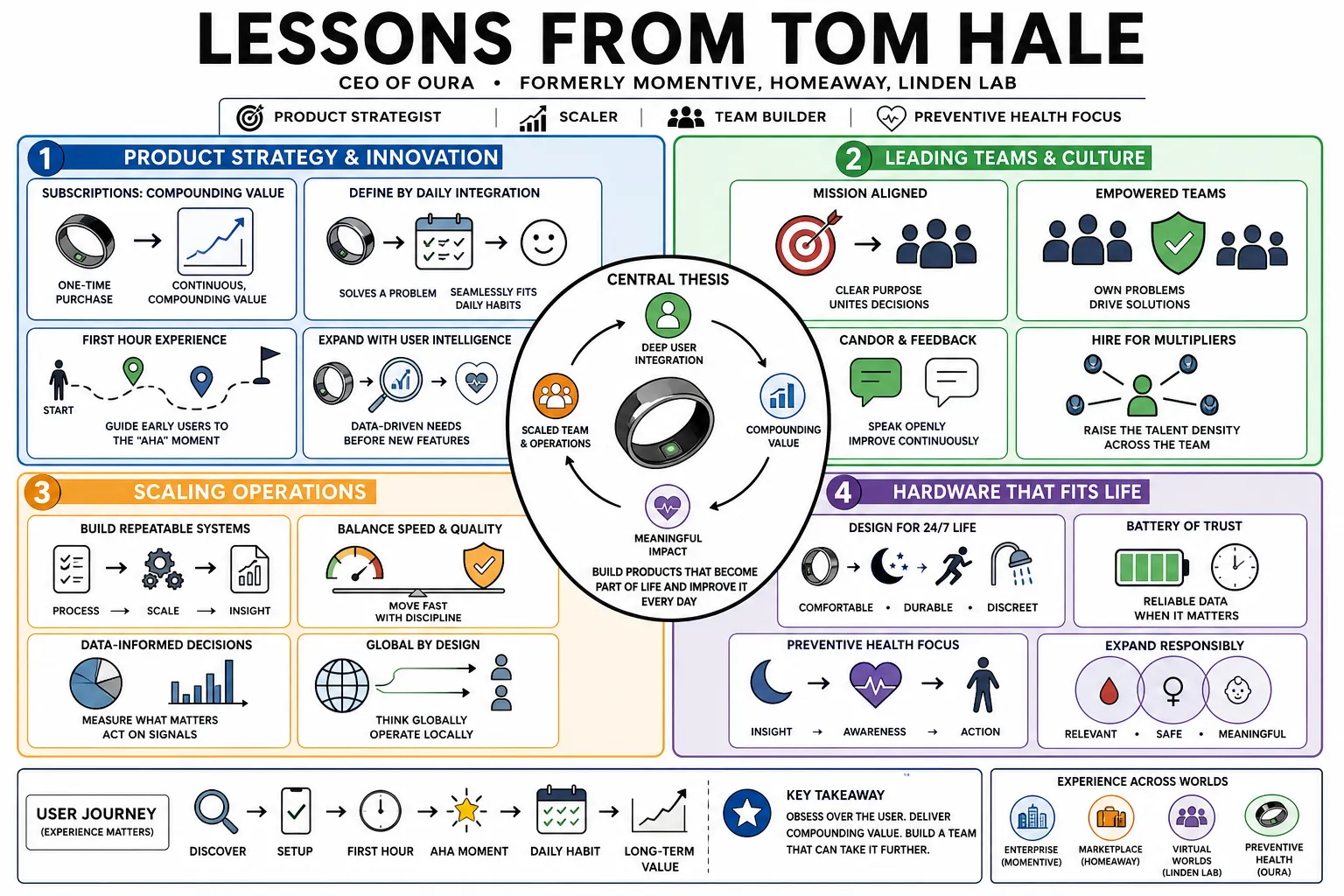
Lessons from Tom Hale
Tom Hale is the CEO of Oura and a former executive at Momentive, HomeAway, and Linden Lab. He is currently steering Oura into the preventive health space, drawing on his background in product strategy and scaling operations. This profile collects his perspectives on managing growing companies, leading teams, and building hardware that fits into daily routines.
Part 1: Product Strategy and Innovation
- On the shift to subscriptions: Fitt Insider frames Oura as a fast-growing wearable company built around a subscription business model, so the lesson is that the ring has to keep turning sleep, readiness, activity, and health data into recurring value after the hardware sale. — Reference: Fitt Insider interview with Tom Hale
- On defining the product: "A successful product does not just solve a problem; it integrates seamlessly into the daily habits of the user without creating friction." — Source: Masters of Scale
- On early adoption: "Early on, products like Second Life had to focus on the 'first hour' experience to bridge the gap between niche early adopters and mainstream social web users." — Source: Computerworld
- On expanding features: "Expanding a product's capability, such as moving from sleep tracking to blood glucose or fertility monitoring, must be driven by meaningful user intelligence, not just the novelty of the metric." — Source: Raconteur
- On platform openness: "Balancing an open platform with intellectual property rights and virtual currency management is a delicate but necessary tension for virtual economies." — Source: Avatar Planet
- On physical form factors: "In wearables, the form factor is everything. A ring succeeds where other devices fail because it respects the ergonomics of human biology and daily wear." — Source: The BoF Podcast
- On competing with giants: The Drum reports that Oura differentiates by treating the ring as both a health wearable and an object of personal expression, including index-finger placement, colorways, and jewelry-like partnerships instead of trying to imitate wrist-based devices. — Reference: The Drum interview with Tom Hale
- On interface evolution: "Rolling out major interface updates, like Viewer 2.0 at Linden Lab, requires making complex software feel as intuitive and familiar as a standard web browser." — Source: Modem World
- On product market fit: "You have to look past the hype of the technology itself and ask if the product is genuinely answering a persistent human need." — Source: Rent Responsibly
- On continuous improvement: "When a product sits at the intersection of software and physical hardware, the software must evolve fast enough to keep the hardware feeling fresh." — Source: Masters of Scale
Part 2: The Healthcare and Wellness Shift
- On preventive care: Jarrard says Hale's professional mission is to shift healthcare toward prevention through technology and AI, while connecting Oura's daily signals to broader healthcare transformation. — Reference: Jarrard interview with Tom Hale
- On redefining wellness: "The industry is moving away from the 'peak performance' gym-body culture toward a more inclusive, complete definition of longevity and health." — Source: The Drum
- On personalized intelligence: "The future of health technology lies in developing large physiological models that provide personalized health intelligence rather than generic advice." — Source: The BoF Podcast
- On women's health: The Drum reports that women's health became central to Oura's strategy because women have been under-researched and under-supported, with partnerships around fertility, cycle tracking, and life-stage health helping change the customer base. — Reference: The Drum interview with Tom Hale
- On chronic stress: "The pandemic highlighted the severe impact of chronic stress and poor sleep, which accelerated the mainstream adoption of health-tracking technology." — Source: Rent Responsibly
- On systemic change: "Making a dent in the healthcare system requires empowering the individual with their own data before they ever need to enter a clinic." — Source: The BoF Podcast
- On invisible health signals: "The body broadcasts physiological signals constantly; the challenge for health tech is capturing those signals accurately without interrupting the user's life." — Source: CNBC
- On proactive interventions: "The goal of health data is to prompt small, proactive behavioral changes today to avoid catastrophic health events a decade from now." — Source: Masters of Scale
- On medical validation: "For consumer health technology to be taken seriously, it must bridge the gap between consumer design and rigorous medical validation." — Source: Raconteur
- On longevity: "Longevity is not just about extending lifespan; it is about extending healthspan, which requires continuous tracking of baseline physiological metrics." — Source: The Drum
Part 3: Scaling and the "Messy Middle"
- On the messy middle: Fitt Insider says Hale discusses the realities of growing mid-size subscription businesses, which makes the scaling lesson less about slogans and more about keeping product, data, and operating cadence aligned as the company matures. — Reference: Fitt Insider interview with Tom Hale
- On maintaining proximity: "As an organization grows, a CEO must fight the tendency for the corporate structure to push leadership away from the customer's actual experience." — Source: Rent Responsibly
- On organizational debt: "Fast growth inevitably creates organizational debt, which must be systematically paid down before it paralyzes decision-making." — Source: Masters of Scale
- On strategic focus: "When a company scales rapidly, the hardest discipline is deciding what not to build, rather than what to build next." — Source: CNBC
- On cultural scaling: Jarrard highlights Hale's emphasis on human-centric leadership, accountability, and ambition, tying culture to how leaders behave while pursuing a mission in preventive health. — Reference: Jarrard interview with Tom Hale
- On scaling infrastructure: "Scaling a platform requires immense focus on backend stability and infrastructure to support an expanding user base without degradation in quality." — Source: Computerworld
- On internal communication: The Drum describes brand and marketing as central company strategy at Oura, which means internal alignment has to connect product, ecommerce, retail, partnerships, and category positioning rather than treating communication as a side function. — Reference: The Drum interview with Tom Hale
- On adapting to size: "What worked for the company at $10 million in revenue will actively harm the company at $100 million in revenue." — Source: Masters of Scale
- On market expansion: "Moving from early adopters to the mass market demands a fundamental shift in how the product is marketed and supported." — Source: Raconteur
Part 4: Leadership and Managing Teams
- On the nature of leadership: "Leadership, in so many ways, is not about the leader; it's about the follower." — Source: Raconteur
- On remote management: "I can't drop by your office, but you know what I can do, I can kind of lurk in your Slack chat, and if I see some really great work, I'm going to comment." — Source: Business Insider
- On humility: "Effective leadership requires leading with humility and care, focusing on enabling the team rather than dictating the outcome." — Source: WebAI
- On meaningful work: Jarrard presents Hale's Oura work as a mission to help move healthcare toward prevention, making the company's daily product work part of a larger health-system change. — Reference: Jarrard interview with Tom Hale
- On building teams: Jarrard emphasizes Hale's lessons on leadership, accountability, and ambition, pointing to team-building as a discipline of combining mission with clear standards for how people work together. — Reference: Jarrard interview with Tom Hale
- On listening: "You learn more from observing the friction points your team encounters than from reading their polished status reports." — Source: Business Insider
- On vulnerability: "Leaders must exhibit vulnerability, especially during difficult transitions, to build genuine trust within the organization." — Source: OpenView Partners
- On decision making: "The CEO’s role is not to make every decision, but to design the system that allows the right decisions to be made quickly by others." — Source: Masters of Scale
- On career transitions: "Moving across different industries, from virtual worlds to vacation rentals to health tech, requires a willingness to remain a student of the business." — Source: Jarrard Inc
Part 5: Data, AI, and Measurement
- On the value of measurement: "When you can measure something, you'll do a better job at understanding it." — Source: Rent Responsibly
- On data application: Fitt Insider describes Oura's ring as collecting biometric data and turning it into sleep, readiness, activity, and health insights, so the data only matters when it becomes usable guidance. — Reference: Fitt Insider interview with Tom Hale
- On AI in health: "AI's most significant contribution to healthcare will be its ability to synthesize disparate continuous data streams into a unified picture of individual health." — Source: The BoF Podcast
- On privacy: "When dealing with sensitive health data, maintaining absolute user privacy and data security is a basic requirement, not a feature." — Source: CNBC
- On predictive analytics: "We are moving from descriptive analytics that tell you how you slept, to predictive analytics that warn you when you are likely to get sick." — Source: Masters of Scale
- On user empowerment: The Heart of Healthcare frames modern wearables as tools that can predict illness, nudge healthier behavior, and make health a daily practice, which fits Oura's emphasis on giving users more continuous feedback about their bodies. — Reference: The Heart of Healthcare interview with Tom Hale
- On model accuracy: "The utility of any AI model in wellness depends entirely on the accuracy and continuity of the sensor data feeding it." — Source: The BoF Podcast
- On the limits of data: "While data is important, it should serve to enhance human intuition and bodily awareness, not replace it entirely." — Source: Raconteur
- On behavioral change: "The hardest part of health tech is not capturing the data; it is designing the feedback loop that actually motivates a user to change their behavior." — Source: Masters of Scale
- On virtual economies: "Tracking data in virtual goods markets taught early lessons about how digital behavior can mirror and predict real-world economic trends." — Source: Forbes
Part 6: The Oura Journey
- On joining Oura: "Experiencing personal struggles with sleep and stress during the pandemic illuminated the direct value of Oura's technology and motivated the career shift." — Source: Rent Responsibly
- On strategic partnerships: The Drum notes that Gucci and broader design choices helped move Oura closer to jewelry and self-expression, showing how partnerships can change the perceived category of a product. — Reference: The Drum interview with Tom Hale
- On hardware constraints: "Packing advanced biometric sensors into a device the size of a wedding band requires ruthless engineering prioritization." — Source: Masters of Scale
- On revenue growth: "Achieving $1 billion in annual revenue reflects a fundamental shift in consumer willingness to invest continuously in their own health intelligence." — Source: The BoF Podcast
- On going public: "While IPOs are significant milestones, they are financing events, not the finish line for a company's product vision." — Source: CNBC
- On market positioning: "Oura succeeded by focusing intensely on sleep as the foundation of health, before expanding into daytime activity and recovery." — Source: The Drum
- On scientific rigor: The Heart of Healthcare episode places Oura in the context of wearables moving from wellness gadgets toward medicine, payer relationships, and health-system integration, where trust depends on stronger evidence and responsible use of data. — Reference: The Heart of Healthcare interview with Tom Hale
- On community feedback: The Drum reports that Oura tracks organic sightings and that wearers recognize one another, compare scores, and create a visible community around the product outside traditional endorsements. — Reference: The Drum interview with Tom Hale
- On company mission: "The ultimate mission is to give every person a dashboard for their own body, making invisible health metrics visible." — Source: Raconteur
Part 7: Navigating Economic Challenges
- On managing downturns: "Navigating economic recessions, such as the dot-com bubble and the 2008 crash, requires leaders to act decisively and communicate transparently." — Source: OpenView Partners
- On strategic pivoting: "When the macroeconomic environment shifts, a company must be willing to abandon legacy plans and pivot to where the market is heading." — Source: OpenView Partners
- On resource allocation: "In a tight economy, capital must be concentrated on the core product experience rather than speculative peripheral projects." — Source: CNBC
- On operational efficiency: Fitt Insider says Hale discusses growing a mid-size subscription business, a context where execution discipline matters because product insight, retention, marketing, and operations all have to compound together. — Reference: Fitt Insider interview with Tom Hale
- On taking companies public: "Leading SurveyMonkey to its 2018 public offering required aligning internal execution with the rigorous expectations of public market investors." — Source: Fitt.co
- On adapting to consumer spending: "As consumer discretionary spending tightens, subscription products must continually prove their immediate value to avoid cancellation." — Source: The BoF Podcast
- On leading through uncertainty: "During times of economic instability, employees look to leadership not for guaranteed answers, but for clarity of direction." — Source: OpenView Partners
- On enduring value: "Companies that survive economic cycles are those whose products are considered essential utilities by their users, rather than luxury novelties." — Source: Rent Responsibly
- On acquisitions: "Being part of HomeAway's acquisition by Expedia demonstrated how integrating specialized marketplaces can drive massive scale." — Source: Phocuswire
Part 8: User Experience and Customer Centricity
- On prioritizing the customer: "You'll do a better job if you're constantly working to understand and appreciate the needs of your customers, or at least you'll have a better chance serving them effectively." — Source: Raconteur
- On interface design: "A user interface should recede into the background; if the user is thinking about the software, the design has failed." — Source: Modem World
- On physical comfort: "For a wearable device, the physical comfort of the user is the primary constraint that dictates all other engineering decisions." — Source: Masters of Scale
- On customer feedback loops: "Building mechanisms for rapid customer feedback into the product itself is more effective than relying on retrospective surveys." — Source: SurveyMonkey
- On user onboarding: "The first few interactions a user has with a platform determine their long-term retention; you have to earn their patience." — Source: Computerworld
- On demystifying metrics: "Presenting health data effectively means translating complex physiological metrics into simple, intuitive scores that guide daily action." — Source: The Drum
- On meeting users where they are: "A successful product integrates into the existing lifestyle of the user, rather than forcing the user to adopt entirely new behaviors to accommodate the product." — Source: Rent Responsibly
- On empathy in product development: "Product teams must cultivate deep empathy for the end user's frustrations and challenges in order to design meaningful solutions." — Source: Business Insider
- On sustained engagement: The Heart of Healthcare episode explicitly explores what draws users to Oura and what sustains engagement, tying retention to behavior change and daily feedback rather than novelty alone. — Reference: The Heart of Healthcare interview with Tom Hale