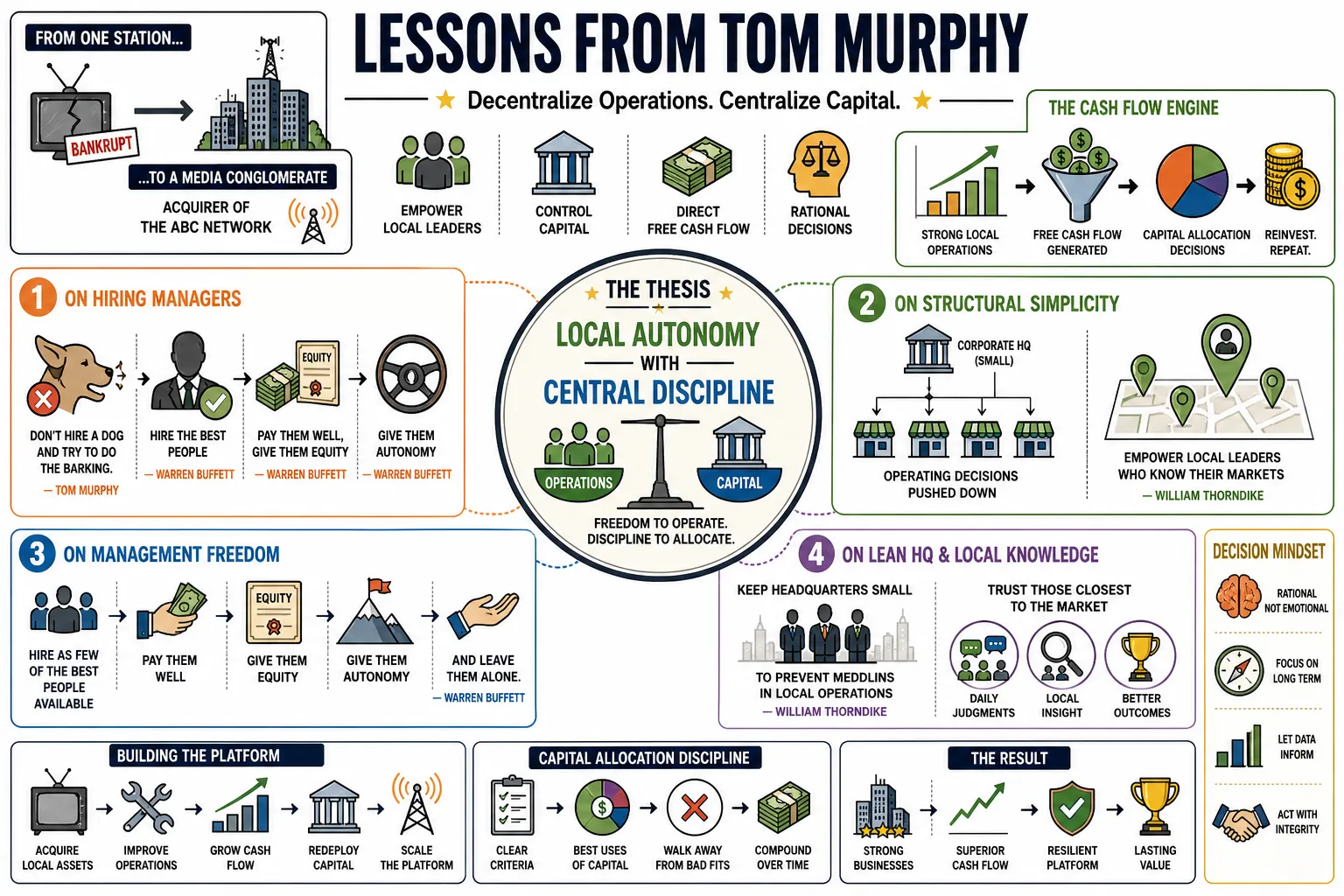
Lessons from Tom Murphy
Tom Murphy built Capital Cities Communications from a single bankrupt television station into the media conglomerate that bought the ABC network. He managed the business by giving local operators extreme autonomy while keeping strict, centralized control over capital allocation. His history offers a practical guide to running efficient operations, directing free cash flow, and making rational, unemotional decisions.
Part 1: Decentralization and Autonomy
- On hiring managers: "Don't hire a dog and try to do the barking." — Source: Tom Murphy
- On structural simplicity: Push operating decisions down the organizational chart to empower local leaders who understand their specific markets. — Source: William Thorndike
- On management freedom: "Hire as few of the best people available, pay them well, give them equity and autonomy in an ethical company and leave them alone." — Source: Warren Buffett
- On corporate staff size: A corporate headquarters should remain intentionally small to prevent executives from meddling in local operations. — Source: William Thorndike
- On local knowledge: Trust the managers closest to the market to make the best daily operating choices. — Source: Tom Murphy
- On extreme delegation: "Murphy delegates to the point of anarchy." — Source: Dan Burke
- On removing bureaucracy: Eliminate middle management layers to keep the organization responsive and moving fast. — Source: William Thorndike
- On separating duties: Grant total autonomy to local operators while keeping capital allocation decisions entirely at headquarters. — Source: William Thorndike
- On trusting operators: Once you put the right person in a role, step back and let them run the business as if they owned it. — Source: Warren Buffett
- On head office restraint: Headquarters exists to allocate capital and monitor performance rather than dictate daily operations. — Source: Tom Murphy
Part 2: Cost Management and Frugality
- On operational efficiency: "The goal is not to have the longest train, but to arrive at the station first using the least fuel." — Source: Tom Murphy
- On leading by example: When asked why he still took cabs instead of limousines to meetings, he simply asked, "Is there any other way?" — Source: Tom Murphy
- On monitoring expenses: Treat minor expenses as long term financial commitments that compound over time. — Source: William Thorndike
- On corporate excess: Avoid the glamour typical of media companies and focus strictly on rational business operations. — Source: Warren Buffett
- On lean structures: A company can run a massive national operation with fewer than fifty people at headquarters if it eliminates unnecessary roles. — Source: William Thorndike
- On the culture of thrift: Frugality is a continuous mindset that demands efficiency and purposeful spending across every department. — Source: Tom Murphy
- On budgeting: Local managers must build their own budgets from the ground up and then be held strictly accountable for meeting those targets. — Source: Dan Burke
- On unnecessary overhead: Internal public relations and large legal staffs are often superfluous drains on free cash flow. — Source: William Thorndike
- On maintaining margins: Strict cost consciousness acts as the primary defense against economic downturns. — Source: Tom Murphy
- On corporate spending: Operating efficiently guarantees that cash can be continually reinvested into better opportunities. — Source: Tom Murphy
Part 3: Capital Allocation and Growth
- On capital deployment: "We just kept opportunistically buying assets, intelligently leveraging the company, improving operations and then we'd … take a bite of something else." — Source: Tom Murphy
- On bold acquisitions: He described Capital Cities' $3.5 billion purchase of the massive ABC network as "the minnow that ate the whale." — Source: Tom Murphy
- On centralized control: Operating authority belongs in the field, but capital allocation must remain tightly controlled at the very top. — Source: William Thorndike
- On acquiring quality: "To achieve a reputation as a good manager, just be sure you buy good businesses." — Source: Warren Buffett
- On sticking to what you know: Avoid diversifying into unrelated industries and focus entirely on businesses where you have deep operational expertise. — Source: Tom Murphy
- On generating free cash flow: The ultimate measure of a business is its continuous generation of free cash flow. — Source: William Thorndike
- On stock repurchases: Aggressively repurchase your own stock when internal operations generate excess cash and outside acquisitions are too expensive. — Source: William Thorndike
- On synergistic deals: Seek acquisitions that provide clear operational overlap rather than relying on abstract strategic theories. — Source: Tom Murphy
- On doing the math: Base all capital allocation decisions on simple mathematics rather than Wall Street expectations. — Source: William Thorndike
Part 4: Talent and Hiring
- On evaluating executives: "You'll never pay a really top-notch executive... as much as they are worth. We're paying the .200 hitters too close to the .350 hitters." — Source: Warren Buffett
- On providing feedback: "Praise by name, criticize by category." — Source: Tom Murphy
- On empowering individuals: A manager's job is to bring out the absolute best in everybody without burning them out. — Source: Warren Buffett
- On character over complexity: The best operators lack the complex character flaws that lead to ego driven decisions. — Source: Warren Buffett
- On hiring for humility: A highly intelligent person who slightly underestimates their own ability will consistently outperform someone who overestimates themselves. — Source: Charlie Munger
- On employee ownership: Bond employees to the company's success by providing them with meaningful equity stakes. — Source: Tom Murphy
- On finding improvements: "Find something that you can improve on in an area, and always have enough cash to weather the good and bad times." — Source: Tom Murphy
- On managing imperfect humans: True leadership requires the patience to inspire and guide very imperfect people. — Source: Warren Buffett
- On retaining talent: Build a culture of intense trust and open communication so that top performers refuse to leave for competitors. — Source: William Thorndike
Part 5: Simplicity and Decision Making
- On common sense: "One of the interesting things I’ve learned in my life is that one of the most uncommon things in life is common sense." — Source: Tom Murphy
- On the nature of business: "The business of business is a lot of little decisions every day mixed up with a few big decisions." — Source: Tom Murphy
- On rational operations: Keep the corporate structure entirely focused on practical realities rather than industry trends. — Source: William Thorndike
- On straightforward negotiations: "Warren is the fairest person I’ve ever dealt with. He never tried to take advantage of us. He always wanted both sides to feel good about the deal." — Source: Tom Murphy
- On ignoring Wall Street: Focus on intrinsic business value and cash generation instead of managing quarterly earnings targets. — Source: William Thorndike
- On speed of execution: Decentralized systems allow operators to make necessary changes rapidly and outmaneuver slower competitors. — Source: Tom Murphy
- On avoiding bad habits: Never let corporate size justify the creation of complicated reporting structures. — Source: William Thorndike
- On clear reporting: Keep financial reporting transparent so that managers focus on actual cash rather than accounting maneuvers. — Source: William Thorndike
- On loving the work: "I loved the business I was in, and I loved going to work every morning. If it had been the railroad business, it would not have been as much fun." — Source: Tom Murphy
Part 6: Emotional Control and Temperament
- On handling anger: "You can always tell someone to go to hell tomorrow." — Source: Tom Murphy
- On preserving options: Waiting to react in anger preserves your options while avoiding irreversible mistakes. — Source: Warren Buffett
- On ethical boundaries: "In your business career, don't do anything that is ethically questionable. You will lose more than you can ever gain." — Source: Tom Murphy
- On praying for humility: A leader must actively guard against arrogance; praying for humility is a practical exercise in maintaining perspective. — Source: Charlie Munger
- On remaining calm: Exceptional managers do not allow the daily pressures of running a business to provoke emotional outbursts. — Source: Warren Buffett
- On trusting partners: Treat the company's problems as shared responsibilities and never abandon a partner during hard times. — Source: Tom Murphy
- On personal priorities: "I’m seventy-five years old now—you recognize that the only thing that’s important is your family and your friends." — Source: Tom Murphy
- On the purpose of work: "Business is just a way to live your life so that you can have a nice life for your family and make good friends." — Source: Tom Murphy
- On the value of health: "The greatest blessing in the world, outside of being an American, is to have good health. To be blessed with good health is a great luxury." — Source: Tom Murphy
Part 7: Partnership and Collaboration
- On the ideal duo: "Tom Murphy and Dan Burke were probably the greatest two-person combination in management that the world has ever seen." — Source: Warren Buffett
- On dividing responsibilities: An executive partnership thrives when one leader focuses on capital allocation while the other manages daily operations. — Source: William Thorndike
- On executing deals: The success of Capital Cities relied on a simple formula where Murphy made the deals and Burke made them work. — Source: Television Academy
- On mutual respect: A multi decade partnership requires total trust, an absence of ego, and a shared operating philosophy. — Source: Tom Murphy
- On the value of a COO: Having a detail oriented operator frees the CEO to scout for transformative acquisitions without neglecting the core business. — Source: William Thorndike
- On shared values: Partnerships endure when both leaders share a strict dedication to frugality and integrity. — Source: Medium
- On seamless communication: Operating a decentralized empire requires the top two executives to project absolute unity to the rest of the organization. — Source: William Thorndike
- On avoiding the spotlight: Both executives preferred low public profiles and let their financial results speak for themselves. — Source: Daniel Scrivner
- On lifelong collaboration: True business partnerships extend beyond professional obligation and mature into deep friendships. — Source: Warren Buffett
Part 8: Long-Term Orientation and Shareholder Value
- On learning from mentors: "Most of what I learned about management, I learned from Murph. I kick myself, because I should have applied it much earlier." — Source: Warren Buffett
- On studying success: "If you did nothing but study him, you wouldn't have to study anybody else." — Source: Warren Buffett
- On true managerial greatness: A reputation as an exceptional manager is fundamentally tied to the long term durability of the businesses you acquire. — Source: Warren Buffett
- On long-term commitment: "I will be in Cap Cities as long as I live. It’s like if you have a kid that has problems — it’s not something we’re going to sell in five years." — Source: Tom Murphy
- On prioritizing the shareholder: Every corporate decision must be measured against its impact on per share value over the long haul. — Source: William Thorndike
- On compounding returns: An unwavering focus on cash flow allows a company to generate returns that significantly outpace broader market indices. — Source: Medium
- On patience in acquisitions: Do not overpay for assets to grow top line revenue if the cash returns do not justify the price. — Source: William Thorndike
- On avoiding institutional imperative: Maintain an independent approach to strategy and resist the temptation to copy competitors' flawed ideas. — Source: Warren Buffett
- On building a legacy: "Tom Murphy has taught me more about running a business than any other person. We have been friends and mental partners for more than 50 years." — Source: Warren Buffett
- On the ultimate standard: His operating doctrine remains the gold standard for constructing a highly profitable and fiercely independent corporate structure. — Source: William Thorndike