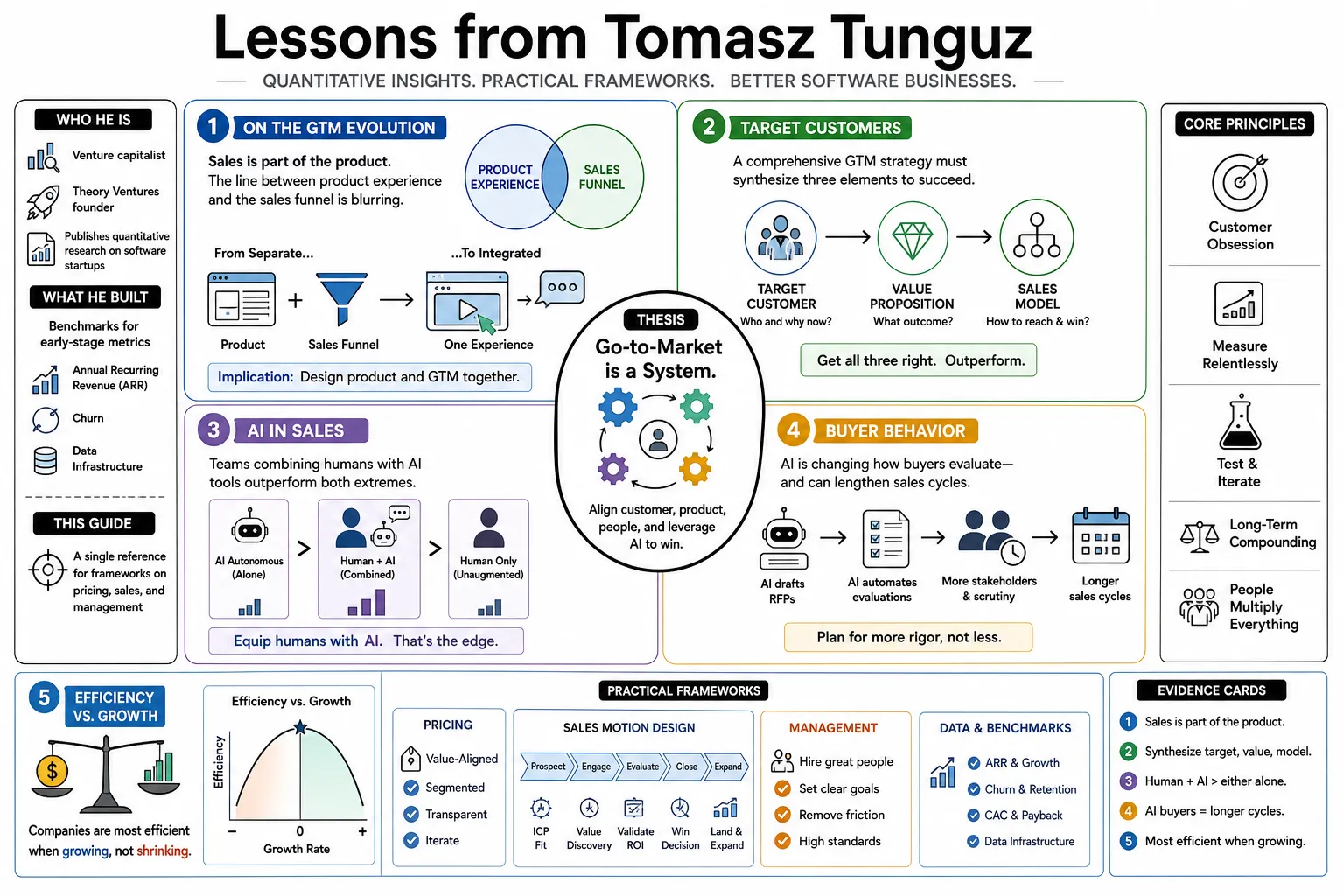
Lessons from Tomasz Tunguz
Venture capitalist and Theory Ventures founder Tomasz Tunguz publishes quantitative research on software startups. He developed benchmarks for early-stage metrics like annual recurring revenue, churn, and data infrastructure. This profile collects his frameworks for pricing, sales, and management into a single reference.
Part 1: Go-to-Market Strategy & Sales
- On the GTM Evolution: "The sales process is a part of the product, and as sales motions evolve, the distinction between product experience and the sales funnel is blurring." — Source: Tomasz Tunguz Blog
- On Target Customers: "A comprehensive go-to-market strategy must synthesize target customer definition, value proposition, and the correct sales model to succeed." — Source: A Founder's Guide to GTM Strategy
- On AI in Sales: "Teams combining humans with AI tools outperform both fully autonomous AI and unaugmented human teams in modern sales environments." — Source: Theory Ventures
- On Buyer Behavior: "Buyers are increasingly using AI to automate RFPs and evaluations, which may ironically lengthen sales cycles rather than shorten them." — Source: Tomasz Tunguz Blog
- On Efficiency vs. Growth: "Companies are often capturing AI productivity gains through headcount flattening rather than accelerated revenue growth." — Source: Tomasz Tunguz Blog
- On Enterprise Sales: "Transitioning to enterprise sales is a natural evolution to grow and scale contract values, not a replacement for self-serve roots." — Source: GTM Now
- On the Modern Sales Challenge: "ROI has replaced security as the primary hurdle for enterprise software adoption in the current market environment." — Source: SaaStr
- On Business-to-Developer (B2D): "B2D companies face unique go-to-market requirements because developers prioritize self-serve technical evaluation over traditional sales outreach." — Source: Tomasz Tunguz Blog
- On Platform Sales: "Platform sales are inherently complex because you are selling a foundation for future use cases rather than a single point solution." — Source: Tomasz Tunguz Blog
- On Market Segments: "GTM motions must map strictly to Annual Contract Value, ranging from product-led growth for SMBs to field sales for strategic enterprise accounts." — Source: Tomasz Tunguz Blog
Part 2: SaaS Metrics & Valuations
- On the Cycle Mental Model: "While SaaS companies are often viewed as a funnel, a superior mental model is a cycle; funnels eventually end, whereas cycles function as a flywheel that builds momentum." — Source: Medium
- On Net Dollar Retention (NDR): "NDR is like compounding interest for your company's annual recurring revenue (ARR). Improving your NDR by 20% might not seem like a monumental change, but it would lead to your company's ARR doubling in 5 years!" — Source: Subscript
- On Series A Benchmarks: "At the Series A, the first metric that we care about is ARR growth. It shows that the company has demonstrated product-market fit." — Source: Medium
- On Valuation Multiples: "The valuation multiples on annual recurring revenue are the highest across startup categories because the guarantee implies predictability, which investors prize." — Source: Tomasz Tunguz Blog
- On Evolving ARR Definitions: "Definitions of ARR have slackened over time, often being applied to infrastructure companies with usage-based pricing and consumer subscription businesses." — Source: Tomasz Tunguz Blog
- On Cohort Analysis: "Traditional aggregate metrics miss hidden business insights that only cohort analysis can reliably uncover." — Source: Subscript
- On Gross Margins: "Gross margin acts as the glass ceiling of profitability for any startup, fundamentally dictating the long-term economics of the business." — Source: Tomasz Tunguz Blog
- On the 100x Multiple: "While a 100x ARR multiple is occasionally supported by the market for the top 5% of businesses, it implies immense expectations for years of perfect future execution." — Source: Tomasz Tunguz Blog
- On Private vs. Public Markets: "The private market often pays a premium over public market figures because access to high-growth companies is the scarcest commodity in startupland." — Source: Tomasz Tunguz Blog
- On Financial Statements: "A startup's financial statements are the Rosetta Stone for understanding its strategy and calculating how long it has before the next fundraise." — Source: Tomasz Tunguz Blog
Part 3: The Modern Data Stack & Culture
- On Data Infrastructure: "Modern data infrastructure is necessary but insufficient for a company to become data-driven. A cutting-edge data supply chain that is unused is just as worthless as a nonexistent one." — Source: Winning with Data
- On Cultural Transformation: "Culture is the key ingredient to ensuring data investments achieve their potential; becoming data-driven is as much about people as it is about tools." — Source: Winning with Data
- On Slaying the HIPPO: "Brutal intellectual honesty aims to slay the HIPPO, or the highest-paid person's opinion, as the determining factor of the direction of a project, team, or company." — Source: Code Arcana
- On Data Storytelling: "In its simplest form, a story is a connection between cause and effect. The implications of data are best conveyed through stories." — Source: Winning with Data
- On Analytical Rigor: "Before undertaking complex data work, always ask: What decisions would that analysis inform?" — Source: Code Arcana
- On Democratizing Access: "Organizations must democratize access to data so that employees across different departments can make informed decisions without waiting for a small group of data scientists." — Source: Logan Frederick
- On Data as a Moat: "Startups should use internal data to build keys to the kingdom, meaning insights that create barriers to entry and economies of scale, rather than simply selling that raw data." — Source: Tomasz Tunguz Blog
- On Synthetic Data: "Synthetic data has emerged as a secret weapon for AI startups to gain a competitive edge without needing massive proprietary datasets." — Source: Tomasz Tunguz Blog
- On the Data Supply Chain: "Raw data is not a competitive advantage on its own; a company must have the ability to effectively query and operationalize it." — Source: Software Engineering Daily
- On Strategic Advantage: "In the modern business landscape, data is becoming the primary asset companies use to differentiate themselves from incumbents." — Source: Business Insider
Part 4: Artificial Intelligence & Machine Learning
- On AI Workflows: Tunguz argues that SaaS companies have mostly layered AI features onto existing products so far, but once users adapt and workflows change, AI-native products can start challenging the incumbent systems of record. — Reference: SaaStock article on Tunguz and how AI is changing SaaS workflows
- On Inference Commoditization: "Reselling inference is a zero-margin commodity. The margin question comes down to cost-plus versus value-based pricing: one anchors to the inference line, the other decouples from it." — Source: Tomasz Tunguz Blog
- On AI Expanding SaaS: "AI will change the world of SaaS because innovations will happen in core categories, but AI will also broaden out SaaS as key processes in offline industries become automated." — Source: Medium
- On AI Depth: "Founders must think critically about their AI depth, deciding whether to build on top of existing models or develop proprietary engine capabilities that create defensible moats." — Source: Tomasz Tunguz Blog
- On Rote Work: "Right now, we are looking at where there is rote work or human toil that can be repeated with AI. That is one big question where there is not a really big incumbent." — Source: Sama
- On Generative AI Strategy: "Startups navigating generative AI must clearly define their market position, proprietary data moats, and enterprise readiness from day one." — Source: Tomasz Tunguz Blog
- On AI as a Feature: "Simply adding AI to a pitch deck is insufficient; successful companies must use these tools to solve specific, quantifiable problems." — Source: Tomasz Tunguz Blog
- On Machine Learning Multipliers: "Machine learning is a force multiplier that embeds classification, prediction, and generation into software to anticipate user needs." — Source: Theory Ventures
- On Foundational Technologies: "While AI is often used as a buzzword, the underlying technical innovations in natural language processing and autonomous systems are creating significant, long-term economic value." — Source: Tomasz Tunguz Blog
- On the AI Buildout: "The AI infrastructure buildout raises macroeconomic questions about whether current capital expenditures represent a speculative bubble or a structural shift akin to an industrial revolution." — Source: Tomasz Tunguz Blog
Part 5: Product-Led Growth & Pricing
- On Product-Qualified Leads (PQLs): "Marketing-qualified leads often have high churn, whereas product-qualified leads (prospects who have actually seen value in the product) are much more likely to close." — Source: TrustRadius
- On the PLG Evolution: "Product-led growth is a bottom-up motion where you get to the users first, allowing them to test and derive value before advocating for broader enterprise adoption." — Source: G Kogan
- On PLG Culture: "Product-led growth is not merely a product feature or a marketing campaign but a company-wide effort that requires a deep commitment to experimentation and data." — Source: Tomasz Tunguz Blog
- On the Skimming Strategy: "Charging early adopters more than later buyers allows a startup to effectively skim the highest willingness-to-pay from the market." — Source: Tomasz Tunguz Blog
- On Combination Pricing: "The modern trend in SaaS pricing is a hybrid structure combining a base platform fee with usage-based components to capture a percentage of marginal ROI." — Source: SaaStr
- On Value-Based Pricing: "Startups must move away from cost-based pricing (adding a margin to costs) and embrace value-based pricing, charging what the customer is willing to pay based on the value delivered." — Source: Tomasz Tunguz Blog
- On Pricing as Offense: "Founders often play defense by being overly cautious with pricing, but they should use it as an offensive tool to reinforce the product's value and core marketing message." — Source: Tomasz Tunguz Blog
- On Veblen Goods in SaaS: "Some enterprise SaaS products exhibit Veblen characteristics, where demand actually increases as the price rises due to associations with higher quality or status." — Source: Tomasz Tunguz Blog
- On Pricing Iteration: "Because pricing is dynamic and evolves as the product matures, founders should re-evaluate at least annually and constantly test to maximize customer lifetime value." — Source: Tomasz Tunguz Blog
- On Annual Prepayments: "Startups should push for annual prepayments as early as possible in their pricing models to fundamentally improve cash flow and fuel growth." — Source: Tomasz Tunguz Blog
Part 6: Churn, Retention & Customer Success
- On Prioritizing Churn: "For seed and Series A companies, churn should take precedence over growth because like friction, at some scale, churn will prevent the business from growing." — Source: Tomasz Tunguz Blog
- On the Math of Attrition: "High churn forces a company to replace massive amounts of customer revenue each year just to achieve zero percent growth, leading to constant, expensive fundraising." — Source: Tomasz Tunguz Blog
- On Product-Market Fit: "High churn is a primary indicator of imperfect product-market fit and a threat to brand equity, as departing customers create a challenging marketing obstacle." — Source: Tomasz Tunguz Blog
- On Negative Churn: "Negative churn is a powerful growth mechanism where existing customer accounts behave like high-yield savings accounts, growing in value over time without additional acquisition effort." — Source: Tomasz Tunguz Blog
- On the Multiplier Effect: "A company with 160% net revenue retention will be 4.2x larger than a company with 120% retention after five years, assuming all else is equal." — Source: ChurnZero
- On Customer Success ROI: "Investing in customer success is often more cost-effective than increasing customer acquisition spend." — Source: Tomasz Tunguz Blog
- On Account Expansion: "Customer success should be viewed as a primary vehicle for driving account expansion, cross-selling, and generating high-quality referrals." — Source: Tomasz Tunguz Blog
- On Maximum Viable Churn: "Founders should identify their maximum viable churn, meaning the rate that enables the company to grow as fast as possible while maintaining an 18 to 24 month runway." — Source: Tomasz Tunguz Blog
- On Misleading Formulas: "Traditional, simple churn formulas can be misleading because they assume constant customer behavior; survival and cohort analyses offer the true picture." — Source: Tomasz Tunguz Blog
Part 7: Management, Hiring & Team Building
- On the Manager's Duty: "When a new leader joins a startup, their impact hinges on their ability to build their teams. Your responsibility as a manager is to hire 7 people." — Source: Tomasz Tunguz Blog
- On Hiring Executives: "When you hire an executive, you are hiring a network. Ask candidates who their first 5 hires will be to understand their ability to attract talent." — Source: Tomasz Tunguz Blog
- On Recruiting Speed: "There is a simple secret to hiring quickly and building a strong team: Invest in great managers early to distribute the recruiting burden." — Source: Tomasz Tunguz Blog
- On Hiring Bias: "Unstructured interviews often lead hiring managers to unconsciously hire people like themselves. Structured interviews triple the predictive power of an interview." — Source: Tomasz Tunguz Blog
- On Planning for Mishires: "You will make mistakes hiring people. Incorporate a buffer, such as a 20% mis-hire rate, into financial models to avoid missing performance targets." — Source: Tomasz Tunguz Blog
- On Unknown Disciplines: "When hiring for a department you do not fully understand, do the job yourself first to grasp the requirements before evaluating candidates." — Source: Tomasz Tunguz Blog
- On the Performance and Culture Matrix: "Companies should only hire candidates who occupy the upper-right quadrant, those who are both high performers and strong cultural fits." — Source: Tomasz Tunguz Blog
- On Management Philosophy: "Great managers manage themselves out of a job by building processes and teams that can operate independently." — Source: Tomasz Tunguz Blog
Part 8: Startups, Venture Capital & Macro Dynamics
- On Venture Investing: "Every investment requires a leap of faith, an emotional act that is not pure reason, and that has got to carry you through the inevitable bad stuff that comes with building a company." — Source: Tomasz Tunguz Blog
- On Consumer Friction: "The dominant dynamic within consumer products is that the least friction in a user experience always wins." — Source: Sama
- On Thesis-Driven VC: "Our goal is not to be in every great company but to make sure all the companies we invest in are great through deep, research-backed theses." — Source: Runtime News
- On Liquidity: "For the first time in venture history, three distinct channels share the liquidity burden roughly equally: M&A, IPO, and secondaries." — Source: Medium
- On the Fund Sales Cycle: Tunguz treated the Theory Ventures fundraise like a disciplined LP sales process: the 20VC episode frames the raise around 150 LP meetings, the documents and data room shared with investors, urgency creation, and the lessons from closing a $230 million Fund I. — Reference: 20VC episode with Tunguz on raising Theory Ventures Fund I
- On Narrative Economics: "Stories and rumors can become powerful economic forces that alter real-world behavior, impacting everything from bank runs to tech exuberance." — Source: Tomasz Tunguz Blog
- On Evaluating Advice: "Founders should avoid accepting economic outlooks at face value; instead, use frameworks, data, and historical precedents to test those assumptions." — Source: Tomasz Tunguz Blog
- On Capital Strategy: "Deciding whether to stay pat to maximize an investment multiple or double down to juice the total holding value is one of the core strategic questions venture firms debate." — Source: Tomasz Tunguz Blog