Tomer Cohen served as Chief Product Officer at LinkedIn, where he oversaw the platform's transition toward an AI-driven, feed-centric professional network. He is known for establishing the "Full Stack Builder" model and his insistence that product teams must operate with absolute clarity, even in uncertain conditions. This collection outlines his practical approaches to product strategy, team alignment, and adapting to the rapid integration of artificial intelligence.
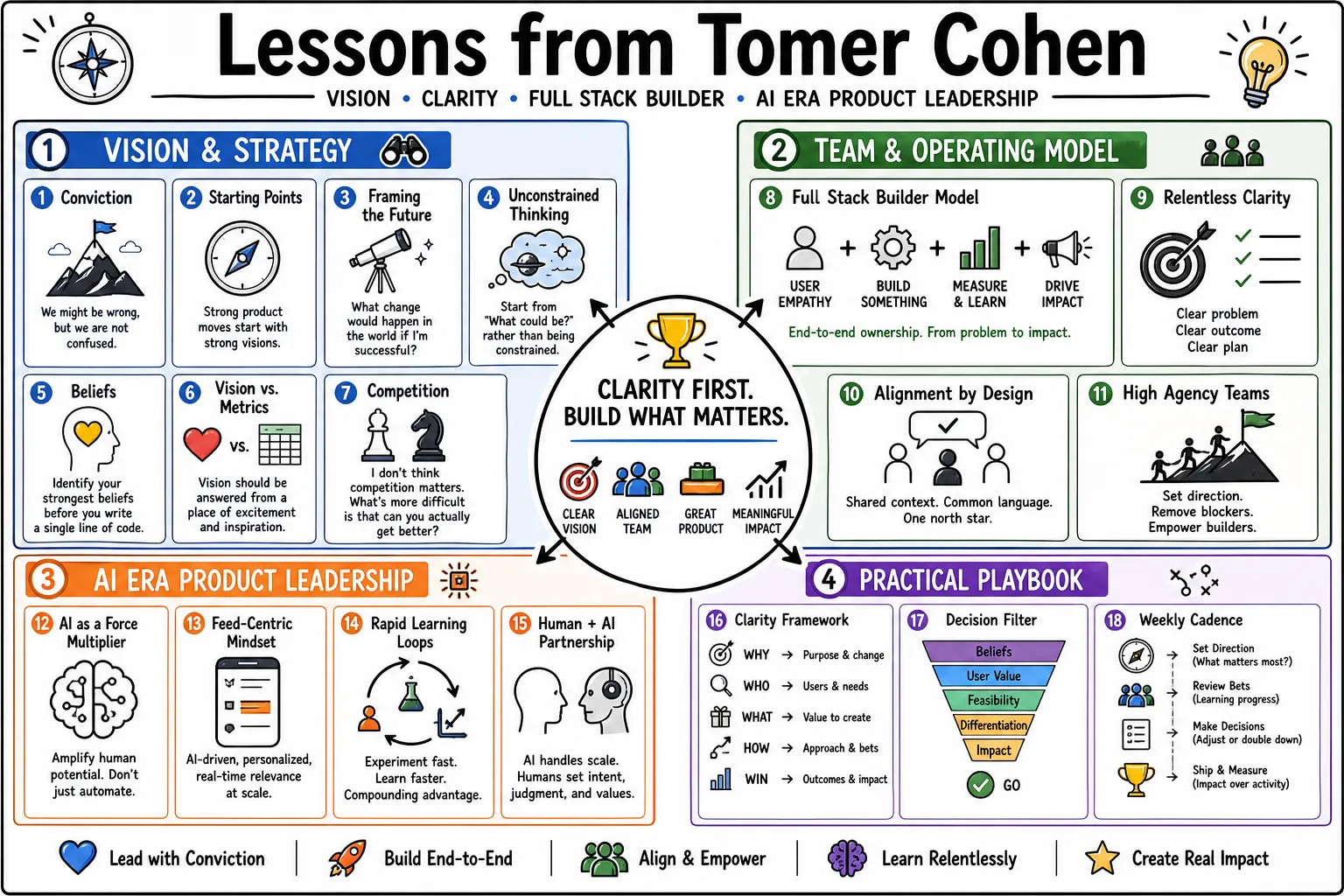
Part 1: Vision and Strategy
- On Conviction: "We might be wrong, but we are not confused." — Source: [Lenny's Podcast]
- On Starting Points: "Strong product moves start with strong visions." — Source: [Lenny's Podcast]
- On Framing the Future: "What change would happen in the world if I’m successful?" — Source: [Lenny's Podcast]
- On Unconstrained Thinking: "Start from 'What could be?' rather than being constrained by existing processes." — Source: [Lenny's Podcast]
- On Beliefs: "Identify your strongest beliefs before you write a single line of code." — Source: [Building One Podcast]
- On Vision vs. Metrics: "Vision should be answered from a place of excitement and inspiration, rather than reading a spreadsheet." — Source: [Decoder Podcast]
- On Competition: "I don’t think competition matters. What’s more difficult is that can you actually go and build a good product?" — Source: [Lenny's Podcast]
- On Alignment: "A team requires strict alignment on the destination and the exact method of travel." — Source: [Decoder Podcast]
- On Idea Quality: "A good vision makes the day-to-day decisions obvious." — Source: [Building One Podcast]
Part 2: The "Full Stack Builder" Model
- On Role Bloat: "Traditional product management became overly specialized, leading to slow development cycles." — Source: [Lenny's Podcast]
- On Empowering Creators: "We need individuals empowered to take products from idea to launch, collapsing the distance between conception and execution." — Source: [Lenny's Podcast]
- On Scrapping the APM: "We replaced our traditional APM program with an Associate Product Builder program to reflect the new reality of building." — Source: [Lenny's Podcast]
- On Skill Blending: "The future belongs to those who combine coding, design, and product management into a single motion." — Source: [Stanford GSB]
- On Independence: "A builder doesn't need to wait for three other departments to test a hypothesis." — Source: [Lenny's Podcast]
- On the New PM: "The job is shifting away from coordinating people toward actively creating the product." — Source: [Decoder Podcast]
- On Speed: "When one person can define the spec, write the prompt, and test the output, your iteration speed multiplies." — Source: [Lenny's Podcast]
- On Foundation: "Success in this new model rests on platform, internal tools, and organizational culture." — Source: [Lenny's Podcast]
- On Talent Evaluation: "The first thing to remind me is like, what did you build? And what did you learn? And how well did it do?" — Source: [Lenny's Podcast]
- On Execution: "The distance between a good idea and a working prototype has never been shorter." — Source: [Building One Podcast]
Part 3: Artificial Intelligence and Agents
- On AI's Role: "AI represents a fundamental shift in how products are built and managed." — Source: [Stanford GSB]
- On Custom Agents: "Off-the-shelf AI tools are often insufficient for enterprise needs; you need specialized agents." — Source: [Lenny's Podcast]
- On Gold Examples: "Feeding AI agents high-quality, curated 'gold examples' is far more effective than providing vast amounts of unrefined data." — Source: [Lenny's Podcast]
- On AI as an Amplifier: "AI tends to amplify the existing capabilities of top talent, rather than leveling the playing field for lower performers." — Source: [Lenny's Podcast]
- On Shifting Scarcity: "As AI takes over research and execution tasks, the real scarcity becomes human judgment." — Source: [Decoder Podcast]
- On Managing AI: "Dealing with the non-deterministic nature of AI is the biggest new challenge for product leaders." — Source: [Lenny's Podcast]
- On Integration: "Using AI must be part of a company's DNA, separate from an isolated research division." — Source: [Stanford GSB]
- On Trust: "Success requires moving beyond impressive AI demos to building systems where trust and reliability are paramount." — Source: [Decoder Podcast]
- On Task Architecture: "A simple user interface often hides a complex collection of 'mini agents' handling specific tasks behind the scenes." — Source: [Lenny's Podcast]
Part 4: Execution and Alignment
- On Confusion: "If a team is fragmented or hedging in different directions, failure is much more likely." — Source: [Decoder Podcast]
- On Singular Focus: "You cannot paralyze a team with indecision; you need a singular, clear path forward." — Source: [Lenny's Podcast]
- On Taking Risks: "While you cannot guarantee a decision will be correct, you must guarantee everyone understands why you are making it." — Source: [Decoder Podcast]
- On Momentum: "Decisiveness creates momentum, and momentum solves a lot of organizational problems." — Source: [Building One Podcast]
- On Hedging: "Trying to accommodate every possible outcome guarantees you won't do anything exceptionally well." — Source: [Decoder Podcast]
- On Shared Understanding: "If I ask five people on your team what the goal is, I should get the exact same answer." — Source: [Lenny's Podcast]
- On Progress over Perfection: "Prioritize progress over perfection; get it into the hands of users to see what breaks." — Source: [Building One Podcast]
- On Strategy vs Tactics: "Strategy is useless if the team is confused about the immediate tactical next steps." — Source: [Decoder Podcast]
- On Correcting Course: "It is much easier to steer a moving ship that is going the wrong way than to steer a stationary one." — Source: [Building One Podcast]
- On Ownership: "I want team members who feel deeply invested in the mission, acting as owners rather than employees." — Source: [Lenny's Podcast]
Part 5: Culture and Team Dynamics
- On Ideal Traits: "I look for a combination of three traits in product managers: dreamer, doer, and learner." — Source: [Lenny's Podcast]
- On Cultural Priority: "You can have the best platform and the best tools, but without the right culture, the transition to AI will fail." — Source: [Lenny's Podcast]
- On Experimentation: "Organizations must foster an environment that encourages experimentation without the penalty of failure." — Source: [Building One Podcast]
- On Curiosity: "The best builders are pathologically curious about how things work under the hood." — Source: [Stanford GSB]
- On Transparency: "Leadership must explain the exact reason behind a goal, rather than only delivering the instructions." — Source: [Decoder Podcast]
- On Collaboration: "Developers and product teams must work closely together to ensure tools are trustworthy and secure." — Source: [Stanford GSB]
- On Blame: "When a bet is wrong, we analyze the process; when a team is confused, we fix the leadership." — Source: [Decoder Podcast]
- On Motivation: "People do their best work when they understand how their specific task moves the needle for the entire company." — Source: [Building One Podcast]
- On Resilience: "A strong culture absorbs the shock of a failed product launch and immediately asks what can be learned." — Source: [Lenny's Podcast]
Part 6: Leadership and Decision Making
- On the Leader's Job: "Great leadership involves setting a clear vision and fostering an environment where everyone understands the objectives." — Source: [Decoder Podcast]
- On Ambiguity: "A leader’s primary function is to absorb ambiguity and output clarity for their team." — Source: [Building One Podcast]
- On Value of Judgment: "Deciding what to build and why to build it is where a product leader earns their keep." — Source: [Lenny's Podcast]
- On Avoiding Paralysis: "Do not let the fear of being incorrect stop you from making a definitive choice." — Source: [Decoder Podcast]
- On Listening: "You must stay close to the ground truth of what users are actually doing, ignoring what they say they want." — Source: [Lenny's Podcast]
- On Scaling: "Managing large teams requires you to rely on context and frameworks rather than micromanaging decisions." — Source: [Decoder Podcast]
- On Conviction: "You have to be willing to stand behind a decision even when the initial data looks messy." — Source: [Building One Podcast]
- On Empowerment: "Give people the guidelines and the ingredients, but let them cook." — Source: [Lenny's Podcast]
- On Accountability: "An owner mindset means you don't pass the buck when a metric goes sideways." — Source: [Building One Podcast]
- On Adaptation: "Leadership today means constantly updating your priors as new information and technologies emerge." — Source: [Stanford GSB]
Part 7: The Future of Work and Skills
- On the 2030 Shift: "By 2030, a significant majority of the skills required for today's jobs will change or become obsolete." — Source: [Stanford GSB]
- On Reskilling: "Modern organizations must shift their focus toward continuous reskilling and adaptability." — Source: [Stanford GSB]
- On Economic Opportunity: "We should design products that create genuine economic opportunity rather than optimizing strictly for time-spent metrics." — Source: [Decoder Podcast]
- On Labor Market Data: "Understanding shifts in the labor market requires looking at the actual skills being acquired, rather than relying on job titles." — Source: [Stanford GSB]
- On the Resume: "The traditional resume is becoming less relevant compared to a verified portfolio of skills and built projects." — Source: [Stanford GSB]
- On Lifelong Learning: "If you are unable to adapt quickly, you will struggle to survive the transition to an AI-first economy." — Source: [Lenny's Podcast]
- On Specialization: "Over-specialization is a risk in a world where AI can automate narrow tasks." — Source: [Lenny's Podcast]
- On Generalists: "The premium is shifting back to generalists who can connect disparate dots and exercise good judgment." — Source: [Decoder Podcast]
- On Automation: "AI will automate the mechanical parts of our jobs, forcing us to become more deeply human in our work." — Source: [Stanford GSB]
Part 8: Product Craft and Measurement
- On Metrics: "You have to approach product success metrics differently depending on whether you are building a utility or an entertainment network." — Source: [Decoder Podcast]
- On Time Spent: "Time spent is a dangerous metric if it doesn't correlate with actual value created for the user." — Source: [Decoder Podcast]
- On User Value: "Ask yourself if the user is leaving your product better off than when they opened it." — Source: [Building One Podcast]
- On Simplicity: "The hardest part of product craft is hiding the immense complexity required to make a feature feel simple." — Source: [Building One Podcast]
- On Iteration: "Your first version is just a hypothesis waiting to be tested by reality." — Source: [Lenny's Podcast]
- On Internal Reviews: "Product reviews should be about uncovering the truth, avoiding the defense of a fragile ego." — Source: [Building One Podcast]
- On Data vs Intuition: "Data tells you what is happening; intuition and qualitative research tell you why." — Source: [Decoder Podcast]
- On the Feed: "Transforming a feed requires understanding the subtle difference between engagement and genuine professional value." — Source: [Lenny's Podcast]
- On the Craft: "Product management is a craft that requires equal parts engineering, psychology, and art." — Source: [Building One Podcast]