Lessons from Tony Schwartz
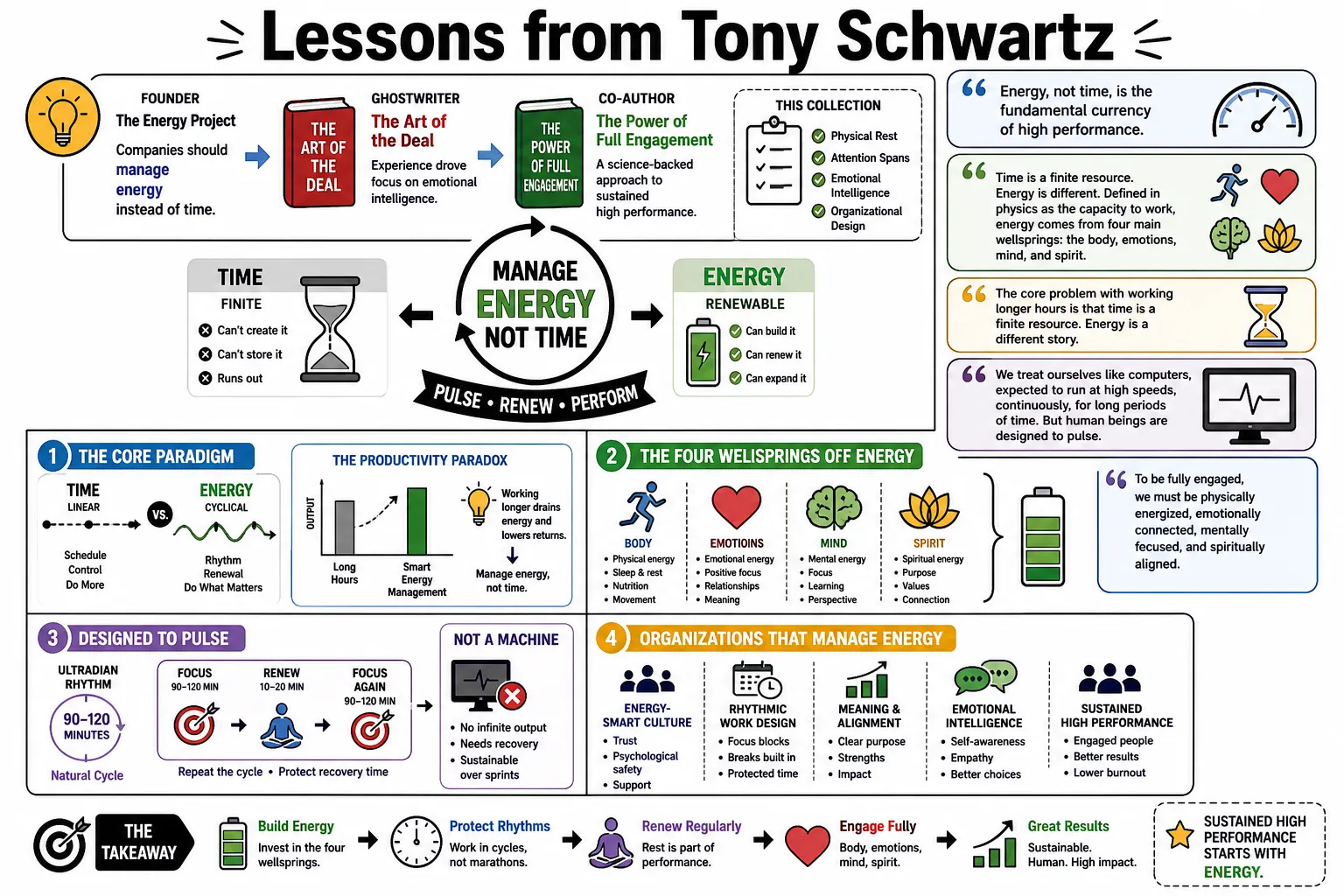
Journalist Tony Schwartz founded The Energy Project to argue that companies should manage energy instead of time. His experience ghostwriting Donald Trump's The Art of the Deal drove his later focus on emotional intelligence and led him to co-author The Power of Full Engagement. This collection gathers his observations on physical rest, attention spans, and organizational design.
Part 1: The Core Paradigm: Managing Energy vs. Time
- On the core currency: "Energy, not time, is the fundamental currency of high performance." — Source: [Harvard Business Review]
- On the limits of time: "Time is a finite resource. Energy is different. Defined in physics as the capacity to work, energy comes from four main wellsprings in human beings: the body, emotions, mind, and spirit." — Source: [Harvard Business Review]
- On the productivity paradox: "The core problem with working longer hours is that time is a finite resource. Energy is a different story." — Source: [The New York Times]
- On continuous output: "We treat ourselves like computers, expected to run at high speeds, continuously, for long periods of time. But human beings are designed to pulse." — Source: [The Energy Project]
- On multi-dimensional capacity: "To be fully engaged, we must be physically energized, emotionally connected, mentally focused and spiritually aligned with a purpose beyond our immediate self-interest." — Source: [The Power of Full Engagement]
- On capacity building: "We build emotional, mental and spiritual capacity in precisely the same way that we build physical capacity." — Source: [The Power of Full Engagement]
- On the illusion of stamina: "More, bigger, faster. This, the ethos of the market, has become the ethos of our lives." — Source: [The Way We're Working Isn't Working]
- On defining performance: "Performance, health and happiness are grounded in the skillful management of energy." — Source: [The Power of Full Engagement]
- On working like sprinters: "Rather than running like a marathoner, we should work like sprinters—giving it our all for short periods, then recovering." — Source: [The New York Times]
- On taking responsibility: "We must learn to take responsibility for managing our own energy, rather than expecting our organizations or bosses to do it for us." — Source: [Harvard Business Review]
Part 2: The Physical Dimension: Sleep, Rest, and Renewal
- On sleep requirements: "On average, we need seven to nine hours of sleep every night to function at our best. Without adequate sleep, depending on the work we do, we can be a danger to others or ourselves." — Source: [MindTools]
- On the cost of skipping sleep: "When you sleep less than you need, you perform at a lower level of cognitive capacity, you are less creative, and you are far more emotionally reactive." — Source: [Harvard Business Review]
- On physical foundation: "Physical energy is the foundational source of fuel in life." — Source: [The Power of Full Engagement]
- On ultradian rhythms: "Human beings operate in 90-to-120-minute cycles. When we ignore our body's signals for a break, we deplete our energy reserves." — Source: [The New York Times]
- On strategic renewal: "Renewal is not for slackers. It's an essential strategy for high performance." — Source: [The Way We're Working Isn't Working]
- On vacations: "A true vacation—one where you unplug entirely from work—is one of the most effective ways to restore depleted energy." — Source: [Harvard Business Review]
- On breathing: "Deep, diaphragmatic breathing is the quickest and most effective way to calm down the physiological symptoms of the fight-or-flight response." — Source: [The Energy Project]
- On exercise as a work tool: "Regular cardiovascular and strength training function as direct work performance strategies that expand your capacity to tolerate stress." — Source: [The Power of Full Engagement]
- On eating habits: "Eating small, highly nutritious meals multiple times a day provides a steady source of glucose, which fuels the brain for cognitive tasks." — Source: [The Way We're Working Isn't Working]
- On the danger of adrenaline: "Adrenaline provides a quick burst of energy, but relying on it chronically is toxic. It floods the body with cortisol and inevitably leads to burnout." — Source: [Harvard Business Review]
Part 3: The Mental Dimension: Focus, Distraction, and Deep Work
- On continuous partial attention: "We are constantly shifting our attention from one thing to another. The result is that we do nothing very well." — Source: [The New York Times]
- On the myth of multitasking: "Multitasking is an insidious illusion. You are simply switching rapidly between tasks, and every switch comes with a cognitive cost." — Source: [Harvard Business Review]
- On digital addiction: "We have built a world that makes it nearly impossible to pay sustained attention. The internet is a brilliant distraction machine." — Source: [The New York Times]
- On designated focus blocks: "Set aside 90 minutes of uninterrupted time for your most important task, and you will accomplish more in that period than most people do in a full day." — Source: [The Way We're Working Isn't Working]
- On mental energy: "Mental capacity is what allows us to focus our attention, manage our time effectively, and think creatively." — Source: [The Power of Full Engagement]
- On the loss of deep reading: "When we consume information in tiny, fragmented chunks, we lose the capacity to digest complex arguments and empathize with deep narratives." — Source: [The New York Times]
- On managing email: "Check your email at designated times rather than reacting to every ping. Reactivity is the enemy of productivity." — Source: [Harvard Business Review]
- On realistic optimism: "Realistic optimism is seeing the world as it is, but always working positively toward a desired outcome." — Source: [The Power of Full Engagement]
- On taking control of attention: "If you don't take control of your attention, someone else will. Your focus is the most valuable commodity you have." — Source: [The Energy Project]
Part 4: The Emotional Dimension: Triggers, Resilience, and Culture
- On the impact of underappreciation: "Feeling underappreciated for the tasks you have accomplished drains your energy to a dangerous degree." — Source: [Goodreads]
- On negative emotions: "Negative emotions like anger, frustration, and fear are highly toxic and drain energy rapidly. We perform best when we feel positive." — Source: [Harvard Business Review]
- On the inner critic: "The voice in our head is often far more critical and unforgiving than any external boss could ever be." — Source: [The Way We're Working Isn't Working]
- On building emotional capacity: "Emotional capacity is built through the experience of navigating difficult feelings, not by avoiding them." — Source: [The Power of Full Engagement]
- On workplace culture: "The most effective leaders are those who manage their own energy alongside the energy of those they lead." — Source: [Harvard Business Review]
- On the power of appreciation: "Expressing appreciation to colleagues does more than make them feel better; it genuinely replenishes their emotional fuel tank." — Source: [The New York Times]
- On vulnerability: "Admitting what we don't know and where we need help is a source of immense emotional relief and connection, yet many corporate cultures punish it." — Source: [The Energy Project]
- On managing triggers: "When you are triggered, buy time. Taking a deep breath and pausing before you respond can mean the difference between a constructive reaction and a destructive one." — Source: [Harvard Business Review]
- On self-awareness: "You cannot manage your emotional energy if you are blind to how you are actually feeling in any given moment." — Source: [The Way We're Working Isn't Working]
Part 5: The Spiritual Dimension: Purpose, Meaning, and Core Values
- On defining spiritual energy: "Spiritual energy is simply the energy derived from connection to a deeply held set of values and to a purpose beyond our self-interest." — Source: [The Power of Full Engagement]
- On the power of purpose: "Purpose is an unparalleled source of energy. When you care deeply about what you are doing, you have access to reserves you never knew existed." — Source: [Harvard Business Review]
- On values in action: "It is not enough to profess your values; you must behave in ways that demonstrate them every single day." — Source: [The Power of Full Engagement]
- On the crisis of meaning: "Many people are exhausted not because they are doing too much, but because they are doing too little of what matters to them." — Source: [The Way We're Working Isn't Working]
- On character: "Character is the courage to stand by your values when doing so costs you something." — Source: [The Power of Full Engagement]
- On making time for what matters: "If you don't actively schedule time for your highest priorities, the demands of others will consume your days." — Source: [Harvard Business Review]
- On legacy: "We spend so much of our lives optimizing for near-term achievements that we often forget to ask what legacy we are building over the long haul." — Source: [The Energy Project]
- On truth-telling: "Facing the truth about ourselves—our shortcomings, our self-deceptions—is the first, necessary step toward spiritual growth." — Source: [The Power of Full Engagement]
- On aligning work and life: "The ultimate goal is not work-life balance, but alignment. Is the life you are living aligned with the values you hold most dear?" — Source: [The Way We're Working Isn't Working]
Part 6: Oscillation: The Rhythm of High Performance
- On the definition of oscillation: "Oscillation is the rhythmic movement between energy expenditure (stress) and energy renewal (recovery)." — Source: [The Power of Full Engagement]
- On biological needs: "Nature has a rhythm, and so do our bodies. Attempting to override that rhythm with caffeine and willpower always ends in a crash." — Source: [The New York Times]
- On stress as a tool: "Stress is not the enemy. The enemy is the absence of recovery." — Source: [The Power of Full Engagement]
- On building muscle: "Just as a muscle grows by being pushed beyond its limits and then resting, human capacity expands through cycles of intense exertion and profound renewal." — Source: [The Power of Full Engagement]
- On the danger of linearity: "Linearity—the expenditure of energy without matching recovery—eventually breaks down the system, whether it is a biological organism or a corporate team." — Source: [The Way We're Working Isn't Working]
- On micro-recoveries: "You don't need an hour to recover. Even taking two minutes to stand up, stretch, and breathe deeply can shift your nervous system back into balance." — Source: [Harvard Business Review]
- On recognizing fatigue: "We have become so accustomed to feeling chronically tired that we no longer recognize it as a deficit. We accept it as the normal state of affairs." — Source: [The New York Times]
- On corporate pacing: "Companies that push their employees for constant, linear output are systematically destroying the very talent they depend on." — Source: [The Energy Project]
- On sustainable routines: "Highly effective people rely on positive rituals—highly specific routines that become automatic over time—to ensure they oscillate effectively." — Source: [The Power of Full Engagement]
Part 7: Leadership and Workplace Design
- On the crisis of engagement: "On one hand, companies are offering more wellness options than ever. On the other hand, employee burnout has risen to such a level that it is considered a workplace hazard." — Source: [The Energy Project]
- On what employees need: "Employees are vastly more satisfied and productive when four core needs are met: physical, emotional, mental, and spiritual." — Source: [The New York Times]
- On bad bosses: "A toxic boss can destroy the energy of an entire department faster than any heavy workload." — Source: [Harvard Business Review]
- On creating safe environments: "Leaders must cultivate an environment where taking a break is not viewed as a sign of weakness, but as a commitment to sustainable high performance." — Source: [The Way We're Working Isn't Working]
- On open-plan offices: "Open-plan offices are catastrophic for focused work. They practically mandate continuous interruption." — Source: [The New York Times]
- On meeting culture: "If you schedule meetings back-to-back without transition time, you are ensuring that people arrive at the next meeting mentally depleted." — Source: [The Energy Project]
- On role modeling: "If the CEO tells people to unplug on weekends but sends emails on Sunday morning, the culture will follow the emails, not the mandate." — Source: [Harvard Business Review]
- On trusting employees: "Give people the autonomy to do their work where and when they want, and evaluate them purely on the value they produce, not the hours they log." — Source: [The New York Times]
- On the cost of turnover: "When you treat humans like machines, they eventually break down or leave. The hidden cost of burnout is the massive expense of replacing your best people." — Source: [The Way We're Working Isn't Working]
Part 8: Trump, Truth, and the Writer's Life
- On writing "The Art of the Deal": "I put lipstick on a pig. I feel a deep sense of remorse that I contributed to presenting Trump in a way that brought him wider attention." — Source: [The New Yorker]
- On short attention spans: "It’s impossible to keep him focused on any topic, other than his own self-aggrandizement, for more than a few minutes." — Source: [The New Yorker]
- On the concept of "truthful hyperbole": "It was a way to justify bending reality to his will. I created the term, but he embraced it because it excused his lies." — Source: [The New Yorker]
- On transactional relationships: "In his world, every relationship is transactional. You are either a winner or a loser, and there is no room for empathy." — Source: [The New York Times]
- On creating a myth: "I was essentially manufacturing a persona. I took his scattered, relentless drive for deals and shaped it into a coherent, appealing narrative." — Source: [The New Yorker]
- On the motivation to speak out: "I couldn't stay silent knowing that the fiction I helped create was being used to manipulate the public into viewing him as a competent leader." — Source: [The New York Times]
- On observing power: "When you sit next to someone with that level of power and wealth for months, you realize very quickly that material success does not equate to emotional maturity." — Source: [The New Yorker]
- On ghostwriting: "The job of a ghostwriter is to inhabit the subject's voice, which means you have to temporarily suspend your own judgment. The danger is when you forget to turn it back on." — Source: [The New Yorker]
- On personal regret: "If I were writing 'The Art of the Deal' today, it would be a very different book. I would call it 'The Sociopath.'" — Source: [The New Yorker]
- On the enduring lesson: "My experience with him ultimately drove my later work on the importance of self-awareness, emotional intelligence, and living with purpose. He was the antithesis of everything I came to value." — Source: [The New York Times]