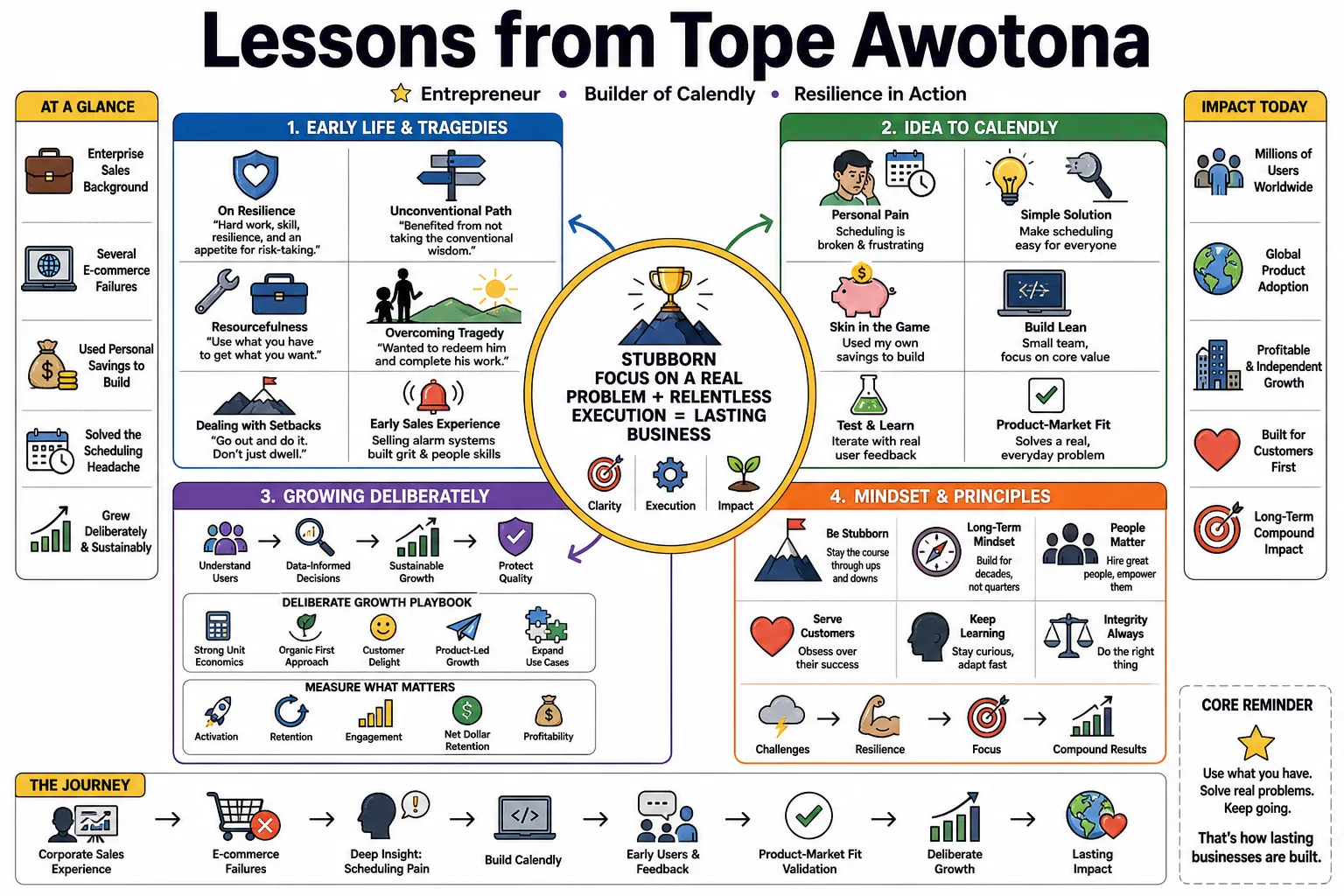
Lessons from Tope Awotona
After a career in enterprise sales and several failed e-commerce sites, Tope Awotona used his own savings to build Calendly, a tool that solved the everyday headache of scheduling meetings. This profile gathers his advice on testing ideas and growing deliberately, along with the stubbornness required to build a lasting business.
Part 1: Early Life and Tragedies
- On resilience: "What makes one successful is hard work, skill, resilience, and an appetite for risk-taking." — Source: ReadTheProfile
- On taking unconventional paths: "In my life, I've benefited from not taking the conventional wisdom. It's benefited me personally, and I think it has benefited the business." — Source: Forbes
- On resourcefulness: "You have to use what you have to get what you want." — Source: ReadTheProfile
- On overcoming tragedy: "I felt like he [my father] didn't get a chance to complete his work. There was a part of me, from a very early age, that wanted to redeem him." — Source: Carnegie
- On dealing with setbacks: "You can dwell on all the reasons you shouldn't do something or why it's harder for you. Or you can just go out and do it." — Source: YirenLu
- On early sales experience: Selling alarm systems door-to-door in college taught him fundamental resilience and the mechanics of closing a deal. — Source: SalesLoft
- On career development: "You should take on 'a tour of duty' within different roles within a company, and also within different industries." — Source: MogulMillennial
- On building business acumen: Broad exposure across different roles gives you a diverse knowledge base necessary for entrepreneurship. — Source: MogulMillennial
- On urgency: He credits his mother for instilling a deep sense of urgency, which translated into an impatience to solve problems immediately. — Source: FutureFounders
Part 2: The False Starts
- On the wrong motivations: "If starting a business is just about making money, it'll probably be very difficult for you to succeed because you can't fake the passion." — Source: ReadTheProfile
- On chasing money: His early failures (a dating site, a projector business, and a grill store) taught him that focusing purely on profit over problem-solving leads to burnout. — Source: SaaSClub
- On domain expertise: He realized he could not succeed in selling projectors or grills because he had absolutely no personal interest in the products. — Source: Goodreads
- On early startup lessons: He views his failed ventures as an expensive education that highlighted the necessity of genuine enthusiasm. — Source: AfricaSignal
- On finding purpose: "I was focused on 'ways to make money' instead of solving problems I cared about. I told myself I wouldn't succeed unless I found a problem I was passionate about solving." — Source: SaaSClub
- On the necessity of passion: "It's not enough to want to start a business... [You need to be] passionate about a problem, and... dedicated to devoting a significant part of your life, really, to solving that problem." — Source: AtlantaStartupPodcast
- On cutting corners: "Something is either worth doing or isn't worth doing. And if you're going to do it, don't take any shortcuts." — Source: SaaSClub
- On the value of failure: Success often requires enduring and analyzing earlier defeats to refine your entrepreneurial thesis. — Source: BizBio
- On starting with the problem: True business longevity comes from identifying a recurring annoyance rather than a quick cash grab. — Source: InformativeAcademy
Part 3: The Genesis of Calendly
- On identifying the problem: He experienced the acute frustration of back and forth scheduling emails firsthand while working in enterprise sales at EMC and IBM. — Source: EarlyStartupDays
- On taking the leap: "Rather than wait indefinitely I got anxious and I just went to my bank in April of 2014." — Source: SaaStock
- On universal pain points: He realized scheduling was a ubiquitous friction point that affected professionals across all industries, making the addressable market massive. — Source: BizBio
- On the advantage of non-technical founders: Though not an engineer, his sales background gave him an edge in defining requirements and understanding the buyer's mindset. — Source: AtlantaStartupPodcast
- On product constraints: By starting with a highly specific scheduling problem, Calendly avoided the feature bloat that plagued larger enterprise tools. — Source: ChartMogul
- On taking action: "There's never been a better time to start a business and bet on your ideas... There's no excuse for anyone to fail, because there's just so much free resources out there right now." — Source: MogulMillennial
- On observing the market: He saw that existing tools were clunky but still had paying users, proving the demand was real before he even built a prototype. — Source: SaaSClub
- On solving personal frustration: He built the tool initially to make his own sales job easier, ensuring the product was rooted in a genuine use case. — Source: ChartMogul
- On the wedge strategy: By targeting external-facing roles like sales and recruiting, he found a natural wedge into broader enterprise adoption. — Source: SaaStr
- On enterprise experience: Selling million-dollar software taught him how to gather requirements and translate business needs into product features. — Source: AtlantaStartupPodcast
Part 4: Product Discovery and Validation
- On avoiding traditional interviews: Rather than asking hypothetical questions, he trusted behavioral evidence, noting that people were already paying for inferior scheduling products. — Source: SaaSClub
- On competitor-led research: He signed up for and personally tested dozens of different scheduling tools to internalize exactly where they fell short. — Source: UIBreakfast
- On studying user complaints: He spent six months reading support forums and submitting tickets to competitors to identify the exact deal-breakers for users. — Source: ReadTheProfile
- On customer empathy: "It starts, it definitely starts and ends with, customer empathy and really understanding what your customers are looking to do." — Source: AtlantaStartupPodcast
- On building intuition: His deep dive into existing software allowed him to develop an intuitive feel for the market's unarticulated needs. — Source: ReadTheProfile
- On the MVP mindset: He treated the first version of the product as a strict minimum viable product, focusing exclusively on core mechanics before adding complexities. — Source: Medium
- On listening versus observing: He believed watching what people struggled with in existing tools was infinitely more valuable than asking them what they wanted. — Source: SaaSClub
- On prioritizing features: "We actually took a pause... and did not add a single feature until we were really able to sort out the requests... what really was a deal breaker for people." — Source: FromFounderToCEO
- On defining the core user: He focused heavily on the experience of the person receiving the link, not just the account holder, which revolutionized the user flow. — Source: BusinessModelCanvas
Part 5: Bootstrapping and The All-In Bet
- On risking everything: He famously drained his retirement account and maxed out his credit cards, investing his entire life savings to fund the initial development. — Source: Forbes
- On outsourcing development: Unable to find a technical co-founder locally, he partnered with a firm in Kyiv, Ukraine to build the initial product cost-effectively. — Source: GetLatka
- On working through instability: He flew to Kyiv during anti-government protests to work directly with his developers, prioritizing the product over personal comfort. — Source: FutureFounders
- On avoiding dilution: Bootstrapping allowed him to retain majority ownership and avoid the pressure of raising venture capital too early in the lifecycle. — Source: EntrepreneurPost
- On forced discipline: Operating entirely on personal funds enforced a strict operational discipline, driving the company to profitability by its third year. — Source: SaaStock
- On having no safety net: While investors were passing, he was flying into uncertainty without approval or a backup plan. — Source: DavidBeatsGoliath
- On financial constraints: "I actually ran out of money. The product was ready, but I ran out of money to build payments into the product." — Source: OrangeOwlMarketing
- On capital efficiency: His bootstrapping journey proves that solving a massive problem efficiently can outweigh the need for early institutional capital. — Source: TryAlma
- On independence: Self-funding granted him the freedom to focus entirely on user experience rather than catering to investor growth metrics in the early days. — Source: UGA
Part 6: Product-Led Growth and Virality
- On accidental freemium: Because he ran out of money to build a paywall before launch, the product debuted as free, accidentally sparking massive viral adoption. — Source: OrangeOwlMarketing
- On viral loops: "Creating virality, loops & collaboration hooks in your product can be a huge accelerant towards profitable growth." — Source: SaaStock
- On the product as marketing: The core mechanic of sending a scheduling link to someone else turned every single user into an active distribution channel. — Source: ChartMogul
- On preserving the free tier: "If your free plan drives viral growth, resist the short-term temptation to squeeze it. Instead, add more value to paid tiers." — Source: SaaStr
- On reducing friction: He obsessed over making the invitee's experience completely frictionless, knowing that a smooth booking process would convert guests into users. — Source: ElevationCapital
- On hybrid growth motions: As the company scales, he advises carefully balancing product-led virality with traditional enterprise sales to avoid cannibalizing organic growth. — Source: SaaStr
- On pricing strategy: "Charge more, charge earlier." — Source: FromFounderToCEO
- On organic acquisition: Awotona treated Calendly itself as the acquisition channel: the freemium product, shared scheduling links, and guest experience helped the product introduce itself to new users before heavy marketing spend was needed. — Reference: ChartMogul interview with Tope Awotona on Calendly freemium and product-led acquisition
- On network effects: The more people used the platform to schedule with external parties, the faster the product became the standard tool for setting meetings. — Source: Substack
- On data-driven scaling: Looking back, he emphasizes the importance of rigorous testing and holdout groups to optimize viral loops as user volume increases. — Source: SaaStr
Part 7: Simplicity and Execution
- On single-minded focus: The company's success stems from doing one specific thing better than anyone else in the world. — Source: BizBio
- On avoiding bloat: He intentionally kept the interface simple, refusing to build complex customer management features that would distract from the core value proposition. — Source: InformativeAcademy
- On design aesthetics: He understood that a beautiful design would stand out in a market populated by visually dated enterprise tools. — Source: ReadTheProfile
- On execution over ideas: "Don't quit too soon. The first year is always the hardest. The future you that will see your idea executed by somebody else will regret it." — Source: MogulMillennial
- On staying under the radar: He deliberately maintained a low public profile during the early years, focusing entirely on product execution instead of hype. — Source: ReadTheProfile
- On playing the long game: He views company building as a marathon that requires ignoring short-term trends in favor of sustained improvements. — Source: TryAlma
- On managing complexity: As the product matures, the goal remains to hide the underlying complexity from the user so the interface feels effortless. — Source: AfricaSignal
- On quality standards: He believes that if something is worth doing, it must be done thoroughly and without taking shortcuts on the fundamentals. — Source: SaaSClub
- On product constraints as an asset: Limiting features early on forced the team to ensure the core scheduling mechanic was bulletproof before expanding. — Source: ChartMogul
- On knowing your limits: He advises founders to enter ventures with their eyes wide open, avoiding confirmation bias by rigorously acknowledging what they do not know. — Source: UGA
Part 8: Hiring, Leadership, and Scaling
- On objective hiring: "Hiring well really starts with you having a clear idea of what you want and what success looks like. If you can't answer that in a very objective way, you're probably not ready to hire." — Source: AtlantaStartupPodcast
- On the ninety-day metric: He demands that managers know exactly how a new hire's performance will be measured and evaluated at the three-month mark. — Source: ReadTheProfile
- On standardization: "Design a process that helps you understand all of those things and standardize that process... have a clear understanding of what good looks like." — Source: AtlantaStartupPodcast
- On treating hiring like product: "Every single time you let somebody go... do a retro and say, 'What did we get right here? What did we get wrong?'" — Source: AtlantaStartupPodcast
- On the role of a CEO: "90% of being the boss is repeating the same thing over and over again." — Source: FromFounderToCEO
- On delegation: "I just try to involve myself in things that I am uniquely qualified to do... and just let the smart people at Calendly figure out the rest." — Source: ChartMogul
- On candidate experience: "They're also looking to learn about you... it's important to make sure that you create a process that actually makes people want to join your company." — Source: AtlantaStartupPodcast
- On representation: "As Calendly has grown, I just get a lot of people who don't fit the mold who reach out to me... that keeps me going through the tough days." — Source: Carnegie
- On personal accountability: "I believe that you get what you give into any given situation." — Source: FromFounderToCEO