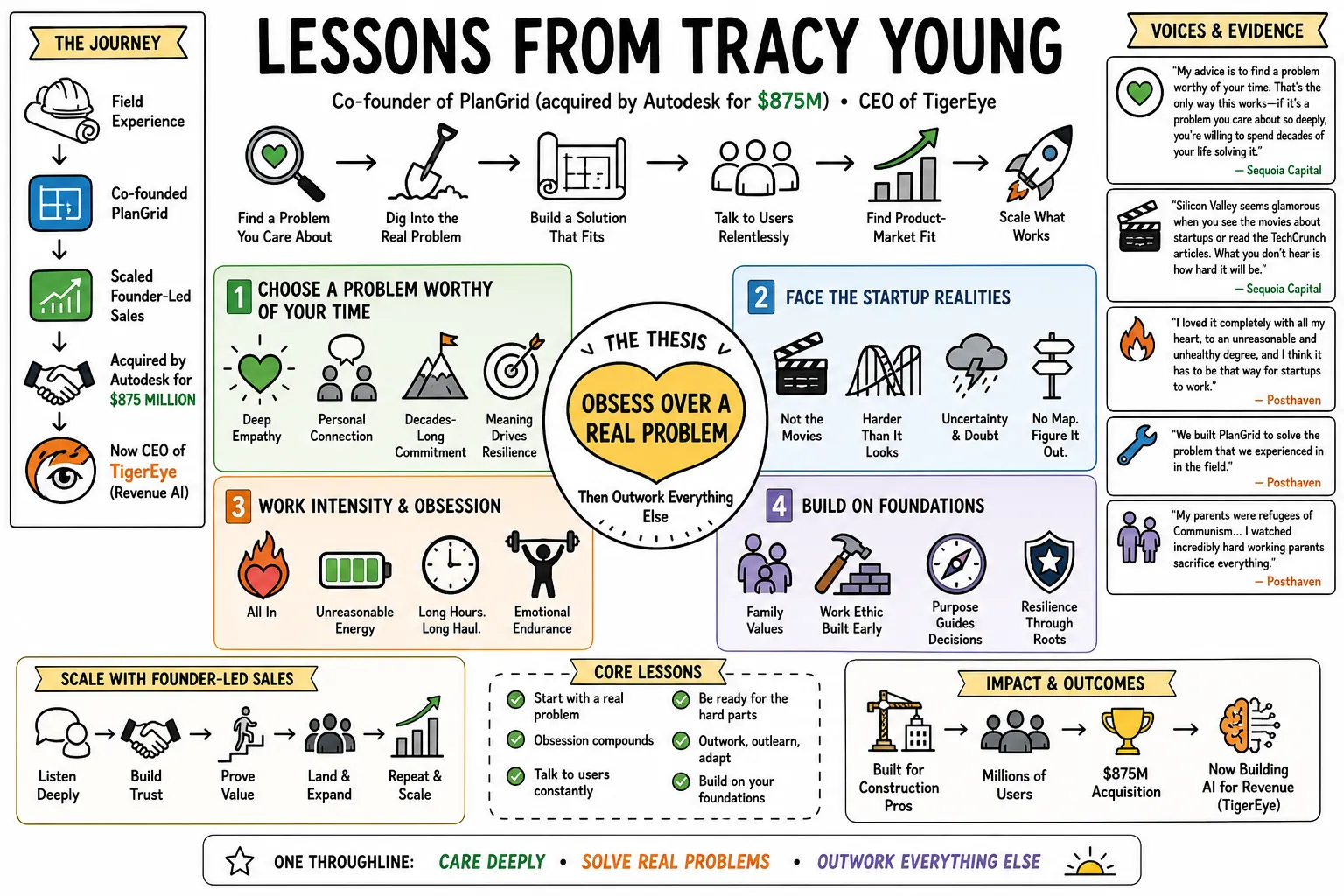
Lessons from Tracy Young
Software engineer Tracy Young co-founded PlanGrid and helped scale the construction app to an $875 million acquisition by Autodesk. Now the CEO of AI revenue management startup TigerEye, she explains how to find product-market fit, scale founder-led sales, and manage the emotional weight of building a company.
Part 1: Entrepreneurship and Founding
- On Choosing a Problem: Young told Sequoia that startup work only holds together when the problem is worthy of years of attention and meaningful enough to act as a guiding light through hard periods. — Reference: Sequoia Seven Questions with Tracy Young
- On Startup Realities: In Sequoia, Young contrasts the glamorous version of Silicon Valley with the pressure, market forces, grief, and persistence that shape real company building. — Reference: Sequoia Seven Questions with Tracy Young
- On Work Intensity: "I loved it completely with all my heart, to an unreasonable and unhealthy degree, and I think it has to be that way for startups to work." — Source: Posthaven
- On Personal Connection to the Product: "We built PlanGrid to solve the problem that we experienced in the field." — Source: Posthaven
- On Foundational Work Ethic: "My parents were refugees of Communism... I watched them work seven days a week without ever complaining so my siblings and I would live a better life than they did. We didn't have much, but there was a lot of love." — Source: Posthaven
- On Life Priorities: "Never do anything that makes you unhappy." — Source: Y Combinator
- On Self-Correction: Dissecting past failures and cataloging past mistakes is an essential exercise before attempting to predict the future with a new company. — Source: Y Combinator
- On Imposter Syndrome: "At 18 years old, I didn’t think [that leadership] looked like me. I know now that I was completely wrong about that." — Source: Y Combinator
- On Surviving the Early Days: Startups require combining relentless determination with deep domain expertise to navigate inevitable operational hardships. — Source: Pear VC
Part 2: Product and Solving Problems
- On Market Pain: A successful product hinges on one question: does the problem hurt the user enough that they will pay to make it go away? — Source: Y Combinator
- On Operational Design: Avoid pursuing "innovation" in your organizational structure; traditional operational efficiency and clarity are significantly more effective early on. — Source: Y Combinator
- On Eliminating Inefficiency: PlanGrid succeeded because it allowed engineers and builders to access project documents via mobile devices, eliminating the persistent friction of paper blueprints. — Source: Medium
- On Revenue Strategy: TigerEye was built to approach revenue management by applying advanced statistics to business operations, similar to a "Moneyball" strategy. — Source: Y Combinator
- On Legacy Tools: Organizations must move beyond static spreadsheets and legacy software if they want to make accurate, strategic business decisions. — Source: Posthaven
- On Empowering Good Products: The goal of modern sales software is to build tools that help companies with genuinely superior products actually win in the open market. — Source: Posthaven
- On Avoiding Hype: Focus on solving real, deeply felt problems rather than chasing fleeting technological trends. — Source: Y Combinator
- On Continuous Improvement: Kaizen, the practice of continuous improvement, is a core mindset required when developing new software products. — Source: Medium
- On Acknowledging Blind Spots: Young's SaaStr lessons explicitly tell young founders to surround themselves with people who know more than they do and to learn from hard failures. — Reference: SaaStr lesson recap with Tracy Young
Part 3: Sales and Go-To-Market
- On Founder Involvement: In the early days of a startup, at least one founder must be directly and deeply involved in selling the product. — Source: Pear VC
- On Direct Feedback: Direct customer interaction is critical for understanding market needs and driving growth, even if founders have no prior sales experience. — Source: Pear VC
- On Scaling Without a Team: PlanGrid managed to scale to $5 million in annual recurring revenue entirely through founder-led sales before building a formal sales organization. — Source: Pear VC
- On Evangelism: Young's Authority Magazine interview defines the CEO role partly as selling: recruiting and retaining people, selling the product to customers, and selling the vision to investors. — Reference: Authority Magazine interview with Tracy Young
- On Predictive Sales: AI, machine learning, and advanced statistics can effectively analyze a company's historical CRM data to predict future business outcomes. — Source: Y Combinator
- On Managing Risk: By taking snapshots of historical sales data, leaders can identify patterns that mitigate risk and accelerate top-line growth. — Source: Her Career Story
- On Validating the Product: Sales execution is the ultimate test where founders learn if their product genuinely solves a pain point for the customer. — Source: Y Combinator
- On the Feedback Loop: Delegating sales too early breaks the critical feedback loop between the market and the product development team. — Source: Pear VC
- On Vertical SaaS: Successfully scaling a vertical SaaS business requires an intimate understanding of the specific technological shifts happening within that exact industry. — Source: Second Acts Podcast
Part 4: Leadership and Vulnerability
- On Listening: Young told Sequoia that she had to learn to listen more and talk less because the team closest to the work often has questions as important as the CEO's. — Reference: Sequoia Seven Questions with Tracy Young
- On Authenticity: Young frames TigerEye's flexibility and her own experience as a CEO and mother as evidence that leadership should make room for people's real lives instead of forcing a narrow archetype. — Reference: Authority Magazine interview with Tracy Young
- On Admitting Ignorance: Being open about what you don’t know establishes a much deeper connection and builds trust with your internal team. — Source: ExCo Leadership
- On Honest Communication: The SaaStr recap treats communication architecture, clear expectations, and core values as essential once a startup grows beyond the point where founders can keep everyone aligned informally. — Reference: SaaStr lesson recap with Tracy Young
- On Sharing Risk: Discussing the company's existential risks and daily challenges openly leads to more candid communication across the entire organization. — Source: Keynote Speak
- On CEO Stereotypes: Feeling pressured to act in ways expected of a "traditional" CEO often hinders a founder's ability to provide genuine leadership. — Source: ExCo Leadership
- On Company Culture: A refreshing and straightforward honesty is the absolute foundation needed for building a resilient corporate culture. — Source: Forbes
- On Collaborative Problem Solving: You don't need to have all the answers; it is more effective to create environments where teams feel comfortable collaborating on difficult problems. — Source: ExCo Leadership
- On Self-Care as a Strategy: Young told Sequoia that eating better and paying attention to routines gave her more energy and made her a more effective leader. — Reference: Sequoia Seven Questions with Tracy Young
Part 5: Hiring and Team Building
- On Hiring Mistakes: When an executive or employee is a bad fit, the "blast radius" is massive because their presence negatively affects everyone around them. — Source: Y Combinator
- On Lasting Impact: "The happiest memories in my heart, the only ones I'll remember 20 years from now, are always with people." — Source: Posthaven
- On Shared Success: The act of building something people want and seeing their reaction is an incredible feeling that is best experienced alongside a dedicated team. — Source: Posthaven
- On Complementary Skills: SaaStr summarizes Young's advice that founders should surround themselves with people who know more than they do, especially after painful lessons expose gaps. — Reference: SaaStr lesson recap with Tracy Young
- On Founder Peer Groups: The severe roughness of the early days is made bearable by surrounding yourself with peers who understand the unique, isolating pressures of startup life. — Source: Y Combinator
- On Representation: Normalizing women and mothers in executive leadership roles is critical for building stronger, more diverse, and more effective organizations. — Source: Parentaly
- On Hiring for Growth: Young says the CEO does not need to know everything; during PlanGrid, she grew by asking for help and surrounding herself with smarter, more experienced leaders. — Reference: Authority Magazine interview with Tracy Young
- On Building Trust: Company culture is built on transparency, and that standard is set strictly by the people you choose to bring into the organization early on. — Source: Medium
- On Collective Resilience: A positive, resilient company culture demands team members who are willing to be vulnerable with one another. — Source: Keynote Speak
- On Debriefing: Before starting a new venture, take months to dissect the past with your co-founders to explicitly catalog what you did right and what you did wrong. — Source: Y Combinator
Part 6: Fundraising and Investors
- On Managing the Raise: Timebox your fundraising efforts. If you do not secure a term sheet within a defined window, stop raising and return to building your product. — Source: Y Combinator
- On Rejection: If an investor tells you no, accept it and move on immediately rather than wasting time trying to convince them. — Source: Y Combinator
- On Investor Motivations: Always remember that venture capitalists are entirely motivated by delivering returns to their own limited partners. — Source: Y Combinator
- On Posturing: Avoid playing games with VCs; the best investors have seen it all and can easily discern your true intentions. — Source: Y Combinator
- On the Reality of Capital: Fundraising is merely a financing event. It is a milestone, but it is not a metric of success or failure for the actual business. — Source: Y Combinator
- On Feedback: Founders must rely on brutally honest feedback from mentors and investors to stay focused on the metrics that actually matter. — Source: Y Combinator
- On Distractions: Do not let the pursuit of venture capital distract you from your primary job: talking to users and building the product. — Source: Y Combinator
- On Capital Mechanics: Founders must understand the underlying mechanics of venture capital so they are not blindsided by subsequent investor expectations. — Source: Y Combinator
- On Ultimate Goals: The goal of a startup is not to raise money; the goal is to build a highly valuable company that happens to require capital to scale. — Source: Y Combinator
Part 7: Resilience and Mental Health
- On Dealing With Failure: "The problems with failure are painfully hard; you can either give up, or learn from it." — Source: Female Founder Stories
- On Physical Toll: The physical and emotional strain of the founder journey is severe; intense stress often manifests in physical symptoms like teeth grinding. — Source: Y Combinator
- On Time Management: Because life is short and unpredictable, you should never commit your time to anything that makes you deeply unhappy. — Source: Y Combinator
- On Health as Leverage: Young's Sequoia answer links basic health routines to stamina, focus, fewer headaches, and better leadership capacity. — Reference: Sequoia Seven Questions with Tracy Young
- On Overcoming Doubt: Defeating imposter syndrome requires the active realization that effective leadership does not conform to a single look or background. — Source: Y Combinator
- On Pacing: Young's Sequoia advice makes pacing implicit in the choice of problem: founders need a mission strong enough to carry them through decades and through the mud. — Reference: Sequoia Seven Questions with Tracy Young
- On Perspective: Experiencing a severe personal loss or tragedy immediately puts the extreme, artificial pressures of startup life into stark perspective. — Source: Y Combinator
- On Required Obsession: An unreasonable level of obsession is required to get a startup off the ground, making the transition to a balanced life later critical for survival. — Source: Posthaven
- On Endurance: Actively learning from failure is the only sustainable way to endure the painful, daily realities of building a business. — Source: Female Founder Stories
- On Personal Scaling: Founders must embrace continuous improvement not just in their product architecture, but in their own personal resilience and psychological framework. — Source: Medium
Part 8: Acquisitions and Exits
- On Getting Bought: Companies are bought, not sold; founders should focus entirely on building a valuable business rather than optimizing for an acquisition. — Source: Y Combinator
- On Tracking Acquirers: Listen to the earnings calls of public companies in your sector to understand their strategic gaps and potential acquisition interests. — Source: Y Combinator
- On Commitment in M&A: If you make the decision to sell the company, be fully committed. Lingering in an ambiguous middle ground during a transaction is highly dangerous. — Source: Y Combinator
- On the Purpose of an Exit: An exit is a byproduct of solving a significant problem at scale, not the primary reason to start the company in the first place. — Source: Y Combinator
- On Alignment: Successfully navigating an acquisition requires deeply understanding both the strict technology fit and the softer cultural alignment between the two companies. — Source: SaaStr
- On Post-Exit Reflection: Dissecting the specific lessons from a previous exit is mandatory before embarking on a new venture as a repeat founder. — Source: Y Combinator
- On Scale and Options: Reaching $100 million in annual recurring revenue creates distinct, high-leverage options for an exit that simply do not exist for early-stage startups. — Source: Medium
- On Emotional Transitions: Selling a company for hundreds of millions of dollars triggers complex, often difficult emotional transitions that accompany the financial windfall. — Source: NFX Podcast
- On Post-Acquisition Leadership: The integration process after an acquisition demands just as much active leadership as the independent scaling phase did. — Source: YPO
- On What Remains: Exits validate the initial premise of the business, but the daily journey and the people you worked with are what permanently remain in your memory. — Source: Posthaven