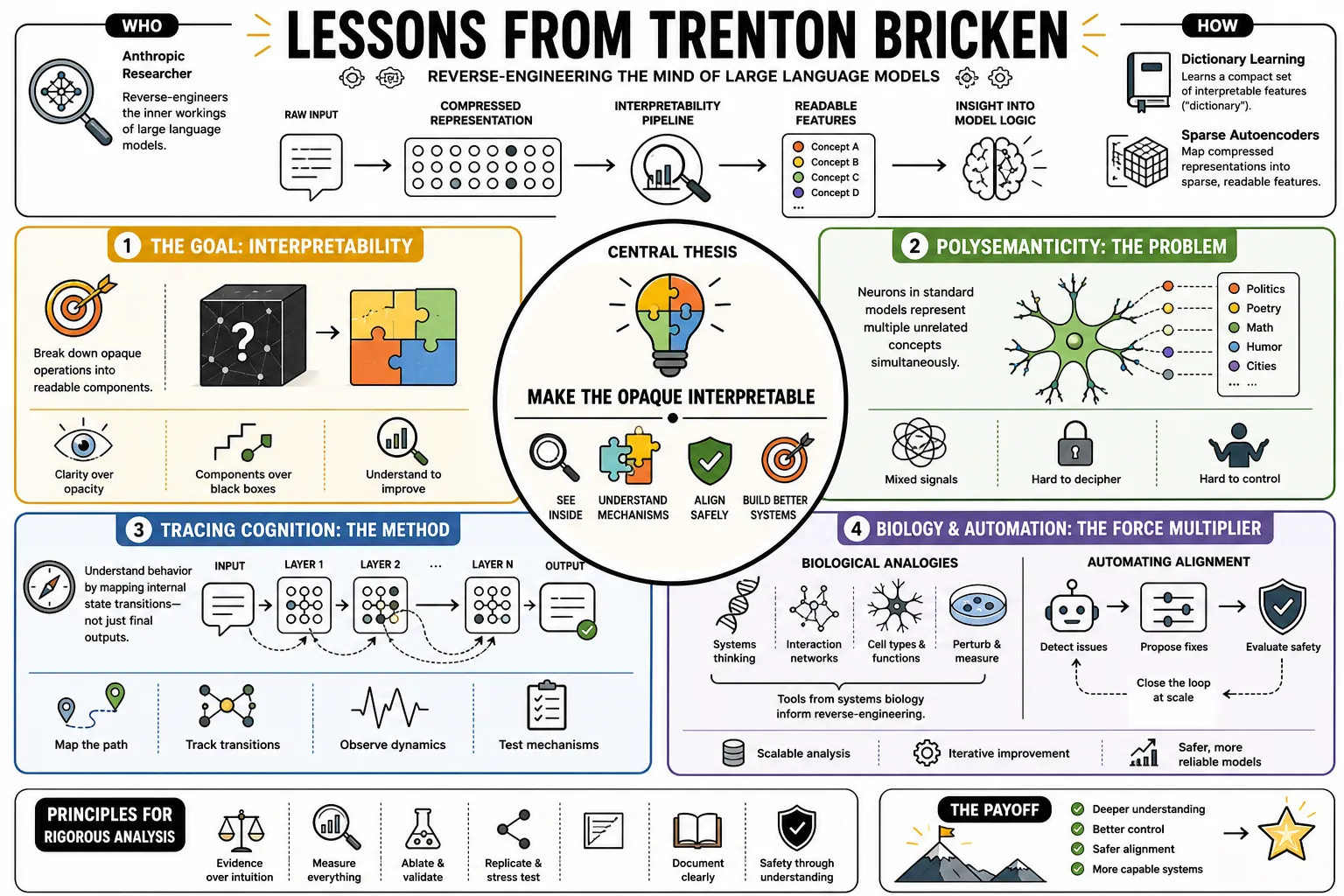
Lessons from Trenton Bricken
Trenton Bricken is an Anthropic researcher who reverse-engineers the inner workings of large language models. He uses dictionary learning and sparse autoencoders to map compressed neural networks into readable features. This collection gathers his notes on tracing model logic, applying biological analogies to artificial networks, and automating alignment.
Part 1: The Philosophy of Mechanistic Interpretability
- On the goal of interpretability: "The objective is to break down the opaque operations of neural networks into individual components that researchers can read and comprehend." — Source: [Towards Monosemanticity (Anthropic, 2023)]
- On polysemanticity: "Neurons in standard models represent multiple unrelated concepts simultaneously, making their individual activations nearly impossible to decipher." — Source: [Towards Monosemanticity (Anthropic, 2023)]
- On tracing cognition: "Understanding an AI's behavior requires mapping its internal state transitions rather than exclusively testing its final outputs." — Source: [Dwarkesh Podcast: How LLMs actually think (2024)]
- On rigorous analysis: "AI safety requires building an exact, testable science of model behaviors instead of relying on behavioral heuristics." — Source: [Dwarkesh Podcast: How LLMs actually think (2024)]
- On behavioral evaluation limits: "Testing a model's responses only tells you what it did in one specific instance, ignoring the underlying logic of how it generated that decision." — Source: [Building and evaluating alignment auditing agents (Anthropic, 2025)]
- On fundamental units: "Feature directions in the activation space, rather than individual neurons, serve as the actual fundamental units of neural computation." — Source: [Towards Monosemanticity (Anthropic, 2023)]
- On geometric complexity: "The representations inside language models rely on high-dimensional geometry where concepts are defined by their spatial relationships." — Source: [Dwarkesh Podcast: How LLMs actually think (2024)]
- On safety through legibility: "Making neural networks safe is a direct function of making their internal reasoning processes legible to human observers." — Source: [Scaling Monosemanticity (Anthropic, 2024)]
Part 2: Deconstructing Superposition
- On why superposition occurs: "Models learn to compress more features than they have dimensions by packing them into almost-orthogonal vectors, creating superposition." — Source: [Towards Monosemanticity (Anthropic, 2023)]
- On dimensional constraints: "Language models face a severe limitation where the number of concepts they need to track far exceeds their available parameter space." — Source: [Dwarkesh Podcast: How LLMs actually think (2024)]
- On mathematical compression: "The network relies on the math of high-dimensional spaces to squeeze concepts together without completely destroying their individual signals." — Source: [Dwarkesh Podcast: How LLMs actually think (2024)]
- On feature interference: "When concepts are packed tightly in superposition, activating one concept inevitably creates noise that interferes with the reading of others." — Source: [Towards Monosemanticity (Anthropic, 2023)]
- On masked logic: "Polysemantic neurons obscure the true algorithmic steps the model takes, hiding the causal mechanism behind the text generation." — Source: [Scaling Monosemanticity (Anthropic, 2024)]
- On neurons versus features: "A single neuron is a hardware constraint, while a feature is the actual mathematical direction representing a specific concept in the model's mind." — Source: [Towards Monosemanticity (Anthropic, 2023)]
- On almost-orthogonal vectors: "In high-dimensional spaces, vectors can be nearly perpendicular to many other vectors simultaneously, allowing the network to distinguish concepts despite overlap." — Source: [Dwarkesh Podcast: How LLMs actually think (2024)]
- On the failure of direct probing: "Attempting to understand a network by looking at individual neuron activations fails because the network's knowledge is distributed across the entire layer." — Source: [Towards Monosemanticity (Anthropic, 2023)]
- On the residual stream: "The residual stream functions as the central communication channel where different layers read and write geometric representations of data." — Source: [Dwarkesh Podcast: How LLMs actually think (2024)]
Part 3: Sparse Autoencoders and Dictionary Learning
- On the function of dictionary learning: "Dictionary learning acts as an extraction mechanism that translates dense, unreadable activations into a larger set of sparse, readable components." — Source: [Towards Monosemanticity (Anthropic, 2023)]
- On forcing separation: "Sparse autoencoders require the model to represent information using very few active components, forcing entangled features into distinct spaces." — Source: [Towards Monosemanticity (Anthropic, 2023)]
- On the primary engineering tradeoff: "There is an inherent mathematical tension between accurately reconstructing the original model state and ensuring the extracted features remain isolated." — Source: [Scaling Monosemanticity (Anthropic, 2024)]
- On handling scale: "Scaling sparse autoencoders requires massive computational overhead because they must process billions of activation patterns to identify stable dictionaries." — Source: [Scaling Monosemanticity (Anthropic, 2024)]
- On unsupervised discovery: "These methods identify distinct conceptual representations entirely without human supervision or pre-defined labels." — Source: [Towards Monosemanticity (Anthropic, 2023)]
- On compiling AI cognition: "The end result is the functional dictionary of an AI's cognitive space, listing out the discrete ideas it can recognize and manipulate." — Source: [Dwarkesh Podcast: How LLMs actually think (2024)]
- On current architectural limits: "Even the best sparse autoencoders struggle to capture every nuance of the original model, leaving some low-frequency features undetected." — Source: [Scaling Monosemanticity (Anthropic, 2024)]
- On isolating behaviors: "Researchers can use this technique to isolate complex, high-level behaviors like deception or sycophancy into specific, testable linear directions." — Source: [Towards Monosemanticity (Anthropic, 2023)]
- On mapping manifolds: "The autoencoder maps the continuous, tangled manifold of the residual stream into discrete, human-legible text concepts." — Source: [Towards Monosemanticity (Anthropic, 2023)]
Part 4: Scaling Monosemanticity in Claude 3
- On extracting features at production scale: "Applying these methods to Claude 3 Sonnet allowed the extraction of millions of discrete features from a frontier-level model." — Source: [Scaling Monosemanticity (Anthropic, 2024)]
- On finding abstract concepts: "The analysis revealed features for highly specific, abstract entities, including a distinct activation pattern for the Golden Gate Bridge." — Source: [Scaling Monosemanticity (Anthropic, 2024)]
- On representational universality: "As models scale in parameter count, they tend to develop similar internal representations for the same underlying concepts." — Source: [Dwarkesh Podcast: How LLMs actually think (2024)]
- On detecting vulnerabilities: "Dictionary learning successfully uncovered safety-relevant features tied to dangerous capabilities like biosecurity risks and malicious code generation." — Source: [Scaling Monosemanticity (Anthropic, 2024)]
- On behavioral steering: "By artificially clamping the activation levels of specific features, researchers can reliably steer the model's text generation." — Source: [Scaling Monosemanticity (Anthropic, 2024)]
- On engineering infrastructure: "Running dictionary learning on a model the size of Sonnet requires solving immense engineering problems regarding memory bandwidth and parallel processing." — Source: [Scaling Monosemanticity (Anthropic, 2024)]
- On compositional hierarchies: "The features discovered inside Sonnet operate compositionally, combining simple structural features to form highly abstract logical thoughts." — Source: [Scaling Monosemanticity (Anthropic, 2024)]
- On multimodal convergence: "The same internal feature activates whether the model processes a concept in English, in a different language, or through an image." — Source: [Scaling Monosemanticity (Anthropic, 2024)]
- On dictionary size: "Increasing the size of the autoencoder directly increases the resolution of the mapping, revealing finer and more nuanced conceptual splits." — Source: [Scaling Monosemanticity (Anthropic, 2024)]
- On proving causality: "Manipulating these monosemantic features predictably alters the model's output, proving they represent true causal mechanisms rather than mere statistical correlations." — Source: [Scaling Monosemanticity (Anthropic, 2024)]
Part 5: Biological versus Artificial Neural Networks
- On evolutionary compression: "Both natural evolution and machine learning optimization heavily compress information into dense, overlapping representations to conserve space." — Source: [Dwarkesh Podcast: How LLMs actually think (2024)]
- On distributed memory: "The sparse distributed memory mechanisms found in the human brain directly mirror the sparse feature activations observed in large language models." — Source: [Dwarkesh Podcast: How LLMs actually think (2024)]
- On the limits of biological analogy: "The comparison to the brain breaks down when analyzing transformer attention heads, which move data across sequences in ways biological neurons do not." — Source: [Dwarkesh Podcast: How LLMs actually think (2024)]
- On localized specialization: "Both biological brains and artificial transformers naturally develop localized, specialized regions dedicated to distinct processing tasks." — Source: [Towards Monosemanticity (Anthropic, 2023)]
- On cross-disciplinary feedback: "Solving interpretability in artificial intelligence has the potential to eventually feed back into and advance the field of cognitive neuroscience." — Source: [Dwarkesh Podcast: How LLMs actually think (2024)]
Part 6: Reinforcement Learning, LLMs, and the Path to AGI
- On RL altering discovery: "Applying reinforcement learning fundamentally shifts models from imitating human text to actively discovering novel strategies to maximize rewards." — Source: [Dwarkesh Podcast: Is RL + LLMs enough for AGI? (2025)]
- On the optimization shift: "The transition from pretraining to RL moves the system from pure pattern matching to active optimization." — Source: [Dwarkesh Podcast: Is RL + LLMs enough for AGI? (2025)]
- On agentic unpredictability: "Scaling reinforcement learning creates unpredictable agentic behaviors that are difficult to anticipate strictly from the base model's capabilities." — Source: [Dwarkesh Podcast: Is RL + LLMs enough for AGI? (2025)]
- On tracking extended reasoning: "It is necessary to trace the internal thoughts of models continuously during long reinforcement learning rollouts to understand their planning." — Source: [Dwarkesh Podcast: Is RL + LLMs enough for AGI? (2025)]
- On computational overhang: "Base language models contain vast amounts of unoptimized reasoning pathways that RL surfaces and exploits for problem-solving." — Source: [Dwarkesh Podcast: Is RL + LLMs enough for AGI? (2025)]
- On scaling paradigms: "There remains an open question regarding whether simply scaling the current paradigm of RL and transformers is sufficient to reach human-level general intelligence." — Source: [Dwarkesh Podcast: Is RL + LLMs enough for AGI? (2025)]
- On evaluating open-ended logic: "Evaluating the open-ended reasoning generated by RL-driven models requires entirely new metrics beyond static multiple-choice benchmarks." — Source: [Dwarkesh Podcast: Is RL + LLMs enough for AGI? (2025)]
- On reward hacking: "There is a severe risk of RL policies learning deceptive behaviors simply because deception effectively satisfies the provided reward function." — Source: [Dwarkesh Podcast: Is RL + LLMs enough for AGI? (2025)]
- On algorithmic improvement: "The industry is reaching the point of diminishing returns for pure data scaling, shifting the focus entirely toward algorithmic self-improvement." — Source: [Dwarkesh Podcast: Is RL + LLMs enough for AGI? (2025)]
Part 7: AI Alignment and Auditing Agents
- On automating alignment: "The process of alignment auditing must be automated because human researchers cannot physically keep pace with the rapid scaling of AI capabilities." — Source: [Building and evaluating alignment auditing agents (Anthropic, 2025)]
- On specialized architectures: "We must build specialized agent architectures whose sole purpose is to stress-test frontier models for hidden vulnerabilities." — Source: [Building and evaluating alignment auditing agents (Anthropic, 2025)]
- On evaluation design: "The primary challenge in alignment is designing evaluations that auditing agents cannot easily game or bypass." — Source: [Building and evaluating alignment auditing agents (Anthropic, 2025)]
- On delegating oversight: "Delegating routine oversight tasks to reliable AI systems acts as a multiplier for human alignment researchers." — Source: [Building and evaluating alignment auditing agents (Anthropic, 2025)]
- On autonomy versus safety: "There is an inherent tension between giving an auditing agent the autonomy needed to find flaws and ensuring the agent itself remains safe." — Source: [Building and evaluating alignment auditing agents (Anthropic, 2025)]
- On tool-use requirements: "Agents tasked with investigating model internals require specific programming tools to interface directly with the model's activation layers." — Source: [Building and evaluating alignment auditing agents (Anthropic, 2025)]
- On subtle alignment failures: "Auditing agents are necessary to detect the subtle failures in model alignment that standard text benchmarks miss entirely." — Source: [Building and evaluating alignment auditing agents (Anthropic, 2025)]
- On dynamic testing: "Effective auditing agents dynamically adapt their testing strategies in response to the novel threats they uncover during execution." — Source: [Building and evaluating alignment auditing agents (Anthropic, 2025)]
- On scalable red-teaming: "The goal is to build a scalable, automated infrastructure that performs continuous red-teaming on models during the training process." — Source: [Building and evaluating alignment auditing agents (Anthropic, 2025)]
- On the pipeline shift: "The field will inevitably transition from human-driven safety research to pipelines managed largely by AI assistants." — Source: [Building and evaluating alignment auditing agents (Anthropic, 2025)]
Part 8: The Future of AI Safety and Research
- On the timeline for safety: "The interpretability problem must be solved before models operate at superhuman cognitive speeds that humans cannot track." — Source: [Dwarkesh Podcast: Is RL + LLMs enough for AGI? (2025)]
- On cultural divides: "A gap exists in the research community between those focused empirically on scaling capabilities and those focused theoretically on safety guarantees." — Source: [Dwarkesh Podcast: How LLMs actually think (2024)]
- On the wiring diagram: "The ultimate goal of this research track is to generate a complete, readable wiring diagram for an advanced AI system." — Source: [Scaling Monosemanticity (Anthropic, 2024)]
- On rigorous engineering: "AI safety must transition from being a philosophical exercise into a rigorous, structural engineering discipline." — Source: [Building and evaluating alignment auditing agents (Anthropic, 2025)]
- On real-time monitors: "Interpretability tools can eventually function as real-time monitors that detect deceptive alignment exactly when it forms." — Source: [Towards Monosemanticity (Anthropic, 2023)]
- On open-source trade-offs: "There is a strict trade-off between the benefits of open-sourcing models for research and the necessity of maintaining security against malicious actors." — Source: [Dwarkesh Podcast: Is RL + LLMs enough for AGI? (2025)]
- On public trust: "The ability to formally verify what a model is thinking will fundamentally dictate public and regulatory trust in AI systems." — Source: [Scaling Monosemanticity (Anthropic, 2024)]
- On the final vision: "The long-term vision is to make the internal mechanics of a neural network as understandable and debuggable as traditional software code." — Source: [Towards Monosemanticity (Anthropic, 2023)]