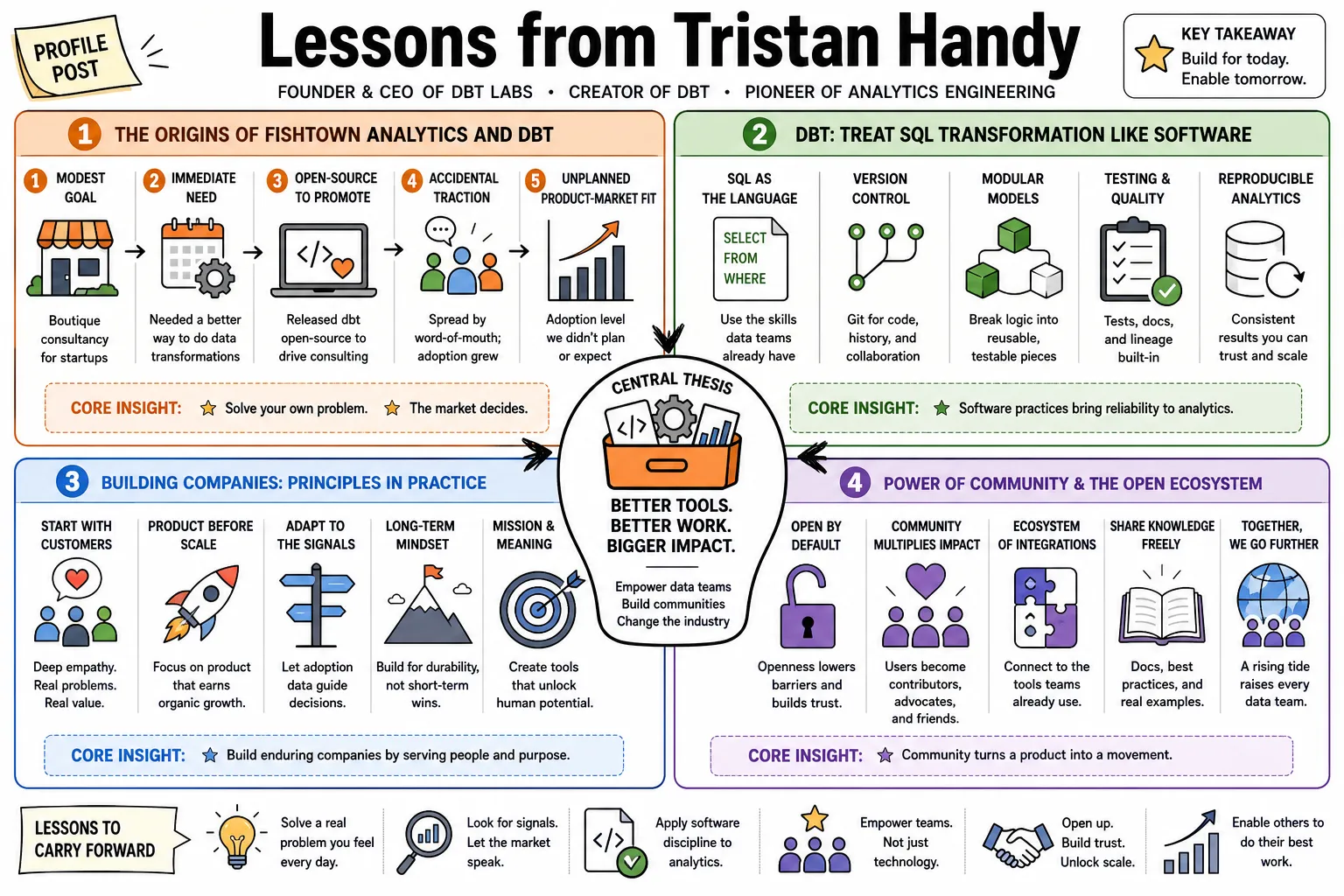
Lessons from Tristan Handy
Tristan Handy is the founder and CEO of dbt Labs and the creator of dbt. By treating SQL data transformation like software development, he established the analytics engineering workflow and changed how data teams structure code and collaborate. This profile collects his thoughts on building companies and communities, and the ideas shaping modern data infrastructure.
Part 1: The Origins of Fishtown Analytics and dbt
- On the founding goal: "Fishtown Analytics was originally started with a modest goal: to operate as a boutique consultancy helping startups manage their data systems." — Source: [First Round Review]
- On the initial need for dbt: "Within weeks of starting the consultancy, we realized we needed a more efficient way to perform data transformations to speed up our own client work." — Source: [First Round Review]
- On open-sourcing the product: "We released dbt as an open-source project primarily to generate interest in our consulting services, never expecting it to gain significant traction." — Source: [First Round Review]
- On accidental product-market fit: "The tool spread through word-of-mouth as data teams at other companies began adopting it, leading to a level of adoption we had not planned for." — Source: [Business Insider]
- On raising venture capital: "I initially resisted raising venture capital, but eventually decided it was necessary to properly support the tool and avoid doing a disservice to our growing community." — Source: [First Round Review]
- On transitioning to a SaaS company: "As dbt’s popularity exploded, we had to transition from a services-first business to a software company." — Source: [Inc. Magazine]
- On naming the company: "We named the consultancy Fishtown Analytics after the neighborhood in Philadelphia where I lived at the time." — Source: [First Round Review]
- On the early days of consulting: "We initially focused on providing data talent for hire to help venture-funded startups build out their internal analytics." — Source: [Medium]
- On resisting traditional paths: "We were not trying to build a billion-dollar company at first; we simply wanted to solve the problems in front of us as consultants." — Source: [First Round Review]
- On the rebranding to dbt Labs: "In 2021, we officially rebranded from Fishtown Analytics to dbt Labs to align the organization directly with the name of our breakout product." — Source: [First Round Review]
Part 2: Defining Analytics Engineering
- On bridging the gap: "dbt is a tool that bridges the gap between data analysts who understand business questions and data engineers who manage pipelines." — Source: [Mixpanel Signals & Stories]
- On applying software principles: "The core idea of analytics engineering is enabling data professionals to apply software engineering best practices, like version control and testing, to data." — Source: [The MAD Podcast]
- On the persistence of SQL: "SQL has remained persistent in the industry because it is the lingua franca of data, accessible enough for analysts but powerful enough for complex transformations." — Source: [The Work Behind the Data Work]
- On the creation of a new role: "We did not invent the analytics engineer, but we helped name and define a workflow that many frustrated analysts were already trying to piecemeal together." — Source: [The Analytics Engineering Podcast]
- On moving beyond Excel: "My own transition from an Excel user to a software founder mirrored the industry's shift toward code-driven analytics workflows." — Source: [Mixpanel Signals & Stories]
- On data quality: "Applying software engineering practices to data is fundamentally about testing and trusting the outputs of your data pipelines." — Source: [The MAD Podcast]
- On empowering analysts: "By giving analysts the tools to transform data themselves, we remove the bottleneck of waiting on data engineering teams to build new tables." — Source: [Mixpanel Signals & Stories]
- On version control: "Treating analytical code like software means version control is non-negotiable; it creates a history of truth and a rollback mechanism for data." — Source: [The Analytics Engineering Podcast]
- On workflow over tooling: "Analytics engineering is more of a workflow and a mindset than it is any single piece of software." — Source: [The Analytics Engineering Roundup]
- On modularity in SQL: "Writing modular SQL allows teams to reuse logic rather than copying and pasting thousand-line scripts, drastically reducing errors." — Source: [The Analytics Engineering Podcast]
Part 3: The Modern Data Stack Evolution
- On the term Modern Data Stack: "The modern data stack is a historical progression rather than a static set of tools; to know where it is going, you must understand where it has been." — Source: [Mixpanel Signals & Stories]
- On vendor collaboration: "Once the MDS became part of the lexicon, founders had reason to claim the moniker. The end-to-end problem was too big for one startup, so swim lanes were established and partnership ruled the day." — Source: [The Analytics Engineering Roundup]
- On the cloud warehouse shift: "The entire ecosystem shift was predicated on the rise of cloud-based data warehouses like Redshift, Snowflake, and BigQuery making compute cheap and scalable." — Source: [The MAD Podcast]
- On unbundling: "The modern data stack unbundled the monolithic BI tools of the past into specialized ingestion, storage, transformation, and visualization layers." — Source: [The Analytics Engineering Roundup]
- On capitalism and ideas: "Vendors claiming the MDS moniker is not a conspiracy; it is just how capitalism and ideas work when a concept reaches critical mass." — Source: [The Analytics Engineering Roundup]
- On diversification of compute: "We are seeing a diversification of compute environments, where vendors create optimizations specific to their own workloads, with a unified layer on top." — Source: [The Analytics Engineering Roundup]
- On utility compute: "Utility compute is not a substitute for processing chunky production workloads, but it allows for very significant optimizations specific to particular analytical tasks." — Source: [The Analytics Engineering Roundup]
- On the death of the MDS: "Debates about whether the Modern Data Stack is dead miss the point; the principles of cloud-native, modular data architecture are permanently established." — Source: [The MAD Podcast]
- On the integration phase: "After a period of massive unbundling and vendor proliferation, the market naturally swings back toward integration and consolidation for a smoother user experience." — Source: [EnterpriseReady Podcast]
- On the gravity of storage: "Data has gravity; wherever the data is stored in the cloud warehouse dictates the center of the ecosystem that surrounds it." — Source: [The Analytics Engineering Podcast]
Part 4: Community-Led Growth
- On organic community: "The best way to create a community is not to try to force it, but to focus on advancing the conversation in the field." — Source: [Founded & Funded]
- On supporting users first: "Fishtown Analytics exists to support the dbt community, rather than the other way around." — Source: [dbt Labs Blog]
- On community intimacy: "At the beginning, everything is sparkling. But after that comes the growing pains of intimacy, which can include unfulfilled needs between a company and its users." — Source: [The Analytics Engineering Roundup]
- On scaling open-source: "One of the biggest challenges in scaling an open-source business is maintaining the trust of the early community while building a commercial platform." — Source: [EnterpriseReady Podcast]
- On conversational growth: "Our growth strategy was not traditional marketing; it was participating in Slack channels, answering questions, and helping people solve actual problems." — Source: [How to Win with Peep Laja]
- On the value of Slack: "The dbt Slack community became the town square for analytics engineering because it was a place where practitioners could share knowledge without being sold to." — Source: [Founded & Funded]
- On event-driven community: "Hosting Coalesce was not about throwing a vendor conference; it was about gathering the practitioners who were defining this new category." — Source: [How to Win with Peep Laja]
- On community as a moat: "Software can be replicated, but a highly engaged, supportive community of thousands of practitioners is nearly impossible to copy." — Source: [How to Win with Peep Laja]
- On open source contribution: "We view every pull request and community contribution as a signal of trust that we must continually earn back." — Source: [EnterpriseReady Podcast]
Part 5: The Semantic Layer and Future Tooling
- On defining the semantic layer: "The semantic layer is about defining business logic like revenue or active users in code once, and allowing every downstream tool to query that same definition." — Source: [The MAD Podcast]
- On metric consistency: "Without a semantic layer, every BI tool and Python script inevitably recalculates core metrics differently, leading to boardroom arguments over whose numbers are right." — Source: [The MAD Podcast]
- On headless BI: "By decoupling the definition of metrics from the visualization of metrics, we pave the way for headless BI, where any tool can consume trusted metrics via an API." — Source: [The Analytics Engineering Podcast]
- On epistemic truth: "A central challenge in data is achieving epistemic truth within an organization, agreeing on what a metric means and having a system that guarantees that definition." — Source: [Founded & Funded]
- On the evolution of BI: "The future of business intelligence looks less like monolithic dashboarding tools and more like flexible interfaces built on top of a unified semantic foundation." — Source: [The Work Behind the Data Work]
- On code as governance: "Defining metrics in code within the transformation layer provides the version control and governance that visual BI tools historically lacked." — Source: [The Analytics Engineering Podcast]
- On organizational trust: "When business users stop trusting the dashboard, they stop using data; the semantic layer is fundamentally an infrastructure for restoring trust." — Source: [The MAD Podcast]
- On metric abstraction: "Abstracting metrics away from the database tables allows data teams to refactor underlying data models without breaking every executive dashboard." — Source: [The Analytics Engineering Roundup]
- On the interface problem: "We have largely solved the data storage and compute problems; the next frontier is solving the interface problem for how humans and applications consume data." — Source: [The Work Behind the Data Work]
Part 6: Data Teams and Organizational Dynamics
- On big data at FAANG: "The problem with the idea of working with petabytes of data is that this has all pretty much been solved in FAANG, and it is being solved by SWEs, not DEs." — Source: [The Analytics Engineering Roundup]
- On the truth-seeking nature of data: "Data work is inherently a truth-seeking exercise; you are trying to accurately represent the complex reality of a business in structured tables." — Source: [The Analytics Engineering Roundup]
- On data team structure: "The most effective data teams operate like product teams, with the data warehouse as their product and internal business stakeholders as their users." — Source: [The Analytics Engineering Podcast]
- On the limits of scale: "The appeal of massive scale is exciting, but for the vast majority of companies, the real challenge is business logic complexity, not petabyte-scale data volume." — Source: [The Analytics Engineering Roundup]
- On centralized vs decentralized teams: "The pendulum always swings between centralized and decentralized data teams; the right architecture allows centralized governance with decentralized creation." — Source: [The Analytics Engineering Podcast]
- On empathy in data: "Good analytics engineers must have deep empathy for the business user; writing perfect SQL is useless if it answers the wrong question." — Source: [Mixpanel Signals & Stories]
- On data as a bottleneck: "If every new business question requires a data engineer to build a custom pipeline, the organization will inevitably move too slowly." — Source: [Mixpanel Signals & Stories]
- On the value of analysts: "Analysts should be spending their time analyzing data and generating insights, not fighting with infrastructure or rewriting boilerplate queries." — Source: [The Analytics Engineering Podcast]
- On cross-functional trust: "The relationship between data teams and the rest of the business is built entirely on the reliable delivery of accurate numbers over time." — Source: [Founded & Funded]
Part 7: Writing, Thinking in Public, and The Roundup
- On the purpose of the newsletter: "I try very hard to take my CEO hat off when I write the Analytics Engineering Roundup and just write as a longtime data practitioner." — Source: [The Analytics Engineering Roundup]
- On content marketing vs writing: "The point of the newsletter has never been product update or content marketing. It has always primarily been about linking to whatever it is that I am reading at the time." — Source: [The Analytics Engineering Roundup]
- On thinking in public: "Publishing the newsletter for years forces me to read broadly and to think in public about where our industry is heading." — Source: [The Analytics Engineering Roundup]
- On the origin of the Roundup: "I started the Roundup in 2015 simply because I was curating articles on data infrastructure for my own understanding and figured others might find it useful." — Source: [The Analytics Engineering Roundup]
- On long-form writing: "In an era of quick takes on social media, long-form writing remains the best way to wrestle with the complex, nuanced shifts in data architecture." — Source: [The Analytics Engineering Roundup]
- On industry curation: "Curating the writing of others is a way of mapping the territory of analytics engineering as it is actively being built by the community." — Source: [The Analytics Engineering Roundup]
- On separating roles: "Balancing the voice of an industry observer with the responsibilities of a CEO requires actively stepping back from the product roadmap to look at the broader ecosystem." — Source: [The Analytics Engineering Roundup]
- On consistency: "The sheer act of showing up to write every week for years builds a compound interest of trust with your readership that cannot be hacked." — Source: [The Analytics Engineering Roundup]
- On the value of reading: "You cannot form an accurate thesis about the future of data without spending a significant portion of your time reading the practical experiences of people doing the work." — Source: [The Analytics Engineering Roundup]
Part 8: AI and the Next Era of Data
- On AI agents in data: "We are moving toward a world where AI agents can interact with the analytics engineering workflow, but they will require a highly structured semantic foundation to be effective." — Source: [The Analytics Engineering Podcast]
- On LLMs and SQL: "Language models are getting very good at writing SQL, but they still need to know the specific definitions and join paths of your business, which is exactly what dbt provides." — Source: [The Analytics Engineering Podcast]
- On the AI hype cycle: "Beyond the immediate hype, the real value of AI in the data space will be in automating the rote, boilerplate tasks so engineers can focus on complex architectural design." — Source: [The Analytics Engineering Roundup]
- On human-in-the-loop: "Data transformation will likely remain a human-in-the-loop process for a long time; AI will act as a powerful copilot instead of a replacement for the analytics engineer." — Source: [The Work Behind the Data Work]
- On context for AI: "An LLM is useless if it hallucinates a revenue number; providing deterministic context via a semantic layer is how you ground AI in ground-truth data." — Source: [The Analytics Engineering Podcast]
- On the democratization of data: "AI interfaces will finally deliver on the decades-old promise of true self-serve BI, allowing any business user to query data using natural language." — Source: [The Analytics Engineering Podcast]
- On code maintenance: "AI will drastically reduce the cost of maintaining and refactoring legacy data pipelines, making it easier for teams to migrate off older systems." — Source: [The Analytics Engineering Roundup]
- On the enduring need for modeling: "No matter how smart AI gets, businesses will always need to explicitly define their logic and rules; data modeling is not going away, it is just evolving." — Source: [The Analytics Engineering Podcast]
- On the future data practitioner: "The future analytics engineer will spend less time writing syntax and more time acting as the editor and architect of the organization's knowledge graph." — Source: [The Analytics Engineering Roundup]