Lessons from Tuomas Sandholm
Carnegie Mellon computer science professor Tuomas Sandholm uses computational game theory to solve complex allocation problems. He built the first AI to beat human professionals at multiplayer poker and designed the algorithms that match kidney donors with patients nationwide. This collection covers his work on optimizing large markets and managing hidden information under uncertainty.
Part 1: Mastering Imperfect Information
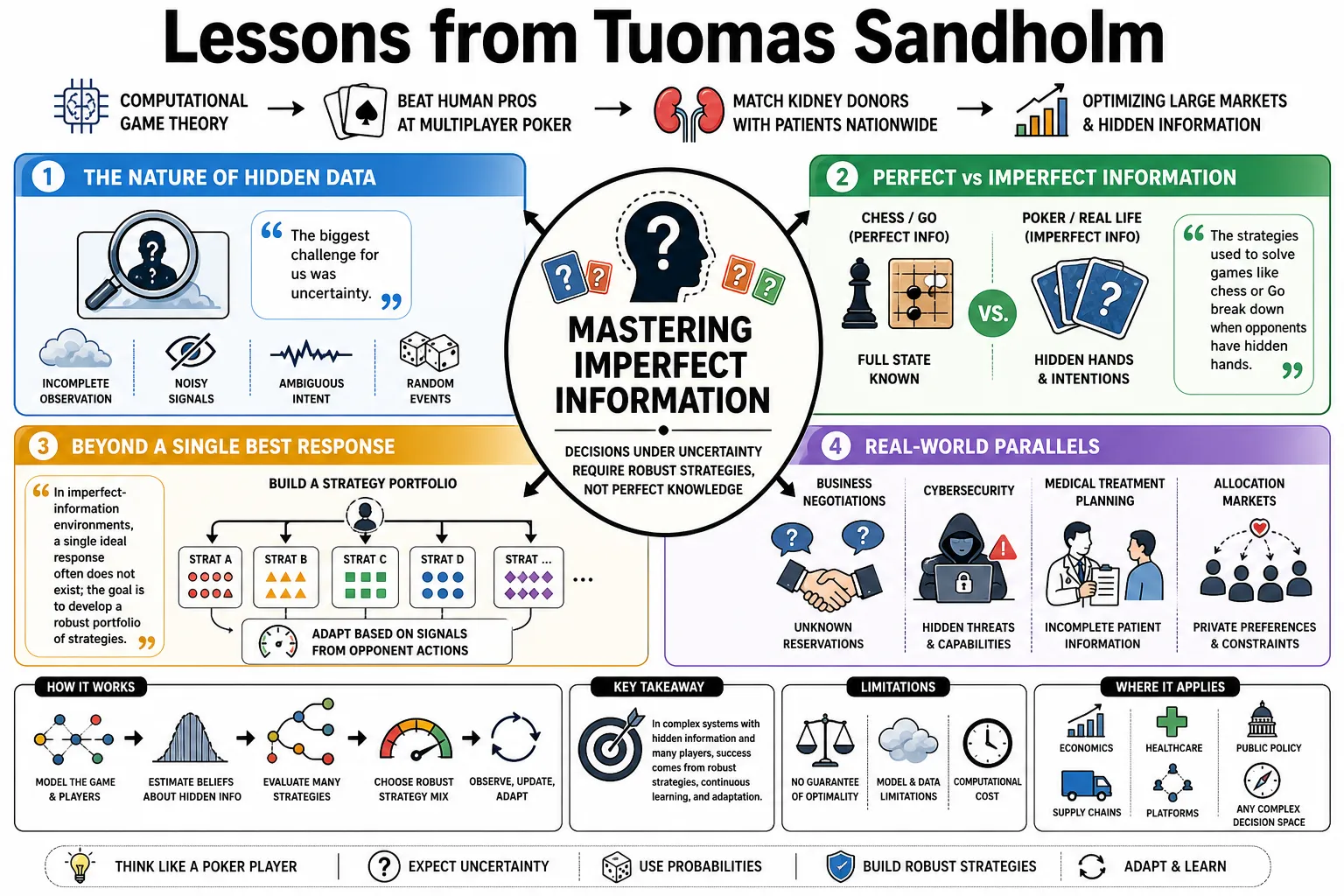
- On the nature of hidden data: "The biggest challenge for us was uncertainty." — Source: [Medium]
- On perfect versus imperfect information: "The strategies used to solve games like chess or Go break down when opponents have hidden hands, requiring a completely different algorithmic approach." — Source: [The TWIML AI Podcast]
- On avoiding a single ideal response: "In imperfect-information environments, a single ideal response often does not exist; the goal is to develop a robust portfolio of strategies that account for the signals conveyed by opponent actions." — Source: [Medium]
- On real-world parallels: "Business negotiations, cybersecurity, and medical treatment planning all involve hidden information, making them closer to poker than to chess." — Source: [Futurity]
- On the limitations of past AI: "Before recent breakthroughs, strategic reasoning with imperfect information was a long-standing hurdle that eluded AI researchers for decades." — Source: [The Guardian]
- On subgame solving: "To address missing information without solving the entire game tree from the beginning, AI can calculate strategies for specific situations as they arise." — Source: [The TWIML AI Podcast]
- On equilibrium: "The core objective in these games is to find a Nash equilibrium approximation, ensuring the algorithm cannot be consistently exploited even if the opponent knows its strategy." — Source: [Lex Fridman Podcast]
- On misdirection: "You have to account for bluffing and misleading signals, which are fundamentally necessary behaviors in environments where actors conceal their true state." — Source: [Pittsburgh Supercomputing Center]
- On interpreting actions: "Every move an opponent makes in a hidden-information setting leaks probabilistic information about their underlying position." — Source: [Carnegie Mellon University]
- On algorithmic milestones: "The best AI's ability to do strategic reasoning with imperfect information has now surpassed that of the best humans." — Source: [Carnegie Mellon University]
Part 2: The Poker AI Breakthroughs
- On expected outcomes: "I didn't expect that we would win by this much. I thought we had a 50-50 chance." — Source: [TIME]
- On external skepticism: "Prior to the Libratus match, international betting sites had the AI listed as a heavy 4-1 underdog against professional human players." — Source: [The Guardian]
- On poker as a benchmark: "Poker is now a benchmark for artificial intelligence research, just as chess once was." — Source: [PBS]
- On overnight learning: "Libratus did not just rely on pre-computed strategies; it ran background computations each night on a supercomputer to patch weaknesses the human professionals had discovered during the day." — Source: [Pittsburgh Supercomputing Center]
- On multiplayer dynamics: "Pluribus demonstrated that AI could succeed in six-player poker, a setting where traditional zero-sum game theory guarantees like Nash equilibrium no longer strictly apply." — Source: [Carnegie Mellon University]
- On unpredictability: "A dominant strategy in poker requires the agent to be unpredictable and to bluff actively, rather than just playing mathematically safe hands." — Source: [Pittsburgh Supercomputing Center]
- On bet sizing: "The AI often used unconventional bet sizes, such as massive overbets, which disrupted human professionals who were accustomed to standard betting patterns." — Source: [Lex Fridman Podcast]
- On computing power: "Achieving superhuman performance required millions of core hours on the Bridges supercomputer to compute the base strategy before the match even began." — Source: [Pittsburgh Supercomputing Center]
- On emotional fatigue: "While human players grew exhausted and tilted over the course of a 20-day tournament, the AI maintained exact mathematical consistency." — Source: [Lex Fridman Podcast]
- On the scale of the challenge: "This challenge is so huge and complicated that it's been elusive to AI researchers until now." — Source: [The Guardian]
Part 3: Kidney Exchanges and Mechanism Design
- On the matching problem: "The clearing problem involves finding a social welfare maximizing set of non-overlapping short cycles. We proved this is NP-hard." — Source: [Carnegie Mellon University]
- On logistical constraints: "These cycles have to occur atomically at the same time and the surgeons are actually on cell phones across the country." — Source: CMU Lecture
- On early obstacles: "The computational difficulty of matching patients and donors was one of the primary barriers to establishing a national kidney exchange." — Source: [Carnegie Mellon University]
- On altruistic chains: "We used our algorithms to launch the first never-ending altruistic donor chains." — Source: [HIIT Lecture]
- On dynamic matching: "Relying on short-sighted, myopic matching misses opportunities; systems must account for the future arrival of new donors and patients over time." — Source: [Carnegie Mellon University]
- On last-minute dropouts: "Algorithms must generate transplant plans that are robust enough to survive execution failures, such as a donor failing a final medical screening just before surgery." — Source: [AAAI]
- On original inspiration: "It became clear to me that there were lots of interesting algorithmic issues to look at after hearing a talk by economist Alvin Roth." — Source: [Pittsburgh Post-Gazette]
- On handling memory limits: "Incremental problem formulation is necessary to handle the massive scale of nationwide kidney exchange data that would otherwise crash standard optimization solvers." — Source: [Carnegie Mellon University]
- On moral algorithms: "Designing these systems requires formalizing medical ethics and policy goals into objective mathematical constraints." — Source: [Lex Fridman Podcast]
- On continuous operation: "The algorithms clear the nationwide exchange autonomously on a regular schedule, continuously searching for the optimal set of life-saving surgeries." — Source: [Carnegie Mellon University]
Part 4: Combinatorial Auctions
- On non-additive valuation: "Combinatorial auctions lead to more efficient allocations when bidders' valuations of items are not strictly additive, allowing them to bid on specific bundles." — Source: [Carnegie Mellon University]
- On calculating winners: "Determining the winning set of bids to maximize revenue in a combinatorial auction is fundamentally an NP-complete problem." — Source: [Carnegie Mellon University]
- On price quotes: "Quotes, even exact quotes, in combinatorial auctions have some interesting properties. The quote on a combination is not necessarily the sum of the quotes on individual items." — Source: [Carnegie Mellon University]
- On scaling up: "Practical algorithms can scale to handle massive numbers of items and bids because the space of possible combinations is rarely fully populated in real-world scenarios." — Source: [IJCAI]
- On preference elicitation: "To avoid the problem of exponentially many potential bids, auctioneers should selectively query bidders only for information necessary to determine the optimal allocation." — Source: [University of Toronto Research]
- On search-based approaches: "Optimal winner determination is best handled through specialized tree search algorithms that aggressively prune suboptimal allocation branches." — Source: [AAAI]
- On industrial sourcing: "These mechanisms have been used to clear tens of billions of dollars in real-world corporate sourcing auctions, moving far beyond theoretical models." — Source: [Semantic Scholar]
- On package bidding: "Allowing participants to express strict conditions, such as only accepting item A if they also win item B, eliminates exposure risk for the bidder." — Source: [Washington University in St. Louis]
- On computational tractability: "While the worst-case time complexity of winner determination is exponential, the average-case complexity on real business data is often highly tractable." — Source: [Carnegie Mellon University]
Part 5: Navigating Uncertainty in Strategy
- On objective decision making: "AI can make better decisions than humans, which will make the world a better place." — Source: [Pittsburgh Quarterly]
- On delegating hard choices: "It’s not so demeaning when we need to even think about what is demeaning when algorithms handle life-and-death triage decisions more fairly than stressed humans." — Source: CMU Lecture
- On automated negotiation: "Algorithms can remove emotional bias and spite from negotiations, finding the mathematical clearing price that maximizes mutual utility." — Source: [Lex Fridman Podcast]
- On adversarial environments: "When facing an opponent actively trying to deceive you, traditional machine learning models that assume a static environment fail completely." — Source: [Carnegie Mellon University]
- On strategic abstraction: "To solve massive games, you must first compress the state space into a smaller, mathematically similar version, solve that abstraction, and map the strategy back." — Source: [The TWIML AI Podcast]
- On continuous refinement: "Once a baseline strategy is established, the AI must continuously compute real-time refinements to navigate the precise situations that arise during execution." — Source: [Lex Fridman Podcast]
- On the limits of human intuition: "Professional players often rely on recognized patterns, but algorithms frequently uncover profitable, counter-intuitive strategies that humans never considered." — Source: [TIME]
- On dynamic risk: "Evaluating a decision requires calculating not just its immediate expected value, but how it shifts the probability distribution of all future opponent actions." — Source: [Carnegie Mellon University]
- On strategic secrecy: "A system that plays optimally does not need to hide its algorithm; the math guarantees a certain baseline performance regardless of what the opponent knows." — Source: [Pittsburgh Supercomputing Center]
Part 6: Computational Complexity
- On algorithmic limits: "Reaching the exact optimal solution in complex economic games requires resources that scale exponentially, forcing a reliance on highly optimized search heuristics." — Source: [ResearchGate]
- On memory generation: "Column generation allows solvers to keep only the most promising variables in active memory, making it possible to solve problems that would otherwise exceed RAM limits." — Source: [Carnegie Mellon University]
- On search pruning: "The speed of a search algorithm depends entirely on how quickly it can prove that a given branch of possibilities will not yield the best outcome." — Source: [AAAI]
- On empirical testing: "Theoretical guarantees of complexity classes matter less than how an algorithm behaves on the specific distribution of data found in the real world." — Source: [Carnegie Mellon University]
- On parallelization: "Distributing game theory computations across supercomputer nodes requires specialized algorithms to minimize the communication overhead between processors." — Source: [Pittsburgh Supercomputing Center]
- On regret matching: "Counterfactual Regret Minimization works by having an algorithm play itself repeatedly, continuously adjusting its strategy away from actions that yielded poor results." — Source: [The TWIML AI Podcast]
- On endgame solving: "As a game tree approaches its conclusion, the number of remaining states shrinks enough that the algorithm can solve the remainder perfectly in real time." — Source: [Carnegie Mellon University]
- On hardware reliance: "Algorithmic breakthroughs, rather than just raw hardware improvements, were the primary driver behind solving large-scale imperfect-information games." — Source: [Carnegie Mellon University]
- On state translation: "The ability to dynamically translate between a compressed abstract game and the full original game is what makes real-time strategic reasoning possible." — Source: [The TWIML AI Podcast]
Part 7: Real-World Implementation
- On medical adoption: "Transitioning kidney exchange algorithms from academic papers to national clinical use required aligning the incentives of individual transplant centers." — Source: [Pittsburgh Post-Gazette]
- On commercialization: "Research algorithms often need to be rewritten from scratch to meet the reliability and interface demands of corporate clients." — Source: [Carnegie Mellon University]
- On defense applications: "The same principles used to bluff in poker can be applied to cybersecurity, placing traps and honeypots to deceive network intruders." — Source: [Futurity]
- On bidding languages: "For combinatorial auctions to work in industry, buyers must be given an intuitive interface to express complex, conditional preferences without writing code." — Source: [University of Toronto Research]
- On trust in AI: "Getting human experts to trust an algorithmic recommendation often requires the system to explain the economic rationale behind its suggested allocation." — Source: [Lex Fridman Podcast]
- On policy integration: "Medical algorithms cannot run in a vacuum; they must be updated continuously to reflect changes in national organ allocation legislation." — Source: [Carnegie Mellon University]
- On market thickness: "The success of any matching algorithm depends on having a large, highly liquid pool of participants to increase the density of potential connections." — Source: [HIIT Lecture]
- On computing costs: "The economic value generated by an optimized allocation must heavily outweigh the massive server costs required to compute it." — Source: [Pittsburgh Supercomputing Center]
- On iterative deployment: "Live systems should be deployed incrementally, allowing researchers to monitor edge cases and adjust the objective functions based on observed outcomes." — Source: [Carnegie Mellon University]
Part 8: The Future of Autonomous Decision Making
- On superhuman reasoning: "We have crossed the threshold where machines are undeniably better than humans at formulating strategy under conditions of hidden information." — Source: [Carnegie Mellon University]
- On multi-agent systems: "The next frontier involves coordinating groups of autonomous agents acting on behalf of humans in complex, overlapping markets." — Source: [Lex Fridman Podcast]
- On ethical alignment: "As algorithms take over high-stakes optimization problems, the primary human task shifts from making decisions to precisely defining the mathematical constraints of fairness." — Source: CMU Lecture
- On the limits of learning: "Pure deep learning without structured search mechanisms will struggle to find mathematically rigorous equilibria in complex strategic environments." — Source: [The TWIML AI Podcast]
- On automated strategy: "Corporations will eventually rely on AI to compute optimal pricing, inventory, and negotiation strategies against competitors using similar software." — Source: [Semantic Scholar]
- On computational economics: "The boundary between computer science and economics has dissolved; mechanism design is now fundamentally an algorithmic discipline." — Source: [Washington University in St. Louis]
- On long-term planning: "AI will move beyond momentary tactical decisions toward executing multi-year strategic plans that account for thousands of variables and cascading uncertainties." — Source: [Carnegie Mellon University]
- On public perception: "Initial skepticism about an AI's ability to handle domains previously thought to require human intuition usually vanishes once the empirical results are demonstrated." — Source: [TIME]
- On the trajectory of AI: "The continuous improvement of algorithmic search and state abstraction ensures that AI will progressively solve problems with wider scopes and deeper uncertainties." — Source: [Pittsburgh Quarterly]