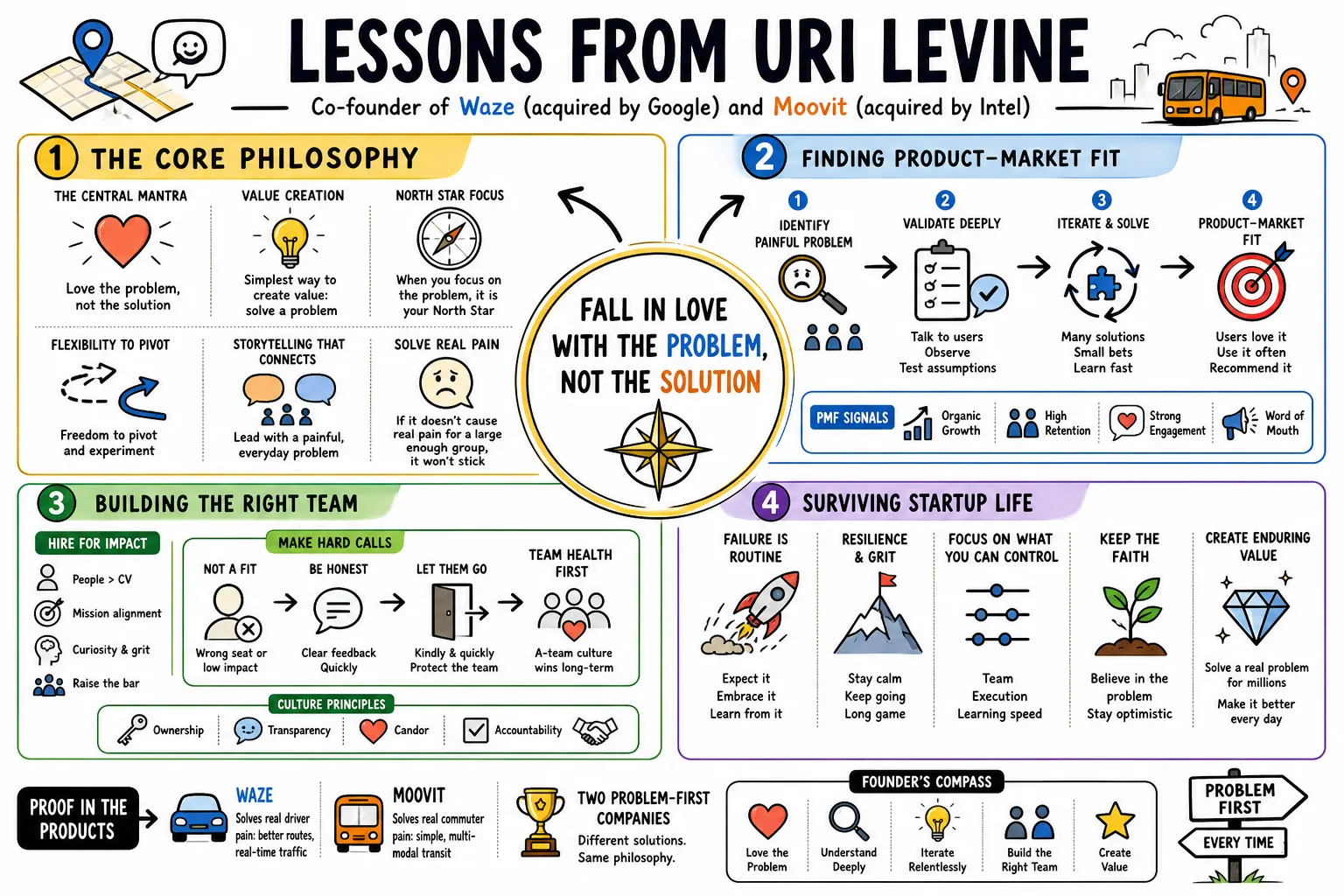
Lessons from Uri Levine
Uri Levine co-founded the navigation app Waze, acquired by Google, and the transit app Moovit, acquired by Intel. He tells founders to "fall in love with the problem, not the solution," meaning they should focus on a specific consumer pain point rather than a rigid technology. This profile collects his advice on finding product-market fit, making hard hiring choices, and surviving the routine failures of startup life.
Part 1: The Core Philosophy
- On The Central Mantra: "Fall in love with the problem, not the solution." — Source: Medium
- On Value Creation: "The simplest way to create value is to solve a problem." — Source: Chief Executive
- On Maintaining Focus: "When you focus on the problem, the problem will serve as the North Star of your journey." — Source: Chief Executive
- On Flexibility: Loving the problem gives you the freedom to pivot and experiment because you remain unattached to any single failed solution. — Source: Medium
- On Storytelling: Centering your pitch on a painful, everyday problem helps investors and users immediately connect with your vision. — Source: Lenny's Newsletter
- On Solving Real Pain: If a problem does not cause actual pain for a large number of people, it is likely not worth building a business around. — Source: Forbes India
- On Longevity: Successful companies like Google and Uber continue to be used largely the same way they were on day one because they solved a core problem correctly from the start. — Source: Next Big Idea Club
- On Avoiding Ego: Focusing on the problem removes ego from the product development process, making it easier to accept critical user feedback. — Source: Medium
- On The Origin of Waze: Levine says Waze had the same mission from day one: help drivers avoid traffic jams by using information from drivers already ahead on the road. — Reference: Leaders interview on Waze mission and traffic jams
- On Emotional Resilience: Being obsessed with a problem provides the emotional fuel required to survive the exhausting rollercoaster of the startup lifecycle. — Source: Podbean
Part 2: Ideation and Validation
- On The 100 People Rule: Before building any product, speak to at least 100 potential users to understand their perception of the problem. — Source: Adam Mendler
- On Instant Comprehension: If you cannot explain the problem to your target audience and have them grasp it within seconds, it is not a viable foundation for a startup. — Source: Forbes India
- On False Positives: Just because you personally experience a frustration does not mean enough other people care about it to sustain a business. — Source: Jewish News
- On Pre-Journey Research: The primary goal before starting a company is validating whether a specific pain point is genuinely shared by a wide audience. — Source: Forbes India
- On Asking Why: The most important tool for understanding users is observing them and repeatedly asking "why" they behave the way they do. — Source: Jeremy Utley
- On Listening to the Market: If you build something users do not actually care about, another founder will eventually come along and solve the problem in a way that they do. — Source: London Speaker Bureau
- On Evaluating Ideas: A great idea is worthless if it addresses a problem that consumers are ultimately willing to live with. — Source: Forbes India
- On Direct Engagement: Do not rely solely on surveys; have actual conversations with potential customers to hear the emotion and frustration in their voices. — Source: Adam Mendler
- On Validating the Pain: Levine tells founders to validate a big problem before building: if many people immediately recognize the pain and describe their own experience with it, the problem may be worth pursuing. — Reference: Forbes India interview on validating a problem worth solving
Part 3: Product-Market Fit and Retention
- On The Ultimate Metric: "The ultimate measure of product-market fit is customer retention." — Source: Lenny's Newsletter
- On PMF or Death: Achieving product-market fit is a binary outcome for startups; it is essentially "product-market fit or die." — Source: Lenny's Newsletter
- On True Value: If customers do not consistently return to your product, you have not created enough value, regardless of your download numbers or initial hype. — Source: IE University
- On Patience: Achieving product-market fit often takes years; it took the Waze team four years of iteration to finally reach that milestone. — Source: IE University
- On Defining PMF: Product-market fit simply means that you are successfully creating tangible value for your users. — Source: IE University
- On Feature Bloat: Levine frames product-market fit as creating value that keeps users coming back; once a product solves that core job, founders should avoid drifting away from the value users actually return for. — Reference: Forbes India interview on product-market fit and retention
- On Sequencing: You must establish product-market fit before you attempt to build a business model or aggressively scale. — Source: Thought Economics
- On User Churn: A high churn rate is the clearest signal that your assumed solution is not adequately addressing the user's actual problem. — Source: Mobility Innovators
- On Simplicity: Levine points out that daily products like Waze, Google, and WhatsApp feel largely unchanged after product-market fit because the original user value remains simple and durable. — Reference: Forbes India interview on durable product-market fit
- On Consistent Behavior: If your product genuinely solves a daily problem, using it will organically become a daily habit for your customers. — Source: Next Big Idea Club
Part 4: Speed and Imperfection
- On The Enemy of Good: "The biggest enemy of good enough isn't perfect; you don't need to be perfect. In order to be successful, you need to be good enough." — Source: Kara Goldin
- On Building Crappy Products: Founders should be willing to build something "crappy" just to get it into the hands of users as quickly as possible. — Source: Medium
- On Real-World Feedback: Internal assumptions are useless compared to the actual data and feedback you receive when real people interact with a live product. — Source: Medium
- On Speed Over Polish: Delaying a launch to perfect the user interface wastes time that could be spent learning whether the core mechanism actually works. — Source: One Knight in Product
- On The Illusion of Perfection: Because you cannot predict exactly what users want, waiting to launch a perfect solution is a dangerous trap. — Source: Ulad Shauchenka
- On Iteration Speed: The faster you can launch, gather feedback, and release a new version, the higher your likelihood of eventual success. — Source: IE University
- On Overthinking: Do not wait for a perfect decision. Make a good enough decision quickly and adjust your course based on the results. — Source: One Knight in Product
- On First Versions: If you are not slightly embarrassed by the first version of your product, you likely spent too much time building it. — Source: Medium
- On Market Testing: A flawed product in the market teaches you infinitely more than a flawless product on a whiteboard. — Source: Bookey
Part 5: Failure and Resilience
- On Failing Fast: "Make your mistakes fast." — Source: Goodreads
- On The Fear of Failure: "If you are afraid to fail, you already failed because you failed to try." — Source: Medium
- On Preserving Runway: Failing fast allows you to identify what is broken while you still have the capital and time to pivot and try another approach. — Source: Forbes
- On The Nature of Startups: Building a new company is inherently a journey of failures because you are attempting something that has never been done before. — Source: Forbes
- On Increasing Your Odds: Entrepreneurship is like shooting a basketball from half-court. Failing fast gives you ten attempts instead of just one, drastically increasing your chance of scoring. — Source: Forbes
- On The Only Real Failure: The only true failure in the startup ecosystem is completely giving up on the problem you set out to solve. — Source: VC Cafe
- On Reframing Mistakes: Mistakes are not negative outcomes; they are mandatory data points that provide the feedback necessary to reach product-market fit. — Source: Forbes
- On Resilience: The defining trait of a successful founder is the ability to absorb a painful failure, quickly extract the lesson, and immediately launch the next iteration. — Source: The Varsity
- On Avoiding Complacency: Comfort is the enemy of innovation. A healthy culture embraces the risk of failure as a requirement for growth. — Source: Startup Lithuania
Part 6: Building the Team and Firing
- On Firing Over Hiring: "It is more important to fire fast than to hire right. Firing is a hard decision hiring is an easy one." — Reference: Forbes India interview on firing fast before hiring right
- On The 30-Day Test: Exactly 30 days after a new employee starts, you must ask yourself: "Knowing what I know today, would I hire this person again?" — Source: Medium
- On Immediate Action: If the answer to the 30-day test is "no," you must fire that employee immediately to prevent long-term damage to the company. — Source: Business Insider
- On Securing Talent: If the answer to the 30-day test is "yes," you should immediately tell the employee you are excited to have them and consider offering them more equity. — Source: Lenny's Newsletter
- On Culture Corrosion: Keeping an underperforming employee on the team will inevitably corrode company culture and drive your top performers to leave. — Source: EPS Pros
- On Startup Mortality: Roughly 50 percent of all startups fail entirely due to poor team-building and an inability to manage personnel effectively. — Source: Medium
- On Talent Density: A foundational rule for building a strong organization is that "A-players hire A-players," while B-players hire C-players. — Source: Medium
- On Early Detection: When a team member is not the right fit for a fast-paced environment, it is almost always apparent within their first month of work. — Source: The Street
- On Managerial Courage: Delaying a necessary firing is a failure of leadership that unfairly burdens the rest of the team. — Source: Forbes
- On Organizational Trajectory: An employee who struggles in their first 30 days is already on a trajectory toward failure, and hoping they will improve is a waste of time. — Source: Medium
Part 7: Leadership and Crisis Management
- On Decisive Action: "Successful CEOs make decisions with conviction. If you hesitate, your team will sense it, and confidence will erode." — Source: The Future Media
- On Integrity: "Say what you do and do what you say. Make hard decisions with conviction." — Source: Adam Mendler
- On The Startup Reality: The daily reality of running a startup is simply a relentless journey from one crisis to the next. — Source: Uri Levine
- On Cash Crises: When a startup's financial runway is jeopardized, leaders must act with absolute transparency and immediately restructure to survive. — Source: Lenny's Newsletter
- On PMF Crises: If market changes render your core product irrelevant, you must ruthlessly pivot back to the problem and find a new solution. — Source: Lenny's Newsletter
- On Transparent Communication: In crisis, Levine emphasizes speed, conviction, responsibility, and keeping people engaged through transparent communication so the team can keep moving instead of losing faith. — Reference: Lenny crisis-management episode on transparency and team motivation
- On Survival Mode: Levine treats survival mode as a runway problem: when revenue or funding suddenly changes, assess remaining cash, adjust expenses quickly, and make critical decisions before options narrow. — Reference: Lenny crisis-management episode on cash crises and runway
- On Navigating Uncertainty: Leaders cannot predict every market shift, but they can control how rapidly their organization responds to new realities. — Source: Lenny's Newsletter
- On Setting the Tone: The team will always mirror the CEO's emotional state during a disaster. Projecting calm conviction is a strategic necessity. — Source: The Future Media
Part 8: The Startup Journey and Scale
- On Fundraising: "If building a startup is a roller-coaster ride, then fund-raising is a roller coaster in the dark, you don't even know what's coming!" — Source: Goodreads
- On Venture Capitalists: "VCs are slow, until they think they're going to lose the deal." — Source: Goodreads
- On The Three Phases: Every successful startup must navigate three distinct phases: establishing product-market fit, finding a business model, and executing a growth strategy. — Source: IE University
- On Scaling Operations: Scaling effectively means transitioning away from a one-man show and building structural processes that support a larger team. — Source: The Future Media
- On Process vs. Bureaucracy: Implementing process is not about creating bureaucracy; it is about building the necessary foundation to manage rapid growth without collapsing. — Source: Tallyfy
- On Long-Term Commitment: Building a unicorn is rarely an overnight success. It often requires a decade of dedicated, grueling work. — Source: IE University
- On Strategic Exits: The decision to exit or sell a company should be based on evaluating the best possible future path for the product and the mission. — Source: Jerusalem Post
- On The Power of Narrative: The story you tell about the problem you are solving is your most valuable asset during both early fundraising and late-stage acquisitions. — Source: Uri Levine
- On The Ultimate Goal: Success is not just about a massive exit; it is about fundamentally disrupting inefficient markets and permanently solving a problem for millions of people. — Source: Next Big Idea Club