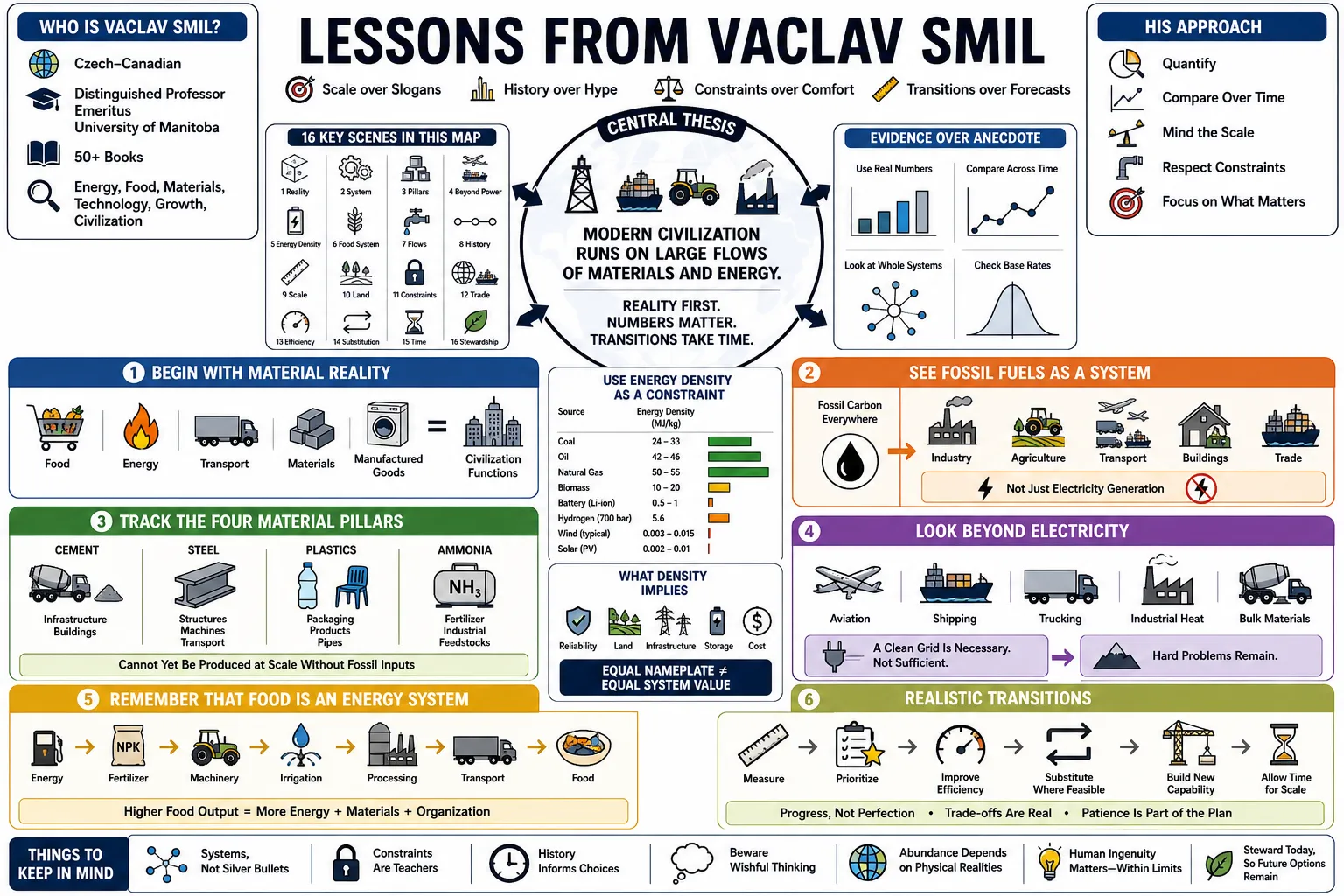
Vaclav Smil is a Czech-Canadian scientist, policy analyst, and Distinguished Professor Emeritus at the University of Manitoba. Across more than 50 books, he has studied energy, food, materials, technology, growth, and the biophysical foundations of modern civilization. These lessons reflect his preference for scale, historical comparison, quantified constraints, and realistic transitions over slogans or forecasts.
Energy and the Material Foundations of Civilization
- On Begin with Material Reality: Digital information may dominate attention, but food, energy, transport, and manufactured materials still determine how civilization functions. — Reference: Yale Environment 360 — Beyond Magical Thinking
- On See Fossil Fuels as a System: Modern prosperity rests on large flows of fossil carbon embedded across industry, agriculture, transport, buildings, and trade rather than only electricity generation. — Reference: Yale Environment 360 — Beyond Magical Thinking
- On Track the Four Material Pillars: Cement, steel, plastics, and ammonia deserve central attention because modern infrastructure and food systems cannot yet produce them at scale without fossil inputs. — Reference: Yale Environment 360 — Beyond Magical Thinking
- On Look Beyond Electricity: A clean grid would still leave difficult problems in aviation, shipping, trucking, industrial heat, and bulk material production. — Reference: Yale Environment 360 — Beyond Magical Thinking
- On Use Energy Density as a Constraint: Energy sources differ in density, reliability, land requirements, and infrastructure needs, so equal nameplate capacity does not imply equal system value. — Reference: Science — How Vaclav Smil Shaped Thinking About Energy
- On Remember That Food Is an Energy System: Raising food output requires energy, fertilizer, machinery, transport, and infrastructure; agriculture cannot be separated from the wider energy transition. — Reference: Yale Environment 360 — Beyond Magical Thinking
- On Treat Globalization as Physical: Modern globalization depends on moving heavy goods through ships, trucks, aircraft, ports, roads, and warehouses, all of which have stubborn material and fuel demands. — Reference: Yale Environment 360 — Beyond Magical Thinking
Transitions, Scale, and Infrastructure
- On Expect Energy Transitions to Take Time: Historical shifts between dominant energy sources unfolded over generations because supply systems, machines, skills, and institutions had to change together. — Reference: Science — How Vaclav Smil Shaped Thinking About Energy
- On Start with the Size of the System: A national or global transition is measured in billions of people, trillions of dollars, and billions of tons, not in the performance of a promising pilot. — Reference: New York Magazine — Vaclav Smil on Leaving Growth Behind
- On Do Not Confuse Capacity with Delivery: Intermittent generation, storage, transmission, and grid expansion must be evaluated as one system rather than counting renewable capacity alone. — Reference: Yale Environment 360 — Beyond Magical Thinking
- On Build Infrastructure as Part of the Plan: Energy goals are not credible unless they include the power, transport, food, and industrial infrastructure required by growing populations. — Reference: Yale Environment 360 — Beyond Magical Thinking
- On Respect Infrastructure Inertia: Power plants, factories, vehicles, buildings, and supply networks have long lifetimes, so replacing them faster than normal turnover carries immense cost and coordination risk. — Reference: Science — How Vaclav Smil Shaped Thinking About Energy
- On Compare Claims with Historical Rates: A proposed transition should be tested against the rates at which comparable systems have actually changed, not only against what engineering models permit in theory. — Reference: Yale Environment 360 — Beyond Magical Thinking
- On Treat Carbon Removal as an Industry: Removing even a modest share of emissions would require a new industry operating at a mass comparable to global oil production and storing material permanently. — Reference: New York Magazine — Vaclav Smil on Leaving Growth Behind
- On Avoid Artificial Deadlines: A deadline that ignores infrastructure, politics, and industrial scale can erode trust when it repeatedly fails rather than accelerating practical action. — Reference: DeSmog — Vaclav Smil Profile and Interview Record
Growth, Consumption, and Waste
- On Accept the Finite Planet: Material growth cannot continue without limit because energy, ecosystems, and conversion efficiencies all face physical boundaries. — Reference: New York Magazine — Vaclav Smil on Leaving Growth Behind
- On Reject Perfect Dematerialization: Efficiency can reduce material intensity, but a house still needs steel, lumber, glass, and other physical inputs; economic activity cannot become weightless. — Reference: New York Magazine — Vaclav Smil on Leaving Growth Behind
- On Expect Diminishing Efficiency Gains: As machines approach thermodynamic and material limits, extracting each additional percentage point of efficiency becomes harder. — Reference: New York Magazine — Vaclav Smil on Leaving Growth Behind
- On Separate Well-Being from Throughput: Affluent societies can reduce energy and material consumption substantially without surrendering the conditions that make life safe, healthy, and meaningful. — Reference: The Guardian — Vaclav Smil on Growth and Consumption
- On Move from Cowboy to Spaceship Thinking: A finite planet requires resource stewardship more like a closed spaceship than an open frontier with unlimited room for extraction and waste. — Reference: The Guardian — Vaclav Smil on Growth and Consumption
- On Use the Slack Already in the System: Before waiting for a breakthrough, remove waste from food, buildings, vehicles, and industrial processes where large savings are already technically possible. — Reference: New York Magazine — Vaclav Smil on Leaving Growth Behind
- On Cut Food Waste Before Expanding Supply: A system that discards a large share of its harvest also wastes the fuel, fertilizer, water, electricity, and labor used to produce it. — Reference: New York Magazine — Vaclav Smil on Leaving Growth Behind
- On Manage Decline Instead of Denying It: If material throughput must fall, societies should manage the adjustment deliberately rather than waiting for uncontrolled constraints to impose it. — Reference: The Guardian — Vaclav Smil on Growth and Consumption
Climate Action Without Magical Thinking
- On Set Goals from the System Up: Climate targets should begin with physical stocks, flows, replacement rates, and institutional capacity rather than be reverse-engineered from a preferred date. — Reference: DeSmog — Vaclav Smil Profile and Interview Record
- On Use the Accurate Middle: Durable solutions are more likely to emerge from a factually correct middle than from ideological extremes that simplify the problem. — Reference: DeSmog — Vaclav Smil Profile and Interview Record
- On Do Not Let Hype Reduce Effort: Sensational reporting about imminent technical rescue can create complacency by implying that behavioral change and efficiency no longer matter. — Reference: Pictet — Vaclav Smil on Innovation Hype and Missed Opportunities
- On Treat Fusion as a Long-Horizon Option: Experimental progress does not erase the decades required to prove commercial viability, build supply chains, and deploy infrastructure at useful scale. — Reference: Pictet — Vaclav Smil on Innovation Hype and Missed Opportunities
- On Question Small-Reactor Timelines: Small modular reactors should be judged by demonstrated cost, licensing, construction, and deployment rather than by repeated promises of near-term arrival. — Reference: Pictet — Vaclav Smil on Innovation Hype and Missed Opportunities
- On Beware Single-Metric Climate Narratives: Climate change is severe, but food security, biodiversity, water, public health, and geopolitical risks must also remain inside the decision frame. — Reference: Yale Environment 360 — Beyond Magical Thinking
- On Reduce SUV Demand as Well as Emissions: Efficiency gains can be canceled when consumers move toward heavier vehicles, larger homes, and more resource-intensive habits. — Reference: Yale Environment 360 — Beyond Magical Thinking
- On Define Sustainability Before Claiming It: A claim of sustainability is incomplete unless it states the system boundary, location, time horizon, and resource being sustained. — Reference: DeSmog — Vaclav Smil Profile and Interview Record
Technology, Innovation, and Hype
- On Do Not Generalize from Digital Speed: Rapid advances in computing can mislead people into expecting the same exponential pace from energy, transport, medicine, and heavy industry. — Reference: American Affairs — Technological Stagnation Is a Choice
- On Distinguish Invention from Deployment: A technical demonstration is only the start; mass adoption requires cost, reliability, regulation, production, distribution, and user acceptance. — Reference: Pictet — Vaclav Smil on Innovation Hype and Missed Opportunities
- On Study Failures After the Excitement: An invention can be celebrated and commercialized before its long-run harms, limitations, or inferior economics become visible. — Reference: Pictet — Vaclav Smil on Innovation Hype and Missed Opportunities
- On Ask What the Physics Implies for Cost: Drag, power density, material intensity, and other physical constraints often determine whether an apparently superior technology can become economical. — Reference: American Affairs — Technological Stagnation Is a Choice
- On Use Doubt as Quality Control: Systematically questioning assumptions is not pessimism; it is a way to expose missing quantities, implausible rates, and hidden dependencies. — Reference: The New Yorker — Vaclav Smil and the Value of Doubt
- On Avoid Permanent Exponential Stories: Even genuinely rapid improvements encounter physical, economic, or demand limits, so extrapolating an exponential indefinitely is unsafe. — Reference: The New Yorker — Vaclav Smil and the Value of Doubt
- On Do Not Forecast for Effect: Smil avoids confident forecasts because complex systems repeatedly defeat predictions that ignore interaction, contingency, and changing behavior. — Reference: The New Yorker — Vaclav Smil and the Value of Doubt
Knowledge, Method, and Realism
- On Quantify Before Arguing: A useful claim should be translated into units, rates, masses, efficiencies, costs, and timelines before it is promoted as a solution. — Reference: The New Yorker — Vaclav Smil and the Value of Doubt
- On Respect Reality Over Plans: Smil's early experience with official claims that contradicted daily life taught him to distrust narratives that cannot survive observation. — Reference: Science — How Vaclav Smil Shaped Thinking About Energy
- On Keep the Biosphere in the Model: The economy remains a subsystem of living and geochemical systems; without a functioning biosphere, other measures of prosperity become irrelevant. — Reference: The Guardian — Vaclav Smil on Growth and Consumption
- On Prefer Breadth to Narrow Certainty: Energy, food, environment, technology, and economics interact, so understanding a transition requires crossing disciplinary boundaries. — Reference: Science — How Vaclav Smil Shaped Thinking About Energy
- On Use Historical Comparison Carefully: History supplies rates, constraints, and analogies, but it should discipline expectations rather than be turned into a mechanical forecast. — Reference: The New Yorker — Vaclav Smil and the Value of Doubt
- On Hold Improvement and Constraint Together: Engineering can steadily improve efficiency and reduce harm while physical scale still prevents the instant transformation promised by extreme narratives. — Reference: New York Magazine — Vaclav Smil on Leaving Growth Behind