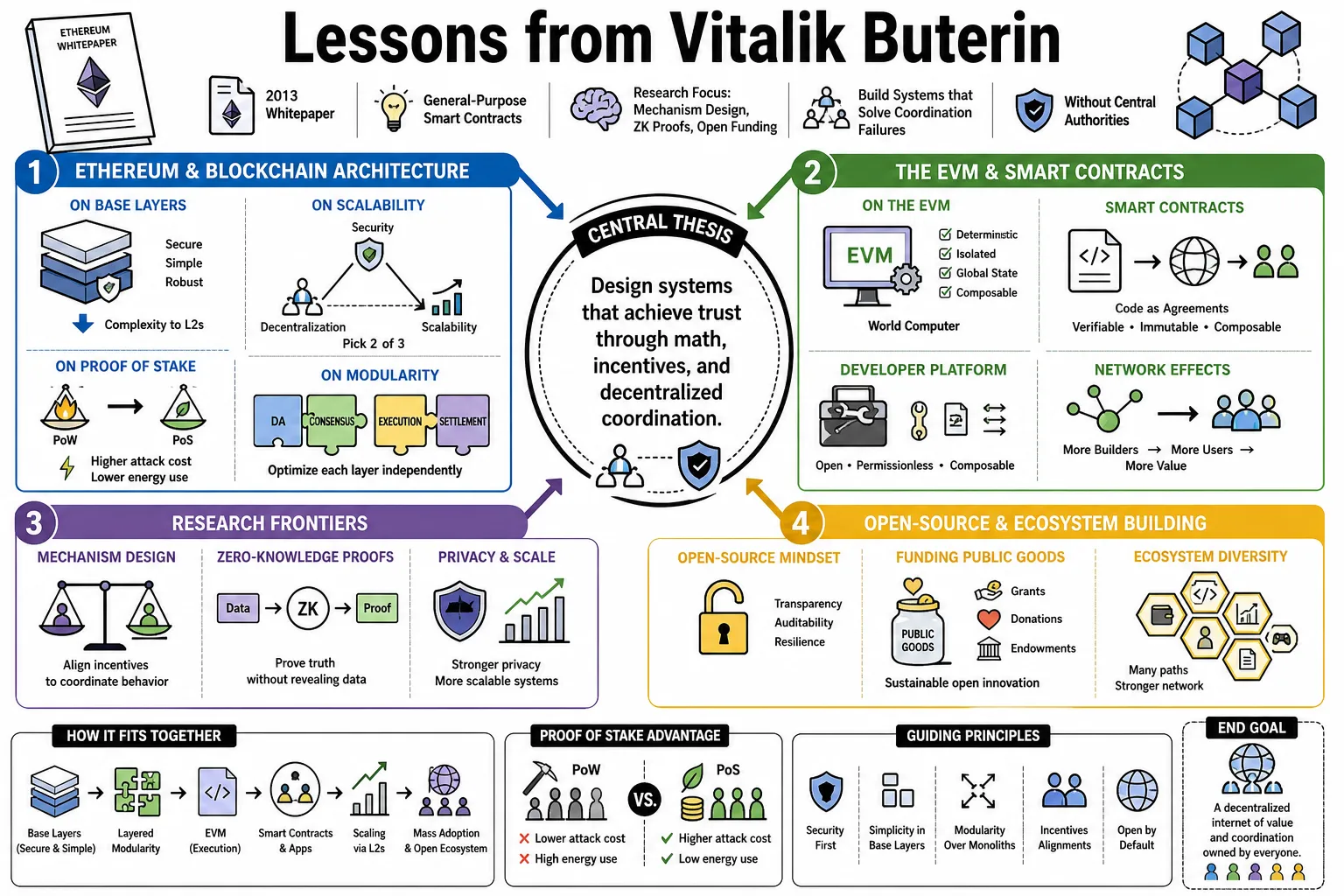
Lessons from Vitalik Buterin
Vitalik Buterin wrote the 2013 Ethereum whitepaper to propose a blockchain that could run general-purpose smart contracts. His later research tackles mechanism design, zero-knowledge proofs, and open-source funding. These notes document his ideas for building systems that solve coordination failures without central authorities.
Part 1: Ethereum & Blockchain Architecture
- On Base Layers: "Base layers must be highly secure and simple, pushing complexity to Layer 2s where experimentation can happen safely without endangering the core protocol." — Source: [Vitalik's Blog: Endgame]
- On Scalability: "The blockchain scalability trilemma dictates that systems can generally only achieve two of three properties simultaneously: decentralization, security, and scalability." — Source: [Ethereum GitHub Wiki]
- On Proof of Stake: "Proof of stake vastly increases the cost of attacking the network compared to proof of work, while simultaneously removing the massive energy expenditure." — Source: [Vitalik's Blog: Why Proof of Stake]
- On Modularity: "Monolithic blockchains attempt to do everything, but modular architectures separate data availability, consensus, and execution to optimize each layer independently." — Source: [Bankless Podcast Appearance]
- On The EVM: "The Ethereum Virtual Machine acts as a Turing-complete environment where any arbitrary state transition logic can be programmed." — Source: [Ethereum Whitepaper]
- On Rollups: "Rollups are the only viable scaling solution for Ethereum in the short and medium term, and likely the long term as well." — Source: [Vitalik's Blog: A rollup-centric ethereum roadmap]
- On Finality: "Single slot finality allows users to know their transactions are permanently finalized within seconds, improving the user experience immensely." — Source: [Vitalik's Blog: Paths toward single-slot finality]
- On Protocol Enshrinement: "We should enshrine certain features directly into the protocol if doing so significantly reduces the complexity and overhead of Layer 2 solutions." — Source: [Vitalik's Blog: Should Ethereum be okay with enshrining more things in the protocol?]
- On Simplicity: "Protocols should be as simple as possible but no simpler, because every added feature increases the attack surface and cognitive load on developers." — Source: [EthCC Conference Speech]
- On Light Clients: "If users cannot run a light client on their phone to verify the chain, the system is fundamentally vulnerable to capture by node operators." — Source: [Vitalik's Blog: The Limits to Blockchain Scalability]
Part 2: Decentralization & Trust
- On Decentralization Types: "Decentralization has three distinct axes: architectural, political, and logical. Blockchains are architecturally and politically decentralized, but logically centralized." — Source: [Vitalik's Blog: The Meaning of Decentralization]
- On Trust Assumptions: "The goal of crypto is to distribute trust so thinly across a network that no single actor can compromise the system." — Source: [Lex Fridman Podcast #188]
- On Censorship Resistance: "A blockchain's primary value proposition is its ability to process transactions even when powerful actors try to stop them." — Source: [Vitalik's Blog: Endgame]
- On Node Requirements: "If running a full node requires a supercomputer, the network inevitably centralizes around a few data centers, destroying the censorship resistance it was built for." — Source: [Vitalik's Blog: The Limits to Blockchain Scalability]
- On Social Slashing: "In Proof of Stake, the ultimate fallback is the community's ability to coordinate a user-activated soft fork to slash the funds of attackers." — Source: [Vitalik's Blog: Why Proof of Stake]
- On Hard Forks: Buterin argues hard forks preserve real user choice: joining one requires opting in, while a soft fork leaves dissenters no way to opt out, which makes hard forks the more voluntary, less coercive path for protocol changes. — Source: [Devcon Presentation]
- On Network States: "Building new digital societies requires more than shared financial ledgers; it requires shared values and mechanisms for resolving disputes without relying on legacy legal systems." — Source: [Review of Balaji Srinivasan's The Network State]
- On Credible Neutrality: "A mechanism is credibly neutral if its design does not discriminate for or against any specific people. This is the foundation of legitimate protocol design." — Source: [Vitalik's Blog: Credible Neutrality As A Guiding Principle]
- On The 51% Attack: "An attacker with 51 percent of the hash power cannot change the rules of the system; they can only censor transactions or reverse recent history, and even then, the community can fork away." — Source: [Vitalik's Blog: On 51% Attacks]
Part 3: Cryptoeconomics & Incentives
- On Cryptoeconomics: "Cryptoeconomics is the use of incentives and cryptography to design robust systems, assuming actors are self-interested and potentially malicious." — Source: [Ethereum Whitepaper]
- On Issuance: "Minimum viable issuance is the principle that the protocol should only mint as much new currency as is strictly necessary to secure the network." — Source: [Bankless Interview]
- On EIP-1559: "Burning the base fee in EIP-1559 aligns the security of the network with the demand for block space, turning ETH from a pure medium of exchange into a productive asset." — Source: [Tim Ferriss Show #504]
- On Penalty Mechanics: "Systems must penalize malicious behavior at a scale proportional to the damage it causes to the network, which is why correlated validator failures are slashed more heavily." — Source: [Vitalik's Blog: Serenity Design Rationale]
- On In-Protocol MEV: "Miner Extractable Value is an inevitable reality of blockchains, and our goal must be to democratize its extraction and minimize its centralizing effects through mechanisms like Proposer-Builder Separation." — Source: [Vitalik's Blog: Proposer/block builder separation-friendly fee market designs]
- On Bounded Rationality: "Mechanisms must be forgiving of minor user mistakes while heavily penalizing deliberate attacks, acknowledging that participants operate with bounded rationality." — Source: [EthCC Conference Speech]
- On Staking Derivatives: "Liquid staking derivatives are useful, but if one provider captures too much market share, it risks cartellizing the consensus layer and subverting network security." — Source: [Vitalik's Blog: Endgame]
- On Token Distribution: "Initial token distributions that favor insiders too heavily destroy the credible neutrality and community alignment required for a protocol to succeed long-term." — Source: [Naval Podcast Appearance]
- On Mechanism Design: "Mechanism design exists to actively defend against coordination failures and the tragedy of the commons, rather than solely creating efficient markets." — Source: [Lex Fridman Podcast #188]
Part 4: Public Goods & Funding
- On Quadratic Funding: "Quadratic funding is the mathematically optimal way to fund public goods in a democratic community, weighting the number of contributors far more than the total amount of money." — Source: [Liberal Radicalism Paper (with Glen Weyl)]
- On Retroactive Funding: "It is much easier to agree on what was valuable in the past than what will be valuable in the future. Retroactive public goods funding harnesses market mechanisms for the public good." — Source: [Vitalik's Blog: Retroactive Public Goods Funding]
- On The Free Rider Problem: Buterin has pointed to Gitcoin's quadratic funding as a working answer to open-source software being underfunded: donors give small amounts, a shared matching pool tops up whichever projects draw the broadest support, rewarding wide backing over a single large check. — Source: [Gitcoin Grants Announcement]
- On Collusion: "The biggest vulnerability in quadratic funding and voting systems is collusion. We must use cryptographic techniques like MACI to prevent vote-buying and bribery." — Source: [Vitalik's Blog: On Collusion]
- On Ecosystem Growth: "A healthy blockchain ecosystem needs a constant stream of public goods funding. If you rely purely on venture capital, you only get projects designed to extract rent." — Source: [Bankless Podcast Appearance]
- On Dominant Assurance Contracts: "Smart contracts can solve coordination failures by allowing people to commit funds conditionally, ensuring that money is only spent if enough other people also contribute." — Source: [Vitalik's Blog: Coordination Problems]
- On Capital Allocation: Buterin has said blockchain ideology originally focused on private goods, like property rights and markets, even though public goods, the shared infrastructure those systems depend on, turn out to matter just as much to a blockchain community's survival. — Source: [RadicalxChange Conference Keynote]
- On Altruism vs Incentives: "We should not rely on pure altruism to maintain critical infrastructure; we need to build systems where doing the right thing for the community is also economically rational." — Source: [Tim Ferriss Show #504]
- On Community Ownership: "When the community funds its own public goods, it retains sovereignty over the platforms it uses, rather than ceding control to centralized entities." — Source: [Lex Fridman Podcast #316]
Part 5: Governance & DAOs
- On Coin Voting: "One-coin-one-vote is fundamentally flawed because it heavily favors whales and allows attackers to buy governance control via flash loans." — Source: [Vitalik's Blog: Moving beyond coin voting governance]
- On DAO Limits: "Not everything needs to be a DAO. If a project requires rapid execution and tight coordination, a traditional corporate structure is often better." — Source: [Vitalik's Blog: DAOs are not corporations]
- On Forking as Governance: "The ultimate governance mechanism is the ability of the minority to fork the protocol and create their own version of the system if they fundamentally disagree with the majority." — Source: [Vitalik's Blog: The Meaning of Decentralization]
- On Governance Minimization: "Protocols should strive for governance minimization, where the rules are set and ossified, reducing the attack surface for political capture." — Source: [EthCC Conference Speech]
- On Reputation Systems: "We need governance systems based on non-transferable reputation or identity, ensuring that those who make decisions have proven, long-term alignment with the project." — Source: [Decentralized Society: Finding Web3's Soul]
- On Futarchy: "Futarchy proposes that we vote on values and bet on beliefs, using prediction markets as a more accurate mechanism for making decisions than raw democratic voting." — Source: [Vitalik's Blog: An Introduction to Futarchy]
- On Veto Rights: "Good governance often looks less like direct democracy and more like giving specific groups veto rights to block changes that would harm the ecosystem." — Source: [Vitalik's Blog: Notes on Blockchain Governance]
- On Legitimacy: "Legitimacy is a higher-order form of consensus. It is the widely shared belief that a particular actor or mechanism has the right to make decisions." — Source: [Vitalik's Blog: The Most Important Scarce Resource is Legitimacy]
- On Constitutionality: "DAOs should adopt written constitutions that clearly outline what changes are permissible, providing a social layer of protection against governance capture." — Source: [Bankless Podcast Appearance]
Part 6: Cryptography & ZK-Proofs
- On ZK-SNARKs: "Zero-knowledge proofs are incredibly powerful cryptographic primitives, allowing us to mathematically prove that computation was done correctly without revealing the underlying data." — Source: [Vitalik's Blog: An approximate introduction to how zk-SNARKs are possible]
- On Privacy: "Privacy is a fundamental human right. Without robust privacy tools on the blockchain, we risk building the most sophisticated surveillance apparatus in history." — Source: [Vitalik's Blog: The Three Transitions]
- On ZK-Rollups: "In the long term, ZK-rollups will win out over optimistic rollups because they rely on cryptographic certainty rather than game-theoretic dispute periods." — Source: [Vitalik's Blog: A rollup-centric ethereum roadmap]
- On Quantum Threat: "We must begin migrating to quantum-resistant cryptography now. Hash-based signatures and STARKs provide a viable path to securing networks against future quantum computers." — Source: [Vitalik's Blog: Exploring fully quantum-resistant SNARKs]
- On Social Recovery: "Hardware wallets are too hard for mainstream users, and centralized exchanges are too risky. Multisig social recovery wallets offer the best balance of security and usability." — Source: [Vitalik's Blog: Why we need wide adoption of social recovery wallets]
- On Verkle Trees: "Upgrading Ethereum from Merkle-Patricia trees to Verkle trees will drastically reduce proof sizes, making stateless clients highly efficient and practical." — Source: [Vitalik's Blog: Verkle trees]
- On MACI: "Minimal Anti-Collusion Infrastructure ensures that a user can prove to a central coordinator how they voted, without being able to prove it to a third-party briber." — Source: [EthResear.ch: Minimal anti-collusion infrastructure]
- On Proof of Humanity: "Creating a decentralized proof of unique human identity is a deeply complex problem, requiring a blend of social graphs, cryptography, and careful mechanism design." — Source: [Vitalik's Blog: What do I think about biometric proof of personhood?]
- On Cryptographic Abstraction: "Account abstraction allows us to replace rigid protocol-level transaction rules with flexible smart contracts, enabling custom cryptographic signatures and entirely new wallet designs." — Source: [Vitalik's Blog: The Three Transitions]
Part 7: Society, Pluralism & Identity
- On Soulbound Tokens: "Non-transferable Soulbound tokens can represent a person's credentials, affiliations, and reputation, forming the foundation of a decentralized society based on trust rather than just wealth." — Source: [Decentralized Society: Finding Web3's Soul]
- On Digital Identity: "If we rely on centralized tech giants to provide our digital identity, we hand them ultimate control over our online lives. Identity must be self-sovereign." — Source: [Bankless Podcast Appearance]
- On Wealth Inequality: "We have the technical tools to build financial systems that actively distribute power and resources more equitably, rather than replicating the wealth disparities of the traditional system." — Source: [Time Magazine Interview]
- On Nationalism: "The nation-state is a relatively recent invention, and it is highly restrictive. Digital communities offer a way to form global tribes based on shared values rather than geography." — Source: [Review of Balaji Srinivasan's The Network State]
- On Social Media: "Decentralized social media is primarily about giving users control over their own algorithms and data, breaking the centralized monopoly on attention." — Source: [Lex Fridman Podcast #316]
- On Radical Markets: "Applying market mechanisms to traditionally non-market areas, like taxation and voting, can unlock enormous societal value if designed carefully to avoid capture." — Source: [Review of Radical Markets]
- On Intersectionality: "Intersecting different social graphs allows us to determine human uniqueness and trustworthiness more accurately than relying on a single centralized authority." — Source: [Decentralized Society: Finding Web3's Soul]
Part 8: Philosophy, AI & The Future
- On D/acc: "Defensive accelerationism focuses on accelerating technologies that protect human agency and safety, like cryptography and decentralized networks, while being cautious about centralized offensive capabilities." — Source: [Vitalik's Blog: My techno-optimism]
- On AI Risk: "Advanced AI presents an existential risk. We must prioritize building architectures where AI serves as a tool to empower humans rather than an autonomous force that replaces human agency." — Source: [Lex Fridman Podcast #316]
- On Life Extension: "Aging is a biological engineering problem, and treating it as an inevitable tragedy rather than a curable condition causes immense unnecessary human suffering." — Source: [Tim Ferriss Show #504]
- On Existential Hope: "We need compelling visions of the future that are both technologically advanced and deeply humanistic, offering an alternative to both stagnation and dystopian control." — Source: [Vitalik's Blog: My techno-optimism]
- On Effective Altruism: "Doing good requires extreme rigorous analysis to ensure resources actually solve problems, rather than just signaling virtue." — Source: [Review of What We Owe The Future]
- On Brain-Computer Interfaces: "High-bandwidth interfaces between humans and computers could be necessary to ensure that humans can meaningfully participate in a world increasingly dominated by artificial intelligence." — Source: [Vitalik's Blog: My techno-optimism]
- On Techno-Optimism: "Technology is inherently a force for human liberation, provided we actively steer its development toward decentralized architectures and away from concentrated power." — Source: [Vitalik's Blog: My techno-optimism]
- On The Long Term: "We are building infrastructure that could potentially run for centuries. This requires prioritizing resilience, simplicity, and credible neutrality over short-term optimizations." — Source: [EthCC Conference Speech]
- On Agency: "The ultimate goal of all these technologies, whether crypto, AI, or life extension, is to maximally expand the freedom, agency, and flourishing of the individual." — Source: [Lex Fridman Podcast #188]