Vlad Tenev co-founded Robinhood in 2013 to remove commissions and account minimums from stock trading. He is known for applying a philosophy of extreme simplicity to complex financial software and steering his company through the 2021 meme-stock trading freeze. This profile covers his approach to product design, his emphasis on maintaining operational urgency, and his perspective on integrating artificial intelligence into consumer finance.
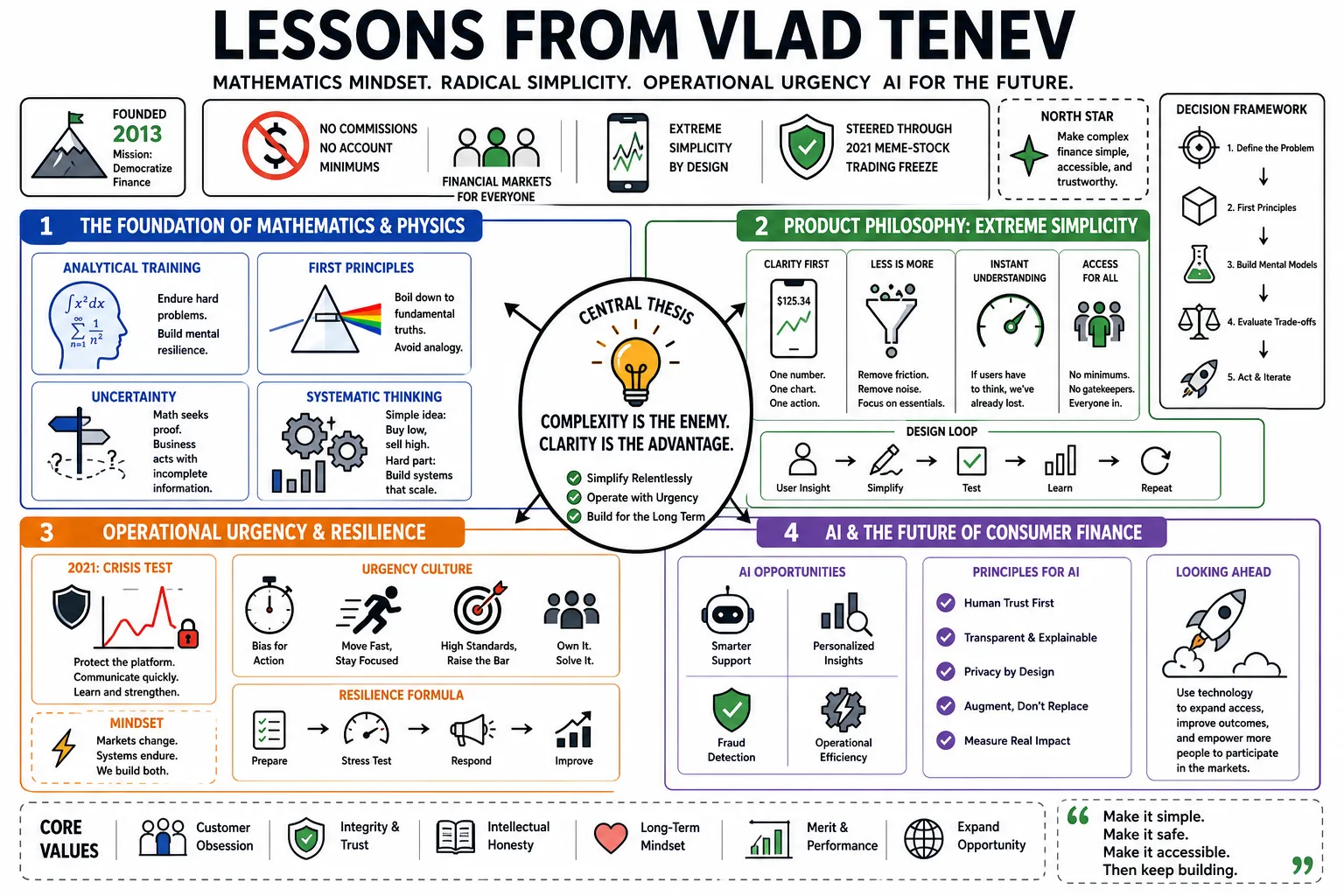
Part 1: The Foundation of Mathematics and Physics
- On Analytical Training: "Enduring the pain and suffering of solving extremely difficult math problems builds the mental resilience required to handle complex business challenges." — Source: [Farnam Street The Knowledge Project]
- On First Principles: "Physics teaches you to boil things down to their fundamental truths rather than reasoning by analogy, which is essential when you want to reinvent an established industry." — Source: [Invest Like the Best]
- On Uncertainty: "In mathematics, you are looking for absolute proofs, but in business, you have to get comfortable making decisions with incomplete information." — Source: [Sequoia Capital]
- On Systematic Thinking: "The market operates on a simple principle of buying low and selling high, but building a system that allows millions of people to do that seamlessly requires rigorous engineering." — Source: [Benzinga]
- On Academic Roots: "I thought I was going to be an academic. The transition to entrepreneurship happened because I realized I could apply the same rigorous models to real-world problems." — Source: [How I Built This]
- On Recognizing Patterns: "A lot of financial engineering is simply recognizing patterns in massive datasets and figuring out how to optimize the routing of that information." — Source: [All-In Podcast]
- On Building Models: "When we started, we built a mathematical model for how order flow could subsidize the cost of trades for retail investors rather than charging upfront fees." — Source: [Business Insider]
- On Iteration: "In science, you run experiments to test a hypothesis. In startups, your product is the experiment, and the market gives you the results." — Source: [Farnam Street The Knowledge Project]
- On Complexity: "The goal of good engineering is to take a mathematically complex backend and hide it completely from the end user." — Source: [Invest Like the Best]
Part 2: Product Philosophy and Simplicity
- On Radical Simplicity: "One screen. One button. One core action. If a user has to search for how to complete a trade, we have failed them." — Source: [Farnam Street The Knowledge Project]
- On Financial Jargon: "Traditional brokerage platforms were built to look complicated because complexity justified high fees. We wanted to strip away the jargon." — Source: [Quartr]
- On Storytelling: "A product launch goes beyond a simple feature update; it is an event. You have to tell a story that resonates emotionally with the user." — Source: [Sequoia Capital]
- On Premium Design: "Nobody really built the James Bond card. Do you see him using American Express? Not a chance. What about Chase Sapphire Reserve? It's not exclusive enough." — Source: [Semafor]
- On Mobile-First Development: "We designed Robinhood for mobile first because we realized the millennial generation was managing their entire lives from their phones, except for their wealth." — Source: [How I Built This]
- On Eliminating Friction: "Every extra tap or confirmation screen is an opportunity for the user to abandon the process. We ruthlessly cut friction." — Source: [Invest Like the Best]
- On Product-Market Fit: "You do not find product-market fit by asking people what they want; you find it by observing what they are currently struggling to do and making it effortless." — Source: [All-In Podcast]
- On Expanding Services: "We should make it so that Robinhood is the best place for all of your financial needs. Do all of your spending with us. Do all of your banking with us." — Source: [Semafor]
- On User Feedback: "Customer trust is built through transparency and by actually listening to the frustrations they face with the legacy financial system." — Source: [Benzinga]
- On Democratization: "Our single organizing principle is maximizing direct equity ownership by retail investors worldwide." — Source: [Farnam Street The Knowledge Project]
Part 3: The Wartime Mindset
- On Defaulting to Urgency: "Founders should treat wartime as their default mindset rather than an exception. It keeps the organization sharp." — Source: [Sequoia Capital]
- On Planning Cycles: "Limit planning cycles to days rather than weeks. If you plan for too long, you lose the agility that makes a startup dangerous to incumbents." — Source: [Farnam Street The Knowledge Project]
- On Taking Action: "When you are stuck or unsure of the right path, do something quickly. Action creates new information." — Source: [Invest Like the Best]
- On Flattening the Org Chart: "We constantly fight the urge to become a heavily-layered organization. We flatten structures to keep the company lean and efficient." — Source: [Business Insider]
- On Crisis Leadership: "During a crisis, a leader must remain completely unflappable. The team absorbs the energy you project." — Source: [Sequoia Capital]
- On Using Forcing Functions: "We use product events and launch dates as forcing functions to keep teams aligned and moving at breakneck speed." — Source: [Farnam Street The Knowledge Project]
- On Market Downturns: "When market conditions shift to headwinds, you navigate this by identifying and strengthening the absolute core of your business." — Source: [Sequoia Capital]
- On Building Resiliency: "The strength of a company is forged when things are breaking. You learn how to operate under pressure because you have no other choice." — Source: [All-In Podcast]
- On Competitive Urgency: "If you aren't operating with a sense of existential dread that someone is trying to eat your lunch, you are going to lose." — Source: [Invest Like the Best]
Part 4: Surviving the GameStop Crisis
- On the Decision to Halt Trading: "The decision to halt trading of GameStop, AMC and other stocks was difficult, but the company did so to protect the firm and protect our customers." — Source: [Congressional Testimony]
- On Asymmetric Restrictions: "Preventing customers from selling is a very difficult and painful experience, where customers are unable to access their money. So we didn't want to impose that experience on our customers." — Source: [Congressional Testimony]
- On Capital Requirements: "It was a CEO's worst nightmare. We had to figure out how we communicate to the public what was going on, and then also raise billions of dollars overnight." — Source: [Farnam Street The Knowledge Project]
- On Apologizing to Users: "Despite the unprecedented market conditions in January, at the end of the day, what happened is unacceptable to us." — Source: [Congressional Testimony]
- On Conspiracy Theories: "Any allegation that Robinhood acted to help hedge funds or other special interests to the detriment of our customers is absolutely false and market-distorting rhetoric." — Source: [Congressional Testimony]
- On the Clearinghouse Mechanics: "People didn't understand the mechanics of T+2 settlement and clearinghouse deposit requirements. Our biggest failure was not explaining the plumbing of the stock market clearly enough." — Source: [All-In Podcast]
- On the Silver Lining: "The crisis connected me with other high-profile tech leaders who offered advice on managing the public fallout and surviving a media firestorm." — Source: [Invest Like the Best]
- On Moving Forward: "It pains us to have had to impose these restrictions, but it forced us to fortify our balance sheet so we never have to be in that position again." — Source: [CNBC]
- On Regulatory Scrutiny: "When you grow that fast and disrupt a legacy system, you have to expect that regulators are going to put you under a microscope. You have to welcome it." — Source: [Fox Business]
Part 5: Founder Mode and Scaling Teams
- On Direct Involvement: "Founders must involve themselves directly in operational details. Founder mode is necessary to cut through corporate bloat." — Source: [Farnam Street The Knowledge Project]
- On Rewarding Impact: "Companies should reward employees disproportionately based on the impact they generate, rather than the size of their team." — Source: [Farnam Street The Knowledge Project]
- On Decentralized Accountability: "We utilize General Manager roles for product fields to decentralize accountability. They focus on profit and loss and operate with independence." — Source: [eFinancialCareers]
- On the Danger of Bureaucracy: "As you scale, the natural entropy of a company is to add middle management. You have to actively fight that gravitational pull every single quarter." — Source: [Business Insider]
- On Hiring the Best: "We maintain an incredibly high bar for talent. We look for individuals with strong mathematical backgrounds who can operate with high autonomy." — Source: [eFinancialCareers]
- On Delegation: "Counterintuitively, if you need something done urgently, give it to the busiest person in the company. They are busy because they know how to execute." — Source: [Farnam Street The Knowledge Project]
- On Meeting Structures: "I prefer large-group leadership meetings over endless one-on-one sessions to ensure everyone has access to the exact same context simultaneously." — Source: [Farnam Street The Knowledge Project]
- On Personal Habits: "I function a little bit better when I get more sleep. You cannot make high-stakes decisions when you are chronically exhausted." — Source: [Deciphr]
- On Managing Growth: "The hardest part of scaling is firing yourself from jobs you used to do and trusting someone else to do them, but still diving deep when the metrics look wrong." — Source: [Sequoia Capital]
- On Product-Led Growth: "Rather than waiting for external market conditions to improve, ask what products would help your customers thrive in the current environment." — Source: [Farnam Street The Knowledge Project]
Part 6: Prediction Markets and the Value of Information
- On the Evolution of News: "I think prediction markets are the future of trading and information. In some cases, you get it even before it happens." — Source: [Business Insider]
- On Economic Value: "The economic value of a prediction market as a product and service should be at least as high, and I would argue strictly greater, than the news after it happens." — Source: [Business Insider]
- On the Necessity of Speculators: "You cannot have a functional financial market without speculators. If everyone is just hedging, the market is going to break." — Source: [TradingView]
- On Market Mechanics: "As long as you have a strategy, and it is systematic, who am I to say that you shouldn't engage in trading of that asset class?" — Source: [TradingView]
- On the Supercycle: "We are at the beginning of a prediction market supercycle that could potentially drive trillions in annual volume." — Source: [TheStreet]
- On Information Arbitrage: "Prediction markets aggregate human knowledge and financial incentive better than polling. They force participants to put their money where their mouth is." — Source: [Bloomberg Odd Lots]
- On Financial Expansion: "Prediction markets are the fastest-growing business in the company's history. People want to trade on outcomes that affect their daily lives." — Source: [Business Insider]
- On Regulatory Clarity: "As these markets grow, we need clear regulatory frameworks to ensure they operate fairly without stifling the innovation they bring to information discovery." — Source: [Bloomberg Odd Lots]
- On Retail Access: "Just as we democratized stock trading, bringing prediction markets to retail investors allows everyone to participate in forecasting the future." — Source: [Robinhood Investors]
Part 7: Artificial Intelligence and the Job Singularity
- On Micro-Corporations: "AI will enable a job singularity by lowering barriers to entrepreneurship, allowing for the rise of micro-corporations or single-person unicorns." — Source: [Decrypt]
- On Empowering Founders: "AI provides individuals with a world-class staff right out of the gate, making it easier for them to build and launch new ventures." — Source: [Decrypt]
- On the Next Generation: "I feel very confident that the young people of the future, perhaps in collaboration with AI, will continue to build new things that we are simultaneously scared of and excited by." — Source: [Decrypt]
- On AI in Trading: "We are integrating AI through tools like Robinhood Cortex to help users with market research and trade execution across various asset classes." — Source: [Stocktwits]
- On the Future of Finance: "Crypto technology combined with artificial intelligence will eventually power the entire backend of the financial system." — Source: [Fox Business]
- On Technological Skepticism: "I feel like I am becoming more of a Luddite as we keep rolling out more business lines, but AI is the one shift you cannot afford to ignore." — Source: [Business Insider]
- On Operational Efficiency: "AI is more than a customer-facing feature; it is going to fundamentally change how we write code, handle compliance, and scale our internal operations." — Source: [YouTube Sourcery]
- On Democratizing Expertise: "Historically, only the wealthy could afford a dedicated team of financial analysts. AI is going to put a personalized analyst in every user's pocket." — Source: [Invest Like the Best]
- On Innovation and Fear: "Great companies are built by people who are not afraid to be different, and right now, leaning into AI is how you separate yourself from legacy incumbents." — Source: [Benzinga]
Part 8: Truth, Narrative, and Resilience
- On Viral Falsehoods: "In the age of viral media, a juicy falsehood can sometimes be more powerful than a boring truth." — Source: [Farnam Street The Knowledge Project]
- On Playing the Long Game: "You have to accept the reality of the narrative and play the long game. Focus on consistent execution rather than trying to combat every false story with evidence." — Source: [Farnam Street The Knowledge Project]
- On Public Perception: "When the internet decides you are the villain, it is impossible to logic your way out of it. You just have to put your head down and build." — Source: [All-In Podcast]
- On Brand Resilience: "A brand is not what you say it is; it is the sum of every interaction a customer has with your product during their most stressful moments." — Source: [Sequoia Capital]
- On Enduring Criticism: "If you want to democratize a system that has enriched a small group of people for a century, you have to expect them to fight back fiercely." — Source: [How I Built This]
- On Internal Morale: "When the external narrative is toxic, the CEO's job is to ensure the internal narrative remains grounded in reality and focused on the mission." — Source: [Sequoia Capital]
- On Owning Mistakes: "You build more trust by admitting a failure transparently and fixing it quickly than by trying to spin a failure into a success." — Source: [Bloomberg Odd Lots]
- On the Founder's Burden: "The emotional toll of leadership is rarely discussed. You are the shock absorber for the entire company." — Source: [Farnam Street The Knowledge Project]
- On Staying Grounded: "The origin of Robinhood was deeply tied to the Occupy Wall Street movement. We have to constantly remind ourselves who we built this for." — Source: [Wikipedia]
- On the Ultimate Measure of Success: "Ultimately, the truth always catches up to the narrative. If you build a product that provides undeniable value, the noise eventually fades away." — Source: [Invest Like the Best]