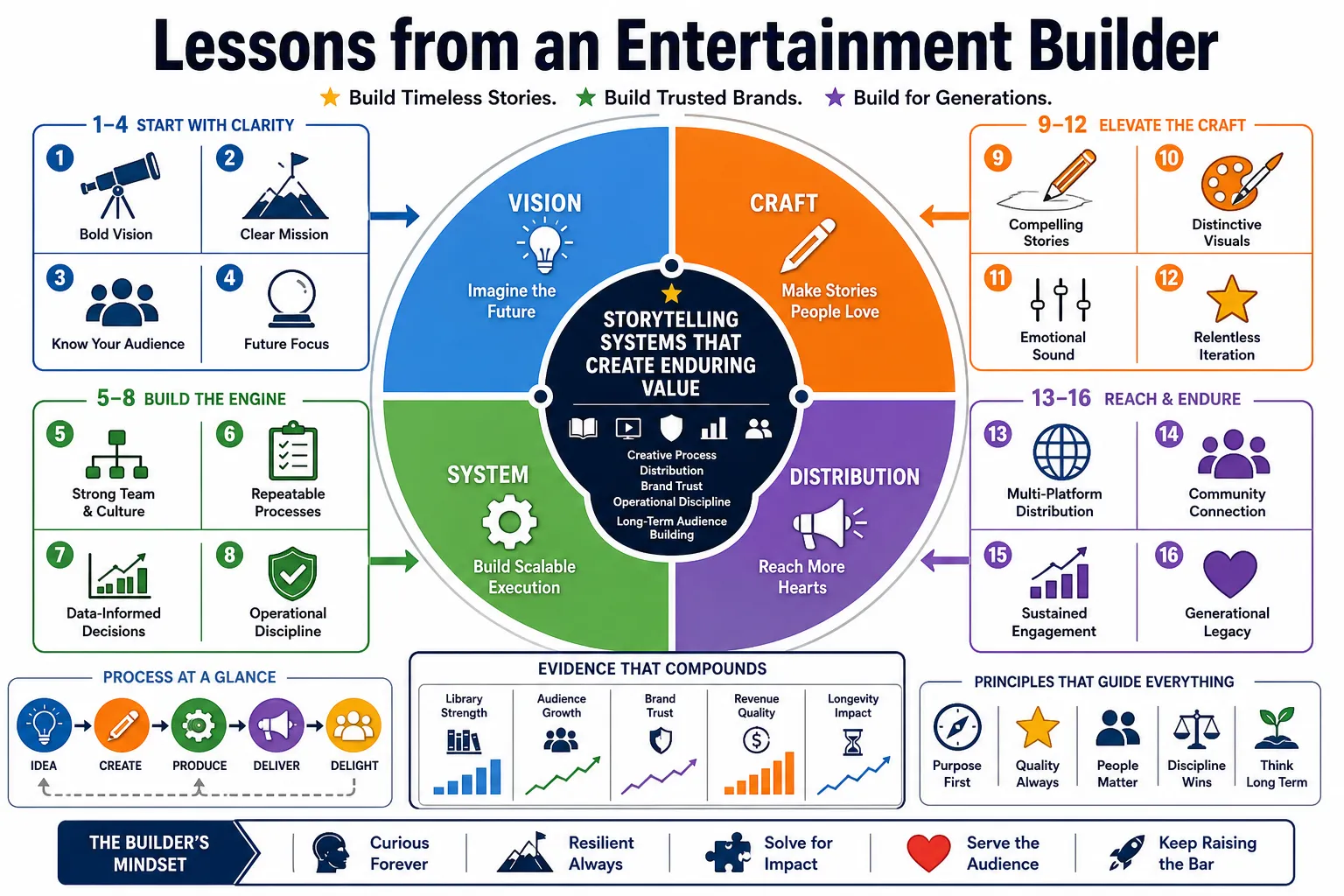
Lessons from Walt Disney
Walt Disney built an empire on the radical bet that cartoons could carry the weight of serious drama. He invented the theme park to make his drawings tangible and spent his career obsessively refining them. This profile breaks down how he managed creative teams and his habit of improving work long after its release.
Part 1: Persistence and Starting Small
- On Ambition: "All our dreams can come true, if we have the courage to pursue them." — Source: Walt Disney Archives (D23)
- On Action: "The way to get started is to quit talking and begin doing." — Source: The CIO Times
- On Small Beginnings: "I only hope that we never lose sight of one thing—that it was all started by a mouse." — Source: Disney Archives (D23)
- On Resiliency: After losing the rights to Oswald the Lucky Rabbit, Disney created Mickey Mouse on the train ride home instead of giving up. — Source: USSF Federal Credit Union
- On Early Hardship: Disney arrived in Hollywood in 1923 with only forty dollars and a single suitcase containing drawing materials and one suit of clothes. — Source: MousePlanet
- On Early Work Ethic: As a boy in Kansas City, Disney delivered newspapers in the snow starting at 3:30 AM, a period he later credited for his discipline. — Source: Walt Disney Family Museum
- On Failure: The bankruptcy of his first studio, Laugh-O-Grams, taught him the necessity of retaining ownership of his creative assets. — Source: Entrepreneur
- On Personal Conviction: He famously mortgaged his home and life insurance to fund his first feature film when banks refused to believe a cartoon could hold an audience's attention. — Source: Lifehack
- On Luck: "I've been up against tough competition all my life. I wouldn't know how to get along without it." — Source: "The Quotable Walt Disney" (Dave Smith)
- On Professional Growth: Disney believed that one should never be satisfied with their current level of skill but should always be reaching for the next plateau. — Source: University of Queensland Business School
Part 2: The Logic of Storytelling
- On Character Thinking: The first duty of a cartoon isn't to duplicate real action as it actually happens, but to give a caricature of life and action, bringing to the screen the dream fantasies the audience has already imagined. — Source: Disney Animation (Technology Page)
- On Audience Connection: Disney believed that for an audience to care about a story, they had to believe in the character’s internal struggle and personal growth. — Source: EllieMotion
- On Visualization: Disney popularized the storyboard to "see" the pacing and emotional beats of a film before the expensive animation process began. — Source: NYFA
- On Believability: "Animation can explain whatever the mind of man can conceive." — Source: Disney Animation
- On Personality: He insisted that every character movement must be dictated by a specific thought or emotion rather than simple physics. — Source: UX Design
- On Humor: "Laughter is timeless, imagination has no age, dreams are forever." — Source: Shutterfly
- On Musical Narrative: Beginning with Snow White, Disney treated music as a structural element that moved the plot forward rather than a simple background track. — Source: EllieMotion
- On Story Pacing: A good story requires a "heartbeat" of rising and falling tension to keep the audience engaged over ninety minutes. — Source: "The Illusion of Life" (Thomas & Johnston)
- On Universal Themes: "I do not make films primarily for children. I make them for the child in all of us, whether we be six or sixty." — Source: Disney Archives (D23)
Part 3: Technological Breakthroughs
- On Sound Synchronization: Steamboat Willie was the first cartoon to use a fully post-produced soundtrack with synchronized voices and sound effects. — Source: Disney Experiences
- On Color Innovation: Disney secured a multi-year exclusive contract for Three-Strip Technicolor to give his Silly Symphonies a competitive edge. — Source: EllieMotion
- On Depth of Field: The invention of the multiplane camera allowed animators to move layers of art at different speeds, creating a realistic sense of three-dimensional space. — Source: UX Design
- On Production Efficiency: The studio adopted Xerography during 101 Dalmatians to transfer drawings directly to cels, preserving the original artist's line. — Source: Disney Experiences
- On Physical Storytelling: Disney developed Audio-Animatronics to extend character performances into the three-dimensional world of theme parks. — Source: Disney Experiences
- On Experimentation: "By nature I'm an experimenter. To this day, I don't believe in sequels. I can't follow popular cycles. I have to move on to new things." — Source: Walt Disney Archives
- On Modernity: He believed technology should always be a tool for the story, never an end in itself. — Source: "The Illusion of Life" (Thomas & Johnston)
- On the Multi-Media Approach: Disney was one of the first film producers to embrace television, using it as a platform to fund and market his films and park. — Source: MousePlanet
- On Problem Solving: If the current technology couldn't achieve his vision, he expected his engineers to build a new tool from scratch. — Source: "The Imagineering Story" (Disney+)
- On Future Tools: He anticipated that computers and automation would eventually solve the repetitive labor of animation. — Source: Original E.P.C.O.T. Project Transcript
Part 4: The Art of "Plussing"
- On Continuous Improvement: Walt coined the term "plussing" to mean finding ways to improve an idea even after it was considered complete. — Source: Entrepreneur
- On Quality Standards: "Good enough" was considered the enemy of excellence in the Disney studio. — Source: Copperfish Books
- On the Details: During Disneyland construction, he insisted on authentic leather straps for stagecoaches because he believed guests would sense the quality even if they didn't consciously notice it. — Source: Forbes
- On Constant Review: Disney would frequently walk through his park and ride the attractions to identify small details that could be improved. — Source: Entrepreneur
- On the Last Ten Percent: He believed that the final small details are what separate a good product from a legendary one. — Source: University of Queensland Business School
- On Maintenance: Disney wanted Disneyland to be the cleanest park in the world, believing that a tidy environment commanded respect from guests. — Source: Entrepreneur
- On Trash Disposal: He studied guest behavior to determine that most people would walk about thirty feet before dropping trash, leading to the precise placement of bins. — Source: Entrepreneur
- On the Importance of Freshness: "Disneyland will never be completed. It will continue to grow as long as there is imagination left in the world." — Source: Disney Parks Blog
- On Guest Perspective: He often knelt down to look at the park from a child's height to ensure the design worked for all ages. — Source: "The Imagineering Story" (Disney+)
Part 5: Leadership and Team Culture
- On Desk Work: Disney famously opposed building a large administration building because he wanted his managers in the field, not behind desks. — Source: Forbes
- On Language and Culture: By calling customers "Guests" and employees "Cast Members," he framed the business as a collaborative performance. — Source: University of Queensland Business School
- On Shared Vision: "People don't follow plans; they follow visions." — Source: Copperfish Books
- On Training: He founded Disney University to ensure every employee understood the company’s philosophy of service and quality. — Source: "Window on Main Street" (Van Arsdale France)
- On Leading by Example: He was often found picking up trash or chatting with guests in the park to understand their experience firsthand. — Source: Forbes
- On Empowering Talent: Disney surrounded himself with the "Nine Old Men," a core group of animators he trusted to maintain his standards while he focused on new ventures. — Source: "The Illusion of Life" (Thomas & Johnston)
- On Financial Partnership: He relied on his brother Roy to handle the finances, once calling Roy the "smartest Disney" for his ability to find the money for Walt's dreams. — Source: Walt Disney Family Museum
- On Resilience: "You may not realize it when it happens, but a kick in the teeth may be the best thing in the world for you." — Source: "The Quotable Walt Disney"
- On Communicating the Impossible: To sell the concept of Disneyland to investors, he commissioned a massive, detailed map to make the dream tangible. — Source: Richard Snow's "Disney's Land"
- On Employee Morale: He believed in giving people "a place where they can have fun together" as a primary motivation for his work. — Source: MousePlanet
Part 6: Handling Risk and the "Impossible"
- On Challenging the Status Quo: "It’s kind of fun to do the impossible." — Source: Reader's Digest
- On "Disney's Folly": Industry insiders mocked Snow White during production, but Disney used that skepticism as fuel to prove the viability of feature animation. — Source: Lifehack
- On Salesmanship: To secure loans for his films, he would often act out the entire story, playing every character, to convince bankers of the project's worth. — Source: Lifehack
- On Natural Curiosity: His True-Life Adventures series brought high-quality nature documentaries to the mainstream by applying dramatic storytelling to real-world animals. — Source: Disney Archives (D23)
- On Adaptability: When World War II halted commercial production, Disney shifted the studio's entire focus to producing training and propaganda films for the government. — Source: Walt Disney Family Museum
- On Large Scale Thinking: "Here in Florida, we have something special we never enjoyed at Disneyland: the blessing of size." — Source: 1966 EPCOT Film
- On Strategic Pivoting: After losing the rights to Oswald the Lucky Rabbit to Universal, Walt didn't fight for the character back. He went home and created a new character he would fully own, which became Mickey Mouse. — Source: The Wisdom of Walt
- On Personal Conviction: He believed that if you don't believe in your product one hundred percent, you shouldn't expect anyone else to buy it. — Source: Lifehack
- On Moving Forward: "We keep moving forward, opening new doors, and doing new things, because we're curious and curiosity keeps leading us down new paths." — Source: Disney Archives (D23)
Part 7: The Guest Experience
- On Atmospheric Immersion: Disney designed Main Street, U.S.A. to trigger a sense of nostalgia and "yesterday" before guests entered the more fantastical lands. — Source: 6Kingdoms
- On Safety: Safety was established as the primary "key" to the Disney guest experience, followed by courtesy, show, and efficiency. — Source: University of Queensland Business School
- On Opening Day: Despite the "Black Sunday" technical failures of Disneyland's opening day, Disney stayed focused on solving operational issues rather than apologizing for the ambition. — Source: MousePlanet
- On the Shared Experience: He wanted a place where parents and children could have fun together, rather than parents just watching their children play. — Source: "Disney's Land" by Richard Snow
- On Dedication: "To all who come to this happy place: welcome. Disneyland is your land." — Source: Disneyland Dedication Speech
- On Operational Empathy: Disney required his executives to stand in the same lines and eat the same food as the guests to understand the true quality of service. — Source: Forbes
- On Emotional Architecture: The castle at the center of the park serves as a "wienie"—a visual magnet that draws guests deeper into the park through curiosity. — Source: "The Imagineering Story"
- On Personal Touch: Walt kept a private apartment above the fire station on Main Street, giving him a place to watch guests enter the park and stay close to the work of running it. — Source: Disney Parks Blog
- On Feedback: He believed that a guest's complaint was the most valuable piece of data for improving the business. — Source: University of Queensland Business School
Part 8: The Vision for EPCOT and the Future
- On the Living Blueprint: "EPCOT... will never cease to be a living blueprint of the future, where people actually live a life they can't find anywhere else in the world." — Source: 1966 EPCOT Film
- On Urban Solutions: "I don't believe there is a challenge anywhere in the world that's more important to people everywhere than finding solutions to the problems of our cities." — Source: 1966 EPCOT Film
- On Free Enterprise: EPCOT was envisioned as a permanent showcase for the ingenuity and imagination of American industry. — Source: Original E.P.C.O.T. Project Transcript
- On Constant Progress: "It will be a community of tomorrow that will never be completed, but will always be introducing and testing new materials and systems." — Source: 1966 EPCOT Film
- On the Pace of Innovation: "The only problem with anything of tomorrow is that at the pace we're going right now, tomorrow would catch up with us before we got it built." — Source: Big Think
- On Legacy: Disney spent his final years planning the Florida Project, ensuring the company had a clear direction for decades after his passing. — Source: 1966 EPCOT Film
- On Individual Contribution: He believed that the future's success depended on the individual's willingness to experiment and take risks. — Source: "The Quotable Walt Disney"
- On Technological Optimism: Disney viewed the future not as a threat but as an opportunity to solve the core stresses of human life through better design. — Source: Original E.P.C.O.T. Project Transcript
- On the Heart of the Dream: "The most exciting and, by far, the most important part of our Florida project... will be our Experimental Prototype Community of Tomorrow!" — Source: 1966 EPCOT Film