Warren Buffett is the Chairman and CEO of Berkshire Hathaway and arguably the most successful investor in history. Known as the "Oracle of Omaha," he has built a multi-billion dollar fortune through a disciplined adherence to value investing principles and a focus on long-term business fundamentals.
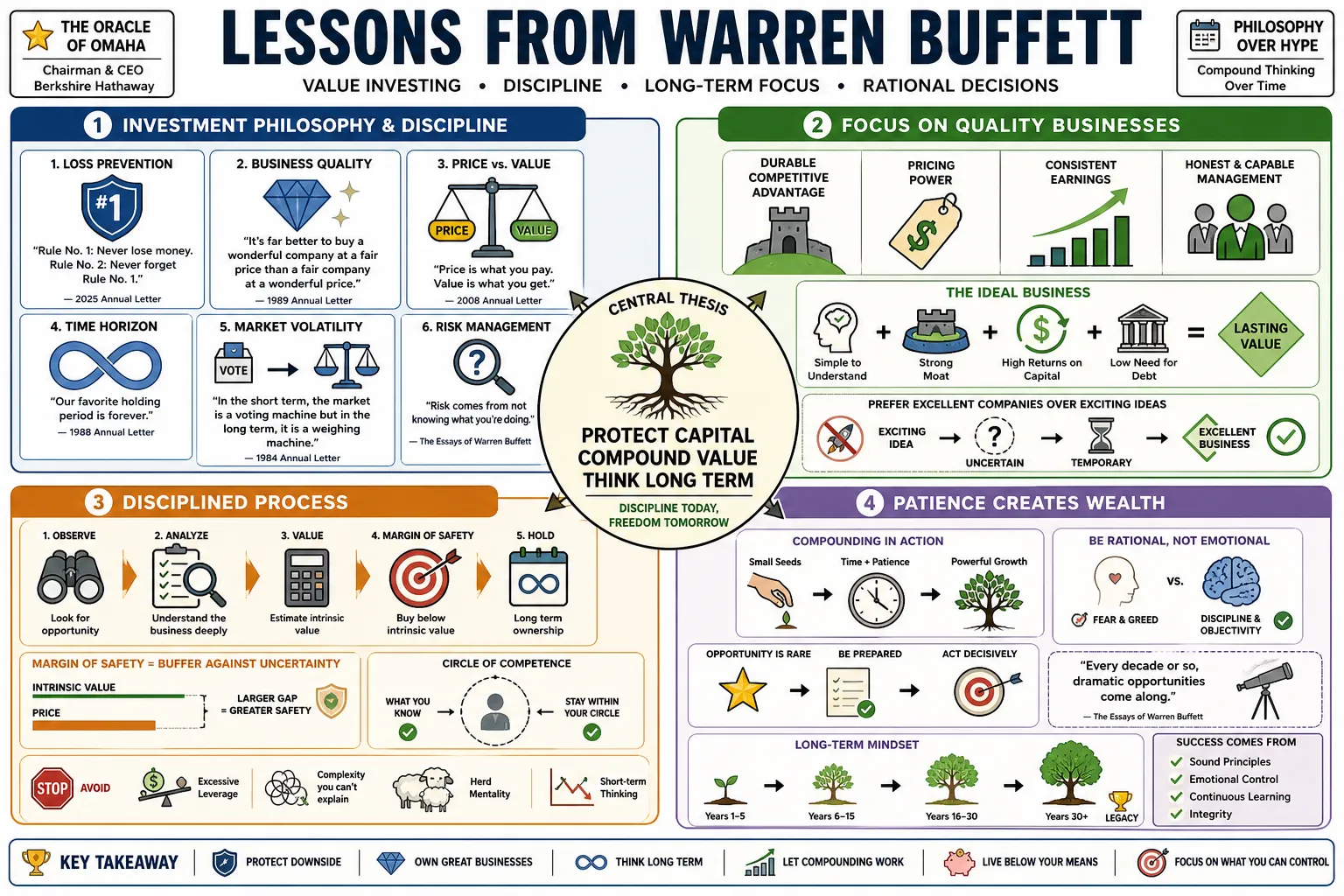
Part 1: Investment Philosophy and Discipline
- On Loss Prevention: "Rule No. 1: Never lose money. Rule No. 2: Never forget Rule No. 1." — Source: [Berkshire Hathaway 2025 Annual Letter
- On Business Quality: "It's far better to buy a wonderful company at a fair price than a fair company at a wonderful price." — Source: [Berkshire Hathaway 1989 Annual Letter
- On Price vs. Value: "Price is what you pay. Value is what you get." — Source: [Berkshire Hathaway 2008 Annual Letter
- On Time Horizon: "Our favorite holding period is forever." — Source: [Berkshire Hathaway 1988 Annual Letter
- On Market Volatility: "In the short term, the market is a voting machine but in the long term, it is a weighing machine." — Source: [Berkshire Hathaway 1984 Annual Letter
- On Risk Management: "Risk comes from not knowing what you're doing." — Source: [The Essays of Warren Buffett
- On Opportunity: "Every decade or so, dark clouds will fill the economic skies, and they will briefly rain gold. When downpours of that sort occur, it’s imperative that we rush outdoors carrying washtubs, not teaspoons." — Source: [Berkshire Hathaway 2016 Annual Letter
- On Liquidity: "We will never become dependent on the kindness of strangers. We will always have a boatload of cash." — Source: [Berkshire Hathaway 2010 Annual Letter
- On Simplicity: "There seems to be some perverse human characteristic that likes to make easy things difficult." — Source: [Berkshire Hathaway 1984 Annual Letter
- On Market Independence: "I buy on the assumption that they could close the market the next day and not reopen it for five years." — Source: [The Intelligent Investor (Preface)
Part 2: Business Evaluation and Management
- On Competitive Moats: "The key to investing is determining the competitive advantage of any given company and, above all, the durability of that advantage." — Source: [Fortune Interview (1999)
- On Pricing Power: "The single most important decision in evaluating a business is pricing power. If you’ve got the power to raise prices without losing business to a competitor, you’ve got a very good business." — Source: [Financial Crisis Inquiry Commission Testimony
- On Resilient Models: "I try to buy stock in businesses that are so wonderful that an idiot can run them. Because sooner or later, one will." — Source: [The Snowball: Warren Buffett and the Business of Life
- On Economic Realities: "When a management with a reputation for brilliance tackles a business with a reputation for bad economics, it is the reputation of the business that remains intact." — Source: [Berkshire Hathaway 1989 Annual Letter
- On Sunk Costs: "Should you find yourself in a chronically leaking boat, energy devoted to changing vessels is likely to be more productive than energy devoted to patching leaks." — Source: [Berkshire Hathaway 1985 Annual Letter
- On Bad Industries: "The worst sort of business is one that grows rapidly, requires significant capital to engender the growth, and then earns little or no money. Think airlines." — Source: [Berkshire Hathaway 2007 Annual Letter
- On Management Alignment: "We do not wish to maximize the popularity of our stock; we wish to maximize the long-term wealth of our owners." — Source: [Berkshire Hathaway Owner’s Manual
- On Circle of Competence: "You only have to be able to evaluate companies within your circle of competence. The size of that circle is not very important; knowing its boundaries, however, is vital." — Source: [Berkshire Hathaway 1996 Annual Letter
- On Capital Allocation: "The goal of each investor should be to create a portfolio that will deliver him the highest possible expected return for the amount of risk he is willing to take." — Source: [The Essays of Warren Buffett
- On Market Corrections: "Only when the tide goes out do you discover who’s been swimming naked." — Source: [Berkshire Hathaway 2001 Annual Letter
Part 3: Integrity, Reputation, and Character
- On Hiring Standards: "In looking for people to hire, you look for three qualities: integrity, intelligence, and energy. And if you don’t have the first, the other two will kill you." — Source: [Speech at University of Nebraska (2001)
- On the Fragility of Reputation: "It takes 20 years to build a reputation and five minutes to ruin it. If you think about that, you’ll do things differently." — Source: [Salomon Brothers Testimony (1991)
- On Ethical Boundaries: "We can afford to lose money—even a lot of money. But we can’t afford to lose reputation—even a shred of reputation." — Source: [Internal Memo to Salomon Brothers (1991)
- On Accountability: "If you lose money for the firm, I will be forgiving. If you lose reputation, I will be ruthless." — Source: [Salomon Brothers Testimony (1991)
- On Money as a Magnifier: "Money just brings out the basic traits in people. If they were jerks before they had money, they are simply jerks with a billion dollars." — Source: [Interview with Charlie Rose
- On Rare Values: "Honesty is a very expensive gift. Don't expect it from cheap people." — Source: [Goodreads
- On True Wealth: "If you get to my age in life and nobody thinks well of you, I don't care how big your bank account is, your life is a disaster." — Source: [The Snowball: Warren Buffett and the Business of Life
- On Character Preservation: "If character is lost, everything is lost." — Source: [Medium Article on Buffett Wisdom
- On Peer Selection: "It’s better to hang out with people better than you. Pick out associates whose behavior is better than yours and you’ll drift in that direction." — Source: [Berkshire Hathaway 2022 Annual Meeting
- On Self-Judgment: "The most important thing to do if you find yourself in a hole is to stop digging." — Source: [Berkshire Hathaway 1985 Annual Letter
Part 4: Decision Making and Psychology
- On Contrarianism: "Be fearful when others are greedy and greedy only when others are fearful." — Source: [New York Times Op-Ed (2008)
- On Selectivity: "An investor should act as though he had a lifetime decision card with just twenty punches on it." — Source: [The Snowball: Warren Buffett and the Business of Life
- On Temperament: "The most important quality for an investor is temperament, not intellect. You need a temperament that neither derives great pleasure from being with the crowd or against the crowd." — Source: [The Essays of Warren Buffett
- On Saying No: "The difference between successful people and really successful people is that really successful people say no to almost everything." — Source: [Inc.com Profile
- On Independent Thinking: "You are neither right nor wrong because the crowd disagrees with you. You are right because your data and reasoning are right." — Source: [The Intelligent Investor (Preface)
- On Emotional Control: "If you cannot control your emotions, you cannot control your money." — Source: [Goodreads
- On Impulsivity: "The stock market is designed to transfer money from the active to the patient." — Source: [Berkshire Hathaway Annual Meetings
- On Quiet Reflection: "I insist on a lot of time being spent, almost every day, to just sit and think. That is very uncommon in American business." — Source: [The Snowball: Warren Buffett and the Business of Life
- On Rationality: "Success in investing doesn't correlate with IQ... what you need is the temperament to control the urges that get other people into trouble." — Source: [Berkshire Hathaway 2017 Annual Meeting
- On Market Fluctuations: "Look at market fluctuations as your friend rather than your enemy; profit from folly rather than participate in it." — Source: [Berkshire Hathaway 1987 Annual Letter
Part 5: Life, Learning, and Philanthropy
- On Compounding Habits: "Read 500 pages like this every day. That’s how knowledge works. It builds up, like compound interest." — Source: [Speech at Columbia Business School (2000)
- On Long-term Impact: "Someone's sitting in the shade today because someone planted a tree a long time ago." — Source: [The Essays of Warren Buffett
- On Personal Growth: "The most important investment you can make is in yourself." — Source: [Forbes Interview
- On Luck and Duty: "If you're in the luckiest one per cent of humanity, you owe it to the rest of humanity to think about the other 99 per cent." — Source: [The Giving Pledge
- On Patience: "No matter how great the talent or efforts, some things just take time. You can't produce a baby in one month by getting nine women pregnant." — Source: [The Snowball: Warren Buffett and the Business of Life
- On Ultimate Success: "Basically, when you get to my age, you'll really measure your success in life by how many of the people you want to have love you actually do love you." — Source: [Berkshire Hathaway 2001 Annual Meeting
- On Continuous Learning: "I constantly see people rise in life who are not the smartest, sometimes not even the most diligent, but they are learning machines." — Source: [Berkshire Hathaway 2022 Annual Meeting
- On Philanthropic Commitments: "More than 99% of my wealth will go to philanthropy during my lifetime or at death." — Source: [Letter to the Bill & Melinda Gates Foundation (2006)
- On Parenting: "If you want to have good children, be a good parent." — Source: [Medium Article on Buffett Parenting
- On Life’s Priorities: "You only have to do a very few things right in your life so long as you don't do too many things wrong." — Source: [Berkshire Hathaway 1993 Annual Letter