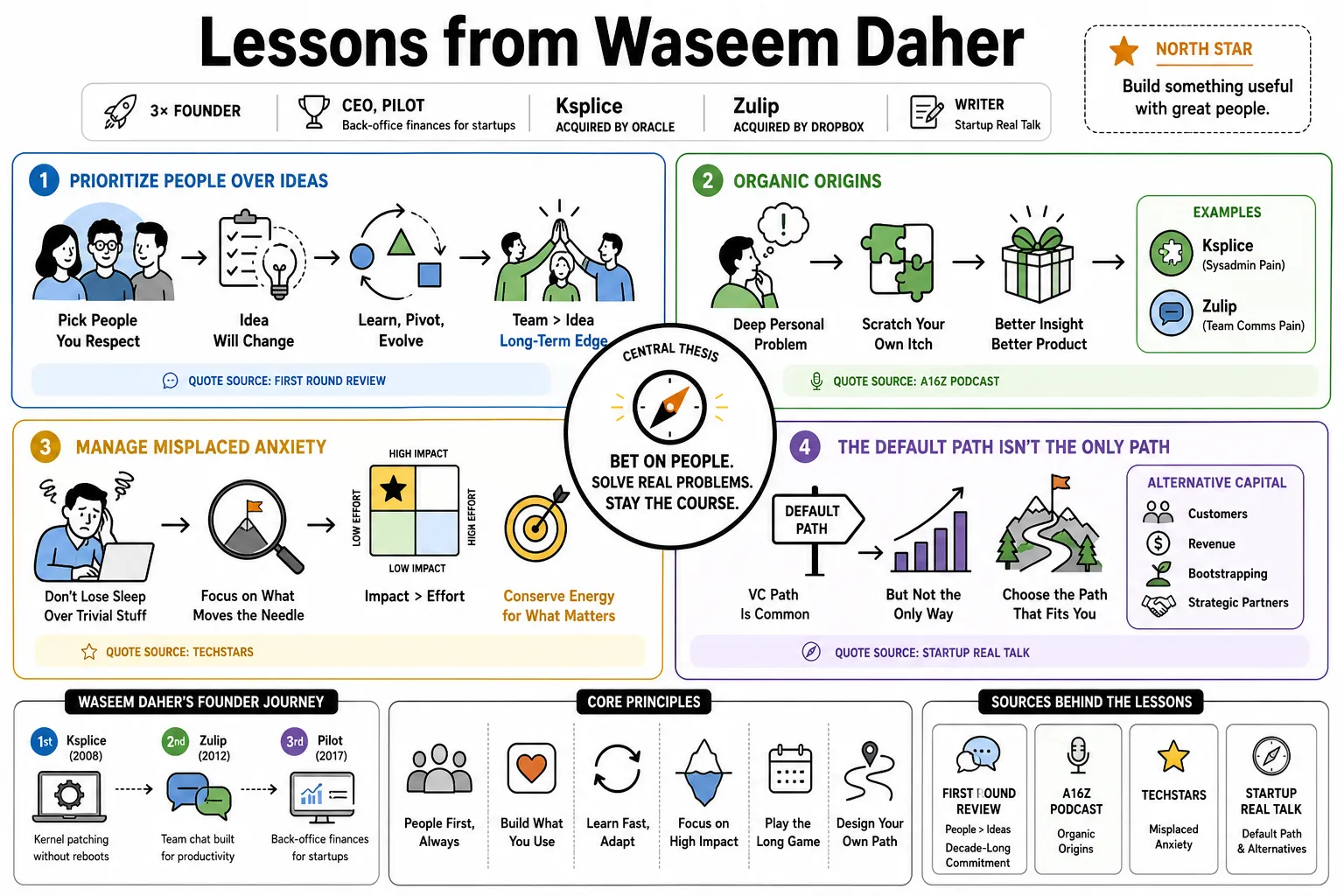
Lessons from Waseem Daher
Waseem Daher is a three-time founder and the CEO of Pilot, a company that handles back-office finances for startups. He previously co-founded Ksplice (acquired by Oracle) and Zulip (acquired by Dropbox). This profile collects his tactical advice on the mechanics of early-stage company building, drawn from his firsthand experience and his newsletter, Startup Real Talk.
Part 1: The Foundations of a Company
- On Prioritizing People Over Ideas: "Choose the team first and the idea second, because the original idea is highly likely to change as you learn." — Source: First Round Review
- On the Decade-Long Commitment: "Building a company takes years or decades, so prioritize working with people you respect and building a product you actually find useful." — Source: First Round Review
- On Organic Origins: "The best startup ideas, like Ksplice and Zulip, often emerge from a deeper personal problem the founders experienced firsthand." — Source: a16z Podcast
- On Misplaced Anxiety: "First-time founders frequently lose sleep over minor details that ultimately have zero impact on the actual success of the business." — Source: Techstars
- On the Default Path: "The venture capital route is frequently presented as the default, but it is often an unnecessarily difficult way to build a sustainable business." — Source: The Silicon Valley Podcast
- On True Validation: "To truly validate an idea, employ the 'money test' by asking a prospect if they would hand you $500 right now for the solution." — Source: Startup Real Talk
- On the Scalability Myth: "Scalability is vastly overrated in the early days; founders should prioritize doing manual, unscalable things to learn exactly what customers need." — Source: The Changelog
- On Maintaining Focus: "Delay cross-selling and tangential side projects for as long as possible to keep the entire company focused on the 'main thing'." — Source: Startup Real Talk
- On Crafting Narrative: "Founders must design a compelling, 'inevitable' story about their company's future to successfully attract early talent and investors." — Source: Startup Real Talk
Part 2: Market Selection and Product
- On the Ultimate Constraint: "While you can fix a bad product or pivot a bad strategy, the one problem you cannot fix is a market that is simply too small." — Source: First Round Review
- On Basic Arithmetic: "Do the back-of-the-envelope math early to ensure the total addressable market actually justifies the years of effort required." — Source: Pilot Blog
- On Problem Severity: "Do not waste energy building nice-to-have features; your product must address one of the top three most painful problems your customer faces." — Source: Just Go Grind
- On Customer Apathy: "If you are solving the tenth-biggest problem on a customer's list, you will inevitably struggle to get them to buy or even pay attention." — Source: Startup Real Talk
- On Navigating the Market: "Your company is a submarine and customer conversations are your periscope." — Source: Startup Real Talk
- On Execution Dependency: "Finding the right market opportunity is only half the battle; without A+ execution, even the best ideas will stall." — Source: First Round Review
- On Honest Feedback: "Polite feedback is useless; you must push prospects for harsh, unvarnished reactions to determine if the product truly hits the mark." — Source: Startup Real Talk
- On Niche Dominance: "It is a stronger strategy to thoroughly solve a specific problem for a defined group than to build a generic tool that sort of works for everyone." — Source: Code Story
- On Competitive Advantage: "A startup's primary advantage over large incumbents is the sheer speed at which it can iterate based on raw user feedback." — Source: The Silicon Valley Podcast
- On Intuitive Design: "When you build software to solve your own pain, you benefit from a highly intuitive understanding of the required user experience." — Source: a16z Podcast
Part 3: Customer Discovery and Sales
- On the Founder's Duty: "In the early days, the founder must be the primary salesperson; you simply cannot outsource the search for product-market fit." — Source: a16z Podcast
- On Wasted Time: "Founders must train themselves to quickly recognize and aggressively walk away from the 'slow no' in sales interactions." — Source: Startup Real Talk
- On Cold Emailing: "When reaching out to busy people, keep emails short, state a specific ask, and clearly demonstrate that you have done your research." — Source: Startup Real Talk
- On Vague Networking: "Never ask for a general 'chat about trends'; always ask for specific, actionable advice on a defined problem." — Source: Startup Real Talk
- On Pricing as a Test: "Avoid giving the product away for free indefinitely, because successfully charging money is the ultimate test of actual value." — Source: The DealMaker Show
- On the Reality of Onboarding: "The sales process does not conclude at the contract signature; onboarding is the decisive moment where the customer actually experiences the value." — Source: Carta
- On Diagnosing Over Pitching: "Effective early sales is less about pitching your solution and much more about diagnosing the nuances of the customer's pain." — Source: Just Go Grind
- On Handling Rejection: "Treat early customer objections not as roadblocks, but as free consulting sessions on how to improve your messaging and product." — Source: Startup Real Talk
- On Selling the Future: In Sequoia's Seven Questions interview, Daher argues there are no cheat codes for developing a deep, visceral understanding of customers; even as the company grows, founders need to spend time in the weeds and on the call. — Reference: Sequoia Seven Questions interview on customer understanding and staying close to customer conversations
Part 4: Leadership and Decision-Making
- On Having a Stance: "I think it's important for a founder to be fairly opinionated, especially when you have imperfect information and there's no way to be sure that you're making the right call." — Reference: Sequoia Seven Questions interview quoting Daher on being opinionated amid uncertainty
- On the Necessity of Action: "Your team needs you to make decisions, even if you have to make adjustments down the road—and even when they're not unanimously popular." — Reference: Sequoia Seven Questions interview quoting Daher on decisions, later adjustments, and unpopular calls
- On Bearing Disapproval: Daher tells Sequoia that as companies grow, leaders cannot make everyone happy; the work is to make firm calls, explain that tough choices are inevitable, and aim for what is best for the company. — Reference: Sequoia Seven Questions interview on tough choices, unpopular decisions, and company-first judgment
- On Minimizing Whiplash: "Constant vacillation creates massive organizational thrash; it is usually better to commit to a path and pivot later if the data demands it." — Source: Pilot Blog
- On Cutting the Fluff: "Founders should seek out tactical, 'low-bullshit' advice rather than relying on the vague platitudes common in startup media." — Source: Startup Real Talk
- On the Two Fatal Risks: "There are two things that kill your company. Thing number one is running out of money... thing number two is giving up." — Source: Carta
- On Bridging the Gap: "As a founder, you hold strategic context the rest of the company lacks; it is your daily responsibility to bridge that information gap." — Source: Startup Real Talk
- On Controlling the Narrative: "If leadership fails to clearly communicate the company's core priorities, employees will inevitably invent their own." — Source: First Round Review
- On the Value of Momentum: "A reasonably good decision executed immediately is almost always more valuable than a perfect decision made three weeks too late." — Source: Code Story
Part 5: Avoiding Distractions and Fake Work
- On Startup Persistence: "The defining trait of successful founders is not raw intellect or pedigree, but the sheer, stubborn refusal to quit when things get hard." — Source: The DealMaker Show
- On Recognizing Illusions: "Much of what feels like productivity, such as attending networking mixers, tweaking logos, or endlessly analyzing competitors, is actually just 'fake work'." — Source: Startup Real Talk
- On the Actual Job Description: "A founder's actual job early on boils down to two things: talking to customers and building a product they desperately want." — Source: Pilot Blog
- On the Social Media Mirage: "High social media engagement rarely correlates with actual, sustainable business traction in the early days of a company." — Source: Startup Real Talk
- On Ignoring the Competition: "Obsessing over competitor movements is a distraction; assume they are likely just as confused and experimental as you are." — Source: Just Go Grind
- On Service Disguises: "Be highly skeptical of building tech-enabled services unless the underlying technology legitimately drives massive efficiency and margin gains." — Source: Startup Real Talk
- On Premature Scaling: "Do not waste time building technical infrastructure for a million hypothetical users when you are still trying to acquire your first ten." — Source: The Changelog
- On the Conference Circuit: "Speaking on industry panels and attending startup conferences does not equal revenue growth or product advancement." — Source: Startup Real Talk
- On Tracking the Right Metrics: "Revenue is a lagging indicator; you must focus your daily attention on the inputs, like calls made and code shipped, that actually generate the output." — Source: Carta
- On Ruthless Trade-offs: "Every hour spent on a secondary, nice-to-have task is an hour stolen directly from the singular goal that keeps the company alive." — Source: First Round Review
Part 6: Co-founders and Team Building
- On Ignoring the Press: "The media narrative surrounding startups is mostly noise and survivorship bias; ignore it and focus entirely on your own internal metrics." — Source: The Silicon Valley Podcast
- On Repeated Partnerships: "Repeating the founder journey with the exact same people provides an unmatched baseline of trust and operational shorthand." — Source: a16z Podcast
- On Healthy Conflict: "When co-founders operate with deep mutual respect, intense disagreements can be resolved based on pure logic rather than fragile egos." — Source: First Round Review
- On Foundational Hires: "The first few engineers set the permanent DNA of the engineering organization; hire for high adaptability as much as raw technical skill." — Source: Code Story
- On Explicit Alignment: "Co-founders must be explicitly and honestly aligned on the timeline, lifestyle, and ultimate scale they are aiming for before incorporating." — Source: Startup Real Talk
- On Correcting Mistakes: "If a new hire is clearly not working out, keeping them around out of guilt is unfair to them and actively detrimental to the rest of the team." — Source: Pilot Blog
- On Early Stage Profiles: "In the earliest stages, you need adaptable generalists who can wear multiple hats, not hyper-specialized experts who only do one thing." — Source: Startup Real Talk
- On Functional Transparency: "Company transparency isn't about aimless oversharing; it is about providing the team with the exact context required to make autonomous, high-quality decisions." — Source: Just Go Grind
- On Setting Salaries: "Founder compensation should be high enough to remove personal financial anxiety, but not so high that it noticeably drains the startup's runway." — Source: Carta
Part 7: Operations and Financial Hygiene
- On Board Dynamics: "Remember that the board of directors ultimately works to serve the company, not the other way around; founders should manage them proactively." — Source: The DealMaker Show
- On the Reality of Admin: "Administrative tasks are a baseline necessity that must be handled flawlessly, rather than a mere distraction to be ignored or deferred." — Source: Pilot Blog
- On Delegating the Non-Core: "Founders must aggressively offload tasks that do not contribute to the core product mission, such as bookkeeping, as early as financially possible." — Source: Pilot Blog
- On Silent Killers: "Perfect back-office operations are rarely the reason a startup succeeds, but ignoring them can easily cause a promising company to fail." — Source: Pilot Blog
- On Financial Fluency: "A CEO cannot outsource the fundamental understanding of their own financial metrics, cash burn rate, and precise runway." — Source: Carta
- On the True Cause of Death: "Startups rarely die because they lack creative ideas; they die because they run out of cash before they manage to find product-market fit." — Source: Carta
- On Fractional Expertise: "Use fractional executives or specialized agencies early on to secure expert guidance without carrying the burden of full-time payroll." — Source: Pilot Blog
- On Operational Debt: "Just like technical debt, operational debt accumulates silently; you must periodically halt feature development to fix broken internal processes." — Source: Startup Real Talk
- On Rhythmic Management: "Establishing highly predictable operational rhythms, like standard weekly meetings, dramatically reduces the cognitive load on the entire team." — Source: Pilot Blog
- On Forced Automation: "If a specific internal process is done manually more than three times, it is time to build a system or automate it completely." — Source: Startup Real Talk
Part 8: Acquisitions, Exits, and Venture Capital
- On the First Rule of M&A: "Companies are bought, not sold." — Source: Mercury
- On the Acquirer's Motive: "Acquisitions are entirely driven by the acquirer's own strategic agenda, not by a founder's internal timeline or sudden desire to exit." — Source: Mercury
- On the Danger of Building to Flip: "Founders should never build a company specifically to be acquired; build a durable, sustainable business first and let the exit be a byproduct." — Source: The DealMaker Show
- On Successful Outcomes: "The exits of Ksplice and Zulip were side effects of building highly valuable technology for users, not the primary goal from day one." — Source: The DealMaker Show
- On the Cost of Capital: "While often necessary, the process of fundraising is a massive, months-long distraction from the actual work of running and growing the company." — Source: The Silicon Valley Podcast
- On Alignment with Investors: "Only take venture capital money if your personal goals explicitly and honestly align with the hyper-growth expectations of institutional investors." — Source: First Round Review
- On Negotiating Leverage: "The strongest possible negotiating leverage in any acquisition or fundraising scenario is having a profitable business that does not actually need the deal." — Source: Mercury
- On Information Asymmetry: "In any M&A process, the acquirer has done this hundreds of times, while the founder is usually doing it for the first time. Get excellent advisors." — Source: The DealMaker Show
- On the Day After: "Selling a company provides capital but does not magically solve your personal problems; ensure you are emotionally prepared for the quiet day after the deal closes." — Source: Just Go Grind