Lessons from Will Ahmed
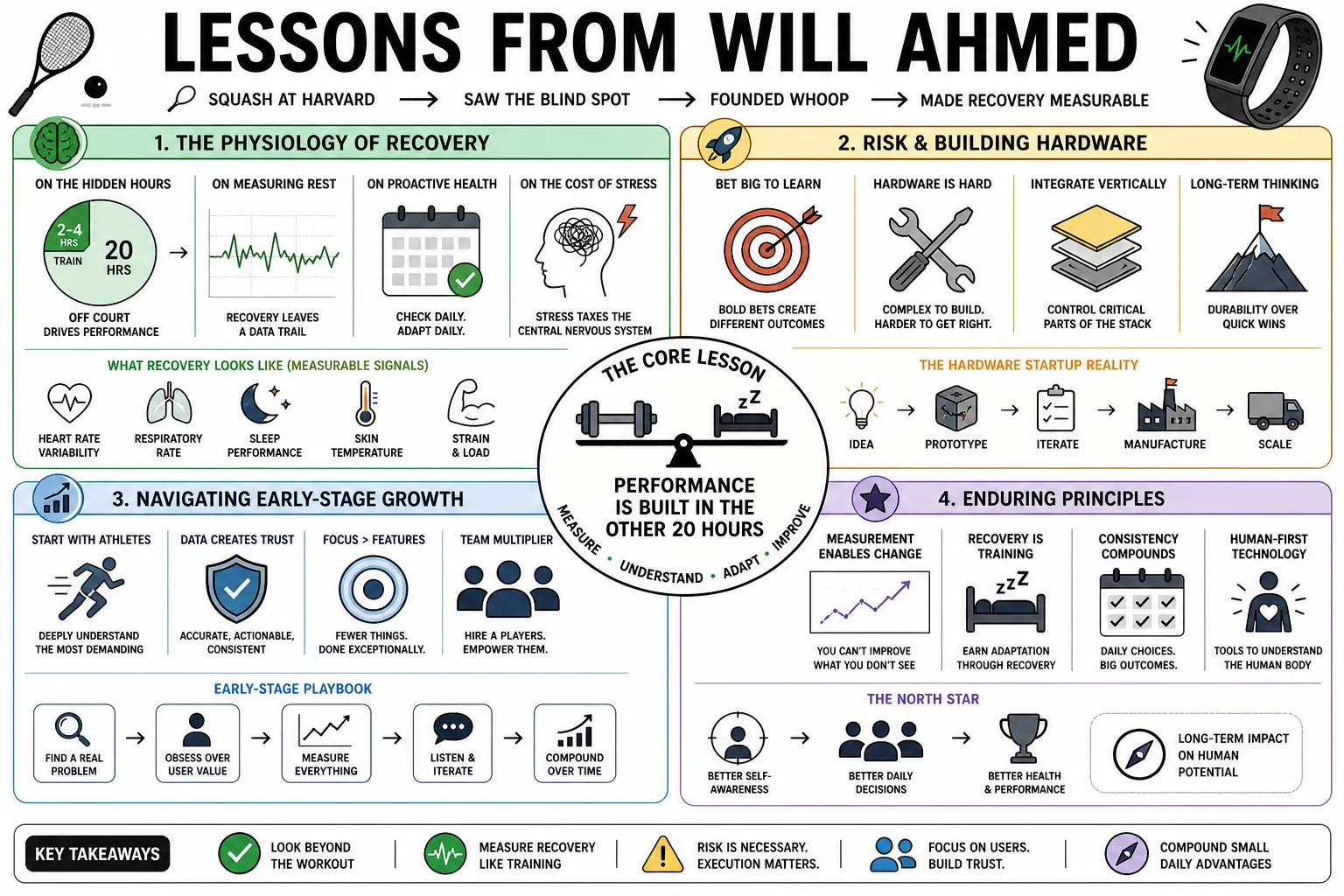
While playing squash at Harvard, Will Ahmed realized athletes were overtraining by ignoring the twenty hours a day they spent off the court. He founded WHOOP to measure that downtime, shifting the fitness industry's focus away from tracking active workouts and toward sleep and physical recovery. Here, he explains why rest is as measurable as training, the necessity of risk in hardware startups, and the realities of navigating early-stage growth.
Part 1: The Physiology of Recovery
- On the hidden hours: "Athletes spend so much time obsessed with the two to four hours they are training, but true performance is dictated by what happens in the other twenty hours of the day." — Source: [The WHOOP Podcast]
- On measuring rest: "Rest used to be treated as an absence of activity, something you couldn't quantify. We realized that recovery is an active physiological process that leaves a distinct data trail." — Source: [Rich Roll Podcast]
- On proactive health: "The medical system looks at you once a year to see if you are sick. Performance requires looking at your body every single day to see how ready you are to adapt." — Source: [Walker Webcast]
- On the cost of stress: "Emotional and psychological stress tax your central nervous system exactly the same way a heavy deadlift does. Your body doesn't know the difference between a tough conversation and a tough workout." — Source: [Diary of a CEO]
- On alcohol: "One of the most profound behavioral changes we see in our users is reducing alcohol consumption. Once you see the objective data of what two drinks do to your resting heart rate overnight, it ruins the bliss of ignorance." — Source: [The WHOOP Podcast]
- On continuous monitoring: "If you only measure something when you are exercising, you are getting a highlight reel. You need the baseline to understand the anomaly." — Source: [How I Built This]
- On readiness: "You shouldn't train based on a predetermined schedule on a calendar. You should train based on your body's readiness to absorb strain on that specific morning." — Source: [Founders Field Guide]
- On overtraining symptoms: "Before we had the data, we called it 'burning out' or 'hitting a wall.' But biologically, you are simply accumulating more strain than your recovery can cover over a sustained period." — Source: [Rich Roll Podcast]
- On the illusion of effort: "Sweat and soreness are terrible proxies for progress. You can work yourself to the bone and actually get slower and weaker if you aren't recovering." — Source: [Diary of a CEO]
- On hydration and recovery: "We noticed early on that even mild dehydration creates a significant drag on cardiovascular recovery. Your heart simply has to work harder to pump less blood volume." — Source: [The WHOOP Podcast]
Part 2: Heart Rate Variability & Nervous System
- On defining HRV: "Heart rate variability is the literal time difference between your heartbeats. It is the clearest window we have into the autonomic nervous system." — Source: [Founders Field Guide]
- On nervous system balance: "You want a high HRV because it means your sympathetic and parasympathetic systems are in a tug of war. A variable heart rate means your body is responsive to its environment." — Source: [Rich Roll Podcast]
- On fighting comparisons: "There is no 'good' universal HRV. An elite marathoner might have a lower baseline HRV than a sedentary person due to genetics. You can only compare your HRV to your own baseline." — Source: [The WHOOP Podcast]
- On HRV as a warning system: "A sudden drop in your HRV is often the first signal your body gives that it is fighting an infection, sometimes days before you feel a scratch in your throat." — Source: [Walker Webcast]
- On age and HRV: "HRV naturally declines as you age. The goal isn't to hold onto a number from your twenties, but to slow the decline through cardiovascular fitness and sleep hygiene." — Source: [Diary of a CEO]
- On travel and HRV: "Crossing time zones wrecks your HRV. The circadian mismatch confuses your nervous system, which responds by entering a low-grade state of fight or flight." — Source: [The WHOOP Podcast]
- On breathing: "If you want a real-time way to manipulate HRV, breathwork is the quickest lever. Prolonged exhales force the parasympathetic nervous system to engage." — Source: [Rich Roll Podcast]
- On resting heart rate: "While HRV measures the variance, your resting heart rate is a measure of baseline efficiency. If your RHR is creeping up day over day, you are under-recovering." — Source: [Founders Field Guide]
- On data literacy: "Early on, nobody knew what HRV was. We had to build an interface that translated a highly clinical cardiovascular metric into a simple red, yellow, or green recovery score." — Source: [How I Built This]
- On mental health: "There is a direct correlation between anxiety and a suppressed HRV. The brain and the heart are in constant communication via the vagus nerve." — Source: [Diary of a CEO]
Part 3: The Science of Sleep
- On sleep consistency: "Going to bed and waking up at the exact same time every day is arguably more important than the total duration of sleep. Your brain loves predictability." — Source: [The WHOOP Podcast]
- On sleep architecture: "Time in bed is only part of the equation. If you don't get sufficient REM sleep for cognitive repair and deep sleep for physical repair, you will wake up feeling wrecked regardless of the hours." — Source: [Rich Roll Podcast]
- On late-night eating: "Eating a heavy meal right before bed forces your body to divert resources to digestion. Your heart rate stays elevated, and your deep sleep plummets." — Source: [The WHOOP Podcast]
- On screen time: "The blue light from screens suppresses melatonin production. Looking at your phone in bed tricks your circadian rhythm into thinking the sun is rising." — Source: [Diary of a CEO]
- On the sleep debt: "You cannot fully 'catch up' on sleep on the weekends. Sleep debt functions like financial debt with a high interest rate; you pay a tax on your cognitive function every day you carry it." — Source: [Walker Webcast]
- On temperature: "Your core body temperature needs to drop by about two degrees to initiate and maintain deep sleep. Sleeping in a cold room is one of the easiest hacks for better sleep." — Source: [Founders Field Guide]
- On caffeine timing: "Caffeine has a quarter-life of up to twelve hours in some people. Having a coffee at four in the afternoon means a significant portion of it is still in your receptors at midnight." — Source: [The WHOOP Podcast]
- On sleep tracking accuracy: "Actigraphy alone, just measuring movement, is insufficient for tracking sleep stages. You need cardiovascular data to accurately determine when someone transitions from light sleep into REM." — Source: [How I Built This]
- On waking up: "Waking up during a deep sleep cycle causes sleep inertia, that groggy feeling that takes hours to shake off. A smart alarm wakes you up during light sleep." — Source: [Rich Roll Podcast]
Part 4: Redefining Strain & Overtraining
- On the definition of strain: "We measure strain as cardiovascular exertion over time. It's an objective measurement of the load you placed on your body, removing the bias of how you think a workout felt." — Source: [The WHOOP Podcast]
- On squash and realization: "I was captain of the Harvard squash team and I was constantly overtraining. I wanted a way to prove to myself and my coach that my body was breaking down." — Source: [How I Built This]
- On relative exertion: "A five-mile run might give an elite runner a strain score of 10, but the same run could give a novice a 17. Strain is scaled to your individual physiological capacity." — Source: [Founders Field Guide]
- On daily limits: "There is a mathematical limit to the amount of strain your body can constructively absorb in a day. Pushing past that limit doesn't make you fitter; it increases injury risk." — Source: [Diary of a CEO]
- On active recovery: "Sitting on the couch all day isn't always the best way to recover. Light cardiovascular strain, like a brisk walk, promotes blood flow and flushes metabolic waste without taxing the nervous system." — Source: [Rich Roll Podcast]
- On the mental strain: "We are working on ways to better quantify cognitive strain. For a CEO or a developer, a twelve-hour workday leaves a physiological footprint that looks remarkably similar to a moderate workout." — Source: [Walker Webcast]
- On pacing: "If you wake up in the red, that is not the day to try and hit a personal best in the gym. It is a day to prioritize mobility, hydration, and an early bedtime." — Source: [The WHOOP Podcast]
- On tapering: "Athletes use strain data to peak for competition. Tapering isn't simply resting; it is a precisely managed reduction in strain volume to maximize a green recovery score on race day." — Source: [Founders Field Guide]
- On weightlifting: "Cardiovascular strain is different from muscular strain. You can lift heavy weights and record a low cardiovascular strain, but your central nervous system is still heavily taxed." — Source: [Rich Roll Podcast]
Part 5: Leadership & The Evolution of a CEO
- On shifting roles: "As a company scales, the CEO has to transition from being the primary individual contributor to becoming a manager of pace, judgment, and people." — Source: [Disrupt Yourself Podcast]
- On hiring: "I look for people who index high on two traits: intensity and humility. High intensity without humility creates a toxic environment. Humility without intensity gets nothing done." — Source: [Diary of a CEO]
- On inviting feedback: "You have to actively invite criticism. If people are afraid to tell you that an idea is bad, you are operating in a dangerous echo chamber." — Source: [Founders Field Guide]
- On emotional regulation: "A leader's mood is contagious. If you show up panicked, the organization panics. Maintaining a steady baseline regardless of external volatility is the job." — Source: [Walker Webcast]
- On delegation: "The hardest thing for an early-stage founder to do is give away their legos. You have to let competent people take over tasks you used to control entirely." — Source: [How I Built This]
- On identity: "Do not conflate your personal worth with the valuation or success of your company. It is a dangerous psychological trap that leads to poor decision-making." — Source: [Diary of a CEO]
- On making decisions: "Most decisions should be made with 70% of the information. Waiting for 100% means you are moving too slowly, and waiting for less than 50% means you are gambling." — Source: [The WHOOP Podcast]
- On managing pace: "Pace isn't simply about moving fast. It's about knowing when to sprint and when to force the team to slow down and ensure the foundation is stable." — Source: [Disrupt Yourself Podcast]
- On continuous learning: "The version of me that started WHOOP in a dorm room was not equipped to run a billion-dollar company. The only way to survive is to learn faster than the company grows." — Source: [Founders Field Guide]
Part 6: Building WHOOP & Entrepreneurial Risk
- On hardware startups: "Everyone in Silicon Valley told me not to build hardware. But if you want to capture pristine physiological data, you cannot rely on someone else's sensors." — Source: [How I Built This]
- On early validation: "We didn't start with consumers. We went straight to the most demanding users in the world: professional athletes. If the product was capable enough for LeBron James, it would work for anyone." — Source: [The WHOOP Podcast]
- On missing features: "We intentionally left out a screen and step counting. A screen distracts you, and step counting is a poor proxy for cardiovascular health. We committed to building a physiological monitor, not a smartwatch." — Source: [Diary of a CEO]
- On playing it safe: "The greatest risk an entrepreneur can take is trying to play it safe. If you build for the market as it exists today, by the time you launch, you are already obsolete." — Source: [Founders Field Guide]
- On the subscription model: "Hardware is a one-time transaction. We shifted to a subscription model because we wanted our incentives aligned with the user: we have to provide new value via software every single month." — Source: [Walker Webcast]
- On naming the company: "WHOOP was a word that expressed energy and excitement. It made people smile, and that made it a great foundation for a brand." — Source: [How I Built This]
- On near failure: "There were multiple times in the early days where we had a few weeks of payroll left. You learn to compartmentlize the existential dread and focus on the next immediate task." — Source: [Diary of a CEO]
- On competing with giants: "You cannot beat massive tech companies on distribution or capital. You beat them by choosing a hyper-specific problem, like 24/7 recovery monitoring, and focusing entirely on solving it perfectly." — Source: [Rich Roll Podcast]
- On iterative design: "The first WHOOP strap was bulky and uncomfortable. You have to be willing to ship a product you are slightly embarrassed by, as long as the core underlying technology is sound." — Source: [Founders Field Guide]
- On long-term vision: "We bet early that the future of healthcare wasn't in hospitals, but on people's wrists. We are building technology for the market of tomorrow." — Source: [The WHOOP Podcast]
Part 7: Focus, Mindset, and Meditation
- On transcendental meditation: "I practice TM for twenty minutes twice a day. It is the single most effective tool I have found for clearing the cache in my brain and lowering my baseline stress." — Source: [Diary of a CEO]
- On finding silence: "In a hyper-connected world, true silence is a competitive advantage. If you are constantly consuming information, you never give your mind the space to synthesize it into original thoughts." — Source: [Rich Roll Podcast]
- On routine: "My morning routine isn't about optimization; it's about eliminating decision fatigue. I do the exact same things in the exact same order so I can save my cognitive energy for the office." — Source: [Founders Field Guide]
- On handling rejection: "If you are starting a company, you will hear 'no' hundreds of times. You have to develop a callous to rejection where it stops hurting and just becomes data." — Source: [How I Built This]
- On breathing practices: "Taking two minutes to do box breathing before a massive pitch lowers your heart rate and changes the literal tone of your voice. You project calm because your physiology is calm." — Source: [The WHOOP Podcast]
- On presence: "When you are in a meeting, you have to be entirely in the meeting. Partial attention is a waste of your time and deeply disrespectful to the people you are working with." — Source: [Walker Webcast]
- On self-awareness: "You cannot manage an organization if you cannot manage yourself. Self-awareness is the foundation of all effective leadership." — Source: [Disrupt Yourself Podcast]
- On the ego: "Ego is loud, but confidence is quiet. The best founders I know do not need to dominate the conversation; they need to get to the right answer." — Source: [Diary of a CEO]
- On perspective: "Whenever I feel overwhelmed, I remind myself that I get to build technology that improves human health. The stress is a privilege." — Source: [Rich Roll Podcast]
Part 8: Work-Life Harmony & High Performance
- On rejecting balance: "I don't believe in work-life balance. Balance implies that if you spend an hour at work, you must spend an hour at home. It's a static concept that creates guilt." — Source: [Business Insider]
- On embracing harmony: "I prefer the term work-life harmony. Harmony acknowledges that life operates in seasons. Sometimes you will be 90% focused on a product launch, and that is okay as long as you adjust later." — Source: [Diary of a CEO]
- On guilt-free work: "Founders should not feel guilty for loving their work and letting it consume them during demanding periods. Building a company requires an unreasonable amount of focus." — Source: [Founders Field Guide]
- On intentional downtime: "When you are resting, you must actually rest. Checking email while sitting on the beach is not recovery; it is just a less efficient form of working." — Source: [The WHOOP Podcast]
- On managing energy: "Time management is less important than energy management. You can have all the time in the world, but if your energy is depleted, the output will be mediocre." — Source: [Walker Webcast]
- On the myth of the grind: "The 'hustle culture' mentality of sleeping four hours a night is biologically stupid. You are sacrificing long-term cognitive function for the illusion of short-term productivity." — Source: [Rich Roll Podcast]
- On setting boundaries: "I don't look at my phone in the first hour after waking up. Allowing the inbox to dictate my morning means I am reacting to other people's priorities instead of setting my own." — Source: [The WHOOP Podcast]
- On longevity: "High performance isn't about having one great year. It's about sustaining excellence over decades, which is impossible if you treat your body like a rental car." — Source: [Founders Field Guide]
- On personal metrics: "Whatever you measure, you can manage. Whether it is your sleep, your company's cash flow, or the time you spend with your family, tracking the data forces accountability." — Source: [Diary of a CEO]