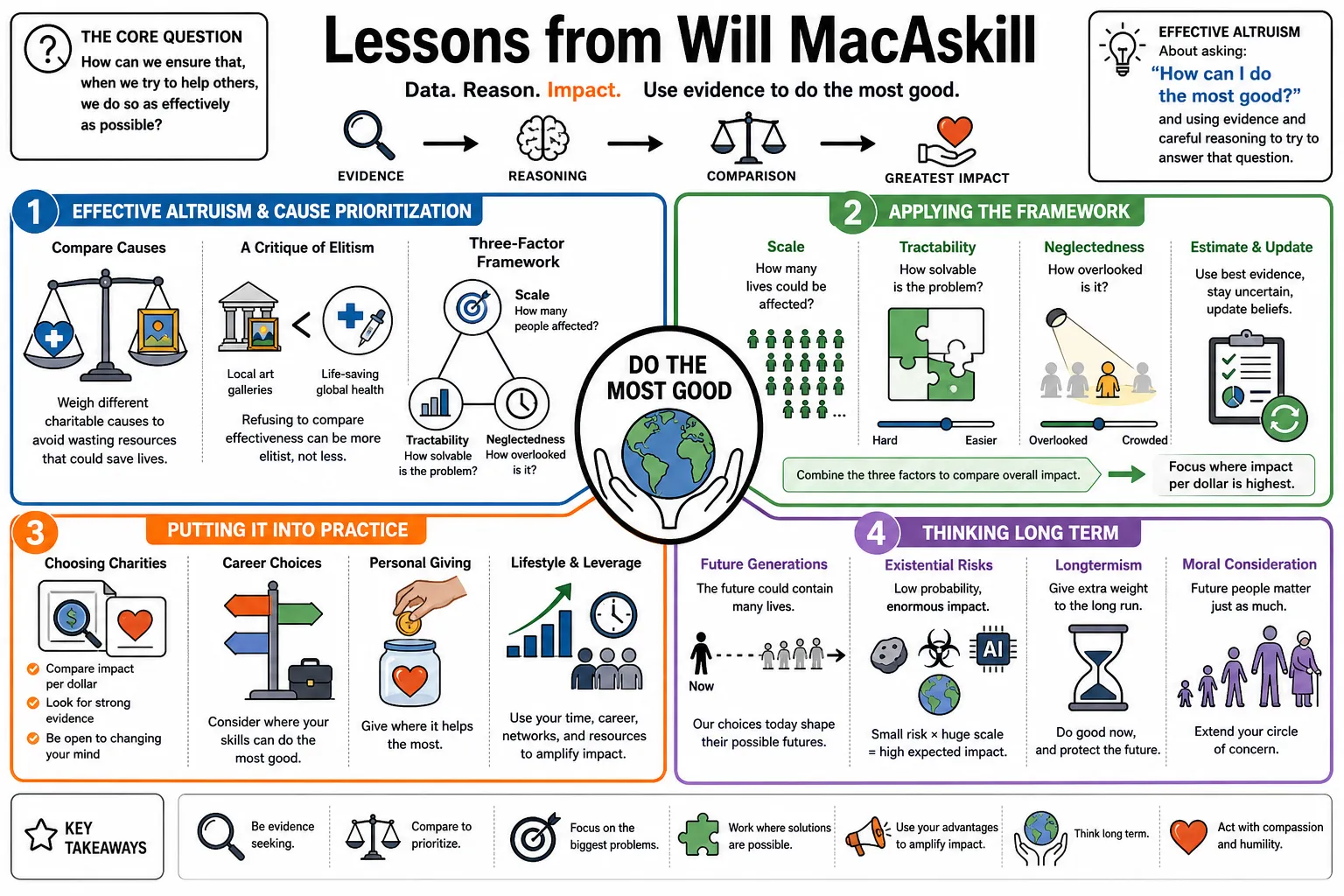
Lessons from Will MacAskill
Oxford philosopher Will MacAskill helped launch effective altruism, a movement that uses data to calculate how to do the most good. This profile gathers his arguments on applying that logic to practical ethical decisions, from evaluating charities and career paths to weighing the moral importance of future generations.
Part 1: Effective Altruism and Cause Prioritization
- On the core question: "How can we ensure that, when we try to help others, we do so as effectively as possible?" — Source: [Doing Good Better]
- On the definition of the movement: "Effective altruism is about asking: 'How can I do the most good?' and using evidence and careful reasoning to try to answer that question." — Source: [Effective Altruism]
- On comparing causes: "It is necessary to weigh different charitable causes against one another to avoid wasting resources that could otherwise save lives." — Source: [Wikipedia]
- On the elitism critique: "Refusing to compare the effectiveness of charities is more elitist than prioritizing, especially when it leads to funding local art galleries over life-saving global health interventions." — Source: [Wikipedia]
- On the three-factor framework: "We can evaluate the potential impact of different problems by analyzing their scale, neglectedness, and tractability." — Source: [Effective Altruism]
- On scale: "When evaluating a problem, we must ask how many people are affected and how significantly their lives are impacted." — Source: [Effective Altruism]
- On neglectedness: "We should look at how many resources are already directed toward a problem, prioritizing areas that receive the least attention relative to their severity." — Source: [Effective Altruism]
- On tractability: "A key component of prioritizing a cause is determining how easily the problem can actually be solved or improved if more resources are applied." — Source: [Effective Altruism]
- On disaster relief allocation: "If the international response to natural disasters was rational, we would expect a greater amount of funding to be provided to larger disasters and to disasters that occur in poorer countries... Funding seems to be allocated in proportion with how evocative and widely publicized the disaster is." — Source: [Doing Good Better]
- On the failure to prioritize: "The focus on individual consumption decisions, like buying fair trade, is often accompanied by a broader failure to prioritize where money actually does the most good." — Source: [Doing Good Better]
Part 2: Rationality, Data, and Impact Measurement
- On data and virtue: "We very often fail to think as carefully about helping others as we could, mistakenly believing that applying data and rationality to a charitable endeavor robs the act of virtue." — Source: [Doing Good Better]
- On defining success: "What matters is not who does good but whether good is done; and the measure of how much good you achieve is the difference between what happens as a result of your actions and what would have happened anyway." — Source: [Doing Good Better]
- On counterfactual reasoning: "To understand your true impact, you must subtract the good that would have occurred even if you had done nothing from the good that occurred because of your actions." — Source: [Doing Good Better]
- On missed opportunities: "Refusing to apply rigorous analysis to charity means we pass up distinct opportunities to make a massive difference in the lives of others." — Source: [Doing Good Better]
- On the 100x multiplier: "One additional unit of income can do a hundred times as much to the benefit the extreme poor as it can to benefit you or I." — Source: [Doing Good Better]
- On unequal options: "It is a rare and powerful situation to face two options where one is literally a hundred times more effective at improving welfare than the other." — Source: [Doing Good Better]
- On the scientific approach: "Altruism should be approached like a scientific experiment, using the best available evidence to test hypotheses about what helps people the most." — Source: [80,000 Hours]
- On cost-effectiveness: "The cost-effectiveness of charitable programs varies wildly, meaning that choosing an average charity instead of the best charity drastically reduces the amount of good accomplished." — Source: [Doing Good Better]
- On emotional giving: "Relying purely on emotional appeal when choosing where to donate often directs money toward less effective interventions, leaving the most pressing needs unfunded." — Source: [Doing Good Better]
Part 3: Career Strategy and 80,000 Hours
- On the weight of career choices: "Your choice of career is a choice about how to spend more than eighty thousand hours over the course of your life, which means it makes sense to invest a considerable amount of time in the decision." — Source: [Doing Good Better]
- On the time investment: "If you were to spend just 1 percent of your working time thinking about how to spend the other 99 percent, that would mean you'd spend eight hundred hours, or twenty working weeks, on your career decision." — Source: [Doing Good Better]
- On following passion: "The popular advice to follow your passion is flawed because passions change over time and rarely align perfectly with the most pressing problems." — Source: [80,000 Hours]
- On cultivating passion: "Job satisfaction is more reliably predicted by engaging, meaningful work where you build mastery, suggesting that passion follows skill rather than preceding it." — Source: [80,000 Hours]
- On thinking like a scientist: "Careers should be treated as a series of experiments where you test hypotheses, gather information, and update your trajectory every few years." — Source: [80,000 Hours]
- On career stages: "A high-impact career typically moves through three stages: exploring promising paths, investing in career capital, and deploying that capital to solve major problems." — Source: [80,000 Hours]
- On building capital: "Early in your career, it is often more effective to build career capital (skills, connections, and credentials) rather than immediately try to maximize direct impact." — Source: [80,000 Hours]
- On evaluating roles: "When assessing a job, you must consider both its direct impact on the world and how well it positions you for greater impact in the future." — Source: [80,000 Hours]
- On career replaceability: "If you take a high-impact job at a non-profit, you must consider whether the person who would have taken the job instead of you would have been nearly as effective." — Source: [Doing Good Better]
- On earning to give: "For some individuals, the most effective career path is to pursue a high-earning profession in order to donate a large percentage of their income to highly effective charities." — Source: [Doing Good Better]
Part 4: The Ethics of Giving and Wealth
- On the glamour of giving: "Donating to charity is not nearly as glamorous as kicking down the door of a burning building, but the benefits are just as great." — Source: [Doing Good Better]
- On lifetime impact: "Rather than just saving one life, we could save a life every working year of our lives." — Source: [Doing Good Better]
- On global wealth distribution: "Because of global income inequality, a middle-class person in a wealthy country is in the top few percent of global earners and has outsized power to help those in extreme poverty." — Source: [Doing Good Better]
- On moral obligation: "The ability to dramatically improve the lives of others at a minor cost to oneself creates a strong moral obligation to do so." — Source: [Making Sense Podcast]
- On the expanding moral circle: "Our ethical considerations should not be limited by geographical borders; a suffering person in another country matters just as much as a suffering neighbor." — Source: [Making Sense Podcast]
- On overhead costs: "Judging a charity by its overhead costs is a mistake; what matters is the actual outcome achieved per dollar spent, not the administrative ratio." — Source: [Doing Good Better]
- On systemic change versus direct aid: "Both systemic political change and direct charitable aid are valuable, but direct aid often has a more measurable, immediate, and certain impact on extreme poverty." — Source: [Effective Altruism Forum]
- On fair trade: "Buying fair trade products is a highly inefficient way to help people in poverty compared to directly donating the price premium to effective global health charities." — Source: [Doing Good Better]
- On sweatshops: "Boycotting sweatshops often harms the poorest workers by removing their best available source of income; targeted donations do much more to improve their material conditions." — Source: [Doing Good Better]
Part 5: Longtermism and Future Generations
- On the moral weight of the future: "Future people count, but we rarely count them. They cannot vote or lobby or run for public office, so politicians have scant incentive to think about them." — Source: [What We Owe the Future]
- On temporal borders: "Just as the world does not stop at our doorstep or our country's borders, neither does it stop with our generation, or the next." — Source: [What We Owe the Future]
- On agency: "Whether the future is wonderful or terrible is, in part, up to us." — Source: [What We Owe the Future]
- On the core priority of longtermism: "Positively influencing the longterm future is a key moral priority of our time." — Source: [What We Owe the Future]
- On our duty to the unborn: "If we truly care about the interests of future generations and recognize that they are real people capable of happiness and suffering, then we have a duty to consider how we impact the world they inherit." — Source: [What We Owe the Future]
- On humanity's potential: "If we anchor our sense of humanity's potential to a fixed-up version of our present world, we risk dramatically underestimating just how good life in the future could be." — Source: [What We Owe the Future]
- On improving trajectory: "Changing the long-term trajectory of human civilization for the better could be even more impactful than simply ensuring the survival of the species." — Source: [What We Owe the Future]
- On clean energy as a baseline: "Decarbonization is a proof of concept for longtermism. Clean energy innovation is so robustly good that I see it as a baseline longtermist activity against which other potential actions can be compared." — Source: [What We Owe the Future]
- On value entrenchment: "The values that become dominant now may become permanently entrenched and suppress alternative moral systems, making our current cultural battles highly consequential for the deep future." — Source: [What We Owe the Future]
- On acting as trustees: "By abandoning the tyranny of the present over the future, we can act as trustees and help to create a flourishing world for generations to come." — Source: [What We Owe the Future]
Part 6: Artificial Intelligence and Existential Risk
- On the scale of existential risk: "Even if you think it is only a one-in-a-thousand chance, the risk to humanity this century is still ten times higher than the risk of your dying this year in a car crash." — Source: [Medium]
- On the intelligence explosion: "Advanced artificial intelligence could completely automate technological innovation, leading to a rate of economic and technological growth that accelerates without bound." — Source: [Medium]
- On shifts in power: "AGI might be developed by a company or a military, and power could be in their hands rather than the public." — Source: [Medium]
- On institutional lag: "What makes this acceleration perilous is that while technology can speed up almost arbitrarily, human institutions and decision-making are much more fixed." — Source: [80,000 Hours]
- On AI value alignment: "The central challenge of AI development is ensuring that the goals of highly capable systems are aligned with human values and safety." — Source: [WilliamMacAskill.com]
- On the spectrum of AI autonomy: "My view is that the interesting, juicy debate is where in between being an extension of our will and having its own goals do we want AI to be." — Source: [80,000 Hours]
- On credible contracts: "We need to build institutions and technical frameworks that allow humans to form reliable, credible contracts with autonomous AI systems." — Source: [Effective Altruism Forum]
- On risk aversion in AI: "To prevent catastrophic errors, advanced AI systems must be trained to act with extreme caution and risk-aversion when navigating human environments." — Source: [Effective Altruism Forum]
- On preventing lock-in: "The danger of advanced AI extends beyond outright extinction to include the possibility of a permanent lock-in of a flawed moral or political system orchestrated by a powerful intelligence." — Source: [Forethought Foundation]
Part 7: Animal Welfare and Factory Farming
- On the nature of factory farms: "The vast majority of the animals we eat are raised in factory farms. These are not humane places; they inflict severe and unnecessary suffering on animals merely for the sake of slightly cheaper produce." — Source: [Oxford University]
- On the worst conditions: "Of all the animals raised for food, broiler chickens, layer hens, and pigs are kept in the worst conditions, by a considerable margin." — Source: [Oxford University]
- On species comparison: "Beef cattle generally experience significantly better lives and less extreme suffering than intensively farmed chickens and pigs." — Source: [Oxford University]
- On dietary change: "If you care about animal suffering, you should certainly alter your diet. However, there's no reason to stop there." — Source: [Doing Good Better]
- On the power of donation: "In terms of making a difference to the lives of animals, the impact you can have through your donations seems even greater than the impact you can have by changing your own behavior." — Source: [Doing Good Better]
- On the cost of influence: "Through effective advocacy organizations, it costs approximately one hundred dollars to persuade one person to stop eating meat for a year." — Source: [Doing Good Better]
- On an overlooked crisis: "Factory farming is an incredibly pressing issue because it is massive in scale, highly solvable through systemic change, and heavily neglected by traditional philanthropy." — Source: [Fast Company]
- On funding disparities: "Animal welfare organizations aimed at factory farming are severely underfunded compared to local pet shelters, meaning marginal donations to the former produce a much larger transformative impact." — Source: [The Politic]
- On moral expansion: "Including farmed animals in our moral circle is one of the most straightforward ways to reduce global suffering using evidence-based interventions." — Source: [WilliamMacAskill.com]
Part 8: Moral Uncertainty and Ethical Caution
- On the "favorite theory" flaw: "An approach that's common is to pick the view that seems most plausible to you, and to go with that. But this approach seems bad." — Source: [80,000 Hours]
- On acting across perspectives: "We think a more plausible approach is to consider a range of perspectives, and take the actions that seem best on balance." — Source: [80,000 Hours]
- On ethical hedging: "When we are unsure which moral theory is correct, we should evaluate our choices based on how they perform across multiple plausible ethical frameworks." — Source: [WilliamMacAskill.com]
- On the foie gras thought experiment: "If there is a 45% chance that animal welfare matters morally, ordering vegetarian risotto over foie gras is the correct choice, because the potential moral cost of being wrong is vastly higher." — Source: [80,000 Hours]
- On moral caution: "If one plausible perspective says an action is extremely wrong, we should probably not take the action, even if other perspectives say it's permissible or even good." — Source: [80,000 Hours]
- On historical blindness: "Throughout history we've consistently believed, as common sense, truly horrifying things by today's standards. It's extremely likely that we're in the same boat today." — Source: [80,000 Hours]
- On questioning common sense: "We need to develop a moral view that criticises common sense intuitions, and gives us a chance to move beyond them." — Source: [80,000 Hours]
- On future judgment: "We must assume that future generations will look back on some of our widely accepted current practices with intense moral condemnation." — Source: [80,000 Hours]
- On decision-making under uncertainty: "The most rational way to make decisions in complex environments is to seek out interventions that remain highly effective regardless of which specific philosophical theory turns out to be ultimately true." — Source: [Effective Altruism]