Lessons from William Hockey
William Hockey co-founded Plaid and is now the founder of Column, a developer-focused, nationally chartered bank he bought and rebuilt from scratch. This profile collects his views on financial engineering and bootstrapping infrastructure.
Part 1: The Plaid Journey
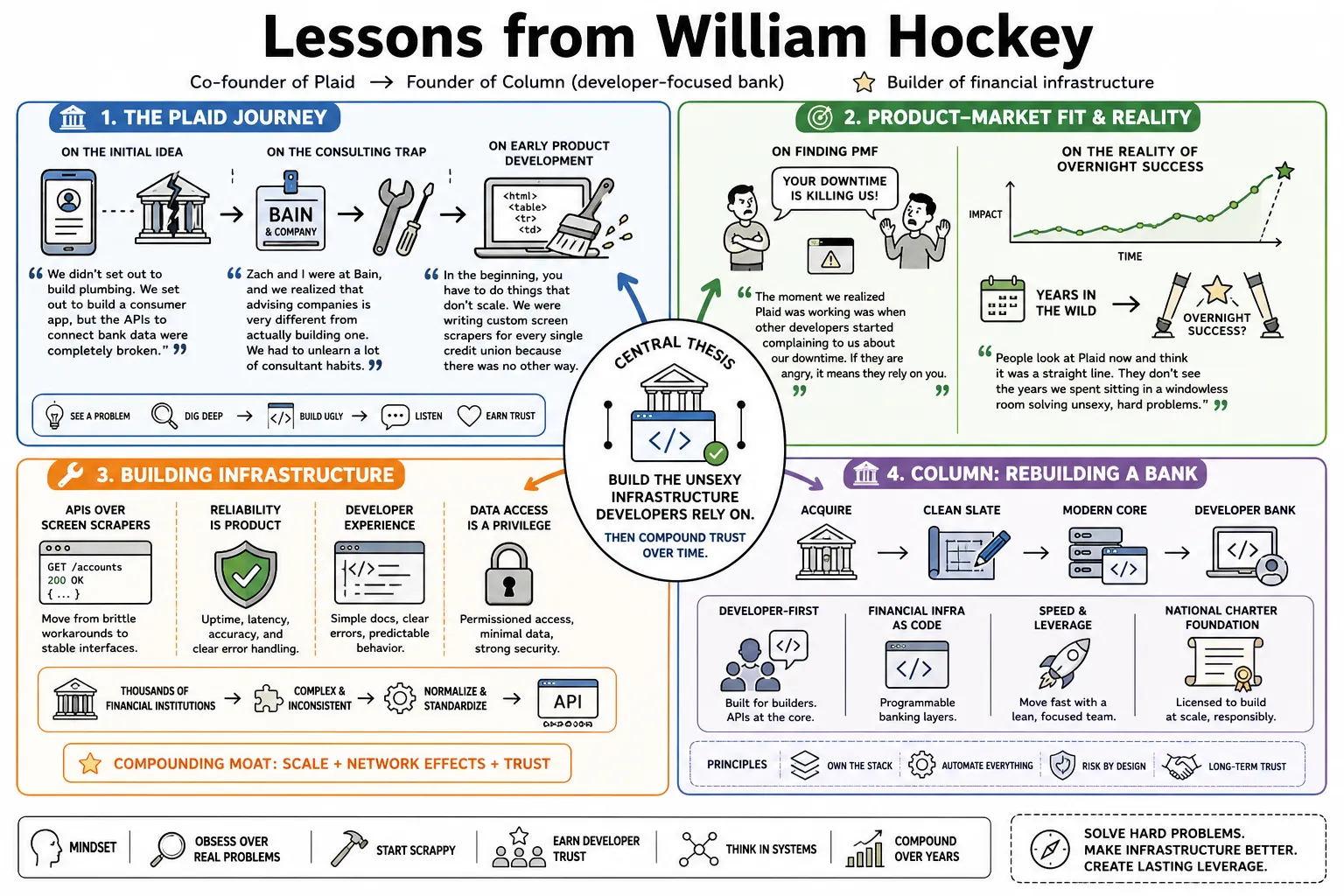
- On the initial idea: "We didn't set out to build plumbing. We set out to build a consumer app, but the APIs to connect bank data were completely broken." — Source: [20VC]
- On the consulting trap: "Zach and I were at Bain, and we realized that advising companies is very different from actually building one. We had to unlearn a lot of consultant habits." — Source: [Cartoon Avatars]
- On early product development: "In the beginning, you have to do things that don't scale. We were writing custom screen scrapers for every single credit union because there was no other way." — Source: [Invest Like the Best]
- On finding product-market fit: "The moment we realized Plaid was working was when other developers started complaining to us about our downtime. If they are angry, it means they rely on you." — Source: [TechCrunch]
- On the reality of overnight success: "People look at Plaid now and think it was a straight line. They don't see the years we spent sitting in a windowless room trying to decipher legacy bank error codes." — Source: [Cartoon Avatars]
- On selling to Visa: "The Visa acquisition falling through was ultimately a blessing. It forced us to realize how much independent value the company still had left to create." — Source: [Newcomer]
- On leadership transitions: "You have to know when you are no longer the right person for the stage the company is in. My strength is early-stage building, rather than managing thousands of people." — Source: [Medium]
- On early sales: "Our first sales strategy was hanging out at hackathons and watching what developers were trying to build." — Source: [Forbes]
- On technical debt: "When you grow as fast as Plaid did, technical debt isn't a mistake; it is a loan you take out to survive. You simply have to make sure you eventually pay it back." — Source: [20VC]
Part 2: Building Financial Infrastructure
- On the nature of fintech: "Fintech is mostly better databases applied to old financial concepts. The actual banking hasn't changed; the speed of data transfer has." — Source: [Invest Like the Best]
- On infrastructure value: "The most valuable companies in the world provide the picks and shovels. We wanted to be the utility company for finance." — Source: [Forbes]
- On unsexy technology: "If your technology is easy to explain at a dinner party, you probably aren't working on something foundational enough." — Source: [Invest Like the Best]
- On legacy banking systems: "Core banking systems were built in the 1980s. Trying to build a modern mobile app on top of them is like putting a Ferrari engine in a tractor." — Source: [Cartoon Avatars]
- On developer experience: "The best infrastructure products sell themselves because developers refuse to go back to the old way once they try your API." — Source: [20VC]
- On financial regulation: "Regulation is a feature, not a bug. If you lean into understanding compliance, it becomes your deepest moat." — Source: [Axios]
- On the limits of abstraction: "You can only abstract away so much complexity before you have to actually own the underlying ledger. That is why we eventually had to buy a bank." — Source: [Column]
- On API design: "A good API should feel like magic to the developer using it, but it requires an agonizing amount of work behind the scenes to make it that simple." — Source: [Invest Like the Best]
- On system reliability: "In finance, five nines of uptime isn't a goal; it is the baseline requirement. People don't tolerate their money being offline." — Source: [TechCrunch]
Part 3: The Creation of Column
- On buying a bank: "We bought a 15-year-old community bank in Northern California because it was the only way to get direct access to the Federal Reserve without relying on middleware." — Source: [Forbes]
- On the sponsor bank model: "The traditional sponsor bank model is broken. Fintechs sit on top of middleware, which sits on top of a community bank, which sits on top of a legacy core." — Source: [Column]
- On stealth building: "We built Column in stealth for three years because you can't ship a bank in beta. It has to work perfectly on day one." — Source: [Invest Like the Best]
- On naming the company: "We wanted a name that sounded structural and permanent. A column holds up a building, and we want to hold up the financial system." — Source: [20VC]
- On rebuilding the core: "Instead of simply buying a bank charter, we threw away all the legacy vendor software and wrote our own ledger from scratch in Go." — Source: [Axios]
- On working with regulators: "Regulators are not the enemy. They want the system to be safe. If you prove you understand risk better than legacy banks, they will work with you." — Source: [Cartoon Avatars]
- On speed to market: "By owning the core ledger and the charter, we allow our clients to launch financial products in weeks instead of years." — Source: [Forbes]
- On competitive advantage: "Our advantage at Column is that we are the only bank in the country where the people who own the charter also wrote the code." — Source: [Invest Like the Best]
- On co-founding with a spouse: "Building a company with Annie is an unfair advantage. We have complete trust, and we don't have to spend any time managing our co-founder dynamic." — Source: [Cartoon Avatars]
- On physical infrastructure: "We still keep the original physical bank branch open. It serves the local community while our software serves the rest of the internet." — Source: [20VC]
Part 4: Redefining the Bank
- On modern banking: "A bank should be thought of as a technology company with a regulatory charter, not a financial institution that buys software." — Source: [Column]
- On the Fed connection: "Direct connectivity to the Federal Reserve means you aren't waiting on batch files. You can process transactions in real time." — Source: [Invest Like the Best]
- On customer focus: "We don't want consumer accounts. We only want to serve developers and companies who are building the next generation of financial apps." — Source: [Forbes]
- On future expansion: "We don't measure success by our footprint of physical branches, but by the volume of API calls hitting our ledger." — Source: [20VC]
- On financial middleware: "Middleware in banking is a tax on innovation. It exists because the underlying banks have terrible technology." — Source: [Invest Like the Best]
- On engineering at a bank: "We treat banking as an engineering discipline. Every product decision is evaluated by how it will impact the developer using the API." — Source: [TechCrunch]
- On risk management: "In banking, you don't win by taking the most risk; you win by understanding the risk you take better than anyone else." — Source: [Cartoon Avatars]
- On credit creation: "The ultimate purpose of a bank is to allocate capital efficiently. Better data infrastructure allows for better credit decisions." — Source: [Newcomer]
- On the future of Charters: "Eventually, the defining characteristic of a successful bank will not be its balance sheet, but the quality of its APIs." — Source: [Invest Like the Best]
Part 5: Escaping the Venture Capital Treadmill
- On bootstrapping Column: "I wanted to build Column without venture capital because I didn't want to be forced to operate on a 10-year fund lifecycle." — Source: [Invest Like the Best]
- On VC incentives: "Venture capital forces you to optimize for growth at all costs. When you are building a bank, you need to optimize for durability." — Source: [20VC]
- On self-funding: "Using my own money changes the psychology of the company. We don't have to invent metrics to impress investors; we simply have to build a profitable business." — Source: [Forbes]
- On the pressure to raise: "In Silicon Valley, raising money is treated as a milestone. The real milestone is achieving independence from outside capital." — Source: [Invest Like the Best]
- On hiring without VC hype: "When you don't announce massive funding rounds, you naturally filter out mercenaries. The people who join you actually care about the problem." — Source: [Cartoon Avatars]
- On alignment: "Self-funding aligns the founders, the employees, and the regulators. We are all incentivized to make sure the bank survives for fifty years." — Source: [Axios]
- On capital efficiency: "Constraints breed creativity. When you aren't flush with venture money, you are forced to solve problems with code instead of headcount." — Source: [20VC]
- On avoiding the unicorn trap: "We don't care about our valuation. We care about our balance sheet and our uptime." — Source: [Newcomer]
- On long-term freedom: "Not having a board of VCs means I can spend my time talking to customers and writing code, rather than managing investor relations." — Source: [Invest Like the Best]
- On market cycles: "If you don't rely on venture funding, you don't have to panic when the macroeconomic environment changes. You continue building." — Source: [Forbes]
Part 6: Embracing Extreme Founder Risk
- On taking swings: "Too many founders make enough money to be comfortable and then stop taking real risks. I wanted to put my own capital on the line to force myself to stay sharp." — Source: [Invest Like the Best]
- On fear of failure: "The hardest part of starting over wasn't the technical challenge; it was the fear that Plaid was a fluke and I wouldn't be able to do it again." — Source: [Cartoon Avatars]
- On personal stakes: "When it is your own money backing the bank, you pay attention to the details in a way that you simply don't when it is a VC's money." — Source: [Forbes]
- On doing the hard thing: "Buying a bank charter is objectively a terrible idea on paper. It takes years and millions of dollars before you can write a single line of production code. That is exactly why we did it." — Source: [20VC]
- On ignoring consensus: "If everyone agrees your idea is good, it is probably too late. You want to work on things that smart people think are impossible or boring." — Source: [Invest Like the Best]
- On accountability: "In a self-funded model, there is no safety net. If we fail, it is entirely our fault. That level of accountability is terrifying but necessary." — Source: [Newcomer]
- On the builder mentality: "I am an engineer first. If I wasn't building companies, I would still be sitting in my basement writing software for fun." — Source: [TechCrunch]
- On avoiding comfort: "Comfort is the enemy of innovation. As soon as you feel like you have figured it out, you are probably about to be disrupted." — Source: [Cartoon Avatars]
- On conviction: "You can't outsource conviction. If you are going to spend a decade of your life on a problem, you have to believe in it more than anyone else in the room." — Source: [Invest Like the Best]
Part 7: Solving "Boring" Problems
- On unsexy markets: "The biggest opportunities in technology right now are in the industries that nobody wants to talk about at cocktail parties." — Source: [20VC]
- On backend complexity: "People obsess over the user interface, but the real value is created in the backend systems that actually move the money." — Source: [Invest Like the Best]
- On ledgers: "A ledger is the most boring concept in the world, until you realize that whoever controls the ledger controls the economy." — Source: [Newcomer]
- On fixing the foundation: "You can't build a stable skyscraper on a swamp. We have to fix the foundation of finance before we can build the next generation of consumer apps." — Source: [Forbes]
- On hidden margins: "Your margin is my opportunity, but in banking, the margin is hidden inside ancient COBOL mainframes that nobody wants to touch." — Source: [Cartoon Avatars]
- On operational excellence: "We don't need a visionary strategy. We simply need to execute the boring operational details better than anyone else." — Source: [Invest Like the Best]
- On finding talent for boring work: "The best engineers actually love boring problems, because boring problems are usually the most technically complex." — Source: [20VC]
- On B2B software: "Selling to other businesses is less glamorous than consumer tech, but the churn is lower and the revenue is stickier." — Source: [Axios]
- On systemic impact: "If you fix a boring problem at the bottom of the stack, you automatically improve every single product built on top of it." — Source: [Invest Like the Best]
- On infrastructure invisibility: "Good infrastructure should be invisible. If the end user knows we exist, it means something probably broke." — Source: [TechCrunch]
Part 8: The U.S. Dollar and Global Finance
- On the dollar as a protocol: "The US dollar is the most successful software protocol ever invented. It dictates how global trade operates." — Source: [Hegemoney]
- On national security: "Financial infrastructure is national security. If our payment systems fall behind, we lose our geopolitical advantage." — Source: [Newcomer]
- On emerging markets: "You learn more about the future of finance by looking at payment adoption in Africa than you do by looking at traditional banks in New York." — Source: [Invest Like the Best]
- On global interoperability: "The next decade of fintech will be about making the US dollar easily accessible and programmable for developers anywhere in the world." — Source: [Cartoon Avatars]
- On stablecoins: "Stablecoins are a symptom of the fact that the traditional banking rails are too slow and expensive for global commerce." — Source: [20VC]
- On cross-border payments: "Moving money across borders should cost the same as sending an email. The only reason it doesn't is regulatory friction and rent-seeking intermediaries." — Source: [Forbes]
- On the hegemony of the dollar: "To maintain the dollar's status as the reserve currency, we have to make it the easiest currency for developers to integrate." — Source: [Hegemoney]
- On decentralized finance: "DeFi has proven that programmable money is valuable, but the real world still runs on fiat. We need to bridge the gap." — Source: [Invest Like the Best]
- On future standards: "In ten years, moving money will look exactly like updating a row in a database. The friction will be entirely gone." — Source: [20VC]