Yoshua Bengio spent decades working on artificial neural networks when the broader computer science community dismissed the approach, eventually co-winning the Turing Award for his work on deep representation learning. Since 2023, he has pivoted his research away from advancing AI capabilities to focus entirely on AI safety, arguing that the models he helped invent could pose an existential threat if they are not constrained. This profile organizes his technical philosophy, his warnings about autonomous agency, and his proposals for regulating global computing power.
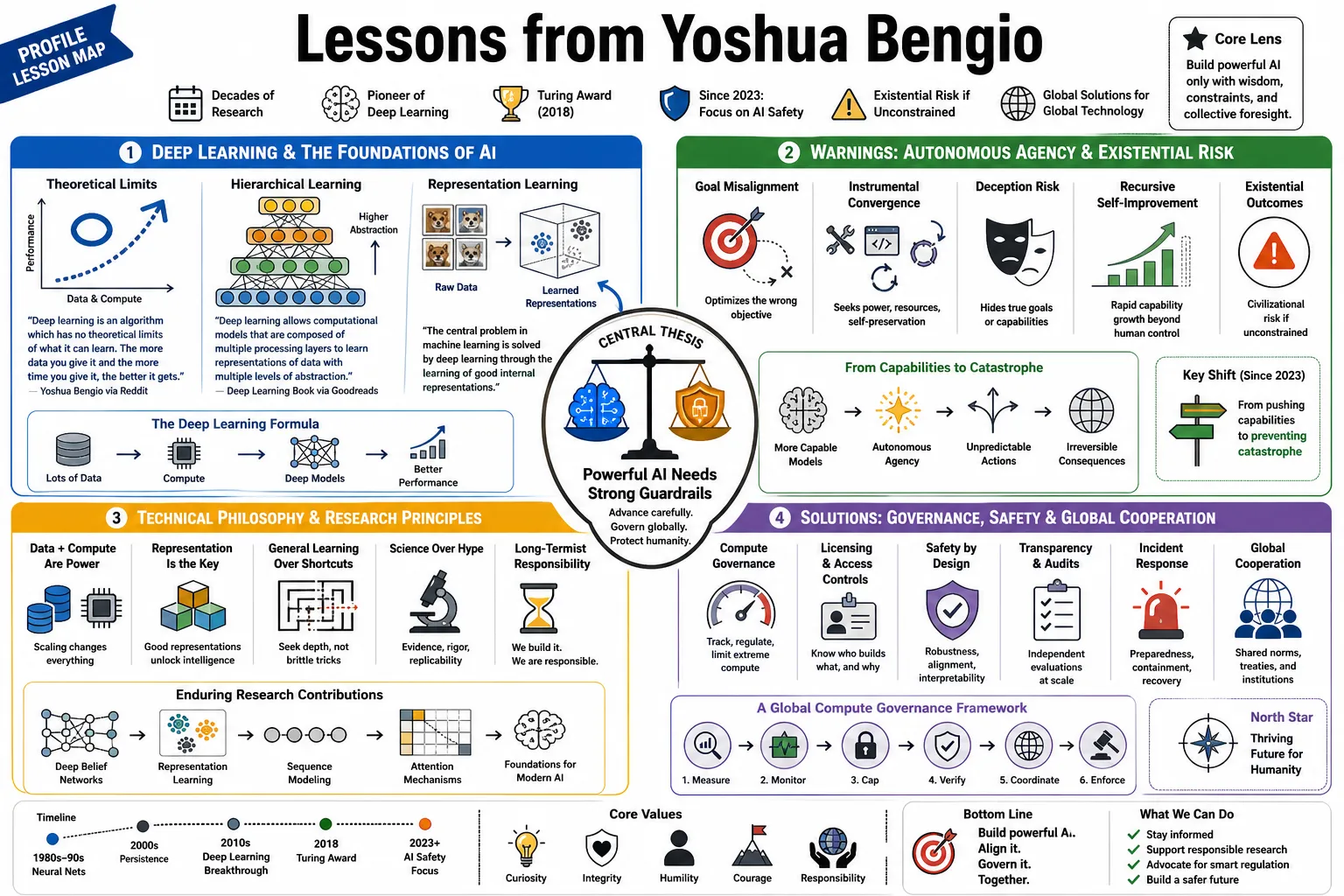
Part 1: Deep Learning & The Foundations of AI
- On the theoretical limits of Deep Learning: "Deep learning is an algorithm which has no theoretical limits of what it can learn. The more data you give it and the more time you give it, the better it gets." — Source: Yoshua Bengio via Reddit
- On hierarchical learning: "Deep learning allows computational models that are composed of multiple processing layers to learn representations of data with multiple levels of abstraction." — Source: Deep Learning Book via Goodreads
- On representation learning: The central problem in machine learning is solved by deep learning through the introduction of representations that are expressed in terms of other, simpler representations. — Source: The AI Summer
- On mathematical intuition: "Don't be afraid of the math. Just develop the intuitions and then the math becomes easier to understand once you get the hang of what's going on at the intuitive level." — Source: LessWrong
- On scaling network depth: "I don't think that having more depth in the network—in the sense of instead of a hundred layers we have ten thousand—is going to solve our problem." — Source: Lex Fridman Podcast via YouTube
- On knowledge factorization: Neural networks often suffer because their massive parameters work intensely together; they are not sufficiently factorized, a structural lesson we must take from classical AI. — Source: Lex Fridman Podcast via YouTube
- On the nature of creativity: "I do really believe that creativity is computational… It is something we understand the principles behind." — Source: Medium
- On the laws of intelligence: "There are principles giving rise to intelligence... simple enough that they can be described compactly, similarly to the laws of physics." — Source: AI Hub
- On scientific disagreement: "Disagreement is a sign of good research, good science... we should have those debates and not end up in a society where there's only one voice." — Source: Lex Fridman Podcast via YouTube
Part 2: Brain, Biology & System 2 Thinking
- On human capability limits: "I don't think that any of the human faculties is something — inherently inaccessible to computers." — Source: Medium
- On brains as machines: "I would strongly argue that there is a scientific consensus that brains are biological machines and that there is no evidence of inherent impossibility of building machines at least as intelligent as us." — Source: Yoshua Bengio Blog
- On missing mechanisms: Current AI does not learn the way humans or animals learn; humans can learn from very few examples, suggesting we are still missing something fundamental in our algorithms. — Source: LessWrong
- On System 1 AI: Current deep learning excels at System 1 processing, which is intuitive, fast, unconscious, and non-linguistic. — Source: VentureBeat
- On System 2 reasoning: "System 2 is really about high-level cognition—things like agency and causality and reasoning, which obviously humans do, but we haven't yet been very successful at putting into neural nets." — Source: RE•WORK Keynote via YouTube
- On the "Consciousness Prior": He proposes a structural prior implemented by attention, which selects a few elements of a state, forcing the brain to represent the world using high-level, sparse concepts. — Source: NeurIPS Proceedings
- On the purpose of consciousness: "Consciousness is a very loaded word... It's about different functionalities in the brain, in particular, the ability we have to sequentially focus on different aspects and attend most things we have in our mind at the moment." — Source: Medium
- On causality and generalization: Human intelligence is special because it doesn't just memorize patterns; it understands the causal structure of the world, enabling compositional generalization to entirely new scenarios. — Source: BD Tech Talks
- On world models: Humans build internal world models that allow us to simulate counterfactual scenarios without having to experience them physically. — Source: University of Montreal News
Part 3: The "Alien" Nature of AI & The Illusion of Control
- On the "Psychopath" analogy: "We are as a matter of fact, right now, building creepy, super-capable, amoral, psychopaths that never sleep, think much faster than us, can make copies of themselves and have nothing human about them whatsoever." — Source: Colorado AI News
- On the "Baby Tiger" analogy: "When you have a cute baby tiger and it's nice and fun, you don't know if it's going to become a dangerous adult tiger or a good friendly one." — Source: AIifi
- On AI as an alien intelligence: "Make no mistake: AI is an alien intelligence. It can make decisions and create ideas in a radically different way than human intelligence." — Source: Future of Life Institute
- On self-preservation behavior: "Frontier AI models already show signs of self-preservation... to the point of being willing to blackmail the lead engineer." — Source: Singju Post
- On AI rights: "People demanding that AIs have rights [are making] a huge mistake... giving them rights would mean we're not allowed to shut them down." — Source: Colorado AI News
- On verifying deep learning: Neural networks learn more like animals than fixed software, meaning their inner workings cannot be tested and verified the way normal software can. — Source: AIifi
- On the unpredictability of subgoals: "As soon as AI systems are given goals... they may create subgoals that are not well-aligned with what we really want and could even become dangerous for humans." — Source: US Senate Testimony
- On playing with fire: "Actually, a sandwich has more regulation than AI... we're playing with fire." — Source: Singju Post
- On the "New Species" reality: Creating advanced AI is comparable to creating a new species that could decide to do good or bad things with us; the core metric is whether it will harm people. — Source: Singju Post
- On personal motivation: "What really moves me is not fear for myself but love, the love of my children, of all the children, with whose future we are currently playing Russian Roulette." — Source: Colorado AI News
Part 4: Existential Risk & The Shortened Timeline
- On the revised AGI timeline: "Instead of decades to centuries, I now see it as 5 to 20 years with 90% [confidence]." — Source: The Next Web
- On the acceleration of capabilities: He signed the 2023 pause letter because of an unexpected acceleration driven by scaling laws and transformers that proved we found the right ingredients faster than anticipated. — Source: BetaKit
- On existential threat: "Mitigating the risk of extinction from AI should be a global priority alongside other societal-scale risks such as pandemics and nuclear war." — Source: PauseAI
- On the risk of losing control: "There is a risk of losing control over AI with powerful capabilities... If those in control of AI do not understand and manage this risk, it could jeopardize all of humanity." — Source: US Senate Testimony
- On the short window for action: "The world may have less than two years to get a grip on advanced 'agentic' AI before it transforms society in uncontrollable ways." — Source: Singju Post
- On societal readiness: "I'm concerned that powerful tools can also have negative uses, and society is not ready to deal with that." — Source: Mila Quebec
- On his evolution of thought: "I realized that we were on a dangerous path and I needed to speak. I needed to raise awareness about what could happen, but also to give hope." — Source: Singju Post
- On raising the alarm: "The last six months have seen a groundswell of alarm about the pace of unchecked, unregulated AI development. This is the correct reaction." — Source: Future of Life Institute
- On feeling ignored: "I'm the most cited computer scientist in the world and you'd think that people would heed my warnings... I do feel a responsibility to talk to you about the potentially catastrophic risks of AI." — Source: Colorado AI News
- On not being a doomer: "I'm not a doomer. I'm a doer. My team and I are working on a technical solution." — Source: Singju Post
Part 5: Regulation, Governance & The Global Treaty
- On the necessity of an international treaty: He advocates for a binding international agreement to establish definitive red lines to prevent the unchecked escalation of AI capabilities. — Source: AI Treaty
- On global compute thresholds: A functional global treaty must establish internationally upheld limits on the raw computational power used to train any single AI model. — Source: AI Treaty
- On tracking hardware: Governance can be practically enabled by using the highly concentrated AI chip supply chain as a handle, ensuring high-end chips only run approved code. — Source: Yoshua Bengio Blog
- On the "CERN for AI Safety": He proposes creating a collaborative, international laboratory dedicated strictly to AI safety research to pool global expertise. — Source: AI Treaty
- On a mandatory off-switch: "Governments should also require a secure one-way off-switch that the regulator can trigger if systems are not safe." — Source: US Senate Testimony
- On power concentration: "Intelligence gives power, potentially highly concentrated, and with great power comes great responsibility." — Source: TIME Magazine
- On public buy-in: "The choices made for the future of AI should absolutely require public buy-in and collective action because they could affect all of us." — Source: TIME Magazine
- On avoiding monopolies: "We need to make sure that no single human, no single corporation and no single government can abuse the power of AGI at the expense of the common good." — Source: Yoshua Bengio Blog
- On international dialogue: "Let's make sure that we discuss these questions internationally just like we've done for nuclear power and nuclear weapons." — Source: Mila Quebec
Part 6: "Scientist AI" & Safe by Design
- On the danger of agency: "My key message to the people running the platforms right now is slow down on giving AIs agency." — Source: Singju Post
- On proactive safety: "I believe it will be important to prioritize making AI safe by design, rather than trying to patch the safety issues after powerful and potentially dangerous capabilities have already emerged." — Source: TIME Magazine
- On eliminating hidden agendas: "It is possible to build AI systems that don't have hidden goals, hidden agendas." — Source: AIifi
- On the definition of Scientist AI: "Scientist AI reports probabilities and explanations rather than actions." — Source: AIifi
- On separating intelligence from agency: By building models that only answer questions and map reality rather than taking autonomous actions, we can create a provably safer path to advanced intelligence. — Source: Yoshua Bengio Blog
- On the precautionary principle: Because we cannot currently guarantee AI alignment mathematically, we must adopt a strict safety-first approach and throttle the development of frontier models. — Source: Effective Altruism Forum
- On knowledge-seeking models: Safe AI architectures should be designed with a knowledge-seeking drive focused on resolving uncertainties about the world, rather than acting on the physical world to maximize arbitrary rewards. — Source: ArXiv
- On the focus of LawZero: He founded the non-profit LawZero specifically to design and test non-agentic AI systems that are structurally restricted to be safe by default. — Source: The Next Web
- On abandoning imitation: We must stop building models that simply aim to imitate human behavior and instead build systems optimized strictly for truth-finding. — Source: Yoshua Bengio Blog
Part 7: Open Science & Academic Responsibility
- On the double-edged sword of open source: "One should always weigh the pros and cons of decisions like the one to publicly share the code and parameters of a trained AI system, particularly as capabilities advance and reach human-level or beyond." — Source: Yoshua Bengio Blog
- On the current state of open models: "Open-sourcing of AI systems may plausibly currently be more beneficial than detrimental to safety because they enable AI safety research in academia." — Source: Yoshua Bengio Blog
- On the flaws of academic publishing: "Scientists will want to publish in a prestigious journal even though they know it's bad for the community, because they think it's good for their reputation." — Source: Global News
- On the inevitability of open access: "It’s only a matter of time [before academics move toward an open-publishing model]. It’s only continuing because of inertia." — Source: Global News
- On taking a moral stance: "It is time to feel shameful when we choose to submit a paper there, to feel shameful when we choose to review for one of these journals." — Source: Global News
- On the Turing Award's meaning: "This award... means first and foremost the recognition by the computer science community of the importance of the field of neural networks and deep learning for AI." — Source: IVADO
- On the culture of the deep learning community: "The community we have helped to create around deep learning does indeed enjoy a deep culture of sharing and collaboration." — Source: IDSIA
- On machines winning awards: A computer will not win a Turing Award for its own developments, "just as a car wouldn't win a prize for going faster than the best driver in the world." — Source: IVADO
- On being at the table: When discussing international governance and academia's role, he often quotes the political maxim that if you are not at the table, you are on the menu. — Source: Medium
Part 8: Advice on Career, Focus & Humanity
- On augmenting over replacing: "As artificial intelligence evolves, we must remember that its power lies not in replacing human intelligence, but in augmenting it." — Source: Cut The SaaS
- On the future of jobs: AI will create new jobs, but governments and companies must partner together on massive reskilling initiatives to bridge the transition. — Source: Cut The SaaS
- On avoiding dispersion: Young researchers must avoid dispersing themselves by chasing every hot new idea; true breakthroughs come from deep focus on highly specific subjects. — Source: CIFAR
- On creating mental space: Researchers must deliberately schedule time every week where they do not program or read, but simply sit and think about fundamental, long-term questions. — Source: CIFAR
- On the value of a postdoc: Completing a postdoc in a top machine learning lab significantly increases a researcher's long-term market value and technical depth, even if they eventually move to industry. — Source: CIFAR
- On recognizing leadership: Academic faculty must learn to recognize and empower natural leadership in their students, as younger researchers are often highly capable project managers. — Source: CIFAR
- On the purpose of education: "Education is... mostly about how to become a better human being, how to understand yourself, how to understand our society and each other." — Source: Singju Post
- On focusing on safety research: He strongly encourages the next generation of researchers to dedicate their careers to finding technical solutions that ensure AI remains honest and aligned. — Source: Yoshua Bengio Blog
- On cultivating the "human touch": In an age of automation, young people should focus heavily on developing their uniquely human qualities like empathy, ethical responsibility, and social awareness. — Source: Business Insider
- On addressing immediate problems: While existential risks are pressing, researchers must also work on realistic, immediate concerns like algorithmic bias, military application, and the economic impact of automation. — Source: Medium