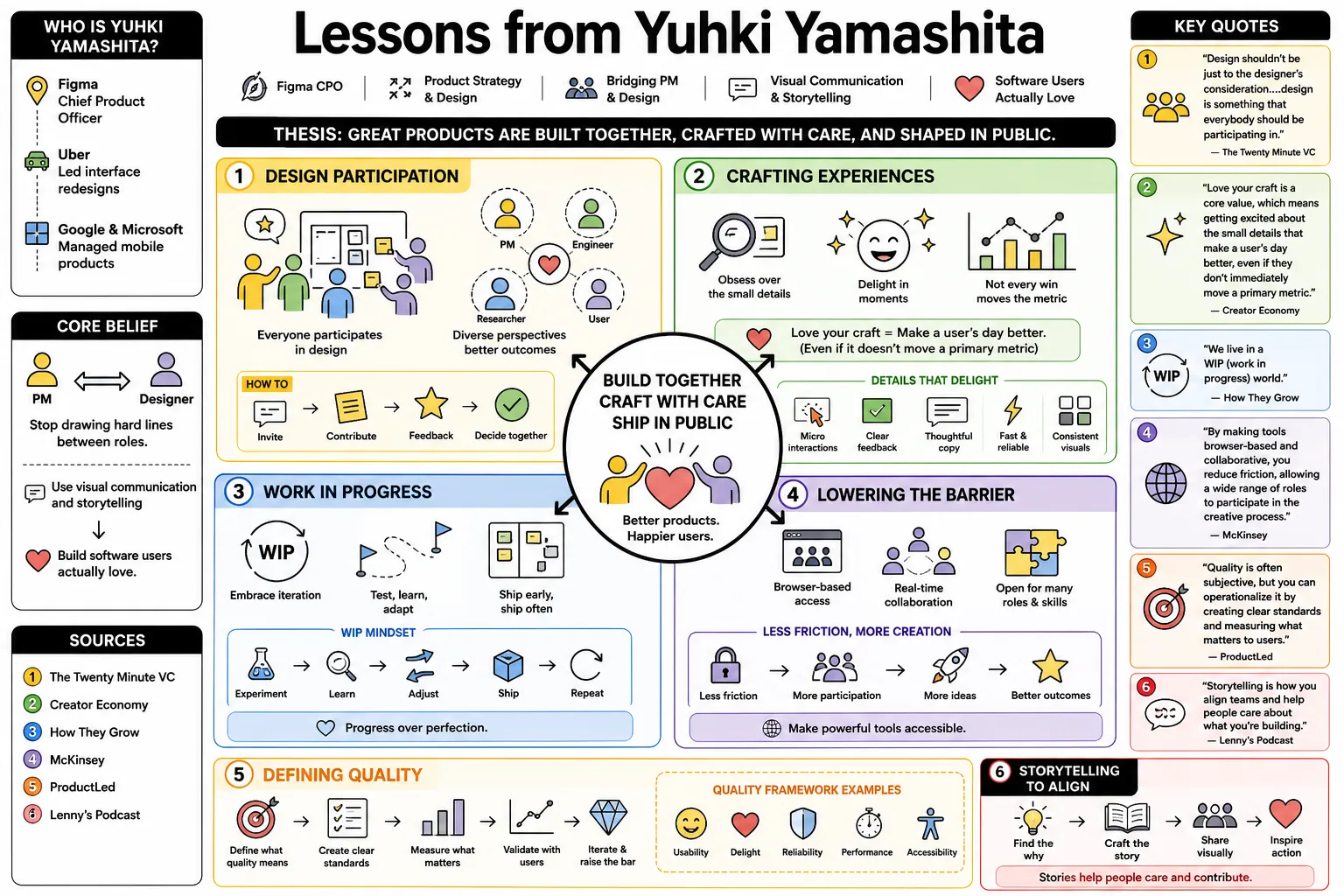
Lessons from Yuhki Yamashita
As Figma's Chief Product Officer, Yuhki Yamashita directs product strategy and design. He previously led interface redesigns for Uber and managed mobile products at Google and Microsoft. He argues that product managers and designers should stop drawing hard lines between their roles, using visual communication and storytelling to build software users actually love.
Part 1: Product Design and Craft
- On Design Participation: "Design shouldn't be just to the designer's consideration….design is something that everybody should be participating in." — Source: The Twenty Minute VC
- On Crafting Experiences: "Love your craft is a core value, which means getting excited about the small details that make a user's day better, even if they don't immediately move a primary metric." — Source: Creator Economy
- On Work In Progress: "We live in a WIP (work in progress) world." — Source: How They Grow
- On Lowering the Barrier: "By making tools browser-based and collaborative, you reduce friction, allowing a wide range of roles to participate in the creative process." — Source: McKinsey
- On Defining Quality: "Quality is often subjective, but you can operationalize it by creating a shared language around what 'good' looks like for your specific product." — Source: Lenny's Podcast
- On Taste: "Taste in product development is about having an intuition for what will resonate with users before the data confirms it." — Source: First Round Review
- On Simplification: "The hardest part of design is editing—figuring out what to remove so the core experience shines." — Source: Think Fast, Talk Smart
- On Iteration: "Your first design is rarely your best design; the magic happens in the cycles of feedback and refinement." — Source: Figma Blog
- On Visual Context: "Using visuals to facilitate communication makes complex ideas stick much faster than text alone." — Source: Think Fast, Talk Smart
- On Design Democratization: "When non-designers can see the design process unfold in real-time, it demystifies the work and builds alignment." — Source: Lenny's Podcast
Part 2: Storytelling and Communication
- On the "Why": "Storytelling is a key skill for product managers, particularly when it comes to owning the 'why' behind a product or feature." — Source: Lenny's Podcast
- On Audience Awareness: "Start from a blank slate to avoid making assumptions about the context the audience already has." — Source: Creator Economy
- On Internal Messaging: "Even as leaders in a company you find that people start repeating things basis what they've heard... therefore you want to spread it more." — Source: The Twenty Minute VC
- On Decks and Documents: "When you see so much energy being poured into decks, reviews, and strategy docs versus just shipping, it's very easy to just try to cut it all out." — Source: Substack
- On Sticky Insights: "Craft insights that people can naturally remember and reuse; if they can't repeat it, the story didn't work." — Source: First Round Review
- On Rhythm and Cadence: "Visuals create cadence and rhythm in a narrative in a way words cannot." — Source: Creator Economy
- On Explaining Decisions: "If you can't tell the story of why a feature exists, you probably shouldn't be building it." — Source: First Round Review
- On Company-Wide Alignment: "Listeners in company-wide settings often have much less background information than your immediate team, so simplify the narrative." — Source: Creator Economy
- On the Role of the PM: "As some companies get bigger, a PM's job can become more and more internal-facing. It's all about alignment. It's all about communication." — Source: Substack
- On Visualizing Strategy: "A good product story often needs a simple diagram to anchor the conversation." — Source: Lenny's Podcast
Part 3: User Love and Customer Empathy
- On User Love as Strategy: "User love is a strategic approach that prioritizes genuine connection over reliance on hard metrics alone." — Source: McKinsey
- On Building Community: "Product-led growth is fueled by creating products that users genuinely love and by fostering active, engaged communities." — Source: Lenny's Podcast
- On Organic Growth: "Giving users a voice in shaping the product drives organic growth and adoption better than traditional marketing." — Source: Menlo Ventures
- On Empathy Over Spreadsheets: "Look beyond spreadsheets and connect with the human experience—what a user is trying to accomplish and how they feel during that process." — Source: McKinsey
- On The Role of Intuition: "While user love can be a fuzzy concept, it remains a critical North Star for product teams." — Source: Stripe
- On Feedback Loops: "Act visibly on customer feedback so users know they are part of the journey." — Source: McKinsey
- On Emotional Connection: "A product that works well is expected; a product that delights creates evangelists." — Source: First Round Review
- On Metrics vs Experience: "Metrics are critical to keeping a pulse on how your product and business are performing, but they cannot replace user feedback in understanding the overall user experience." — Source: Sprig
- On Frustration as Inspiration: "Experiencing friction as a user yourself is often the best catalyst for building better tools." — Source: First Round Review
- On Deep Connections: "Maintain a deep, empathetic connection to the user; boundaries between PMs and designers should blur to ensure the final product is both functional and delightful." — Source: Creator Economy
Part 4: Product Management and Scaling
- On Phase Transitions: "The skills required to take a product from 0 to 1 are entirely different from those needed to scale it from 1 to 10." — Source: First Round Review
- On Prioritization: "Saying no is easy; the hard part is saying no to things you actually want to build." — Source: Lenny's Podcast
- On OKRs: "Goal-setting frameworks like OKRs can sometimes artificially restrict a team's ability to react to new user insights." — Source: Lenny's Podcast
- On Product Launches: "A launch isn't the finish line; it's the starting line for the next phase of learning." — Source: First Round Review
- On PM Talent: "The difference between a good and an extraordinary product manager lies in their ability to synthesize ambiguity into a clear direction." — Source: First Round Review
- On Scaling Teams: "As you scale, you have to replace organic communication with deliberate structures without killing the startup energy." — Source: Lenny's Podcast
- On Product Debt: "Technical debt gets a lot of attention, but product debt—features that no longer serve the core use case—can be just as damaging." — Source: First Round Review
- On Multi-Product Platforms: "Transitioning from a single tool to a multi-product platform requires a shift in how you think about navigation and core workflows." — Source: Lenny's Podcast
- On Growth Mechanics: "Sustainable product-led growth relies on building loops where every new user naturally invites others through the core functionality." — Source: McKinsey
Part 5: Cross-Functional Collaboration
- On Blurring Lines: "The boundaries between product management and design should be fluid, not rigid walls." — Source: First Round Review
- On Shared Tools: "Encourage product managers, designers, and engineers to collaborate directly within the tools they use." — Source: McKinsey
- On Deck-Based Culture: "Moving away from a document-heavy culture to a deck-based or canvas-based culture changes the nature of the conversation." — Source: Lenny's Podcast
- On Engineering Alignment: "When engineers understand the user context early in the process, they build better solutions instead of merely writing faster code." — Source: The Twenty Minute VC
- On Co-Creation: "The best features emerge when a designer and an engineer sit next to each other and just iterate." — Source: First Round Review
- On Reducing Friction: "If handing off work from design to engineering feels like throwing it over a wall, your process is broken." — Source: Lenny's Podcast
- On Shared Language: "A cross-functional team succeeds when they develop a shared vocabulary for the problems they are solving." — Source: McKinsey
- On Early Feedback: "Bring stakeholders into the process when the work is still messy; polished presentations invite critique, messy work invites collaboration." — Source: Creator Economy
- On Team Dynamics: "The health of the relationship between a PM, designer, and engineering lead directly dictates the quality of the product." — Source: First Round Review
Part 6: Lessons from Uber, Google, and Microsoft
- On Mobility Scale: "Redesigning the Uber rider and driver apps required balancing immense technical complexity with an experience that felt instantly familiar." — Source: Web Summit
- On Two-Sided Marketplaces: "At Uber, we learned that changing something for the driver fundamentally alters the experience for the rider, and vice versa." — Source: First Round Review
- On Physical and Digital: "Working on New Mobility at Uber taught me how digital interfaces must react sensibly to unpredictable physical environments." — Source: Stanford
- On Google's Scale: "Managing a product at Google scale means recognizing that a one percent change impacts millions of lives." — Source: Product School
- On YouTube iOS: "Building for mobile video at YouTube required understanding that consumption habits on a phone are fundamentally different than on a desktop." — Source: Get Merit
- On Legacy Systems: "My time at Microsoft working on Hotmail taught me how to navigate and modernize deeply entrenched legacy systems without breaking user trust." — Source: CWG Speakers
- On Organizational Complexity: "Navigating large organizations like Microsoft and Google forces a PM to master internal alignment before external execution." — Source: First Round Review
- On Global Products: "A feature that works perfectly in San Francisco might fail completely in a different market; you have to design for global edge cases from day one." — Source: Stanford
- On Adapting Processes: "What works for software development at Google doesn't necessarily translate to rapid iteration at a startup." — Source: Lenny's Podcast
Part 7: Leadership and Culture
- On Setting Standards: "Leadership is about consistently demonstrating what an acceptable level of quality looks like until the team internalizes it." — Source: Lenny's Podcast
- On Autonomy: "You have to give teams enough context so they can make the right decisions without needing your approval." — Source: First Round Review
- On Hiring: "Look for people who are naturally curious and have a bias toward action, rather than those who prefer to manage processes." — Source: Lenny's Podcast
- On Failure: "A healthy product culture treats a failed experiment as a valuable data point, not a career setback." — Source: First Round Review
- On Vision vs Execution: "A grand vision is useless if you can't break it down into a sequence of executable, valuable shipments." — Source: Lenny's Podcast
- On Cultural Artifacts: "The tools a company uses shape its culture; if you use collaborative tools, you become a collaborative culture." — Source: The Twenty Minute VC
- On Empathy in Leadership: "Understanding what motivates your team is just as important as understanding what motivates your users." — Source: First Round Review
- On Transparency: "Share the reasoning behind tough decisions openly; it builds trust and helps everyone learn." — Source: Creator Economy
- On Momentum: "The most important thing a product leader can do is unblock their team and maintain momentum." — Source: Lenny's Podcast
Part 8: The Future of Work and AI
- On AI in Design: "AI will replace the tedious aspects of design, allowing humans to focus on higher-level problem solving." — Source: The Startup Podcast
- On Designing for AI: In Behind the Craft, Yamashita frames Figma's AI work as a product-design problem: FigJam AI should solve real user problems while Figma keeps design accessible to everyone, including non-designers, without ignoring power users. — Reference: Apple Podcasts page for Behind the Craft on Figma AI, real user problems, accessibility, and power/new-user balance
- On AI as a Teammate: The Building One episode frames Yamashita's Figma discussion around AI evolving from a personal assistant into a true multiplayer teammate, extending Figma's collaboration model into AI-assisted product work. — Reference: Building One episode page on collaborative design, AI teammates, and building for builders
- On New Workflows: "The introduction of AI into creative tools will fundamentally alter how we transition from a blank canvas to a first draft." — Source: The Startup Podcast
- On Quality Control: In the Creator Economy interview, Yamashita says AI quality cannot be treated as a black box: PMs and teams have to hold the bar, inspect weak outputs, change prompts and inputs, and repeat until the result is useful. — Reference: Creator Economy interview on owning quality, prompt/input iteration, and FigJam AI outputs
- On The Future of Collaboration: "The future of work is synchronous and asynchronous blending together seamlessly in the same environment." — Source: The Twenty Minute VC
- On AI Trust: In his Figma essay on AI-assisted building, Yamashita warns that convincing outputs can create a false sense of progress; teams build confidence by comparing concrete directions, questioning defaults, and choosing deliberately rather than accepting the first plausible result. — Reference: Figma essay on speed, direction, craft, and resisting convincing but merely good-enough AI outputs
- On Speed vs Accuracy: Yamashita argues that speed is now table stakes: the differentiator is direction and craft, moving quickly while still deciding what is worth building and refining past good enough. — Reference: Figma essay on speed as table stakes and direction plus craft as the durable edge
- On Continuous Learning: "The pace of AI advancement means product teams must build a culture of continuous learning and rapid prototyping to stay relevant." — Source: The Startup Podcast