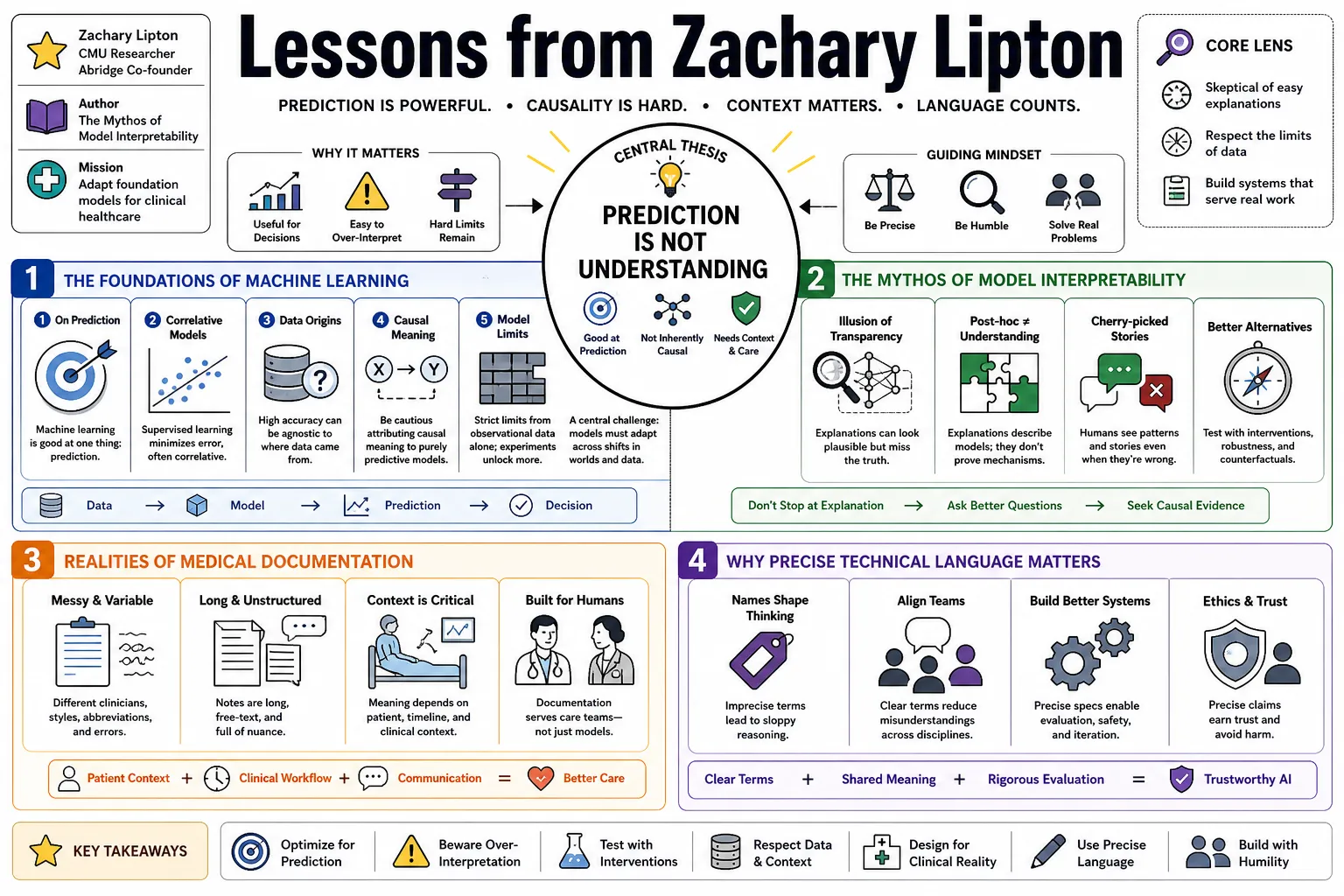
Lessons from Zachary Lipton
Carnegie Mellon machine learning researcher and Abridge co-founder Zachary Lipton is known for critiquing explainable AI in "The Mythos of Model Interpretability" and adapting foundation models for clinical healthcare. This profile collects his views on the limits of prediction, the realities of medical documentation, and why precise technical language matters.
Part 1: The Foundations of Machine Learning
- On Prediction: "Machine learning is good at one thing, which is prediction." — Source: [Consequential Podcast]
- On Correlative Models: Supervised learning models primarily seek to minimize error, which they often achieve in a purely correlative fashion. — Source: [The Mythos of Model Interpretability]
- On Data Origins: Highly accurate predictive models are frequently agnostic to where the data came from, lacking theoretical understanding of the underlying processes. — Source: Zachary Lipton Interview
- On Causal Meaning: We must be cautious about attributing causal meaning to models that have only been optimized for prediction. — Source: [Momin Malik]
- On Model Limits: There are strict limits to what a model can learn from observational data alone without experimental intervention. — Source: [ACM Queue]
- On Adaptivity: A central challenge in modern machine learning is building models that can adapt to changing distributions instead of failing silently. — Source: [UC Berkeley Seminar]
- On Memorization vs. Generalization: Deep learning models have massive capacity and can easily memorize training data, making true generalization harder to guarantee. — Source: [Dive into Deep Learning]
- On Algorithmic Foundations: Advancing machine learning requires a dual focus on theoretical methodology and engineering implementation. — Source: [ACMI Lab]
- On Tool Building: The value of an algorithm is often realized only when it is engineered into a practical, accessible tool. — Source: [Abridge]
Part 2: The Mythos of Interpretability
- On Slippery Terminology: The concept of interpretability is important but inherently slippery in its usage. — Source: [The Mythos of Model Interpretability]
- On Conflicting Goals: The term interpretability is frequently used as a catch-all for various, sometimes contradictory, goals like transparency or trust. — Source: [ACM Queue]
- On Precise Language: Instead of asking for interpretability in a general sense, the community must ask exactly what specific property they are trying to achieve. — Source: [Northwestern University]
- On The Transparency Trade-off: In some cases, transparency may be directly at odds with the broader objectives of artificial intelligence. — Source: [ArXiv Preprint]
- On Penalizing Performance: Arguments against black-box algorithms can sometimes preclude the use of models that could match or surpass human abilities on complex tasks. — Source: [Medium]
- On Internal Transparency: Transparency focuses on how the model works internally, such as with decomposable models. — Source: [Spheres Journal]
- On Post-hoc Explanations: Post-hoc interpretability relies on using separate methods to explain the output of a model that is otherwise opaque. — Source: [Journal of Critical Realism]
- On User Trust: A model's ability to explain its decision-making process is often less about mathematical proof and more about building psychological trust with a human user. — Source: [University of Athens]
- On Debugging: Interpretability methods are often best applied as debugging tools rather than guarantees of algorithmic fairness. — Source: [A Feder Cooper]
- On Simplicity: A linear model is not inherently more understandable than a deep neural network if the features themselves are uninterpretable. — Source: [The Mythos of Model Interpretability]
Part 3: AI in Clinical Healthcare
- On General-Purpose AI: Off-the-shelf foundation models are insufficient for the nuanced requirements of clinical settings. — Source: [Amplify Partners]
- On Medical Lexicons: "It transcribes Ozempic as Olympic. There are 500 different ways to misspell Mounjaro." — Source: [Amplify Partners]
- On Specialized Training: A lot of the medical lexicon consists of new and unusual words that standard models are not trained on. — Source: [Amplify Partners]
- On Clinical Audio: Healthcare involves complex, noisy, and overlapping conversations that require highly adapted models. — Source: Zachary Lipton Interview
- On The Core Mechanism: "AI won't fix healthcare unless it starts with the conversation." — Source: Zachary Lipton Interview
- On The Nature of Healthcare: "The key insight: healthcare is a conversation." — Source: Zachary Lipton Interview
- On Physician Burnout: Clinical documentation is a primary driver of physician burnout and a specific issue that targeted AI can address. — Source: [Abridge]
- On Shifting Focus: Automating the transformation of raw audio into clinical notes frees doctors to focus more on patients and less on paperwork. — Source: [Zachary Lipton's Website]
- On High Stakes: We must engineer trust into AI when the stakes are patient lives instead of clicks. — Source: Zachary Lipton Interview
Part 4: Evaluation and Gold Standards
- On The Evaluation Problem: Rigorous evaluation is uniquely difficult in medicine because there is often no single gold standard or gold note. — Source: Zachary Lipton Interview
- On Generating Free Text: "Whenever you're generating free text, you always run into this problem." — Source: [Amplify Partners]
- On Multiple Correct Answers: In generation tasks, there might be multiple correct outputs, and the golden one in the dataset isn't necessarily the only correct version. — Source: [Amplify Partners]
- On Model Accuracy: A model's output might diverge from a specific human label while still being clinically accurate. — Source: [Amplify Partners]
- On Offline Metrics: Offline metrics like accuracy and F1 scores rarely capture the operational reality of a deployed machine learning system. — Source: [The Mythos of Model Interpretability]
- On Measuring What Matters: Researchers often optimize for metrics that are easy to compute rather than metrics that reflect true utility. — Source: [ACM Queue]
- On Dataset Bias: Evaluating models solely on their training distribution hides how quickly they degrade when faced with real-world distribution shifts. — Source: [Berkeley AI Research]
- On Human Baselines: Comparing AI performance to a human baseline is complicated by the fact that human experts frequently disagree with one another. — Source: Zachary Lipton Interview
- On Continuous Monitoring: Evaluation is not a one-time step before deployment; it requires continuous monitoring in the live production environment. — Source: [CMU ACMI Lab]
- On Meaningful Benchmarks: The field needs better benchmarks that reflect complex tasks rather than simplified toy problems. — Source: [The Gradient Podcast]
Part 5: Public Perception and The Media
- On Public Misunderstanding: The general public and the media are poorly informed about the current state and actual limitations of AI technologies. — Source: [TechTarget]
- On Splashy Quotes: Media outlets tend to prioritize splashy quotes from high-profile figures over deep technical explanations. — Source: [TechTarget]
- On Hype Cycles: The hype surrounding artificial intelligence frequently obscures the genuine, practical advancements being made in the field. — Source: [TechTarget]
- On Anthropomorphism: We run a serious risk when we describe machine learning models using language that implies human cognition or understanding. — Source: [The Mythos of Model Interpretability]
- On Managing Expectations: Practitioners have a responsibility to communicate exactly what their models cannot do. — Source: [The Gradient Podcast]
- On Misaligned Narratives: There is a gap between the sci-fi narrative of artificial general intelligence and the mathematical reality of empirical risk minimization. — Source: [TWIML AI Podcast]
- On Tech Literacy: Improving public tech literacy is essential for having productive societal conversations about AI adoption. — Source: [CMU News]
- On Fearmongering: Alarmist rhetoric about AI distracts from immediate, practical concerns like algorithmic bias and data privacy. — Source: [Consequential Podcast]
- On Academic Responsibility: Researchers must be careful not to overstate the implications of their findings in press releases. — Source: [The Gradient Podcast]
Part 6: AI Policy and Regulation
- On Specific Guidance: "For better or worse, to effectively guide AI practitioners, policy must move in the direction of more focused, application-specific guidance." — Source: [U.S. Senate Testimony]
- On The Curse of Generality: We should avoid one-size-fits-all AI regulations that attempt to cover every possible use case. — Source: [Tech Policy Press]
- On Bespoke Legislation: Different applications within different industries will likely require their own bespoke bodies of legislation. — Source: [U.S. Senate Testimony]
- On Unified Protocols: Attempting to build unified protocols that govern all AI activity is an inefficient way to address concrete risks. — Source: [U.S. Senate Testimony]
- On Sector Expertise: Effective regulation requires lawmakers to collaborate closely with domain experts in specific sectors like healthcare or finance. — Source: [Tech Policy Press]
- On Stifling Innovation: Overly broad regulations run the risk of stifling practical innovation without actually preventing malicious use. — Source: [U.S. Senate Testimony]
- On Liability: Questions of liability become highly complex when decision-making is shared between a human professional and an algorithm. — Source: [Tech Policy Press]
- On Auditing: Meaningful auditing of algorithmic systems requires access to both the model and the specific data distribution it operates on. — Source: [U.S. Senate Testimony]
- On Practical Guardrails: Policy should focus on establishing clear performance baselines and safety guardrails rather than dictating specific model architectures. — Source: [Tech Policy Press]
Part 7: Interdisciplinary Collaboration and Systems
- On Strategic Partnerships: "We need to partner really tightly with the other tech providers that constitute the health system's backbone." — Source: [Business Insider]
- On Isolated Solutions: An AI tool built in isolation, no matter how accurate, will fail if it does not integrate into existing professional workflows. — Source: [Business Insider]
- On Human-in-the-Loop: AI should be viewed as a tool to assist clinicians rather than a replacement for human judgment. — Source: Zachary Lipton Interview
- On System Design: Utility comes from designing the entire sociotechnical system instead of solely tuning the algorithm. — Source: [Abridge]
- On Cross-Disciplinary Teams: Solving healthcare problems requires engineers to sit directly with practicing doctors to understand their daily friction points. — Source: [CNBC Events]
- On Vendor Ecosystems: Integrating new AI capabilities requires navigating complex ecosystems of legacy enterprise software. — Source: [Business Insider]
- On Jazz Background: The improvisational nature of jazz music shares similarities with the iterative, problem-solving mindset required in computer science research. — Source: Zachary Lipton Interview
- On Translation: Academic researchers must actively translate their theoretical findings into language that industry practitioners can act upon. — Source: [TWIML AI Podcast]
- On Open Source: The progress of modern deep learning is tied to the community's willingness to share code and educational resources. — Source: [Dive into Deep Learning]
Part 8: The Future of Machine Learning Research
- On The Peer Review System: The current scale and speed of machine learning research places immense strain on traditional academic peer-review processes. — Source: [TWIML AI Podcast]
- On Scientific Rigor: The community must prioritize rigorous experimental design over marginal gains on standard leaderboards. — Source: [The Gradient Podcast]
- On Trend Chasing: Researchers often flock to the most popular architectures, leaving important fundamental questions underexplored. — Source: [TWIML AI Podcast]
- On Robustness: Future breakthroughs will depend on building models that can maintain their performance when deployed in noisy, unpredictable environments. — Source: [ACMI Lab]
- On Education: Providing accessible, interactive resources is necessary for training the next generation of machine learning practitioners. — Source: [Dive into Deep Learning]
- On Industry vs. Academia: Balancing roles in both academia and industry allows researchers to ground their theoretical work in immediate, real-world problems. — Source: [Healthcare Dive]
- On NLP Advances: Natural language processing has moved from parsing structured text to understanding the messy, overlapping reality of spoken conversation. — Source: [Zachary Lipton's Website]
- On Algorithmic Fairness: Addressing bias in AI requires moving beyond mathematical definitions of fairness to consider historical context. — Source: [ResearchGate]
- On Data Quality: The quality and curation of the training data are often more determinative of success than the specific neural network architecture used. — Source: [Dive into Deep Learning]
- On Long-Term Impact: The true measure of AI research is not citation count, but whether the technology ultimately improves human well-being. — Source: [Consequential Podcast]