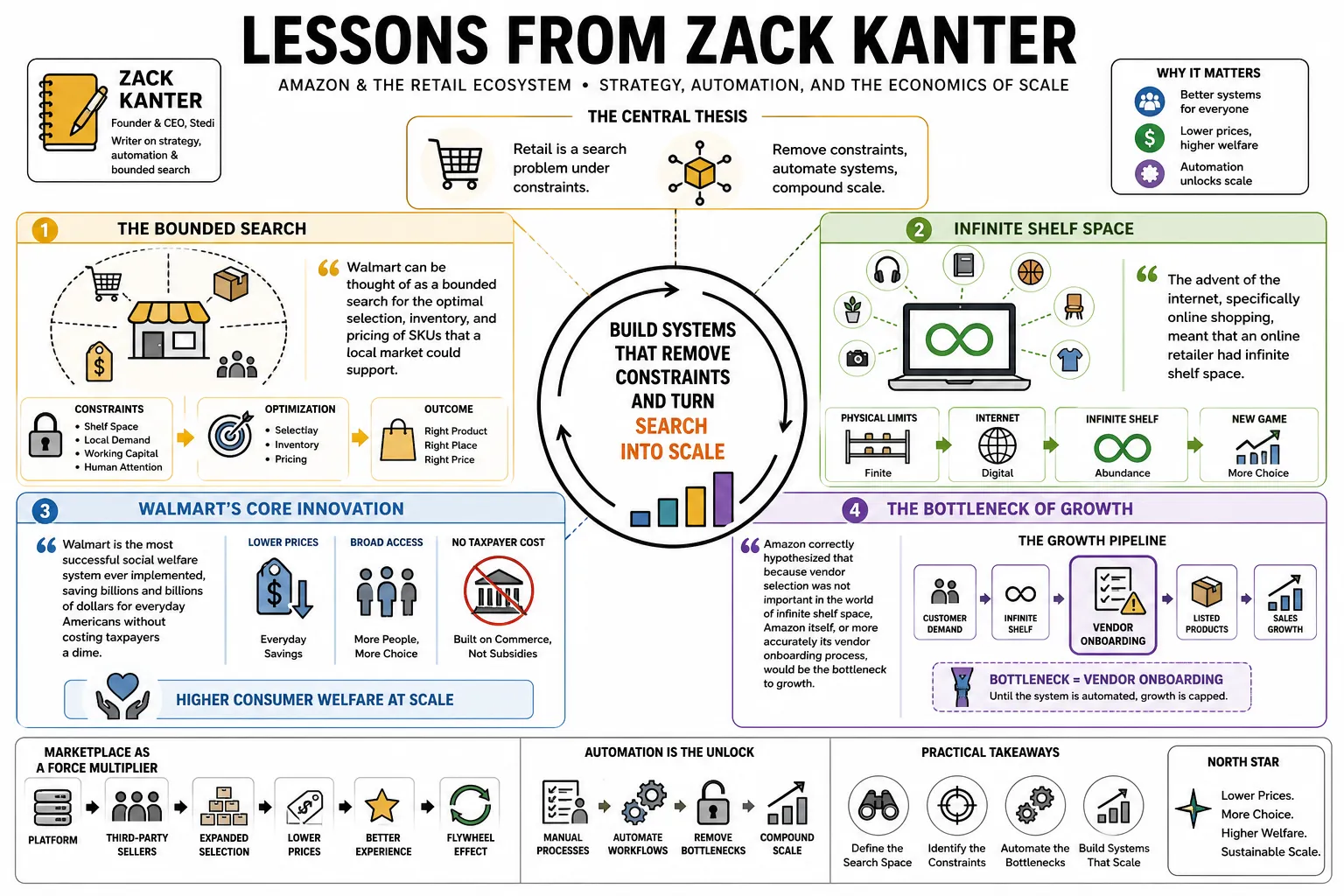
Lessons from Zack Kanter
Zack Kanter is the founder and CEO of Stedi, an infrastructure company rebuilding the plumbing of B2B commerce. He is best known for his writing on corporate strategy, particularly the economics of automation and Amazon's approach to "bounded search." This profile collects his essays and interviews into a single reference.
Part 1: Amazon & The Retail Ecosystem
- On The Bounded Search: "Walmart can be thought of as a bounded search for the optimal selection, inventory, and pricing of SKUs that a local market could support." — Source: [What is Amazon?]
- On Infinite Shelf Space: "The advent of the internet, specifically online shopping, meant that an online retailer had infinite shelf space." — Source: [What is Amazon?]
- On Walmart's Core Innovation: "Walmart is the most successful social welfare system ever implemented, saving billions and billions of dollars for everyday Americans without costing taxpayers a dime." — Source: [What is Amazon?]
- On The Bottleneck of Growth: "Amazon correctly hypothesized that because vendor selection was not important in the world of infinite shelf space, Amazon itself, or more accurately its vendor onboarding process, would be the bottleneck to growth." — Source: [What is Amazon?]
- On Marketplace as a Solution: "By allowing sellers to bypass the gatekeepers altogether, Amazon could rapidly fill its infinite shelf space with a vast selection of SKUs not available from other retailers." — Source: [What is Amazon?]
- On Price Negotiation at Scale: "When Amazon was competing against sellers for a given SKU... either Amazon had negotiated the best possible price with the vendor and would win the sale, or it had failed... but Amazon would collect a 12-15% commission." — Source: [What is Amazon?]
- On Winning the Customer: "Losing the sale to a third party seller still meant that Amazon would keep the customer." — Source: [What is Amazon?]
- On Frictionless Onboarding: "Amazon systematically removed friction from the seller onboarding workflow, doing seemingly small things like eliminating the UPC code requirement that would serve as a barrier for newer, less established sellers." — Source: [What is Amazon?]
- On The Intelligent Designer: "Sam Walton was the intelligent designer behind the Walmart algorithm: a wide assortment of good quality merchandise offered at the lowest possible prices." — Source: [What is Amazon?]
- On The True Nature of Amazon: "Amazon is not a retailer; it is a logistics and infrastructure company acting as an API for commerce." — Source: [What is Amazon?]
Part 2: Automation & The Future of Transportation
- On Underestimating Autonomous Vehicles: "Most people, experts included, seem to think that the transition to driverless vehicles will come slowly over the coming few decades... I believe that this is significant underestimation." — Source: [How Uber's Autonomous Cars Will Destroy 10 Million Jobs]
- On The Inefficiency of Car Ownership: "Cars are driven just 4% of the time, which is an astonishing waste considering that the average cost of car ownership is nearly $9,000 per year." — Source: [How Uber's Autonomous Cars Will Destroy 10 Million Jobs]
- On Fleet Ownership: "The car purchasers of the future will not be you and me, cars will be purchased and operated by ride sharing and car sharing companies." — Source: [How Uber's Autonomous Cars Will Destroy 10 Million Jobs]
- On The Transportation Cloud: "Such convenience and low cost will make car ownership inconceivable, and autonomous, on-demand taxis, the transportation cloud, will quickly become dominant form of transportation." — Source: [How Uber's Autonomous Cars Will Destroy 10 Million Jobs]
- On The Fleet Size Reduction: "PricewaterhouseCoopers predicts that the number of vehicles on the road will be reduced by 99%, estimating that the fleet will fall from 245 million to just 2.4 million vehicles." — Source: [How Uber's Autonomous Cars Will Destroy 10 Million Jobs]
- On Legacy Automakers: "Disruptive innovation does not take kindly to entrenched competitors... it is unlikely that major automakers like General Motors, Ford, and Toyota will survive the leap." — Source: [How Uber's Autonomous Cars Will Destroy 10 Million Jobs]
- On Ancillary Industry Collapse: "Ancillary industries such as the automobile insurance market, automotive finance market, parking industry, and the automotive aftermarket will collapse as demand for their services evaporates." — Source: [How Uber's Autonomous Cars Will Destroy 10 Million Jobs]
- On Eliminating Parking: "Driverless cars do not need to park, vehicles cruising the street looking for parking spots account for an astounding 30% of city traffic." — Source: [How Uber's Autonomous Cars Will Destroy 10 Million Jobs]
- On Real Estate Transformation: "As parking lots and garages, car dealerships, and bus stations become obsolete, tens of millions of square feet of available prime real estate will spur explosive metropolitan development." — Source: [How Uber's Autonomous Cars Will Destroy 10 Million Jobs]
- On Job Destruction and Creation: "Despite the job loss and wholesale destruction of industries, eliminating the needs for car ownership will yield over $1 trillion in additional disposable income, and that is going to usher in an era of unprecedented efficiency, innovation, and job creation." — Source: [How Uber's Autonomous Cars Will Destroy 10 Million Jobs]
Part 3: Strategy, Tempo, & The OODA Loop
- On Organizational Tempo: "The speed at which a company can run its internal feedback cycles determines its ultimate rate of compounding." — Source: [Invest Like the Best Podcast]
- On the OODA Loop in Business: "Observing, orienting, deciding, and acting is not just a framework for fighter pilots; it is the fundamental rhythm of any organization trying to survive a competitive market." — Source: [Invest Like the Best Podcast]
- On Decentralized Decision Making: "You cannot maintain a fast tempo if every decision has to travel to the top of the hierarchy and back down." — Source: [Invest Like the Best Podcast]
- On Amazon's Strategy: "Amazon operates by combining intelligent design with evolutionary principles, allowing thousands of small experiments to determine the future." — Source: [Invest Like the Best Podcast]
- On The Memo Culture: "Forcing people to write six-page memos and starting meetings with silent reading ensures that everyone is actually aligned before a decision is made, eliminating the illusion of agreement." — Source: [Invest Like the Best Podcast]
- On Disruption: "Incumbents rarely die from a single fatal blow; they bleed out from a thousand paper cuts delivered by faster, smaller competitors." — Source: [Invest Like the Best Podcast]
- On Building Moats: "A true moat is not about having a singular advantage, but about interlocking systems that are too complex and tedious for a competitor to replicate." — Source: [Invest Like the Best Podcast]
- On Lateral Expansion: "The best companies expand laterally by taking internal tools they built to solve their own problems and externalizing them as products." — Source: [Invest Like the Best Podcast]
- On Competitive Advantage: "Speed of iteration is the only sustainable competitive advantage in a software-driven world." — Source: [Invest Like the Best Podcast]
- On Recognizing Constraints: "The most critical job of a CEO is to continually identify the current bottleneck in the business and reallocate resources to break it." — Source: [Invest Like the Best Podcast]
Part 4: Startups & Entrepreneurship
- On Geographical Constraints: "There is no geographic utopia for startups. Every city has constraints, whether it's the cost of living in San Francisco or the lack of talent in a smaller market." — Source: [There Is No Good Place to Start a Startup]
- On Embracing Discomfort: "Building a company is an exercise in managing continuous discomfort; moving to a new city won't change the underlying reality of the struggle." — Source: [There Is No Good Place to Start a Startup]
- On Choosing Your Hard: "You have to choose which set of problems you want to deal with, because no location will solve the fundamental difficulty of creating something out of nothing." — Source: [There Is No Good Place to Start a Startup]
- On Naming a Startup: "A name should be easy to spell, easy to say, and ideally free of strong pre-existing associations so the brand can define the word." — Source: [How to Name Your Startup]
- On The Value of Ignorance: "Sometimes not knowing how hard a market is to penetrate is the only way a founder will actually attempt to disrupt it." — Source: [Zack's Notes]
- On Founder Psychology: "The hardest part of entrepreneurship is managing your own psychology during the long stretches where nothing seems to be working." — Source: [Zack's Notes]
- On Early Customers: "Your first customers are not buying a finished product; they are buying into your vision and your willingness to fix things quickly when they break." — Source: [Zack's Notes]
- On Raising Capital: "Venture capital is a tool to accelerate a working machine, not a patch for a fundamentally broken business model." — Source: [Zack's Notes]
- On The Myth of the Perfect Idea: "Execution beats the initial idea every time. The business you end up with rarely looks exactly like the one you started." — Source: [Zack's Notes]
- On Building for the Long Term: "True value creation requires a time horizon that outlasts the patience of your competitors." — Source: [Zack's Notes]
Part 5: Infrastructure & The API Economy
- On B2B Transactions: "The plumbing of global commerce relies on EDI, a standard that is invisible to consumers but essential for moving trillions of dollars of goods." — Source: [Stedi Core Philosophy]
- On Modernizing Legacy Systems: "Replacing a deeply entrenched legacy system doesn't require reinventing the standard; it requires building a vastly superior developer experience around it." — Source: [Stedi Core Philosophy]
- On The API-First Approach: "An API-first company treats software developers as its primary customers, prioritizing clear documentation and frictionless onboarding." — Source: [Stedi Core Philosophy]
- On Invisible Infrastructure: "The best infrastructure is entirely invisible to the end user. It simply works, quietly and reliably, in the background." — Source: [Stedi Core Philosophy]
- On Removing Friction: "Reducing the time it takes for a developer to make their first successful API call is the single most important metric for an infrastructure product." — Source: [Stedi Core Philosophy]
- On The Power of Standards: "Even flawed, decades-old standards like EDI maintain their dominance because the switching costs for global supply chains are too high to justify." — Source: [Stedi Core Philosophy]
- On Commercial Plurality: "The goal of modern infrastructure is to enable any system to talk to any other system without requiring bespoke integration work every single time." — Source: [Stedi Core Philosophy]
- On Developer Freedom: "Providing building blocks rather than finished applications gives developers the freedom to solve problems you never anticipated." — Source: [Stedi Core Philosophy]
- On Reliability: "When you build infrastructure, downtime is not an inconvenience; it is a breach of trust that halts your customer's operations." — Source: [Stedi Core Philosophy]
- On Scaling Through Software: "True scale is achieved when adding a new customer requires zero incremental human intervention from the provider." — Source: [Stedi Core Philosophy]
Part 6: Productivity & Process
- On The Deep Cleanse: "Every so often, a system becomes so bogged down by accumulated technical and organizational debt that it requires a 'deep cleanse', a total reset to regain efficiency." — Source: [Projects, Process, and the Deep Cleanse]
- On Projects vs. Process: "A process is a repeatable action designed to maintain the status quo; a project is a temporary endeavor designed to alter it." — Source: [Projects, Process, and the Deep Cleanse]
- On Organizational Debt: "Organizations naturally accumulate rules and processes over time, eventually choking their own ability to move quickly unless deliberately pruned." — Source: [Projects, Process, and the Deep Cleanse]
- On Managing Overwhelm: "When overwhelmed, the solution is rarely to work harder within the broken system; it is to step back, redesign the system, and clear the backlog." — Source: [Projects, Process, and the Deep Cleanse]
- On Automating the Mundane: "Any task that must be done more than a few times should be documented, standardized, and eventually automated." — Source: [Projects, Process, and the Deep Cleanse]
- On Iterative Improvement: "You cannot perfect a process on the first try. You must launch it in a flawed state and trust the iteration cycle to sand down the rough edges." — Source: [Projects, Process, and the Deep Cleanse]
- On Focus: "True focus means aggressively saying no to good ideas so you have the bandwidth to execute on the great ones." — Source: [Projects, Process, and the Deep Cleanse]
- On System Failures: "When an error occurs, the instinct is often to blame the person. The better instinct is to blame the system that allowed the error to happen." — Source: [Projects, Process, and the Deep Cleanse]
- On Simplifying Workflows: "The most effective processes are those with the fewest necessary steps and the lowest cognitive overhead for the operator." — Source: [Projects, Process, and the Deep Cleanse]
Part 7: Ambition & The Future
- On Limitless Ambition: "For a long time, technological progress felt confined to software. SpaceX represents a return to the kind of physical, limitless ambition that put a man on the moon." — Source: [SpaceX and the Return of Limitless Ambition]
- On Inspiring the Next Generation: "Ambitious physical projects do more than just advance technology; they capture the public imagination and inspire a new generation of engineers." — Source: [SpaceX and the Return of Limitless Ambition]
- On Reusability: "The true breakthrough of SpaceX is not just going to space, but proving that rockets can be reusable, permanently altering the economics of space travel." — Source: [SpaceX and the Return of Limitless Ambition]
- On Hard Problems: "The brightest minds should be directed toward solving the hardest, most physically constrained problems facing humanity, not just optimizing ad clicks." — Source: [SpaceX and the Return of Limitless Ambition]
- On First Principles Thinking: "Progress requires stripping a problem down to its fundamental physics and building a solution up from there, rather than relying on analogy." — Source: [SpaceX and the Return of Limitless Ambition]
- On Patience in Engineering: "Hardware iteration is inherently slower and more expensive than software iteration, requiring a different kind of patience and capital structure." — Source: [SpaceX and the Return of Limitless Ambition]
- On The Role of Visionaries: "A single visionary leader who is willing to absorb immense personal and financial risk can accelerate human progress by decades." — Source: [SpaceX and the Return of Limitless Ambition]
- On Optimism: "Despite short-term setbacks, the long-term trajectory of technological capability gives us every reason to be radically optimistic about the future." — Source: [SpaceX and the Return of Limitless Ambition]
Part 8: Personal Growth & Mindset
- On Life Timelines: "You are not behind. The timelines we set for ourselves are arbitrary, and comparing your trajectory to someone else's highlight reel is a guaranteed recipe for misery." — Source: [You Are Not Behind]
- On Redefining Success: "True success is living a life aligned with your own internal scorecard, rather than chasing the default metrics society hands you." — Source: [You Are Not Behind]
- On Self-Compassion: "We are often our own harshest critics. Extending the same grace to yourself that you would to a struggling friend is a necessary survival skill." — Source: [You Are Not Behind]
- On Authentic Relationships: "Love is not about finding someone who completes you; it is about finding someone with whom you can be entirely yourself without fear of judgment." — Source: [What I've Learned About Love]
- On Vulnerability: "The willingness to be vulnerable and communicate openly is the foundational infrastructure of any lasting relationship." — Source: [What I've Learned About Love]
- On Constant Evolution: "You are not a finished product. The person you are today should look back at the person you were five years ago and cringe slightly; that is proof of growth." — Source: [You Are Not Behind]
- On Managing Stress: "Stress is often the result of carrying the weight of uncontrollable outcomes. Focus entirely on inputs, and let the outputs resolve themselves." — Source: [Are You Stressed?]
- On Finding Meaning: "Meaning is not something you discover out in the world; it is something you deliberately construct through your choices and commitments." — Source: [When I Grow Up]