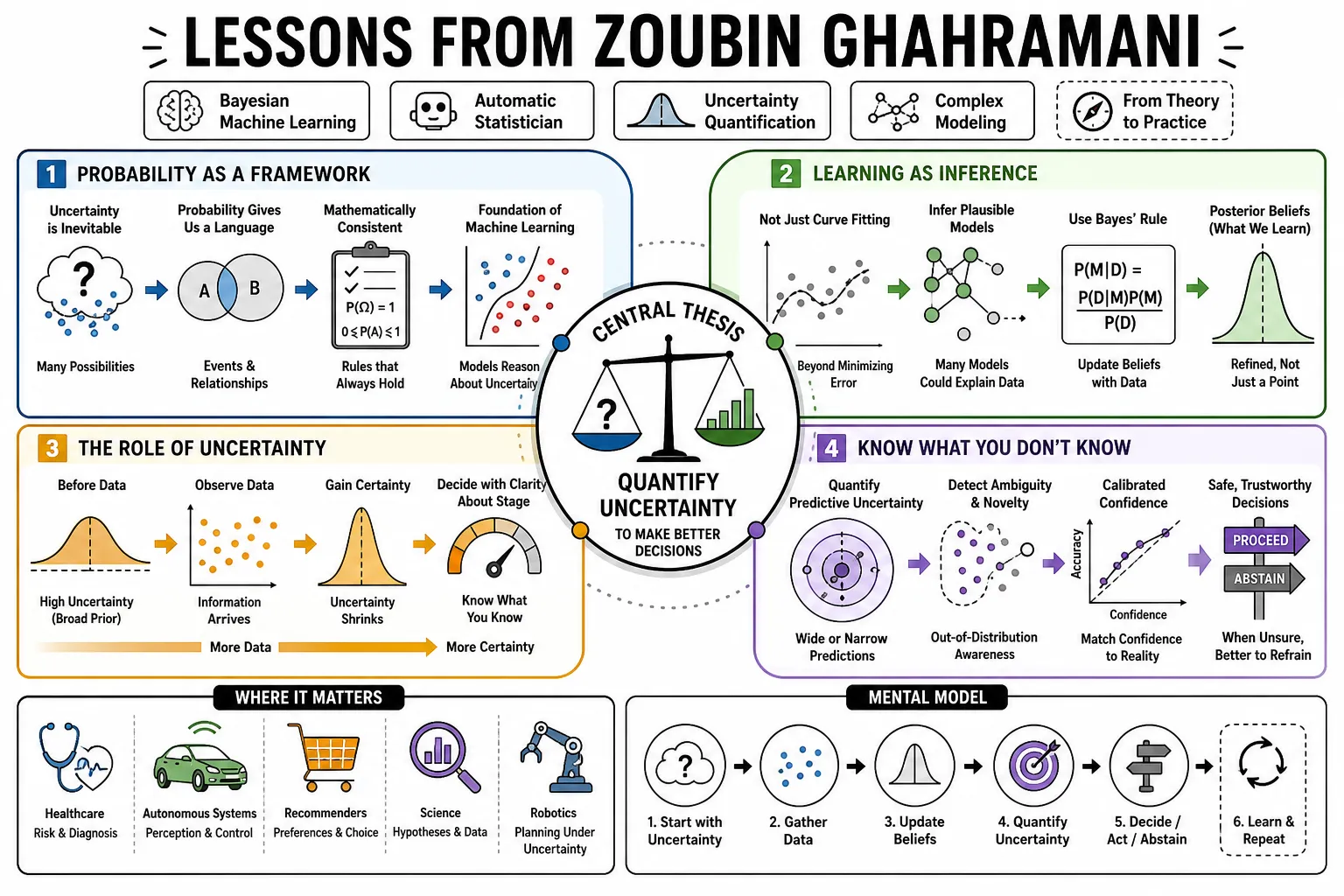
Lessons from Zoubin Ghahramani
Zoubin Ghahramani has spent decades formalizing how machines handle uncertainty. Known for his work on Bayesian machine learning and the Automatic Statistician, he argues that systems must mathematically quantify their own ignorance. This collection tracks his ideas on probability and complex modeling as AI moves from theory into practice.
Part 1: Probability and Uncertainty
- Probability as the Core Language of Learning: Probability theory represents the unique mathematically consistent framework for reasoning under uncertainty, providing the foundational language through which artificial intelligence represents beliefs and infers models from observations. — Nature: Probabilistic Machine Learning and Artificial Intelligence.
- Quantifying Uncertainty Across the Learning Arc: Learning begins in widespread uncertainty and gradually converges toward certainty as observations accumulate; autonomous systems must mathematically represent what stage of that progression they have reached before committing to irreversible actions. — Google DeepMind: The Mathematics of AI Uncertainty.
- Learning as Probabilistic Inference: Machine learning should be understood fundamentally as the process of inferring plausible generative models that explain observed data, rather than merely adjusting numerical parameters to minimize an empirical error metric. — Talking Machines: The Automatic Statistician with Zoubin Ghahramani.
- Epistemic Humility in Autonomous Systems: A dependable intelligent system must recognize its own boundaries; when confronted with unfamiliar inputs, its predictive distributions should widen to reflect genuine uncertainty rather than asserting erroneous conclusions with unwarranted confidence. — Google DeepMind: The Mathematics of AI Uncertainty.
- Explicit Assumptions Through Prior Distributions: Generalizing from data is mathematically impossible without inductive assumptions; Bayesian methods enforce scientific transparency by requiring researchers to specify their inductive biases explicitly as prior probability distributions. — Nature: Probabilistic Machine Learning and Artificial Intelligence.
- The Fragility of Point Estimates: Relying exclusively on a single optimal parameter vector discards the entire spectrum of competing explanations; integrating over the full posterior distribution produces decisions that remain robust against unexpected distributional shifts. — NeurIPS: Occam's Razor (Rasmussen & Ghahramani).
- Handling Incomplete Data via Marginalization: A rigorous probabilistic framework treats missing observations naturally by integrating over unobserved variables in the joint distribution, bypassing the systematic distortion introduced by heuristic data imputation. — Cambridge MLG: Reviews and Foundational Papers.
- Confidence Measures for High-Stakes Interventions: In life-critical domains such as medical diagnosis or autonomous navigation, an isolated prediction without calibrated uncertainty is actionable liability; accurate confidence scores are necessary to signal when control must defer to human practitioners. — Google DeepMind: The Mathematics of AI Uncertainty.
- Uncertainty as the Core Discipline of Machine Learning: The mathematics of modern artificial intelligence resides entirely within the science of managing uncertainty, transforming disparate algorithms for pattern recognition and regression into unified applications of probability calculus. — Nature: Probabilistic Machine Learning and Artificial Intelligence.
- Decision Theory as the Objective of Modeling: Statistical models exist to inform action; coupling probabilistic distributions over state space with explicit utility functions delivers a mathematically complete framework for rational decision making in stochastic environments. — Nature: Probabilistic Machine Learning and Artificial Intelligence.
Part 2: The Automatic Statistician
- Automating the Statistical Discovery Pipeline: The Automatic Statistician project seeks to automate the end-to-end scientific analysis workflow, taking raw tabular or time-series data to discover governing statistical structures and synthesize natural-language explanatory reports without human supervision. — ICML: Structure Discovery in Nonparametric Regression.
- Synthesizing Interpretable Natural-Language Reports: Discovering predictive patterns is insufficient if the results cannot be communicated; an automated data scientist must compile its quantitative inferences into natural-language summaries that substantiate its conclusions for domain specialists. — Talking Machines: The Automatic Statistician with Zoubin Ghahramani.
- Grammar-Based Open-Ended Model Discovery: Rather than hand-crafting model structures, researchers can formulate a compositional grammar of kernels and apply Bayesian marginal likelihood to guide an open-ended search across infinite spaces of functional explanations. — ICML: Structure Discovery in Nonparametric Regression.
- Interpretable Composition of Base Kernels: Combining elementary statistical primitives—such as linear trends, periodic cycles, smoothness operators, and noise—yields regression architectures that achieve high predictive fidelity while retaining full analytical interpretability. — ICML: Structure Discovery in Nonparametric Regression.
- Robustness to Outliers and Structural Changepoints: Empirical datasets frequently contain non-stationary drift and abrupt structural breaks; robust automation requires models flexible enough to detect changepoints and separate true physical trends from localized noise artifacts. — Talking Machines: The Automatic Statistician with Zoubin Ghahramani.
- Decomposing Forecasts into Additive Components: When generating future trajectories, an automated modeling system must isolate individual additive components, showing users exactly how long-term secular growth, recurring seasonal periodicity, and residual noise contribute to the forecast. — ICML: Structure Discovery in Nonparametric Regression.
- Elevating Human Analysts Above Mechanical Modeling: Automating the mechanical computations of model exploration and hypothesis testing does not eliminate human statisticians; it elevates practitioners to focus on critical higher-order challenges like problem formulation, experimental design, and causal validation. — Nature: Probabilistic Machine Learning and Artificial Intelligence.
- Linguistic Analogy for Compositional Kernels: Just as natural languages combine elementary words through grammatical rules to express sophisticated thoughts, statistical architectures can compose elementary kernel operations into highly descriptive models of complex time-series phenomena. — ICML: Structure Discovery in Nonparametric Regression.
- Democratizing Rigorous Statistical Analysis: Rigorous statistical analysis should not remain confined to specialized research institutes; automating model discovery and explanation democratizes access to sophisticated Bayesian methods for scientists and organizations worldwide. — Talking Machines: The Automatic Statistician with Zoubin Ghahramani.
Part 3: Bayesian Nonparametrics and Complexity
- Adaptive Model Growth with Nonparametrics: Real-world processes possess unbounded complexity; Bayesian nonparametric priors allow statistical representations to adaptively expand their effective capacity and discover new structure as additional observations are collected. — JMLR: The Indian Buffet Process: An Introduction and Review.
- Bayesian Occam's Razor via Marginal Likelihood: Bayesian model comparison embodies Occam's razor as an automatic mathematical consequence; calculating marginal likelihood penalizes overly complex models that dilute probability mass across excessive dimensions, removing the need for ad-hoc validation heuristics. — NeurIPS: Occam's Razor (Rasmussen & Ghahramani).
- Open-Ended Clustering with the Chinese Restaurant Process: The Chinese Restaurant Process formalizes clustering under an infinite mixture prior, allowing an algorithm to partition data points dynamically while reserving a non-zero probability of instantiating novel clusters as unexpected data arrives. — JMLR: The Indian Buffet Process: An Introduction and Review.
- Multi-Feature Discovery via the Indian Buffet Process: Rather than forcing data points into mutually exclusive clusters, the Indian Buffet Process provides a non-parametric prior over infinite binary feature matrices, enabling models to assign an unbounded collection of overlapping latent attributes to observed entities. — NeurIPS: Infinite Latent Feature Models and the Indian Buffet Process.
- Resisting Overfitting Through Integration: Integrating over the full posterior parameter space allows highly expressive non-parametric architectures to resist overfitting; marginalization accounts for model volume, preventing flexible models from chasing noise artifacts in sparse data. — Nature: Probabilistic Machine Learning and Artificial Intelligence.
- Assuming Infinite-Dimensional Parameter Spaces: Statistical models should avoid artificial constraints of fixed finite dimensionality; beginning with an infinite-dimensional parameter distribution permits the observed dataset to determine precisely how many degrees of freedom are active. — JMLR: The Indian Buffet Process: An Introduction and Review.
- Discovering Latent Relational Structure: The primary challenge in machine learning extends beyond optimizing numerical parameter weights; it requires uncovering the latent topological structure, causal graph, or hierarchy that generated the observed phenomena. — Talking Machines: The Automatic Statistician with Zoubin Ghahramani.
- Balancing Prior Support with Structural Regularization: An effective Bayesian prior must remain expansive enough to accommodate surprising observations while possessing sufficient mathematical structure to regularize inference toward parsimonious hypotheses. — Nature: Probabilistic Machine Learning and Artificial Intelligence.
- Transcending Rigid Parametric Boundaries: Committing to rigid parametric architectures prior to data collection is computationally expedient but conceptually brittle; open environments demand models whose functional flexibility scales dynamically with observed environmental complexity. — JMLR: The Indian Buffet Process: An Introduction and Review.
Part 4: Deep Learning vs. Bayesian Methods
- Synthesizing Deep Representations with Bayesian Uncertainty: Deep neural networks excel at extracting expressive hierarchical representations from perceptual data, while Bayesian methods supply the formal calculus for reasoning under uncertainty; combining both paradigms forms the core of robust machine intelligence. — Nature: Probabilistic Machine Learning and Artificial Intelligence.
- Treating Neural Network Weights as Probability Distributions: Placing probability distributions across neural network weights enables deep architectures to quantify parameter uncertainty, allowing complex deep learners to indicate when an input falls outside their training support. — Google DeepMind: The Mathematics of AI Uncertainty.
- Combating Overconfidence on Out-of-Distribution Inputs: Deterministic deep networks trained purely by gradient descent suffer from pathological overconfidence, frequently assigning extreme certainty to wildly erroneous predictions when encountering out-of-distribution inputs. — Google DeepMind: The Mathematics of AI Uncertainty.
- Acknowledging the Representational Revolution of Deep Networks: The representational breakthroughs achieved by deep neural architectures have transformed high-dimensional perception across vision, speech, and language, solving feature engineering challenges that constrained earlier statistical models. — Nature: Probabilistic Machine Learning and Artificial Intelligence.
- Scalable Approximate Inference as the Practical Bottleneck: Exact Bayesian integration becomes computationally intractable in high-dimensional non-linear networks; unlocking probabilistic deep learning relies directly on developing scalable variational approximations and stochastic gradient Markov chain algorithms. — Machine Learning: Introduction to Variational Methods for Graphical Models.
- The Gaussian Process Limit of Infinite Neural Networks: Under appropriate weight priors, single-layer neural networks converge in distribution to Gaussian processes as their hidden layer width approaches infinity, providing a rigorous analytical bridge that connects deep architectures to nonparametric kernel methods. — Cambridge MLG: Reviews and Foundational Papers.
- Constructing Hybrid Deep Probabilistic Architectures: Effective system design leverages deep neural networks to extract non-linear feature embeddings from high-dimensional inputs while placing probabilistic graphical models on top of those latent representations to govern decision making under uncertainty. — JMLR: Pyro Deep Universal Probabilistic Programming.
- Data Efficiency Through Domain Priors: While conventional deep learning requires massive training corpora, Bayesian formulations incorporate structured domain knowledge into priors, enabling robust generalization in small-data regimes where gathering observations is prohibitively expensive. — Talking Machines: The Automatic Statistician with Zoubin Ghahramani.
- Enforcing Empirical Probability Calibration: A dependable model must exhibit strict probability calibration; an asserted prediction confidence of ninety percent must correspond empirically to nine correct evaluations out of ten across repeated operational deployments. — Google DeepMind: The Mathematics of AI Uncertainty.
- The Essential Tradeoff Between Optimization and Uncertainty: Treating machine learning purely as loss minimization accelerates training optimization but compromises system reliability; accepting the computational overhead of Bayesian posterior evaluation is essential for building safe decision-making infrastructure. — Nature: Probabilistic Machine Learning and Artificial Intelligence.
Part 5: AI for Scientific Discovery
- Machine Learning as the Instrument for 21st-Century Discovery: Machine learning has emerged as the analytical microscope of modern scientific inquiry, uncovering complex mathematical regularities across vast empirical datasets that remain intractable to manual human inspection. — Google DeepMind: The Mathematics of AI Uncertainty.
- Embedding Physical Constraints and Symmetries: Applying artificial intelligence to the physical and biological sciences requires respecting fundamental natural laws; models must explicitly incorporate known physical invariants, geometric symmetries, and conservation constraints into their architecture. — Google DeepMind: GraphCast Global Weather Forecasting.
- Guiding Scientific Experimentation via Bayesian Optimization: Probabilistic algorithms can autonomously steer the empirical scientific loop, computing expected information gain to propose the most informative subsequent laboratory experiments while minimizing trial expenditure. — Nature: Probabilistic Machine Learning and Artificial Intelligence.
- Targeted Uncertainty Reduction via Active Learning: Active learning transforms models from passive pattern observers into proactive investigators, systematically querying candidate observations in regions of maximum epistemic uncertainty to refine hypotheses with minimal sample volume. — Nature: Probabilistic Machine Learning and Artificial Intelligence.
- Augmenting Scientific Hypothesis Testing at Scale: Automated machine learning platforms are designed to augment rather than displace human researchers, providing computational tools that enable scientists to formulate, evaluate, and discard complex hypotheses across millions of experimental configurations. — Google Research: Zoubin Ghahramani Profile.
- Modeling High-Dimensional Biological Dependencies: Biological and structural systems involve intricate combinatorial dependencies across molecular chains; capturing these phenomena demands probabilistic representations capable of reasoning over complex 3D coordinate distributions. — Google DeepMind: AlphaFold Solution to Protein Folding.
- Probabilistic Modeling for Climate and Atmospheric Dynamics: Simulating planetary atmosphere and weather systems is fundamentally a problem of stochastic dynamics; generating reliable medium-range forecasts requires evaluating complete probability ensembles rather than deterministic point trajectories. — Google DeepMind: GraphCast Global Weather Forecasting.
- Structural Interpretability for Scientific Validation: Rigorous scientific investigation demands knowing why an architecture reaches a particular conclusion; opaque black-box predictors are insufficient for domain discovery unless accompanied by decomposable structural rationales. — ICML: Structure Discovery in Nonparametric Regression.
- Autonomous Theory Formulation from Observations: The frontier of scientific artificial intelligence lies in transitioning systems from evaluating pre-specified human hypotheses toward autonomously generating novel theoretical explanations directly from observational records. — Talking Machines: The Automatic Statistician with Zoubin Ghahramani.
Part 6: Real-World AI and Decision Making
- Transitioning Probabilistic Methods to Production Scale: Deploying machine learning models in commercial infrastructure forces researchers to confront production constraints, engineering Bayesian algorithms that maintain rigorous uncertainty bounds while meeting millisecond latency budgets. — JMLR: Pyro Deep Universal Probabilistic Programming.
- Managing Spatio-Temporal Uncertainty in Dynamic Networks: Operating large-scale dispatch and transportation systems requires reasoning about complex spatio-temporal dependencies, where estimating travel times and local demand surges demands continuous probabilistic modeling of volatile network conditions. — Pyro: Deep Universal Probabilistic Programming.
- Translating Uncertain Forecasts into Safe Actions: Computing a statistical prediction is straightforward compared to the engineering challenge of converting an uncertain distribution into an optimal, risk-bounded action under asymmetric real-world cost functions. — Nature: Probabilistic Machine Learning and Artificial Intelligence.
- Connecting Reinforcement Learning to Bayesian Inference: Sequential decision making under environmental feedback is mathematically isomorphic to Bayesian inference across optimal trajectories, establishing a foundational theoretical bridge between reinforcement learning and probabilistic modeling. — Nature: Probabilistic Machine Learning and Artificial Intelligence.
- Balancing Exploration and Exploitation via Posterior Uncertainty: Agents deployed in unknown environments face an inescapable tradeoff between exploiting established rewards and exploring novel states; maintaining calibrated posterior uncertainty provides the mathematical basis for optimal exploration policies like Thompson sampling. — Talking Machines: The Automatic Statistician with Zoubin Ghahramani.
- Uncertainty Quantification as the Precondition for AI Safety: Operational safety cannot be treated as a post-hoc patch; an autonomous control system that cannot mathematically measure and communicate its own uncertainty is fundamentally unsafe for real-world deployment. — Google DeepMind: The Mathematics of AI Uncertainty.
- Graceful Degradation Through Expressing Ignorance: In autonomous vehicles and robotic delivery platforms, handling unmodeled edge cases gracefully depends entirely on the system mathematical capability to signal ignorance and trigger failsafe fallback behaviors. — Google DeepMind: The Mathematics of AI Uncertainty.
- Reasoning About Cascading Failures in Networked Systems: Deploying artificial intelligence inside complex societal and infrastructure networks requires algorithms capable of reasoning about systemic interdependencies, feedback loops, and cascading failure propagation. — University of Cambridge: Zoubin Ghahramani Engineering Profile.
- Integrating Probabilistic Reasoning into the Frontier Mission: Advancing frontier artificial intelligence to accelerate scientific discovery requires synthesizing deep representational learning, reinforcement learning, and rigorous probabilistic uncertainty modeling into unified cognitive architectures. — Google DeepMind: The Mathematics of AI Uncertainty.
- Scalable Gaussian Processes via Pseudo-Input Approximations: Overcoming the cubic computational bottleneck of Gaussian processes requires formulating sparse pseudo-input approximations, allowing non-parametric Bayesian regression to scale efficiently to massive real-world datasets. — NeurIPS: Sparse Gaussian Processes using Pseudo-inputs.
Part 7: Probabilistic Programming
- Decoupling Model Specification from Inference Engines: Probabilistic programming fundamentally decouples declarative model specification from the execution engine, enabling developers to write statistical models without manually deriving bespoke inference mathematics. — Pyro: Deep Universal Probabilistic Programming.
- Embedding Probability into Universal Turing-Complete Languages: Embedding stochastic sampling and conditioning primitives directly into universal programming languages allows engineers to express any computable probabilistic distribution while exploiting standard software abstractions. — JMLR: Pyro Deep Universal Probabilistic Programming.
- Probabilistic Compilers as Democratizing Infrastructure: Just as automated compilers liberated software developers from writing raw machine assembly, probabilistic programming languages democratize statistical modeling by translating high-level model code into automated inference routines. — Nature: Probabilistic Machine Learning and Artificial Intelligence.
- Modeling Arbitrary Stochastic Control Flow: Uniting probability theory with Turing-complete language semantics allows researchers to model stochastic processes containing variable recursion, dynamic branching, and unbounded structural dimensions. — Talking Machines: The Automatic Statistician with Zoubin Ghahramani.
- Automating the Derivation of Inverse Inference Equations: Probabilistic execution environments automate mathematical derivation; practitioners simply code the forward generative process, and the underlying compiler automatically derives the corresponding inverse conditioning algorithms. — Nature: Probabilistic Machine Learning and Artificial Intelligence.
- Accelerating Research Iteration Cycles: Modern probabilistic frameworks compress modeling research timelines, allowing investigators to prototype and test elaborate hierarchical Bayesian models in hours rather than spending months manually deriving specialized Gibbs samplers. — JMLR: Pyro Deep Universal Probabilistic Programming.
- Instilling Software Engineering Principles into Applied Statistics: Probabilistic programming introduces software engineering rigor—including modularity, automated testing, and layer abstraction—into the historically fragmented practice of applied statistical computing. — Pyro: Deep Universal Probabilistic Programming.
- Composable Probabilistic Building Blocks: Building modular libraries of probabilistic subroutines—such as temporal filters and spatial kernels—allows developers to assemble complex system-level architectures from verified mathematical components. — Cambridge MLG: Reviews and Foundational Papers.
- Normalizing Uncertainty as a Core Programming Primitive: Future software development will treat reasoning under uncertainty as an intrinsic primitive, making the execution of stochastic probabilistic functions as standard as deterministic logic in production codebases. — Google DeepMind: The Mathematics of AI Uncertainty.
Part 8: The Future of AI, Society, and Human Collaboration
- Human-Centric Augmentation Over Replacement: Artificial intelligence should be engineered to augment human capabilities, designing collaborative tools that amplify human scientific and operational expertise rather than pursuing wholesale displacement. — University of Cambridge: Zoubin Ghahramani Engineering Profile.
- Sustaining Curiosity Across Multi-Decade Paradigms: Navigating a multi-decade research career through dramatic discipline shifts requires enduring curiosity and intellectual adaptability, staying anchored in mathematical fundamentals as niche academic concepts transform into mainstream computing infrastructure. — Google Research: Zoubin Ghahramani Profile.
- Interdisciplinary Stewardship of Frontier Technologies: The societal consequences of machine intelligence are too profound to remain within the exclusive domain of computer scientists; guiding development requires active collaboration among ethicists, philosophers, social scientists, and policymakers. — University of Cambridge: Zoubin Ghahramani Engineering Profile.
- AI as an Epistemically Humble Collaborative Partner: The ultimate objective of AI is not to construct an infallible oracle, but to build a collaborative partner that articulates its reasoning transparently and defers authority whenever its uncertainty threshold is exceeded. — Google DeepMind: The Mathematics of AI Uncertainty.
- Establishing Trust Through Transparent Calibration: Public trust in automated decisions within high-stakes civic and clinical settings requires inspectable model architectures; deploying uncalibrated, opaque predictors undermines institutional accountability. — Google DeepMind: The Mathematics of AI Uncertainty.
- Formalizing Ethical Constraints Within Utility Functions: Ensuring responsible automated systems requires translating societal principles and fairness guarantees into formal mathematical constraints and asymmetric loss functions within Bayesian decision frameworks. — Nature: Probabilistic Machine Learning and Artificial Intelligence.
- Managing Expectations Amidst Accelerating Hype: While advances in perceptual scaling are substantial, researchers must temper public hype; deep pattern matching remains fundamentally distinct from genuine causal reasoning, robust planning, and common-sense intelligence. — Google DeepMind: The Mathematics of AI Uncertainty.
- Prioritizing Foundational Theory Over Benchmark Chasing: Fixating narrowly on short-term benchmark leaderboards encourages brittle architectural tweaks; building dependable general intelligence requires enduring institutional investment into foundational mathematical and statistical theory. — Google Research: Zoubin Ghahramani Profile.
- Curiosity-Driven Exploration in Learning Theory: The most transformative breakthroughs in artificial intelligence originate not from optimizing predefined commercial benchmarks, but from curiosity-driven investigations into the fundamental mathematical principles of learning and inference. — Cambridge MLG: Reviews and Foundational Papers.