Aaron Zamost is the founder of the communications consulting firm Background Partners and a lecturer at the UC Berkeley School of Law. He previously led communications at Square (now Block) through its 2015 IPO and later ran its People organization, following his time in public affairs at Google and YouTube. He is best known for defining “Silicon Valley Time,” a framework that maps the predictable media cycles that build up and tear down tech startups. This collection details his approach to corporate messaging, media relations, and why communications should report directly to the CEO. — First Round Review — Aaron Zamost on Executive Communications. — Backchannel — What’s Your Hour in ‘Silicon Valley Time’?.
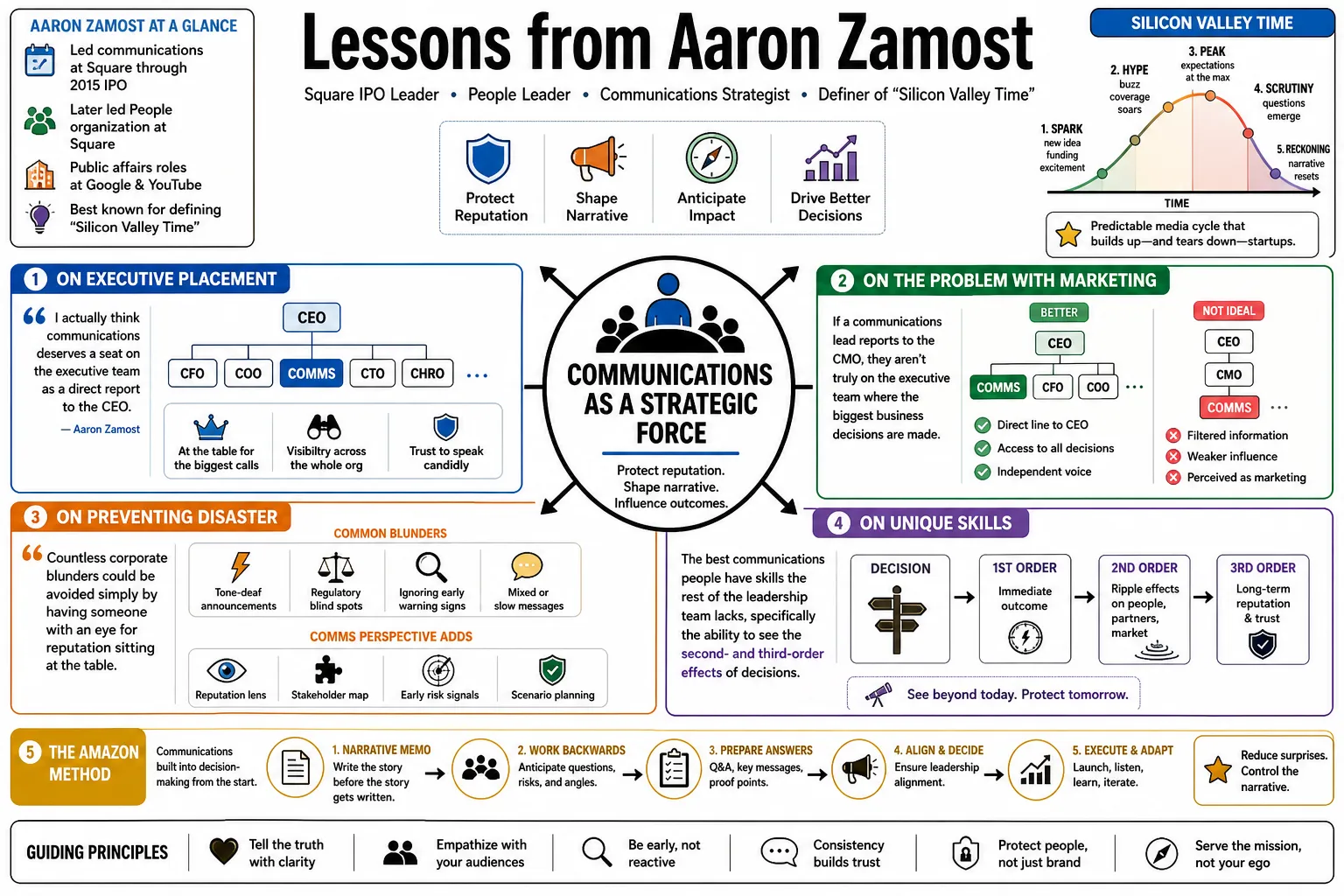
Lessons from Aaron Zamost
Part 1: The Strategic Role of Communications
- On executive placement: "I actually think communications deserves a seat on the executive team as a direct report to the CEO." — First Round Review — Aaron Zamost on Executive Communications.
- On the problem with marketing: If a communications lead reports to the CMO, they aren't truly on the executive team where the biggest business decisions are made. — First Round Review — Aaron Zamost on Executive Communications.
- On unique skills: The best communications people have skills the rest of the leadership team lacks, specifically the ability to see the second- and third-order effects of decisions. — First Round Review — Aaron Zamost on Executive Communications.
- On the Amazon method: Instead of starting with a press release, start with a list of the hardest possible questions and take them down rabbit holes to see where the narrative will go. — First Round Review — Aaron Zamost on Executive Communications.
- On issue spotting: Great comms leaders operate like lawyers; they can walk into a fire and instantly identify the one fact that matters more than everything else. — First Round Review — Aaron Zamost on Executive Communications.
- On the matrix: Elite communications operators “see the world in code” and anticipate how decisions can create second- and third-order reputational effects. — First Round Review — Aaron Zamost on Executive Communications.
- On team composition: A leadership team should be a “team of rivals”—people whose different strengths complement one another and make the CEO better. — First Round Review — Aaron Zamost on Executive Communications.
- On unconventional backgrounds: Many of the best communications leaders were originally trained as lawyers, policy experts, or financial reporters, giving them a different structural approach to problems. — First Round Review — Aaron Zamost on Executive Communications.
- On speaking truth to power: Someone in the room needs to have the authority to tell the CEO when an idea—like laying off 900 people over Zoom—is incredibly damaging. — First Round Review — Aaron Zamost on Executive Communications.
Part 2: The Problem with PR Agencies
- On agency value: "I think 99% of PR agencies provide little to no value to the companies that hire them." — First Round Review — Aaron Zamost on Executive Communications.
- On wasted capital: Founders frequently wake up seven months into an agency contract, having spent over $200,000, with nothing to show for it but long coverage reports that omit their own company. — First Round Review — Aaron Zamost on Executive Communications.
- On internal reliance: Square went public and spent nearly a decade in the United States without ever hiring a PR agency. — First Round Review — Aaron Zamost on Executive Communications.
- On exception one: Hire an agency when your startup explodes with product-market fit overnight and you physically cannot scale to handle the inbound media requests. — First Round Review — Aaron Zamost on Executive Communications.
- On exception two: Agencies can be useful when leadership has created a major corporate crisis and needs specialist help navigating it. — First Round Review — Aaron Zamost on Executive Communications.
- On exception three: Use agencies for international expansion to test foreign markets before committing to full-time local hires. — First Round Review — Aaron Zamost on Executive Communications.
- On exception four: Bring in external help when you enter a completely new vertical, like Hollywood or music, and need an existing Rolodex. — First Round Review — Aaron Zamost on Executive Communications.
- On bad tactics: Most agencies rely on brute force, sending identical press releases to BCC lists with embargo times the reporters never agreed to. — First Round Review — Aaron Zamost on Executive Communications.
- On universal dissatisfaction: Zamost argues that the agency model often disappoints startups because clients can spend heavily without receiving meaningful results. — First Round Review — Aaron Zamost on Executive Communications.
Part 3: Crafting the Message
- On onboarding: An early-stage communications hire should not rush to pitch reporters; the first three to six months should prioritize clarifying the company’s message while building internal and media relationships. — First Round Review — Aaron Zamost on Executive Communications.
- On the grandparents test: "I really do subscribe to the belief that you should be able to describe things in a way that your grandparents would understand them." — First Round Review — Aaron Zamost on Executive Communications.
- On the messaging hierarchy: You must master a simple sequence: first explain what the company does, then how it does it, and finally why it does it. — First Round Review — Aaron Zamost on Executive Communications.
- On jargon: Technical language that successfully sells software to IT buyers is terrible for explaining the company to the public or the press. — First Round Review — Aaron Zamost on Executive Communications.
- On simplicity: Square Capital reduced the highly complex mechanics of loan APRs to a simple promise: "every time you take a payment, a little bit goes toward your balance." — First Round Review — Aaron Zamost on Executive Communications.
- On mission: The "why" of the company elevates the narrative from a purely functional pitch to an aspirational one that makes people want to root for you. — First Round Review — Aaron Zamost on Executive Communications.
- On overconfidence: Because everyone can talk and read the news, everyone assumes they know how to do communications—usually to their detriment. — First Round Review — Aaron Zamost on Executive Communications.
- On aggressive editing: The person reviewing your statements and blog posts should be deleting text, not adding to it. — First Round Review — Aaron Zamost on Executive Communications.
- On finding the narrative: The best way to learn how to message the product is to read customer case studies and talk to the sales team about why users love it. — First Round Review — Aaron Zamost on Executive Communications.
- On persuasion: Communications is not just passing out facts; it is actively persuading the public to perceive the company in a way that accomplishes business goals. — First Round Review — Aaron Zamost on Executive Communications.
Part 4: Navigating the Media Landscape
- On customer acquisition: "If you are reliant on communications for customer acquisition, your marketing team is broken." — First Round Review — Aaron Zamost on Executive Communications.
- On outdated tactics: The era of securing fawning press coverage by giving a reporter an office tour to look at glass conference rooms and snacks is over. — First Round Review — Aaron Zamost on Executive Communications.
- On volume expectations: A startup shouldn't expect a steady drumbeat of coverage; it is completely normal for early-stage B2B companies to get very little press. — First Round Review — Aaron Zamost on Executive Communications.
- On building relationships: Instead of sending press releases, founders should simply take relevant reporters out for coffee to understand their interests. — First Round Review — Aaron Zamost on Executive Communications.
- On targeting: Find the reporters who genuinely cover your niche—whether it’s fitness, pets, or enterprise software—rather than blanketing the top tech publications. — First Round Review — Aaron Zamost on Executive Communications.
- On expanding strategy: Modern communications requires using non-traditional media relations, like owned editorial channels, content marketing, and targeted influencers. — First Round Review — Aaron Zamost on Executive Communications.
- On adversarial press: Tech leaders incorrectly assume the media is out to get them, when in reality, reporters are just no longer willing to write standard corporate puff pieces. — First Round Review — Aaron Zamost on Executive Communications.
- On comms as a bank: Communications functions as a reputation bank account you make deposits into, not a performance marketing engine. — First Round Review — Aaron Zamost on Executive Communications.
- On Blending Owned and Earned Media: Owned channels provide control, but most leaders still need credible third-party media to reach beyond their echo chamber and build legitimacy. — Axios — The “Go Direct” Communications Debate
Part 5: The Art of the Interview
- On the Kissinger rule: Approach media interactions with the mindset: "I hope you have questions for my answers." — First Round Review — Aaron Zamost on Executive Communications.
- On maintaining control: You must answer the reporter's question, but you are not obligated to answer it exactly the way they want you to. — First Round Review — Aaron Zamost on Executive Communications.
- On being quoted: Every single sentence that leaves your mouth must be one you are fully comfortable seeing isolated in print. — First Round Review — Aaron Zamost on Executive Communications.
- On humbling CEOs: "The greatest way to make a person humble in understanding of the unique role and skills of communications is to make them give an interview and record them." — First Round Review — Aaron Zamost on Executive Communications.
- On efficient practice: Founders don't need $10,000 day-long media bootcamps; they just need 30 minutes of targeted practice twice a week. — First Round Review — Aaron Zamost on Executive Communications.
- On elevating the narrative: Technical founders must learn to stop retreating into product specifications and start opining on bigger-picture industry topics. — First Round Review — Aaron Zamost on Executive Communications.
- On tough questions: You will never know your actual response to a brutally hard question until you force yourself to answer it aloud during practice. — First Round Review — Aaron Zamost on Executive Communications.
- On discussing competitors: It is acceptable to talk about competitors as long as you punch up at massive incumbents, rather than punching down at smaller startups. — First Round Review — Aaron Zamost on Executive Communications.
- On providing value: Unless you are a celebrity founder, you have to actively provide compelling insights, otherwise reporters have no reason to speak with you. — First Round Review — Aaron Zamost on Executive Communications.
Part 6: The "Silicon Valley Time" Hype Cycle
- On predictable arcs: Zamost’s “Silicon Valley Time” framework maps the predictable cycle through which media and public narratives build up and tear down technology startups. — Backchannel — What’s Your Hour in ‘Silicon Valley Time’?.
- On the beginning: At midnight, a startup is flying under the radar, building quietly while nobody outside the company knows or cares. — Backchannel — What’s Your Hour in ‘Silicon Valley Time’?.
- On the morning rise: As the clock moves forward, the company raises funding, gains momentum, and the media begins to champion its potential. — Backchannel — What’s Your Hour in ‘Silicon Valley Time’?.
- On the apex: By mid-afternoon, the startup is heralded as the greatest company in the industry and is treated as if it can do no wrong. — Backchannel — What’s Your Hour in ‘Silicon Valley Time’?.
- On the inevitable turn: As evening approaches, the media narrative violently turns, and critics emerge to declare that the product actually sucks. — Backchannel — What’s Your Hour in ‘Silicon Valley Time’?.
- On the bottom: By 11:59 PM, the company is widely labeled a complete mess, setting the stage for either failure or a narrative rebirth. — Backchannel — What’s Your Hour in ‘Silicon Valley Time’?.
- On ignoring the hype: Founders should never let mid-afternoon praise inflate their egos, because that adulation is just a temporary phase of the cycle. — Backchannel — What’s Your Hour in ‘Silicon Valley Time’?.
- On surviving the downfall: When the media cycle turns negative, leaders must ignore the noise and focus entirely on their product and team. — Backchannel — What’s Your Hour in ‘Silicon Valley Time’?.
- On Courage Eroding With Scale: As technology companies become incumbents, self-preservation can replace their willingness to challenge authority. — Techdirt — Courage Doesn’t Scale
Part 7: Managing Internal Communications and Crises
- On employee respect: "If you treat employees like adults, for the most part, they will behave like them. So tell them the truth." — First Round Review — Aaron Zamost on Executive Communications.
- On layoff transparency: When conducting layoffs, provide direct context, explaining exactly which investments the market can no longer support. — First Round Review — Aaron Zamost on Executive Communications.
- On accountability: The CEO must explicitly take the blame for bad macroeconomic outcomes, simply stating: "This is completely my fault as the CEO because I call the shots." — First Round Review — Aaron Zamost on Executive Communications.
- On being human: Soften the blow of bad news with humane gestures, like extending healthcare, accelerating stock vesting, and letting departing employees keep their hardware. — First Round Review — Aaron Zamost on Executive Communications.
- On the ultimate metric: The definitive sign of a healthy culture is when an employee can say, "I can express a contradictory opinion and feel I have been heard." — First Round Review — Aaron Zamost on Executive Communications.
- On stock drops: During a market collapse, falling share prices can drive attrition even when internal communications are strong; communications alone cannot solve the underlying economic pressure. — First Round Review — Aaron Zamost on Executive Communications.
- On gauging sentiment: A communications leader can gauge employee sentiment and trust by reading the tone of internal Slack discussions and pairing that observation with pulse surveys. — First Round Review — Aaron Zamost on Executive Communications.
- On internal spin: You cannot successfully spin your own employees; they have access to the exact same information you do and will recognize corporate talking points immediately. — First Round Review — Aaron Zamost on Executive Communications.
- On preventing self-inflicted wounds: A valuable role of crisis communications is preventing self-inflicted wounds before they happen, including visibly inhumane approaches to mass layoffs. — First Round Review — Aaron Zamost on Executive Communications.
- On Incentives Behind Corporate Values: Treat corporate values as incentive-sensitive commitments: executive behavior often follows economics and leverage more closely than ideology. — Techdirt — Bringing Your Whole Self to Work
- On Culture Following Labor Leverage: “Whole self” culture expanded when scarce talent held leverage and receded when that leverage shifted back to management. — Techdirt — Bringing Your Whole Self to Work
- On the Cost of Reversing Values: Abruptly reversing professed values produces employee detachment and weakens the tribal loyalty companies once relied on. — Techdirt — Bringing Your Whole Self to Work
- On AI as a Layoff Narrative: An AI explanation for layoffs may be a fashionable story layered over familiar prioritization, duplicated teams, and cost management. — Futurism — Block’s AI Layoff Narrative
Part 8: Leadership, Culture, and Operations
- On dual credibility: A great leader maintains respect at the "adults' table" on the executive team while retaining the trust of the "kids' table" across the broader company. — First Round Review — Aaron Zamost on Executive Communications.
- On speaking up: "Leadership team of companies are people who have to represent the company and be willing to speak out on things, you know, respectfully outside of their lane." — First Round Review — Aaron Zamost on Executive Communications.
- On imposter syndrome: It is natural to feel out of place when sitting among legendary tech executives, but that feeling shouldn't stop you from voicing your perspective. — First Round Review — Aaron Zamost on Executive Communications.
- On decision authority: You should fiercely debate topics outside your specific area of ownership, as long as you respect who ultimately holds the decision-making power. — First Round Review — Aaron Zamost on Executive Communications.
- On disagreeing: Vigorously debating an idea and then fully committing to support the final decision is a beautiful and essential business practice. — First Round Review — Aaron Zamost on Executive Communications.
- On writing culture: Taking a colleague's sprawling statement and aggressively editing it down to its core message is a vital act of leadership. — First Round Review — Aaron Zamost on Executive Communications.
- On intellectual honesty: Good leaders recognize that while they might not be the final decision maker in every room, they still have an absolute duty to shape the discussion. — First Round Review — Aaron Zamost on Executive Communications.
- On Betting Before the Evidence Settles: When leaders invoke AI to justify sweeping workforce decisions, they should acknowledge what remains uncertain and whether current systems can actually absorb the eliminated work. — Futurism — Block’s AI Layoff Narrative
Learn more: