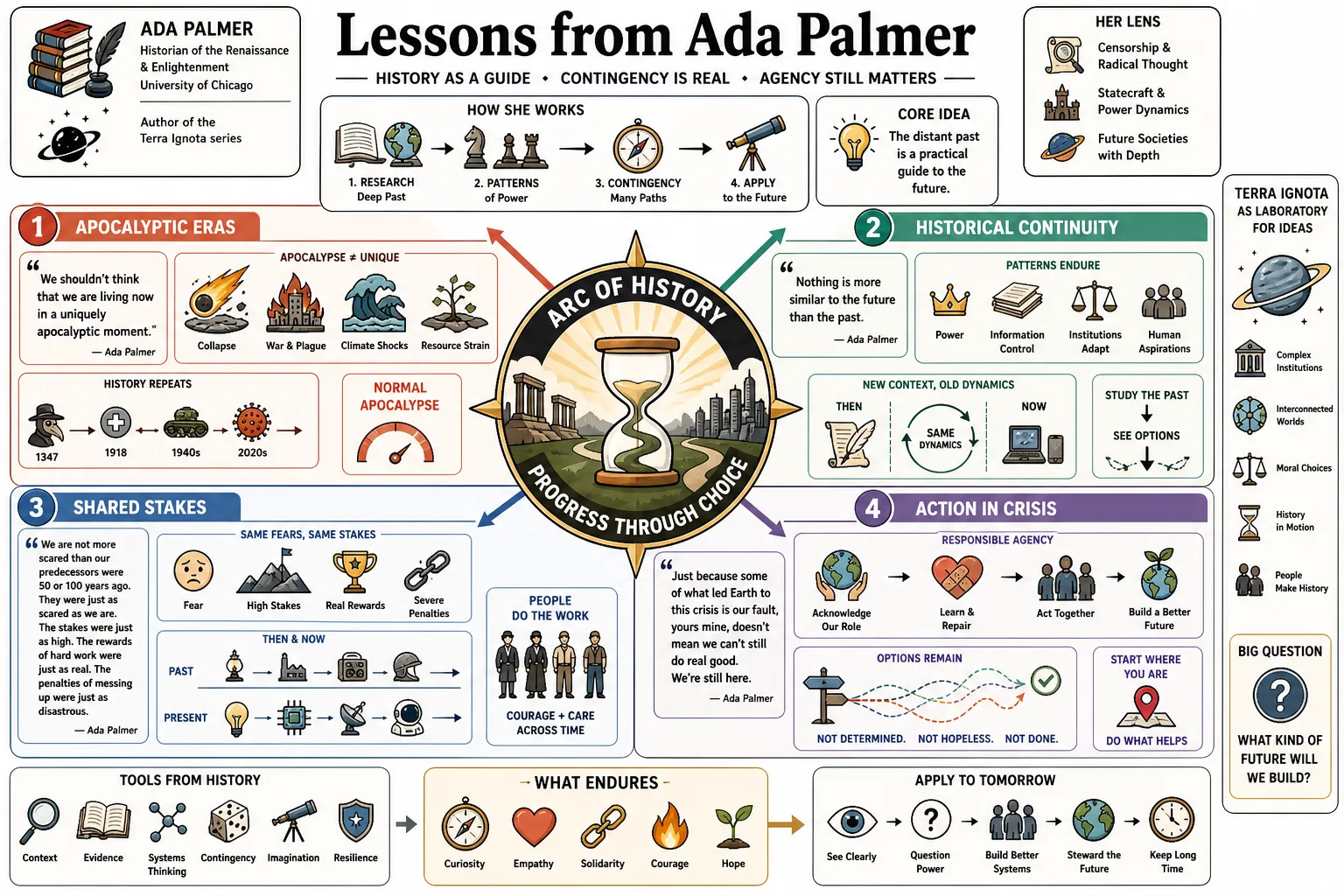
Lessons from Ada Palmer
Ada Palmer is a University of Chicago historian of Renaissance intellectual history and censorship, and the author of the Terra Ignota science-fiction series. Her work uses long historical comparisons to examine how institutions, technologies, and ideas change. — Ada Palmer — Audio and Video Interviews.
Part 1: The Arc of History and Progress
- Apocalyptic Feelings Are Historically Normal: Our era is not uniquely apocalyptic; earlier generations also faced moments in which choices felt urgent and civilization seemed at risk. — Meant For It — What If the World Isn’t Ending?.
- The Past Is a Laboratory for the Future: Long histories of cultural and technological change help us reason about futures that will differ sharply from the present. — The Browser Interview with Ada Palmer.
- Earlier Generations Faced Comparable Stakes: People fifty or a hundred years ago were also frightened, responsible for difficult choices, and exposed to severe consequences. — Meant For It — What If the World Isn’t Ending?.
- History Denaturalizes the Present: Studying societies unlike our own reveals that present institutions are contingent arrangements rather than permanent features of human life. — The Browser Interview with Ada Palmer.
- Progress Often Means Reducing Harm: Historical success is rarely total victory; partial mitigation and sustained collective work can still change outcomes dramatically. — Hope Is a Verb — A History of Saving the World.
Part 2: Censorship, Information, and Control
- Censorship Is Often Distributed: Information control frequently depends on households, local institutions, and ordinary participants rather than a single centralized censor. — Censorship from the Inquisition to the Present — Course Syllabus.
- Social Systems Can Suppress Without a Master Plan: Many restrictive systems begin as improvised responses to perceived threats and are enforced through routine institutions and social pressure. — Censorship from the Inquisition to the Present — Course Syllabus.
- Information Revolutions Produce Control Efforts: The spread of printing and the digital revolution both triggered new attempts to regulate, monopolize, curate, and restrict information. — Censorship from the Inquisition to the Present — Course Syllabus.
- Radical Thought Adapts to Constraint: Renaissance thinkers often presented new arguments through commentary on ancient authorities so that innovation could survive hostile institutions. — Dwarkesh Podcast — Machiavelli Is the Most Misunderstood Thinker.
- Information Control Extends Beyond Formal Bans: Copyright, access rules, labeling, and platform systems can restrict circulation even when nobody describes the mechanism as censorship. — Censorship from the Inquisition to the Present — Course Syllabus.
- The Inquisition Relied on Local Infrastructure: Inquisitors depended on local governments, prisons, guards, money, and cooperation, making enforcement uneven rather than monolithic. — Conversations with Tyler — Ada Palmer.
- Printing Created New Bottlenecks: Print expanded copying while licensing and censorship systems made prior approval and printer monopolies new points of control. — Dwarkesh Podcast — Machiavelli Is the Most Misunderstood Thinker.
- Control Often Means Unequal Access: A recurring goal of censorship is to determine who may see information and under what conditions, not necessarily to erase it. — Censorship from the Inquisition to the Present — Course Syllabus.
- The Internet Repeats Some Print-Era Patterns: Digital platforms echo older information revolutions, while differing in who performs moderation and how cheaply institutions try to scale it. — The Browser Interview with Ada Palmer.
Part 3: Machiavelli, Power, and the Renaissance
- Read Machiavelli in His Political Emergency: The Prince is easier to understand when situated in Florence’s wars, regime changes, and Machiavelli’s loss of office. — Dwarkesh Podcast — Machiavelli Is the Most Misunderstood Thinker.
- Machiavelli Was a Florentine Patriot: Palmer presents him not as an advocate of evil but as a committed republican trying to return to public service and protect Florence. — Dwarkesh Podcast — Machiavelli Is the Most Misunderstood Thinker.
- Context Changes What The Prince Means: Reconstructing the crises, patronage systems, and intellectual conventions of Machiavelli’s time changes how his political analysis reads. — Dwarkesh Podcast — Machiavelli Is the Most Misunderstood Thinker.
- Political Knowledge Can Be Dangerous: Palmer compares Machiavelli’s sense of a new political science to a scientist deciding which state can safely receive a powerful technology. — Dwarkesh Podcast — Machiavelli Is the Most Misunderstood Thinker.
- Florence Combined Creativity and Instability: Florence’s art and scholarship flourished amid war, factional struggle, and rapidly changing alliances rather than tranquil prosperity. — Dwarkesh Podcast — Why Leonardo Was a Saboteur.
- Leonardo Could Disrupt Rivals Deliberately: Palmer describes cases in which Leonardo’s interventions frustrated competitors and reshaped artistic or engineering projects. — Dwarkesh Podcast — Why Leonardo Was a Saboteur.
- The Golden-Age Renaissance Is a Later Myth: People living through the celebrated Renaissance also experienced violence, disease, inequality, and political collapse. — The Browser Interview with Ada Palmer.
- Reception Changes Political Texts: A work’s meaning and influence depend partly on the institutions, conflicts, and reading conventions through which later audiences encounter it. — Conversations with Tyler — Ada Palmer.
- Machiavelli Made Politics an Object of Analysis: His innovation was to examine recurring mechanisms of power and statecraft historically rather than only prescribe an ideal ruler. — Dwarkesh Podcast — Machiavelli Is the Most Misunderstood Thinker.
- Humanism Was Entangled with Government: Renaissance scholarship, diplomacy, patronage, and civic competition were practical tools of city-state survival as well as intellectual pursuits. — Conversations with Tyler — Ada Palmer.
Part 4: Worldbuilding and Speculative Fiction
- Build Futures with Historical Thickness: A convincing future contains layered institutions, inherited contradictions, and unfinished reforms rather than one clean utopian premise. — Track of Words — Ada Palmer on Terra Ignota.
- Historians Can Model Cultural Consequences: Historical training helps a writer ask how a technology changes politics, migration, family, and identity across generations. — The Browser Interview with Ada Palmer.
- Separate Citizenship from Geography: Terra Ignota’s Hives let people choose nonterritorial political affiliations, changing how majorities, borders, and taxation work. — Social Science Fiction — Interview with Ada Palmer.
- A Better Future Can Remain Deeply Flawed: Terra Ignota combines peace, longevity, and mobility with censorship, surveillance, religious restrictions, and unresolved inequality. — Track of Words — Ada Palmer on Terra Ignota.
- Silencing Gender Does Not End Gendered Power: Palmer’s future suppresses gendered language without fully dismantling the assumptions and political inequalities beneath it. — Track of Words — Ada Palmer on Terra Ignota.
- Write the Present as Somebody Else’s Past: Terra Ignota treats contemporary institutions as distant history that future narrators interpret through their own biases. — The Browser Interview with Ada Palmer.
- Science Fiction Tests Social Systems: Speculative fiction lets historians explore how altered technologies and institutions might interact over generations. — The Browser Interview with Ada Palmer.
Part 5: Human Nature, Desire, and Morality
- Censorship Often Begins with Protective Motives: Many people who restrict information believe they are shielding others from danger, immorality, or contamination. — Censorship from the Inquisition to the Present — Course Syllabus.
- Present Moral Systems Are Historically Contingent: Long historical comparison shows that norms which feel permanent are products of conflict, institutions, and change. — The Browser Interview with Ada Palmer.
- Historical Knowledge Creates Responsibility: Knowing that earlier people repeatedly faced hard choices is a reason to act, not a guarantee that present crises will resolve themselves. — Hope Is a Verb — A History of Saving the World.
Part 6: Technology, Institutions, and Change
- Institutions Are Social Technologies: Political membership, family arrangements, and other structures can change radically when societies adopt new technologies and norms. — Social Science Fiction — Interview with Ada Palmer.
- Mobility Reshapes Political Geography: Near-instant travel would alter citizenship, community, migration, and the practical importance of borders. — The Browser Interview with Ada Palmer.
- New Media Produce New Regulation: Printing and digital platforms both created pressures for licensing, copyright, moderation, and other control systems. — Censorship from the Inquisition to the Present — Course Syllabus.
- Trauma Can Produce Lasting Taboos: Terra Ignota imagines religious violence leading later generations to suppress public religious discussion in the name of peace. — Track of Words — Ada Palmer on Terra Ignota.
- Human Needs Persist Outside Old Institutions: Even where organized religion is restricted, characters still seek private philosophical and spiritual counsel. — Track of Words — Ada Palmer on Terra Ignota.
- Infrastructure Changes the Meaning of Place: Fast global transportation makes political communities less territorial and allows people to live near chosen relationships rather than workplaces. — The Browser Interview with Ada Palmer.
- Technology Does Not Remove Ideological Conflict: Terra Ignota’s abundance and peace redirect competition into politics, economics, sport, propaganda, and identity rather than eliminating it. — The Browser Interview with Ada Palmer.
Part 7: Historical Contingency and the Future
- Small Contingencies Can Redirect History: Palmer studies moments when choices by non-famous actors could have sent a person, text, or institution down another branch. — Conversations with Tyler — Ada Palmer.
- Progress Was Never Guaranteed: The past contains abandoned paths and fragile breakthroughs, which makes linear accounts of inevitable progress misleading. — Hope Is a Verb — A History of Saving the World.
- Ideas Survive Through Fragile Chains: The recovery and reception of Lucretius depended on manuscripts, copying, annotation, and historically contingent readers. — Reading Lucretius in the Renaissance.
- History Clarifies Mechanisms, Not Exact Predictions: Past cases help distinguish recurring structures from genuinely new features without yielding a precise forecast. — The Browser Interview with Ada Palmer.
- Crisis and Creativity Can Coexist: The artistic and intellectual achievements later called a golden age occurred amid severe political instability and suffering. — Dwarkesh Podcast — Why Leonardo Was a Saboteur.
- History Maps a Wider Range of Possibility: By showing how differently people have organized life, historians expand the set of futures we can imagine and evaluate. — The Browser Interview with Ada Palmer.
- Structural Forces Do Not Erase Agency: Large constraints shape the available choices, but collective work and partial victories still matter. — Meant For It — What If the World Isn’t Ending?.
Part 8: Philosophy, Myth, and "Viking Metaphysics"
- Viking Metaphysics Makes Courage Finite: Norse myth imagines mortal gods who know they will lose at Ragnarök, making courage meaningful precisely because victory is not guaranteed. — Conversations with Tyler — Ada Palmer.
- Revisit Traditions Through Better Scholarship: Later scholars can recover primary materials from nationalist or ideological appropriations and ask new questions of them. — Conversations with Tyler — Ada Palmer.
- The Aesir Frame Heroism Through Fate: A worldview with mortal gods and a foretold ending offers a distinctive way to examine duty, determinism, and martial courage. — Conversations with Tyler — Ada Palmer.
- Women Scholars Helped Reconstruct Norse Thought: Palmer credits overlooked women translators and scholars with foundational work in understanding Old Norse texts and metaphysics. — Conversations with Tyler — Ada Palmer.