Adam Fishman is a product and growth leader whose work focuses on growth systems, product management, company building, and parenting while working. He publishes the FishmanAF newsletter and hosts the Startup Dad podcast. — FishmanAF Newsletter — About.
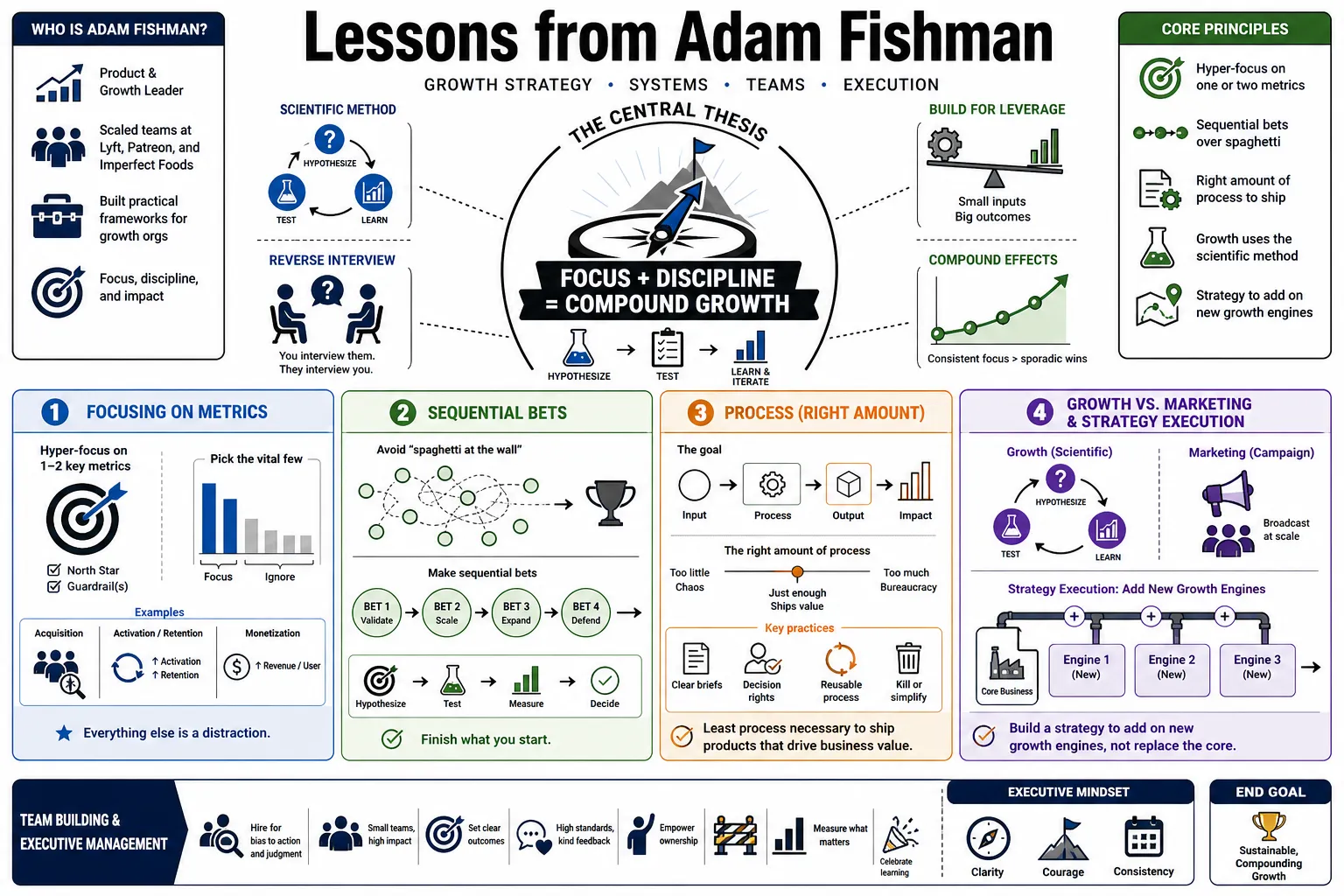
Part 1: Growth Strategy and Systems
- Focus on Outcome Metrics: Concentrate teams on a small set of outcome-linked metrics, then review them regularly to separate real progress from shipping activity. — FishmanAF — Motion vs. Progress.
- Make Sequential Bets: Use an explicit growth strategy to choose and sequence the loops or initiatives that matter instead of scattering effort across unrelated experiments. — FishmanAF — Motion vs. Progress.
- Growth Is a Cross-Functional Discipline: Growth work combines experimentation, customer understanding, strategy, and influence; it is broader than running marketing campaigns. — Reforge — The Growth Competency Model.
- Turn Strategy Into a System: Connect growth strategy to a repeatable operating system for prioritizing, executing, and learning from growth work. — Reforge — The Growth Competency Model.
- Model the Whole Growth System: Treat acquisition, retention, monetization, and cost as connected parts of one quantitative growth model rather than isolated targets. — Reforge — The Growth Competency Model.
- Test Before Scaling Spend: Use bounded experiments to learn whether a channel can work before making a large capital commitment. — FishmanAF — Hiring Your First Growth Employee, Part 2.
- Develop Customer Knowledge: High-performing growth teams need a concrete understanding of user psychology and behavior, not only channel expertise. — Reforge — The Growth Competency Model.
- Make the Product Prove the Brand: A brand promise only works when the product experience supplies convincing proof of that promise. — FishmanAF — When Branding Is a Growth Strategy.
Part 2: Team Building and Hiring
- Do Not Hire for a Unicorn: The competency model is not a search for one person who excels at every growth skill; such a candidate is not a realistic hiring target. — Reforge — The Growth Competency Model.
- Build a Well-Rounded Team: Evaluate growth capability across the team so that complementary strengths cover the competency model. — Reforge — The Growth Competency Model.
- Use Four Growth Competencies: Assess growth practitioners across Growth Execution, Customer Knowledge, Growth Strategy, and Communication & Influence. — Reforge — The Growth Competency Model.
- Treat Influence as a Growth Skill: Senior growth work requires stakeholder management and team leadership alongside analytical and channel skills. — FishmanAF — Hiring Your First Growth Employee, Part 2.
- Understand User Psychology: Customer knowledge includes understanding the motivations, behaviors, and narratives behind user decisions. — Reforge — The Growth Competency Model.
- Prioritize Execution in Early Hires: Early growth hires should be strong at experimentation and channel execution because they must create a repeatable learning engine. — FishmanAF — Hiring Your First Growth Employee, Part 2.
- Raise the Bar for Growth Leaders: As growth roles become more senior, strategy, communication, and influence matter more than tactical execution alone. — FishmanAF — Hiring Your First Growth Employee, Part 2.
- Pair Data With Psychology: A capable growth team needs both quantitative analysis and a grounded view of why customers behave as they do. — Reforge — The Growth Competency Model.
- Define the Team’s Capability Gaps: Use the competency model to identify which strengths the current team has and which gaps the next hire should fill. — Reforge — The Growth Competency Model.
- Evolve the Growth Team: As the business changes, revisit the team’s mix of execution, customer, strategy, and influence skills instead of preserving a fixed org design. — Reforge — The Growth Competency Model.
Part 3: Innovation and Stage-Gating
- Say No Earlier: Stage gates make it possible to stop weak projects before they absorb years of time and large teams. — FishmanAF — A Stage-Gating Process for New Products.
- Replace Innovation Theater With Evidence: Require teams to demonstrate market, problem, solution, and business evidence before advancing a new product. — FishmanAF — A Stage-Gating Process for New Products.
- Use Gates to Force Learning: When a team cannot answer the questions for its current gate, it should revise, pivot, or stop rather than continue on conviction alone. — FishmanAF — A Stage-Gating Process for New Products.
- Plan Distribution Early: New-product evaluation should include a credible go-to-market and growth hypothesis before large-scale investment. — FishmanAF — A Stage-Gating Process for New Products.
- Use Five Stages: Move new products through Discovery, Exploration, Viability, Growth, and Sustain, with a distinct question at each gate. — FishmanAF — A Stage-Gating Process for New Products.
- Increase Investment With Evidence: Tie additional budget, headcount, and governance to the evidence required at each successive gate. — FishmanAF — A Stage-Gating Process for New Products.
Part 4: The Concept of Reverse Interviewing
- Interview the Employer Too: Evaluate a prospective employer with the same rigor it uses to evaluate you. — FishmanAF — How to Reverse Interview.
- Test Perception Against Reality: Use reverse interviewing to identify gaps between a company’s recruiting story and the job you would actually enter. — FishmanAF — How to Reverse Interview.
- Prepare Specific Questions: Plan questions around the company, team, and role instead of relying on generic questions at the end of an interview. — FishmanAF — How to Reverse Interview.
- Time the Hard Questions: Ask the most sensitive questions after the company has shown meaningful interest and enough trust exists for candid answers. — FishmanAF — How to Reverse Interview.
- Examine Business Viability: Ask about financial health, goals, and runway so that you understand the company risk behind the role. — FishmanAF — How to Reverse Interview.
- Investigate the Daily Reality: Ask how decisions are made, how success is measured, and why people leave to understand the operating environment. — FishmanAF — How to Reverse Interview.
- Understand the Reporting Structure: Learn how your manager operates and how adjacent teams are organized before accepting the role. — FishmanAF — How to Reverse Interview.
- Evaluate Mutual Fit: Use the evidence from the process to decide whether the company, team, and role fit your goals. — FishmanAF — How to Reverse Interview.
- Synthesize the Evidence: Record answers against a structured set of criteria so the decision is not driven by the last conversation or recruiting momentum. — FishmanAF — How to Reverse Interview.
Part 5: Leadership and Execution
- Build Trust Before Forcing Change: In a senior role, establish credibility and trust before attempting broad organizational changes. — Right Side Up — Advice to New Marketing Leaders.
- Measure Early Leadership Differently: For a new VP, influence, judgment, and trust can be more meaningful early indicators than immediate operating outcomes. — Right Side Up — Advice to New Marketing Leaders.
- Begin With a Listening Tour: New leaders should first gather context from the team, stakeholders, customers, and finance before chasing apparent low-hanging fruit. — Right Side Up — Advice to New Marketing Leaders.
Part 6: Early-Stage Startup Lessons
- Compete Through Differentiation: Define the mission and product experience that make the business distinct instead of accepting a competitor’s framing of the market. — Adam Fishman — Rideshare Wars, Part 1.
- Look for an Unclaimed Position: Find the customer need and product position that competitors do not serve well rather than copying their visible tactics. — Adam Fishman — Rideshare Wars, Part 1.
- Align Positioning and Product: When positioning changes, change the product proof points as well so customers experience the value being promised. — FishmanAF — When Branding Is a Growth Strategy.
- Hire for a Learning Engine: The first growth hire should be able to run experiments, interpret customer behavior, and establish repeatable execution—not merely launch campaigns. — FishmanAF — Hiring Your First Growth Employee, Part 2.
Part 7: Product Management in the AI Era
- Build AI Fluency Into Product Work: Product managers need practical AI fluency because the tools are changing how product work is performed and evaluated. — FishmanAF — Grading AI Fluency in Product Management.
- Use Speed With Judgment: AI can increase output, but product quality still depends on questioning assumptions, cutting weak material, and applying judgment. — FishmanAF — Grading AI Fluency in Product Management.
- Do Not Confuse Output With Product Skill: Generating more artifacts does not replace product sense, taste, or responsibility for outcomes. — FishmanAF — Grading AI Fluency in Product Management.
- Make AI Fluency an Organizational Expectation: Adoption improves when teams define levels of AI fluency, share reusable workflows, and coach skeptics rather than treating AI as a private tool choice. — FishmanAF — Grading AI Fluency in Product Management.
- Use AI to Accelerate Prototyping: AI can help teams prototype and pressure-test early product ideas faster, but the evidence required at each gate still matters. — FishmanAF — A Stage-Gating Process for New Products.
- Evaluate AI Investments as Investments: Require an explicit customer problem, expected return, evidence, and resource case before funding an AI product initiative. — FishmanAF — Evaluating Product Investments.
- Keep Learning as the Role Changes: AI fluency is becoming part of product work, but it must be developed alongside durable judgment and product craft. — FishmanAF — Grading AI Fluency in Product Management.
Part 8: Balancing Fatherhood and Leadership
- Design for the Juggling Act: Combining senior leadership and active parenting requires explicit choices about time, flexibility, and support; it does not balance itself. — FishmanAF — Parenting While Producting.
- Be Honest About the Mess: Working parenthood includes unpredictable interruptions and exhaustion, so leaders should plan around reality rather than an ideal schedule. — FishmanAF — Parenting While Producting.
- Seek Sustainable Integration: Splitting the day and returning to deep work at night can help temporarily, but Fishman warns that the pattern becomes unsustainable without other changes. — FishmanAF — Parenting While Producting.
- Use Structure to Protect Attention: Plan workdays in advance, prefer asynchronous discussion where possible, and reserve predictable windows for family. — FishmanAF — Parenting While Producting.
- Set Explicit Family Boundaries: Fishman protects mornings and evenings with his children and limits travel because parenting responsibilities are shared at home. — FishmanAF — Parenting While Producting.
- Expect Parenthood to Change Perspective: Parenthood can shift where people derive identity and purpose, changing how a demanding career fits into the rest of life. — FishmanAF — Parenting While Producting.