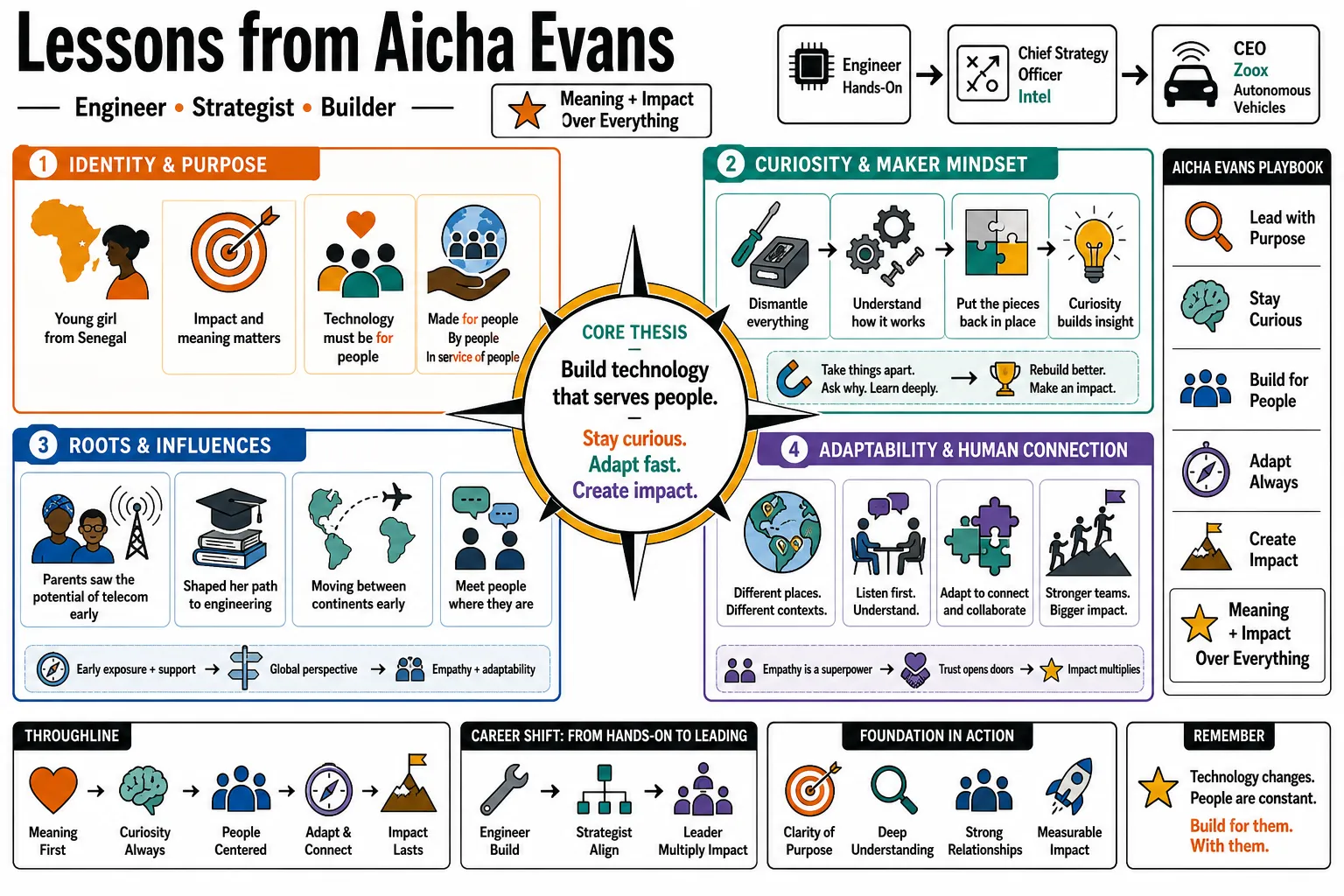
Aicha Evans leads Zoox after serving as Intel’s chief strategy officer. Her interviews examine the move from doing engineering work to enabling teams, the demands of building a safety-critical robotaxi service, and the tension between startup speed and disciplined execution. — Greylock interview.
Part 1: Early Life and Foundational Philosophy
- Identity: Growing up between Senegal and France shaped Evans’s desire to work on technology with visible benefits for people. — Stanford eCorner talk.
- Technology's Purpose: Evans credits her mother with teaching her that technology is made by people and should serve people. — Chief interview.
- Parental Influence: Her father worked in telecommunications engineering, while her family’s expectations and frequent moves helped shape her path into engineering and leadership. — Greylock interview.
- Adaptability: Moving among Senegal, France, Israel, and the United States taught Evans to observe new environments and adapt to them. — Greylock interview.
- Career Choices: Evans chose Zoox in part because the mission felt like a calling and she believed she could have an impact alongside its founder. — Bolt interview.
- Humility: Evans warns that success is not an entitlement; she recommends staying humble and continuing to learn. — Chief interview.
- Personal Growth: She treats both success and failure as occasions to examine what assumptions, timing, or decisions led to an outcome. — Chief interview.
Part 2: Navigating the Tech Industry and Intel
- Finding Opportunity: Evans advises early-career people to seek difficult projects, take risks, and learn from outcomes rather than favor easy assignments. — Stanford eCorner talk.
- Standing Out: She argues that difficult work can build a record of contribution even when an initial attempt fails. — Stanford eCorner talk.
- Corporate Bureaucracy: After criticizing Intel’s bureaucracy, Evans found that leading Zoox required her to create processes, organizational structure, and a common language. — Masters of Scale interview.
- Hardware and Software Integration: Evans learned at Intel that hardware and software need equal standing in major system-level decisions. — Masters of Scale interview.
- Strategic Transformation: At Intel, Evans helped lead a shift from a PC-centric business toward data-centric opportunities. — Stanford eCorner talk.
- Long Tenures: She says her 12 years at Intel supplied lessons in integration and process that she later applied at Zoox. — Masters of Scale interview.
- Betting on Emerging Tech: Her Intel wireless work taught her how long-term technology development can enable services that people later take for granted. — Greylock interview.
Part 3: The Transition to Executive Leadership
- The Leadership Shift: Evans says becoming a manager required moving from solving problems herself to enabling other people to solve them. — Bolt interview.
- The Ego Trap: She regards supplying every answer herself as a leadership failure because it limits her team’s development. — Bolt interview.
- Teaching to Fish: Her “teach people to fish” principle means building a team’s problem-solving capacity instead of making the leader the bottleneck. — Bolt interview.
- Dealing with Failure: When an effort fails, Evans recommends examining timing, assumptions, and decisions so the next attempt improves. — Chief interview.
- Executive Coaching: Evans says an executive coach should be someone with whom a leader can discuss even uncomfortable weaknesses. — Chief interview.
- Achieving Potential: She links productive coaching to trust and vulnerability, rather than treating the coach as a detached consultant. — Chief interview.
- Integrity: Evans argues that a leader must act consistently with stated values, especially when employees take risks and fail. — Bolt interview.
- Valuing People: She says leaders should care about employees as people and demonstrate that care through investment in their development. — Bolt interview.
- Team Selection: When choosing a close leadership partner, Evans tests whether values align and whether both people can handle hard disagreements. — Bolt interview.
- Managing Success: Evans urges leaders to examine both successful and failed outcomes without assuming that past success guarantees the next one. — Chief interview.
Part 4: Building a Culture of Execution
- Startup Realities: Evans cautions that startup work is difficult and urges people to choose challenging opportunities deliberately. — Stanford eCorner talk.
- Irrational Belief: She argues that a demanding long-term venture requires conviction while still learning from evidence and adjusting course. — Stanford eCorner talk.
- Ideas vs Execution: Evans emphasizes execution and determination alongside the initial idea when pursuing a hard technology mission. — Stanford eCorner talk.
- Patience: Because Zoox builds a vertically integrated, safety-critical service, Evans expects progress to take longer than some observers want. — Chief interview.
- Internal Transparency: Evans describes a single transparent plan at Zoox, with decisions explained through their reasons, alternatives, and trade-offs. — Greylock interview.
- The "Invisible Army": Evans wants a distributed group of people willing to challenge assumptions across Zoox’s functions. — Masters of Scale interview.
- Psychological Safety: Evans says leaders cannot invite employees to take risks and then punish them for every well-intentioned failure. — Bolt interview.
- Safety Culture: She describes safety as a shared responsibility across Zoox rather than the exclusive job of one safety group. — Greylock interview.
- Determination: Evans advises teams to learn from failed attempts, reassess, and try again rather than treating every setback as final. — Stanford eCorner talk.
Part 5: Diversity, Inclusion, and Perspective
- Industry Progress: Evans acknowledges some progress on diversity in technology but says the industry still has much more work to do. — Bloomberg Studio 1.0 interview.
- Explaining Inclusion: She argues that explaining how inclusion improves innovation and business outcomes should be part of changing the industry. — Stanford eCorner talk.
- Erasing Assumptions: Evans says she encounters disrespect and assumptions, and chooses to answer them through her work while continuing to learn from setbacks. — Masters of Scale interview.
- Additive Value: She urges students from minority and international backgrounds to treat their different experiences and questions as an advantage. — Stanford eCorner talk.
- The "High Heels" Story: Evans uses the example of riders in high heels to show why a diverse design team must consider practical pickup and drop-off needs. — Bloomberg Studio 1.0 interview.
- Diversity of Thought: Evans connects a variety of backgrounds and viewpoints with stronger innovation and problem solving. — Stanford eCorner talk.
- Mutual Understanding: She argues that a genuinely inclusive environment matters more than achieving diversity numbers alone. — Masters of Scale interview.
- Early Intervention: Evans points to middle school as a moment when girls may need better support to stay engaged with mathematics. — Bloomberg Studio 1.0 interview.
- Career Support Systems: She calls for support that helps women continue their careers through changes such as marriage and childbirth. — Bloomberg Studio 1.0 interview.
- Societal Impact: Evans says she values technology for its capacity to improve people’s lives and advance society. — Stanford eCorner talk.
Part 6: The Vision for Autonomous Mobility
- Redefining the Industry: Evans describes Zoox as a people-moving business that uses autonomous technology, rather than a business selling self-driving cars. — Greylock interview.
- The Ultimate Capability: She imagines eventually moving goods and services as well as passengers, but says Zoox must earn the opportunity first. — Greylock interview.
- Purpose-Built Design: Zoox designed its robotaxi for autonomous ride-hailing from the ground up instead of adapting a conventional driver-operated car. — Zoox vehicle reveal.
- Removing Legacy Controls: Evans argues that a passenger vehicle without a human driver need not preserve controls designed for a human driver. — Masters of Scale interview.
- Sensor Geometry: Zoox says its four sensor pods combine cameras, radar, and LIDAR to provide a 270-degree field of view from each corner. — Zoox vehicle reveal.
- Vehicle Aesthetics: Evans describes the robotaxi as cute and likens its interior to a living room on wheels. — Chief interview.
- Emotional Connection: Evans says the purpose-built design emphasizes passenger experience alongside safety and sensor placement. — Masters of Scale interview.
- Earning Trust: She says public trust must be earned through safety-first deployment and dialogue with regulators and communities. — Masters of Scale interview.
- Foundational Safety: Evans says safety permeates Zoox’s work and that employees should be able to raise concerns even when doing so slows production. — Chief interview.
Part 7: Navigating the Amazon Acquisition
- The Acquisition's Impact: Evans presented Amazon’s acquisition as an opportunity to continue Zoox’s purpose-built approach to autonomous mobility. — Amazon acquisition announcement.
- Operational Discipline: Evans says Amazon gives Zoox financial backing, advice, and a focus on execution as it works toward scale. — Masters of Scale interview.
- Cloud Infrastructure: Evans specifically cites Zoox’s relationship with AWS compute alongside Amazon’s financial support. — Masters of Scale interview.
- Commercial Reality: Evans argues that Zoox must turn its technology into a marketable ride service rather than remain a research project. — Bolt interview.
- Maintaining Autonomy: Evans says Amazon has given Zoox room to grow while the company remains accountable for its progress. — Chief interview.
- Leadership Quality: She values Amazon leaders’ habit of asking questions as Zoox confronts difficult decisions. — Chief interview.
- Priority Sequencing: Evans says Zoox should first establish safe passenger transportation before earning opportunities to work with other Amazon businesses. — Stanford eCorner talk.
- Future Collaborations: She describes possible future intersections with Amazon businesses as opportunities to earn, not benefits already delivered. — Stanford eCorner talk.
- Bridging Two Worlds: Evans brought lessons about process and cross-functional coordination from Intel into Zoox’s startup environment. — Masters of Scale interview.
- Resource Leverage: She says the capital intensity and time spent fundraising made Amazon’s long-term support strategically important to Zoox. — Bolt interview.
Part 8: The Future of Transportation and Society
- Inefficient Models: Evans points to city parking and congestion as reasons to make urban transportation more efficient. — Greylock interview.
- Replacement Ratios: Evans imagines that widely available shared mobility could reduce a household’s need for multiple personally owned cars; she does not claim one robotaxi replaces dozens. — Greylock interview.
- Transportation as a Service: Evans says Zoox intends to sell rides and a passenger experience rather than sell driverless technology itself. — Bolt interview.
- Reducing Costs: Evans argues that more accessible transportation could help more people reach a city’s economic opportunities. — Greylock interview.
- Deployment Realities: She expects autonomous ride services to spread step by step rather than appear everywhere at once. — Masters of Scale interview.
- Solving the Core Tech: Evans describes the industry as having reached real-world proof points while still facing the work of preparing for scale. — Masters of Scale interview.
- Preparing for Scale: For Evans, demonstrated robotaxi service is a beginning; routine use requires sustained, careful scaling. — Masters of Scale interview.
- The Transportation Inflection Point: Evans sees autonomous mobility as an industry transition and expects several companies to contribute rather than one winner. — Stanford eCorner talk.
- Timelines: Evans avoids a firm prediction for mass adoption and says deployment will depend on safety and public acceptance over time. — Masters of Scale interview.