Ajay Banga led Mastercard before becoming president of the World Bank Group. He argues that decency, inclusion and trust belong in the way organizations pursue competitive goals. — Banga’s WEF essay.
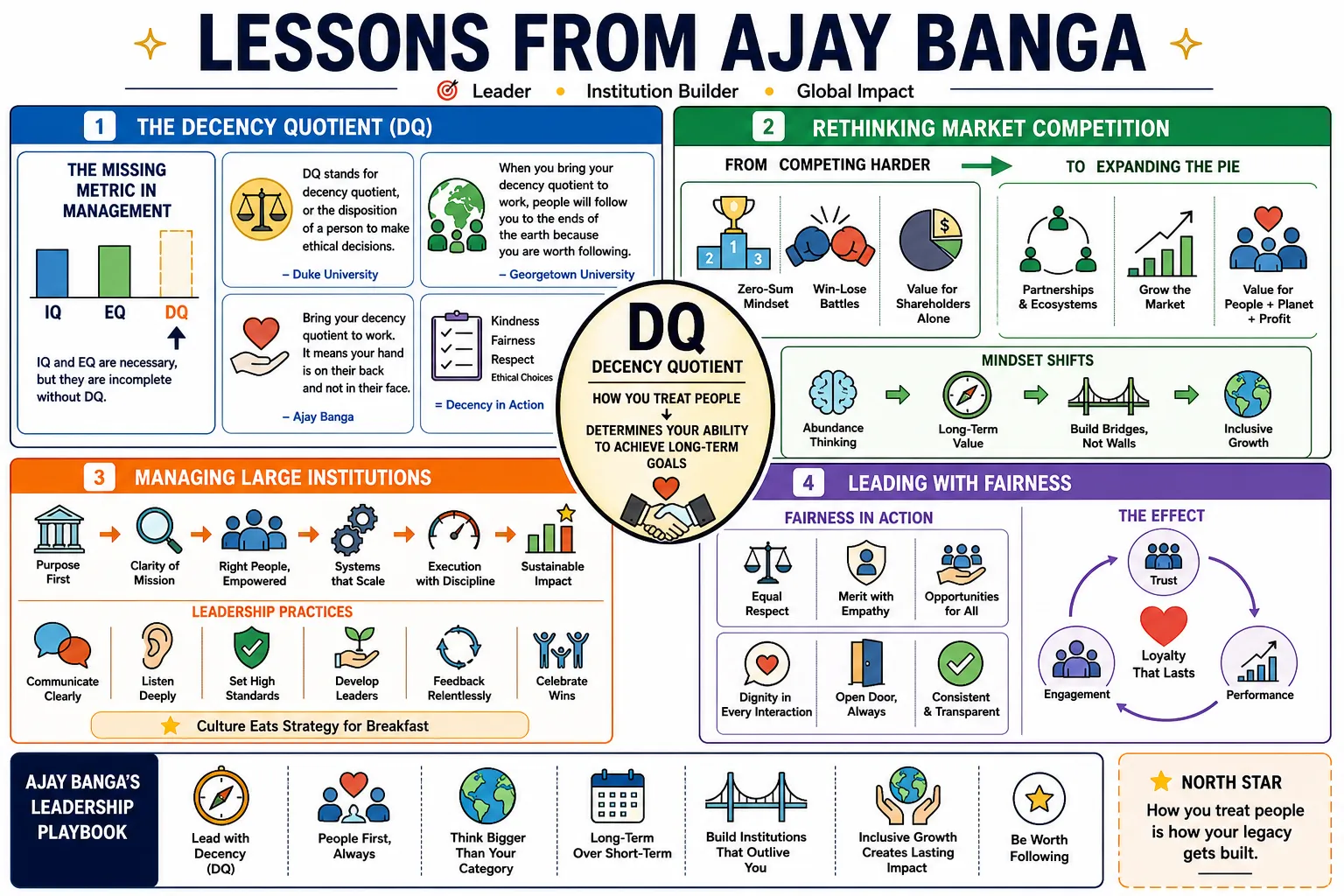
Part 1: The Decency Quotient (DQ)
- The missing metric in management: Banga argues that intelligence and emotional awareness are not enough for leadership without decency: making ethical choices and treating people fairly. — Duke Fuqua interview.
- Supportive management: For Banga, decency at work means guiding people fairly and giving them support rather than obstructing them. — Milken Institute conversation.
- Creating a level playing field: He says employees should have a level playing field and the authority to pursue results. — Duke Fuqua interview.
- Treating people as humans: Banga puts human decency at the center of how a company treats employees, partners and the wider society. — Banga’s WEF essay.
- Trust and execution: He describes trust as the basis for collaboration and sees decency and listening as ways to build it. — Banga’s WEF essay.
- Winning the right way: Banga rejects a choice between commercial success and social purpose; he argues that firms still need profit while treating stakeholders decently. — Banga’s WEF essay.
Part 2: Leadership and Culture
- The privilege of leadership: Banga calls leadership an earned privilege to serve others, not an entitlement conferred by a title. — Duke Fuqua interview.
- The power of 'Yes, If': Banga credits an early manager with replacing a reflexive no with “yes, if”: explain what support would make a proposal possible. — Wharton Leadership Conference.
- Questioning the status quo: He urges leaders to question whether they are missing part of a problem or a better solution, a habit he calls competitive paranoia. — NYU Stern commencement remarks.
- Organizational culture: Banga says organizational culture takes repeated work, sharing and cross-fertilization of people and ideas; it is not created by decree. — Milken Institute conversation.
- Clarity of purpose: At Mastercard, Banga used the simple mission of a world beyond cash to align the company’s competitive direction. — Wharton Leadership Conference.
- Mistakes: Banga says responsible risk brings mistakes; management should respond, learn and avoid layering on endless processes after each error. — CGD fireside chat.
- Taking ownership: He argues that giving employees real power to make decisions can change a company’s culture and energy. — Wharton Leadership Conference.
- Long-term thinking: Banga pairs patience in listening with urgency in deciding and executing; he does not treat those habits as opposites. — NYU Stern commencement remarks.
Part 3: Financial Inclusion and the War on Cash
- Redefining competition: Banga reframed Mastercard’s larger competitive opportunity as cash and checks, not only other payment networks; his 85% figure described retail purchases at the time of his 2014 remarks. — Wharton Leadership Conference.
- The cost of cash: He argued that printing, moving and counting cash imposes costs on governments, retailers and banks. — Wharton Leadership Conference.
- Doing well by doing good: Banga argues that financial inclusion can advance both social opportunity and a competitive business rather than treating those aims as necessarily opposed. — Banga’s WEF essay.
- Systemic change: Moving people from cash to digital services requires offerings that are useful, secure and suited to local needs—not merely new payment rails. — Banga’s WEF essay.
- Partnerships: Banga describes partnerships with governments, banks, NGOs and businesses as necessary to reach excluded people with locally appropriate services. — Banga’s WEF essay.
- Data and poverty: In Banga’s Kenya example, digitized shopkeeper-supplier payments create a purchase history that can help entrepreneurs seek micro-credit. — Banga’s WEF essay.
Part 4: The Global Jobs Challenge
- The demographic wave: Banga projects that by 2050 more than 80% of people will live in countries now considered developing, making job creation there a central policy challenge. — World Bank plenary.
- Youth entering the workforce: He uses the pace of roughly four young people entering the workforce each second to convey the scale and urgency of the jobs challenge. — World Bank plenary.
- The arithmetic of employment: Banga cites projections of 1.2 billion young people reaching working age in developing countries over about 10–15 years against roughly 400 million expected jobs; he cautions that forecasts can be wrong. — World Bank jobs fireside chat.
- Jobs and dignity: For Banga, a job offers more than income: it can provide purpose, dignity and a steadier foundation for families. — World Bank plenary.
- The cost of failure: He warns that failure to create opportunity for a large youth cohort can turn optimism toward despair and social instability; he presents this as a risk, not an inevitable result. — World Bank plenary.
- Viewing youth as an asset: Banga argues that investments aimed at opportunity can turn a young population into a source of future growth. — World Bank plenary.
- Infrastructure and employment: His job-creation strategy begins with public investment in roads, electricity, education, digitization and health so businesses can start and expand. — World Bank plenary.
- The role of the private sector: Banga says most jobs ultimately come from the private sector, but governments must help create the infrastructure and rules that let firms invest and hire. — World Bank plenary.
Part 5: Institutional Reform and the World Bank
- Updating the mission: Banga says the World Bank’s poverty mission must also address a livable planet because climate, fragility and development pressures intersect. — World Bank Lowy remarks.
- Simplicity over process: He calls for a World Bank that is faster, simpler and more focused on impact, alongside its financing role. — World Bank Lowy remarks.
- Client accessibility: Banga argues that simpler operations and more coordinated assistance would make the institution a better partner for its client countries. — World Bank Lowy remarks.
- Collaboration: He says the World Bank cannot meet development-financing needs alone and must work with governments, other development banks, philanthropies and business. — World Bank Lowy remarks.
- Bureaucratic inertia: Banga described reviews finding far more sign-offs than necessary; he wants to remove procedural accretion without losing essential controls. — CGD fireside chat.
- Climate finance: Banga says development and climate needs run into trillions annually, beyond public and philanthropic resources alone, so private investment must be mobilized with workable risk-sharing. — World Bank 2024 plenary.
- Acting with speed: Banga reports cutting average World Bank project-approval time from 19 to 12 months as part of a speed-and-simplicity reform. — World Bank plenary.
- Measuring success: He says the Bank replaced a sprawling internal metric set with a smaller scorecard focused on outcomes for people rather than only money disbursed. — World Bank plenary.
- The necessity of scale: Banga argues that development programs must be designed for meaningful scale and describes larger platforms and financing instruments rather than relying only on bespoke projects. — World Bank 2024 plenary.
- Small AI versus Big AI: Banga sees practical, sector-specific “small AI” as a potentially useful tool for developing economies whose needs differ from frontier-model infrastructure. — World Bank jobs fireside chat.
Part 6: Diversity, Inclusion, and Talent
- Cognitive diversity: Banga argues that people with different backgrounds widen a leader’s field of vision and help teams make better decisions. — NYU Stern commencement remarks.
- Cohesive culture: He says diverse membership alone is insufficient: leaders must make people feel part of the team. — Duke Fuqua interview.
- Inclusion vs. diversity: Banga distinguishes assembling a diverse team from making its members feel included and able to contribute. — Duke Fuqua interview.
- Hiring for adaptability: He urges graduates to stay curious and open to change, learning from people who do not look, sound or think like them. — Georgetown commencement.
- Women in leadership: Banga says an institution needs a pipeline of women leaders at multiple management levels, not only equal pay at existing levels. — CGD fireside chat.
- Humility in talent: He links better decisions to listening patiently to different perspectives before acting with urgency. — NYU Stern commencement remarks.
Part 7: Risk, Urgency, and Decision Making
- The cost of inaction: Banga says rapidly shortening innovation cycles make procrastination costly; leaders should surface bad news quickly. — NYU Stern commencement remarks.
- Competitive urgency: He urges competitive paranoia: keep asking whether a changing market or technology reveals something the organization has missed. — NYU Stern commencement remarks.
- Calculated risk: Banga advocates thoughtful risk when perfect information is unavailable, rather than treating uncertainty as a reason never to decide. — NYU Stern commencement remarks.
- Learning from failure: He says institutions should acknowledge mistakes, learn from them and avoid responding to every error with another layer of procedure. — CGD fireside chat.
- Managing uncertainty: Banga frames a faster, more coordinated World Bank as a response to interconnected climate, poverty and fragility shocks. — World Bank Lowy remarks.
- Strategic patience: Banga argues that leaders can listen patiently while still deciding and executing with urgency. — NYU Stern commencement remarks.
- Avoiding complacency: His competitive-paranoia principle is to keep questioning assumptions even when an organization is performing well. — NYU Stern commencement remarks.
Part 8: Life, Luck, and Career Advice
- The role of luck: Banga says luck shapes careers, but people also need the willingness to recognize and pursue unexpected opportunities; he does not give a verified 50/50 formula. — Georgetown commencement.
- Staying grounded: He encourages people to be comfortable with who they are and judge contribution by what they do, not appearance or origin. — NYU Stern commencement remarks.
- Continuous learning: Banga recommends curiosity as a continuing habit: approach new situations and different people as chances to learn. — Georgetown commencement.
- Mentorship: Banga describes learning from leaders who gave people focused attention, an example that shaped his own management approach. — Wharton Leadership Conference.
- Dealing with setbacks: He cautions graduates against plotting every career move as a fixed ladder and encourages openness to unexpected changes. — Georgetown commencement.
- Giving back: Banga presents leadership as service: support others with a clear vision, authority and room to succeed. — Duke Fuqua interview.
- Intellectual honesty: When asked about an unpublished report, Banga said he saw no reason to hide a factual finding and would look into it. — CGD fireside chat.
- The ultimate goal: His closing message to graduates joins curiosity with decency: how people support others matters alongside professional achievement. — Georgetown commencement.