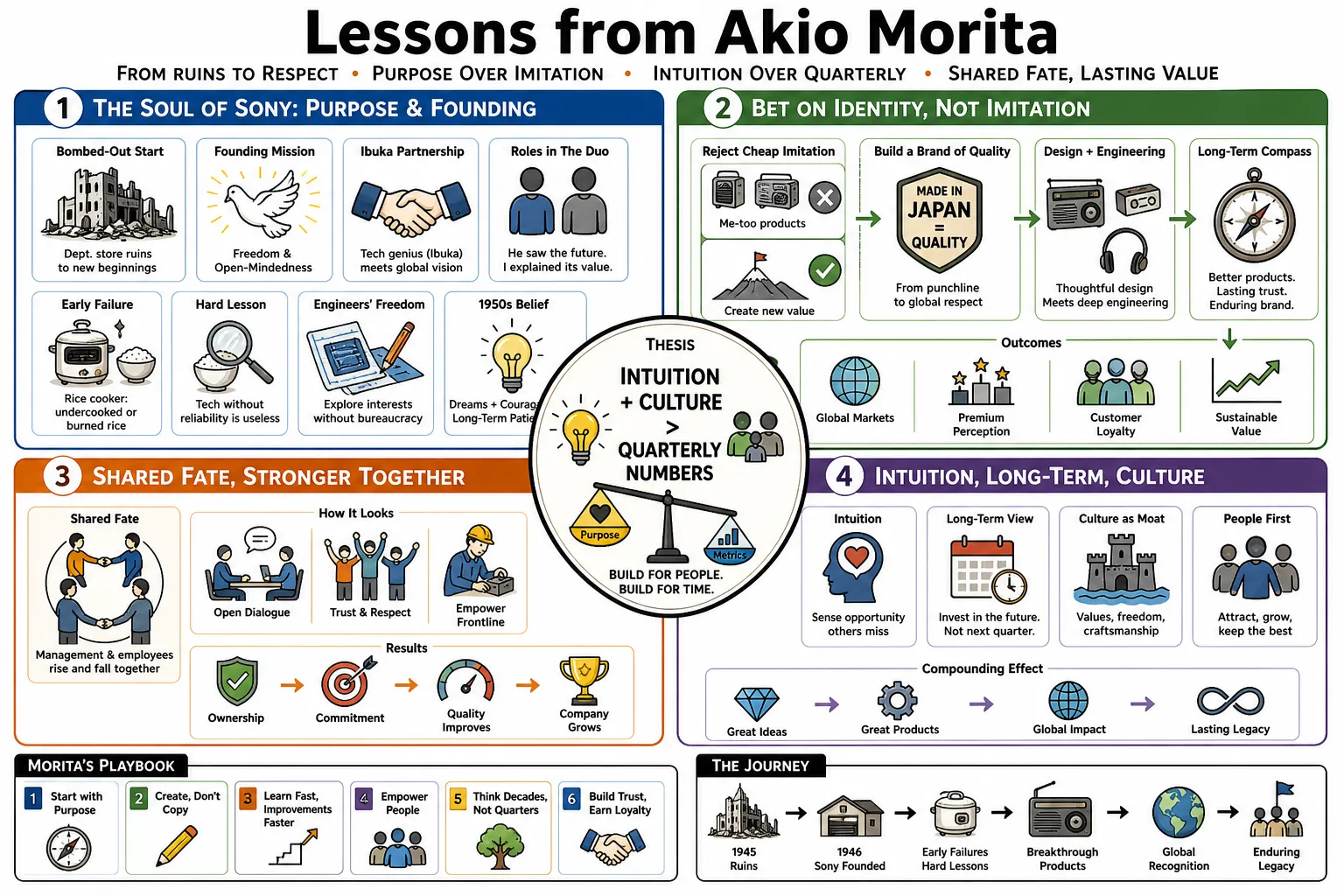
Lessons from Akio Morita
Akio Morita started Sony in a bombed-out department store and turned "Made in Japan" from a punchline into a global mark of quality. He rejected the safety of cheap imitation, betting instead on brand identity and a "shared fate" with his workforce. He proved that intuition and long-term culture build more value than chasing quarterly metrics.
Part 1: The Soul of Sony: Purpose and Founding
- On the Founding Mission: "The first purpose of our company was to establish an ideal factory that stresses a spirit of freedom and open-mindedness." — Source: Sony History Archive
- On the Ibuka Partnership: "Ibuka-san was the technical genius who saw the future, and my job was to make sure the world understood why that future mattered." — Source: Britannica
- On Early Failure: "Our first product was an electric rice cooker that either undercooked or burned the rice; it taught us that technology without reliability is useless." — Source: Sony Global History
- On Engineering Freedom: "We wanted to create a place where engineers could examine their technological interests to their heart's content without being buried by bureaucracy." — Source: Sony Prospectus 1946
- On the Risk of the New: "If you are only doing what others are doing, you are not a leader; you are just a follower waiting for someone else to fail." — Source: Addicted2Success
- On Capital vs. Spirit: "In the beginning, we had almost no money, but we had a wealth of curiosity and a stubborn refusal to accept the status quo." — Source: Made in Japan via Scribd
- On the First Transistor: "We didn't invent the transistor, but we were the first to see it as a consumer's companion rather than a laboratory curiosity." — Source: PBS NewsHour
- On Company Culture: "The most important mission for a manager is to develop a healthy relationship with his employees and create a family-like feeling." — Source: Nick McHardy Management Notes
Part 2: Managing the Human Connection: The "Shared Fate" Philosophy
- On the Concept of Shared Fate: "A company is not a machine for making profit, but a community where every member shares the same destiny." — Source: Anaheim University
- On Hiring Standards: "Once we hire an employee, his school records are a matter of the past and are no longer used to evaluate his work." — Source: Never Mind School Records (Gakureki Muyo Ron)
- On the Tuition of Salary: "In school, you pay to learn; in Sony, we pay you to learn, so do not waste the company's investment in your growth." — Source: Made in Japan (Autobiography)
- On Internal Mobility: "I introduced internal job postings because if a person is unhappy in one department, they should have the chance to find their passion elsewhere in the company." — Source: Sony History Archive
- On Management's Responsibility: "If a company is doing poorly, the management should take a pay cut before asking the workers to suffer." — Source: Nick McHardy
- On Face-to-Face Communication: "I spent my time visiting factories and eating in the cafeteria because you cannot understand your people from a high-rise office." — Source: Fortune Magazine Archive
- On Loyalty: "Loyalty is not something you demand; it is something you earn by showing the employee that you care about their long-term security." — Source: Britannica
- On Mistakes: "I tell my people: go ahead and do what you think is right; if you make a mistake, you will learn from it, just don't repeat it." — Source: QuotesWise
- On Collective Brainpower: "A company will get nowhere if all of the thinking is left to management." — Source: Medium
Part 3: Innovation Beyond Data: The Walkman and Market Intuition
- On Market Research Skepticism: Morita believed the public does not always know what is possible until it is shown to them, so rather than lean on market research, Sony refined its own thinking on a product and then worked to create a market for it by educating and communicating with the public. — Source: Goodreads
- On the Walkman's Launch: "I do not believe that any amount of market research could have told us that the Sony Walkman would be successful." — Source: Nick McHardy
- On Educating the Public: "Our job is not to follow the market but to create the market by educating people on how a product can change their lives." — Source: Made in Japan
- On Product Skeptics: "When I proposed the Walkman, even my own engineers said people wouldn't buy a tape player that didn't record." — Source: Sony Global History
- On Personal Use Cases: "I saw young people carrying large stereos on their shoulders and realized they wanted their music to be portable, not just loud." — Source: Time Magazine
- On Product Names: "I initially hated the name 'Walkman,' but once the promotional machine starts, a manager must sometimes let his personal taste go for the sake of the momentum." — Source: The Verge / Sony History
- On the Three Creativities: "You must have creativity in technology, product planning, and marketing; missing any one of these leads to failure." — Source: Addicted2Success
- On Future-Proofing: "Innovation is not a single event but a continuous process of making your own products obsolete." — Source: Forbes
- On Simplicity: "The best products are those that are so simple a child can understand their purpose without reading a manual." — Source: QuotesWise
Part 4: Branding and the Global Stage: The Rebirth of "Made in Japan"
- On the Sony Name: "We chose 'Sony' because it was easy to pronounce in any language and didn't tie us to a specific location like 'Tokyo Tsushin Kogyo'." — Source: Sony History
- On Rejecting OEM Deals: "I turned down a 100,000-unit radio order from Bulova because they wanted their name on it; I told them 'In 50 years, Sony will be as big as your company'." — Source: Medium
- On Trademark Protection: "I have always believed that a trademark is the life of an enterprise and that it must be protected boldly." — Source: Made in Japan
- On Quality as Marketing: "Advertising and promotion alone will not sustain a bad product; the product itself must be the advertisement." — Source: Addicted2Success
- On National Reputation: "When we started, 'Made in Japan' meant shoddy; we decided that Sony would make it mean excellence." — Source: PBS NewsHour
- On Premium Pricing: "If you sell purely on price, you are in a race to the bottom; if you sell on quality, you are in a race to the top." — Source: Nick McHardy
- On Global Localization: "To be a global company, you must be a good local citizen in every country where you do business." — Source: JEF.or.jp
- On Understanding the Consumer: "I moved my family to New York in the 1960s because I couldn't understand the American market from a distance." — Source: Time Magazine
- On the Sony Logo: "A logo is a promise of quality; every time a customer sees it, they should feel a sense of security." — Source: Sony Design History
Part 5: The Discipline of Excellence: Quality and Manufacturing
- On the Trinitron Struggle: "We spent seven years and nearly all our money on color television development; it was a gamble that almost destroyed us." — Source: Sony Global History
- On Zero Defects: "Quality is not something you 'check' at the end of the line; it is something you build into the process at every step." — Source: Made in Japan
- On Miniaturization: "My obsession was making things smaller; if you can make it fit in a pocket, you change the way the world uses it." — Source: Britannica
- On the First Pocketable Radio: "We made the radio smaller than the pocket, then we made special shirts with larger pockets for our salesmen just to prove it was 'pocketable'." — Source: Sony History
- On Technical Targets: "Management must give engineers specific targets; without a target, technology is just a toy." — Source: JEF.or.jp
- On Manufacturing Pride: "The person on the assembly line is just as responsible for the brand's reputation as the chairman." — Source: Made in Japan via Nick McHardy
- On Reliability: "A high-tech product that breaks down is worse than no product at all; it destroys the consumer's trust in the future." — Source: Fortune Archive
- On Automation: "Machines are good for precision, but only humans can provide the intuition needed for true quality." — Source: QuotesWise
- On the Cost of Quality: "It is far cheaper to do it right the first time than to fix it later." — Source: Addicted2Success
- On The Innovation Chain: Treat applied research, development, design, production engineering, manufacturing, sales, and service as equally important links in one innovation chain, and give high achievers comparable prestige across those functions. — Akio Morita, First United Kingdom Innovation Lecture (1992)
Part 6: Leadership and Personal Responsibility: Taking the Long View
- On Quarterly Reports: "American managers are too focused on the bottom line of the quarterly report; we look ten years ahead." — Source: Fortune Magazine
- On Short-Termism: "If you only care about this year's profit, you are eating your own seed corn and will have nothing to plant for the future." — Source: The Japan That Can Say No (Summary)
- On Curiosity: "Curiosity is the key to creativity; once you stop being curious, you stop being a leader." — Source: YouTube / Sony Interviews
- On Self-Correction: "A leader must be able to admit when they are wrong; if you stick to a bad idea just to save face, you sink the whole ship." — Source: Made in Japan
- On Executive Pay: "I believe that when an executive's salary is 100 times that of a worker, the 'shared fate' of the company is broken." — Source: Fortune Archive
- On Influence: "You cannot lead people by force; you must lead them by creating a vision they want to be part of." — Source: Britannica
- On the Role of the CEO: "The CEO should be the chief spokesperson for the brand, not just a manager of the balance sheet." — Source: PBS NewsHour
- On Persistence: "There were many times when we were nearly bankrupt, but we never stopped believing in our engineers." — Source: Sony Global History
- On Technologists Leading Industry: Manufacturing and high-technology companies should be led by people who understand both business and technology, because judging R&D, automation, and emerging technical potential requires more than financial expertise. — Akio Morita, First United Kingdom Innovation Lecture (1992)
Part 7: Technology as a Lifestyle: The Design Engineer's Perspective
- On Personal Electronics: "I wanted electronics to become part of a person's fashion and lifestyle, not just a box in their living room." — Source: Time Magazine
- On Portability: "If a person can take their favorite things with them, they feel a sense of freedom and control over their environment." — Source: Sony Walkman History
- On Design Aesthetics: "A product must look beautiful even when it is turned off; design is the bridge between technology and the soul." — Source: Sony Design History
- On User Experience: "We don't sell hardware; we sell the experience of enjoying sound and vision anywhere in the world." — Source: Addicted2Success
- On the Digital Future: "I saw that the world would move from analog to digital, and that change would require a completely new way of thinking about data." — Source: Britannica
- On Entertainment: "Hardware and software are two wheels of the same cart; without good content, even the best machine is empty." — Source: Sony-Columbia Pictures Acquisition History
- On Intuitive Controls: "A person should be able to use a Sony product without being an engineer; the technology should be invisible." — Source: Made in Japan
- On Innovation Cycles: "In electronics, if you don't move forward every day, you are moving backward." — Source: Fortune Archive
Part 8: The International Citizen: Bridging East and West
- On Glocalization: "Think globally, act locally; that is the only way for a company to survive in the modern world." — Source: JEF.or.jp
- On Trade Friction: "Americans often resent Japanese salesmanship, but they should instead look at why their own products are not selling." — Source: Playboy Interview 1982
- On the San Diego Factory: "Opening a factory in San Diego in 1972 was my way of proving that Japanese management could work with American labor." — Source: Sony History Archive
- On Learning from the West: "I learned the importance of marketing and legal protection from America, but I kept the Japanese heart of employee relations." — Source: Time Magazine
- On Money Games: "The United States is hollowing out its industry by focusing too much on finance and not enough on making real things." — Source: The Japan That Can Say No
- On Cultural Understanding: "You cannot sell to a people if you do not respect their culture; every market requires a different approach." — Source: Made in Japan
- On Global Citizenship: "A company's first duty is to its employees, but its second duty is to the society it operates in." — Source: Anaheim University
- On the Pacific Century: "The future of the world economy lies in the cooperation between the technology of the East and the capital of the West." — Source: PBS NewsHour
- On the Legacy of Sony: "I want Sony to be remembered not for the money it made, but for the way it changed the way people live and think." — Source: YouTube / Akio Morita Farewell Speech