Lessons from Alan Howard
Alan Howard is the co-founder of Brevan Howard Asset Management and a defining figure in global macro trading for over three decades. Known for a "paranoid" approach to risk and a massive institutional bet on digital assets, he has successfully navigated numerous market crises by prioritizing capital preservation over speculative gains. This profile explores his transition from the bond desks of the 1980s to building a multi-billion-dollar digital infrastructure in Abu Dhabi.
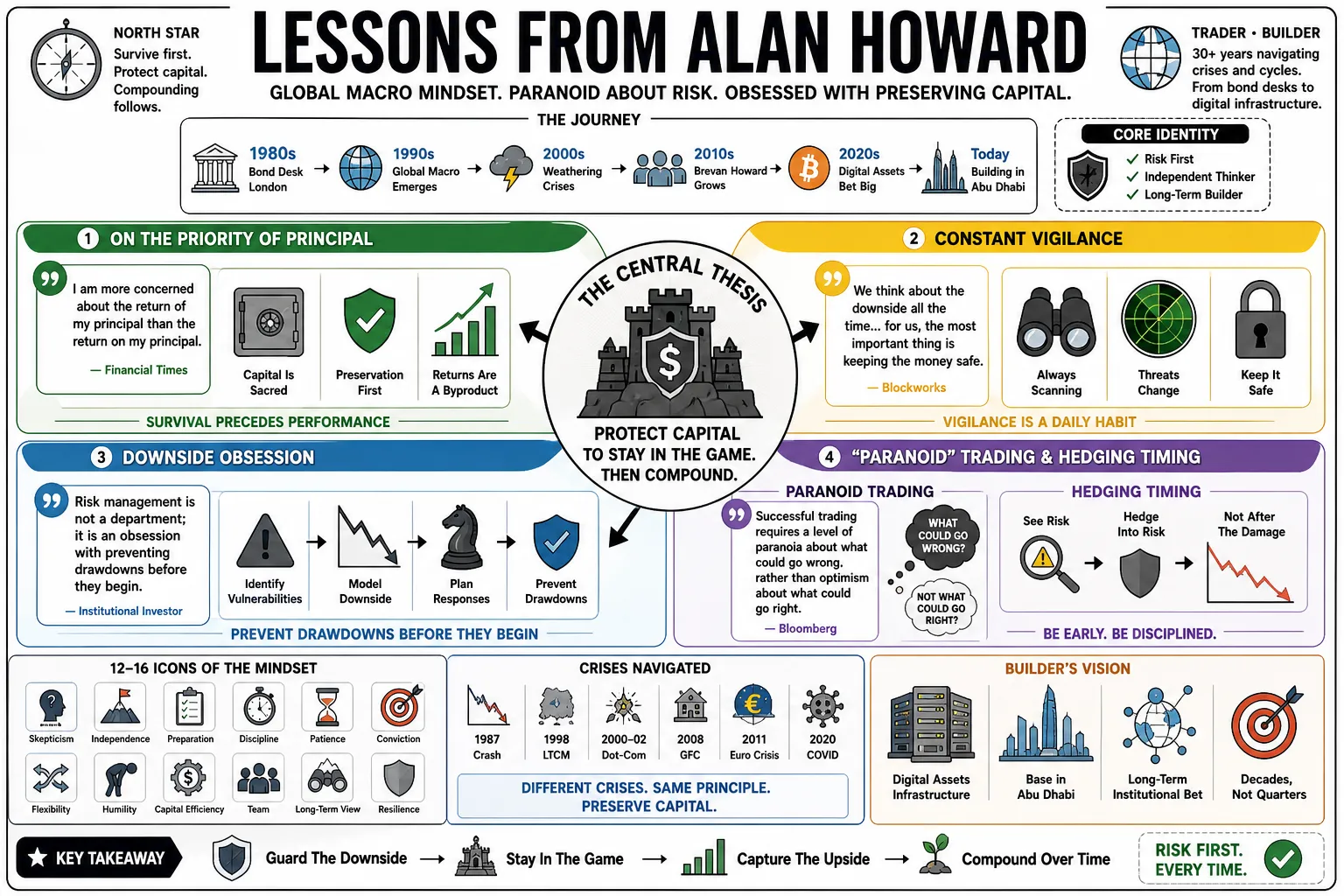
Part 1: Risk Management & Capital Preservation
- On the Priority of Principal: "I am more concerned about the return of my principal than the return on my principal." — Source: Financial Times
- On Constant Vigilance: "We think about the downside all the time... for us, the most important thing is keeping the money safe." — Source: Blockworks
- On Downside Obsession: Risk management is not a department; it is an obsession with preventing drawdowns before they begin. — Source: Institutional Investor
- On "Paranoid" Trading: Successful trading requires a level of paranoia about what could go wrong, rather than optimism about what could go right. — Source: Bloomberg
- On Hedging Timing: You must hedge whenever it is possible to do so cheaply, not just when you feel you need it. — Source: Business Insider
- On Capital Tolerance: The firm’s goal is to never lose more than low single digits in any given year, regardless of market conditions. — Source: Financial Times
- On Stop-Loss Discipline: Every trader operates under a strict written mandate where risk is automatically scaled back if loss limits are breached. — Source: Medium
- On Crowded Trades: If you find yourself in a position that everyone else is also holding, you are no longer trading macro; you are trading liquidity. — Source: Institutional Investor
- On Survival: The first rule of the arena is ensuring you have enough capital to stay in the game for the next day. — Source: The Block
Part 2: Macro Frameworks & The "Golden Period"
- On the Return of Macro: "My view is that we're going to have a 5 to 10 year golden period of macro trading." — Source: Reuters
- On Central Bank Failure: Central banks overstayed their welcome with QE, and the fallout from those decisions will reverberate for a decade. — Source: Financial Times
- On Interest Rate Volatility: The move from zero interest rates to a high-rate environment is the most significant macro event in forty years. — Source: Bloomberg
- On "Easy Money" End: The era of suppressed volatility driven by central bank intervention has been shattered. — Source: YouTube / Abu Dhabi Finance Week
- On Global Debt Levels: High levels of global debt ensure that any future economic adjustments will be violent and volatile. — Source: Financial Times
- On Volatility as Opportunity: Macro traders do not need a bull market; they need a market that is moving and mispriced. — Source: Institutional Investor
- On Inflation Persistence: Inflation is often stickier than central bank models predict because it is driven by structural shifts, not just monetary policy. — Source: Business Insider
- On Geopolitics: Geopolitical instability is no longer a "side event" but a permanent driver of commodity prices and currency shifts. — Source: LSE News
- On Market Regime Changes: We have shifted from a world of "don't fight the Fed" to a world where the Fed is the primary source of market risk. — Source: Bloomberg
Part 3: Trading Discipline & Market Technicals
- On the "Plumbing" of Markets: "We spend a lot of time looking at the weeds of the market... the plumbing of markets." — Source: The Art Investor
- On Information Mastery: Information is only useful if it is processed faster and more accurately than the consensus. — Source: Institutional Investor
- On the "Penalty Box": If a trader hits a loss threshold, they must stop trading to clear their head and regain objectivity. — Source: Financial Times
- On Trading Against the Herd: Profiting during a market rout requires the discipline to stay short when everyone else is hoping for a rebound. — Source: Bloomberg
- On Intellectual Humility: "Stay humble or the market will do it for you." — Source: BH Macro Limited Reports
- On Technical Detail: You cannot trade interest rates without understanding repo markets and the underlying collateral mechanisms. — Source: The Block
- On Concentrated Risk: Never confuse a high-conviction trade with a trade that should be allowed to bypass risk limits. — Source: Medium
- On Decision Memos: Putting a trade thesis in writing forces a level of rigor that prevents impulsive or emotional betting. — Source: Institutional Investor
- On Liquidity Traps: Being right about a macro trend is worthless if you are stuck in an illiquid market when it turns. — Source: Financial Times
Part 4: The Evolution of Digital Assets
- On Crypto as Macro: "Digital assets are a significant macro trend that will impact the global economy for decades." — Source: The Block
- On the "One Universe" View: In digital assets, venture capital and liquid trading exist in the same universe and should be managed together. — Source: ForkLog
- On Diversified Participation: "Because digital assets are still rather a new asset class, it’s most prudent to invest across the entire crypto ecosystem." — Source: The Block
- On the 10-15 Year Horizon: Real institutional wealth in crypto is built on a decade-long view, not short-term token flips. — Source: CryptoTimes
- On Tokenization: The "plumbing" of the financial system is being rewritten through the tokenization of real-world assets. — Source: Ledger Insights
- On DeFi Advantages: Traditional expertise in derivatives gives institutional players a massive advantage in navigating DeFi markets. — Source: The Block
- On Market Maturity: We are entering a phase where the "asymmetric upside" of digital assets is being validated by institutional entry. — Source: Medium
- On Early Adoption: While others were exiting the sector during drawdowns, the most successful firms were "running in" to build infrastructure. — Source: Blockworks
- On Stablecoins: Stablecoins represent the first major "killer app" for blockchain by providing a more efficient rails for global payments. — Source: The Block
- On "Being in the Arena": You cannot understand the crypto world from the sidelines; you must be an active participant to identify its problems. — Source: The Block
Part 5: Institutional Infrastructure & "The Arena"
- On Infrastructure Gaps: Institutional adoption was hindered for years by "cumbersome and illiquid" infrastructure that banks could not use. — Source: Financial Times
- On Elwood Technologies: The goal of Elwood was to provide the "institutional-grade" order management systems that the crypto world lacked. — Source: Elwood Technologies
- On Regulatory Alignment: To succeed at scale, crypto firms must be willing to meet the same regulatory standards as global banks. — Source: Ledger Insights
- On the Convergence of TradFi and Crypto: The wall between traditional finance and digital assets is effectively gone; it is now one market. — Source: Medium
- On Market Making: Providing liquidity is a core function of an institutional firm, helping to "bootstrap" new protocols and assets. — Source: The Block
- On Smart Contract Security: The biggest risk in digital assets is not price, but the technical failure of the underlying code. — Source: The Block
- On Execution Speed: In a volatile macro environment, the ability to execute across dozens of liquidity venues simultaneously is a competitive necessity. — Source: Elwood Technologies
- On Web3 Infrastructure: Investing in cross-chain tools and wallet aggregation is as important as investing in the tokens themselves. — Source: The Block
- On Institutional Trust: Banks will only enter the sector when they see names and infrastructure they already trust from the traditional world. — Source: Bloomberg
Part 6: Career Lessons & Global Transitions
- On the Salomon Desk: The early days at Salomon Brothers taught the value of being a "human spreadsheet" by memorizing every spread and position. — Source: Institutional Investor
- On the 1994 Bond Rout: Standing apart from the herd during a crash is often the only way to generate generational alpha. — Source: Financial Times
- On Avoiding Contagion: "When you see the same positions you hold blowing up at a peer like LTCM, you don't wait; you exit immediately." — Source: Institutional Investor
- On the Spin-Off: Leaving a major bank to start a hedge fund requires not just capital, but the confidence of your former employer to back you. — Source: Financial Times
- On Abu Dhabi’s Advantage: "Abu Dhabi is the best place to trade macro because you can see Asia at the start of your day and the US at the end." — Source: Financial Times
- On the Abraham Accords: Geopolitical shifts like the Abraham Accords create new financial hubs that are more efficient than old traditional centers. — Source: Medium
- On Personal Relocation: Moving to where the risk-taking center is allows a founder to stay connected to the "pulse" of the market. — Source: Bloomberg
- On Local Ecosystems: A financial hub is only as strong as the "service ecosystem" of global banks and talent it attracts. — Source: Medium
- On Time Zone Dominance: Trading GMT+4 provides a unique window into global liquidity that London and New York cannot match. — Source: Financial Times
Part 7: Talent, Teams, and the Olympic Mindset
- On High Ambition: "I think every top trader wants to be viewed as an Olympic gold medalist." — Source: Financial Times
- On Chris Rokos: "He is an exceptional trader," capable of generating billions in profit while managing granular, high-conviction risk. — Source: The Guardian
- On Backing Former Partners: Even after legal disputes, it is logical to back the world’s best traders because skill is the scarcest resource. — Source: Bloomberg
- On Training the Next Generation: The role of a senior founder shifts from daily trading to coaching younger traders in risk management. — Source: Financial Times
- On Performance-Based Scaling: Traders who make money are given more capital; those who lose money have their limits slashed immediately. — Source: Institutional Investor
- On the Multi-Manager Model: Success comes from a "pod" system where no single person’s mistake can sink the entire firm. — Source: Bloomberg
- On Hiring Standards: We are looking for people who are obsessed with markets, not people who are looking for a job in finance. — Source: Medium
- On Technical Proficiency: In the modern era, a macro trader must be as comfortable with code and data as they are with economic theory. — Source: The Block
- On Accountability: A trader must own their losses as much as their wins; there are no excuses for exceeding a stop-loss. — Source: BH Macro Limited Reports
- On Intellectual Friction: The best investment decisions come from a team that is willing to challenge the founder’s core assumptions. — Source: Institutional Investor
Part 8: Strategic Evolution & Future Shifts
- On Long-Term Capital Stability: Moving toward two-year capital lock-ups ensures the firm is not forced to sell assets during temporary panics. — Source: Bloomberg
- On Sovereign Wealth Ties: Partnering with regional entities like Lunate provides the scale needed to compete with global mega-funds. — Source: Reuters
- On the "Trump Trade": Geopolitical shifts and changes in US trade policy create the kind of volatility that macro funds were built to trade. — Source: Bloomberg
- On Back-Office Excellence: Coremont was built to ensure that "middle and back-office" failures never undermine front-office trading gains. — Source: Coremont
- On Scaling Risk: Abu Dhabi is now the firm’s primary risk-taking center, reflecting a permanent shift in where global macro alpha is found. — Source: Financial Times
- On Market Resilience: The firm has survived every crisis for 20 years by assuming that the "worst-case scenario" is always a possibility. — Source: Financial Times
- On Future-Proofing: BH Digital reflects the belief that the next generation of global macro trends will be born on-chain. — Source: The Block
- On the Final Goal: "The ultimate aim is to keep the money safe and do a good job for our investors, year after year." — Source: Financial Times