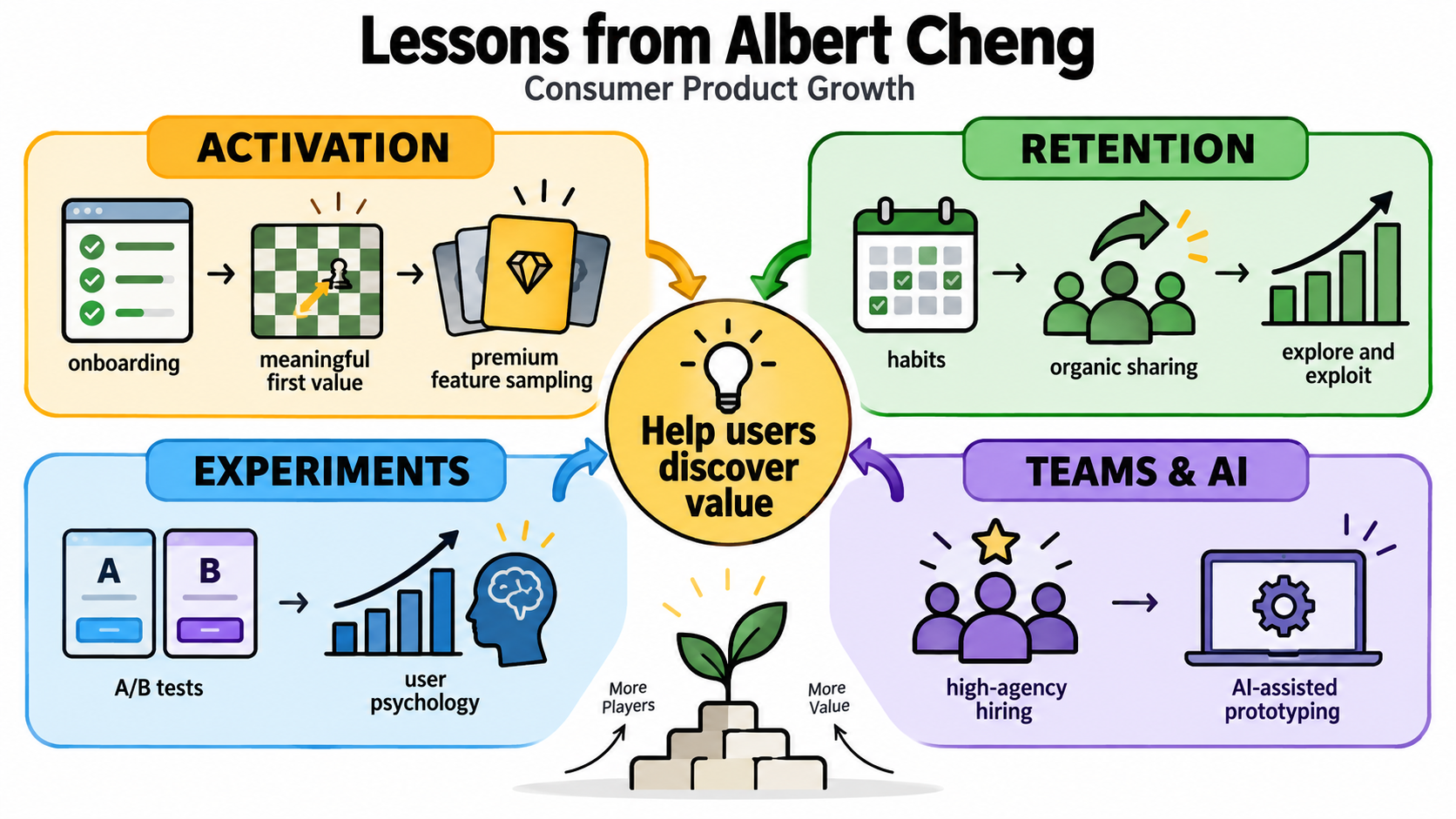
Visual summary of operating lessons from Albert Cheng.

Lessons from Albert Cheng

While several media and tech leaders share the name Albert Cheng, this profile focuses on two: a consumer product expert who scales digital user bases through psychology, and a senior entertainment executive who adapted legacy media for streaming. It compiles their public statements and working principles into a single reference for operators handling product growth and media distribution.

Part 1: Product Growth and User Activation

  1. On user onboarding: Cheng's growth approach starts with understanding user psychology, because early drop-off often signals that users have not yet felt the product's core value. — Reference: Lenny's episode on growth opportunities and user psychology
  2. On activation metrics: Cheng treats activation as the moment a user reaches real value, then uses experimentation to find which product moments create durable retention. — Reference: Lenny's episode on retention and product activation
  3. On retention: "You cannot growth-hack long-term retention. You either solve a recurring problem for the user or you become a novelty they forget." — Source: Medium
  4. On feature discoverability: Cheng's experimentation discipline is about surfacing value at the right moment, not just shipping features and hoping users notice them. — Reference: Lenny's episode on rapid experimentation
  5. On friction: "Not all friction is bad. Sometimes slowing a user down forces them to make a commitment that increases their long-term engagement." — Source: Business Insider
  6. On growth teams: Cheng runs growth like disciplined exploration: generate hypotheses, test quickly, exploit what works, and keep searching for the next opportunity. — Reference: Lenny's episode on explore-exploit growth
  7. On acquisition channels: "When a channel works, you scale it until the marginal cost equals the lifetime value. But you must always be testing the next channel in the background." — Source: Medium
  8. On virality: Cheng's consumer-growth lens ties word of mouth to retention and habit formation; sharing matters most when it reinforces the user's own reason to keep coming back. — Reference: Lenny's episode on retention and gamification
  9. On product-led growth: "If sales has to explain the basic functionality to every lead, your product needs a redesign, rather than a better sales deck." — Source: Medium
  10. On data blindness: Cheng pairs metrics with user psychology: experiments show what changes behavior, but research explains why the behavior changed. — Reference: Lenny's episode on experimentation and user psychology

Part 2: Media Distribution and Streaming

  1. On digital transformation: "Moving a legacy media business to digital is less about updating the technology and more about entirely rebuilding the operational culture." — Source: Forbes
  2. On streaming models: "The transition from broadcast to streaming shifted the industry's focus from filling time slots to retaining subscriber attention over months." — Source: Los Angeles Times
  3. On content windowing: "Exclusivity is expensive. You have to calculate whether holding a title on your platform drives more subscription revenue than licensing it outward." — Source: NATPE Global
  4. On global expansion: "You cannot export a purely domestic strategy. International markets require local storytelling combined with global production standards." — Source: Forbes
  5. On platform aggregation: "Consumers are frustrated by fragmentation. The platforms that succeed will figure out how to bundle services seamlessly." — Source: Los Angeles Times
  6. On viewing habits: Cheng's Disney and streaming work shows how audience behavior changed when television moved from fixed schedules to on-demand digital access. — Reference: Marty Party episode on Cheng and the future of streaming
  7. On original programming: "Originals drive acquisition, but deep catalog libraries drive retention. You have to invest heavily in both to maintain a healthy churn rate." — Source: Forbes
  8. On ad-supported tiers: "Advertising in streaming requires a lighter ad load than traditional television to preserve the premium user experience." — Source: NATPE Global
  9. On studio operations: Cheng's studio leadership sits between creative judgment and operating scale, translating content decisions into a streaming business with many competing constraints. — Reference: Marty Party episode on Prime Video and Amazon Studios
  10. On measuring hits: "In a subscription model, a show is a hit if it brings in new subscribers or keeps existing ones from canceling, regardless of cultural noise." — Source: Los Angeles Times

Part 3: Leadership and High-Agency Teams

  1. On hiring: "I saw some of the highest performers just being people that had very high agency, had that clock speed, had that energy." — Source: Business Insider
  2. On industry experience: "They cared about the mission, but they didn't necessarily need to have deep experience on that matter to succeed." — Source: Business Insider
  3. On delegation: Cheng's growth model depends on teams that can run many experiments without every decision bottlenecking at the top. — Reference: Lenny's episode on growth teams and experimentation scale
  4. On performance reviews: "Feedback should never be a surprise at the end of the year. It must be continuous, direct, and actionable." — Source: Medium
  5. On team structure: "Small, cross-functional teams move faster than large, siloed departments. Communication overhead kills momentum." — Source: Forbes
  6. On managing underperformers: "Ignoring a poor performer brings down the entire team's standard. Address it early for the benefit of everyone else." — Source: Business Insider
  7. On decision making: Cheng's explore-exploit framework separates quick learning decisions from bigger bets, so teams can move fast without treating every choice as equally irreversible. — Reference: Lenny's episode on the explore-exploit framework
  8. On culture: "Culture is defined by who you hire, who you fire, and who you promote. Everything else is just a poster on the wall." — Source: Medium
  9. On meeting efficiency: "If a meeting has no agenda and no clear decision to be made, cancel it and send an email." — Source: Forbes
  10. On mentorship: Cheng frames leadership partly as paying it forward, using access and experience to help others navigate media and representation. — Reference: Marty Party episode on mentorship and representation

Part 4: Digital Transformation Strategy

  1. On legacy systems: "You cannot bolt a digital interface onto a legacy process. You have to rebuild the process from the ground up." — Source: Forbes
  2. On organizational resistance: "People resist change because they fear losing their status. You have to show them how the new system benefits their specific role." — Source: Los Angeles Times
  3. On setting milestones: "Digital transformations fail when they are treated as multi-year monoliths. Break them into quarterly deliverables you can actually measure." — Source: Medium
  4. On technological debt: "Cutting corners to launch faster is fine, as long as you document the debt and schedule time to pay it off later." — Source: Forbes
  5. On cross-department alignment: "Engineering, product, and content teams must share a single roadmap. If they have conflicting goals, nothing moves." — Source: NATPE Global
  6. On user-centric design: "When overhauling a platform, the user's experience must dictate the engineering architecture, rather than the other way around." — Source: Los Angeles Times
  7. On resource allocation: Cheng's digital-media career shows that transitions require funding both the old business and the new platform while audience behavior shifts. — Reference: Marty Party episode on the shift from broadcast to streaming
  8. On external partnerships: "Sometimes it is faster to buy a solution or partner with a vendor than to build every piece of technology in-house." — Source: Forbes
  9. On continuous iteration: "A digital platform is never finished. The day you launch is simply the day you start gathering data for the next update." — Source: Medium

Part 5: Experimentation and Data

  1. On A/B testing: Cheng sees failed tests as useful information: a disciplined experimentation system prevents teams from scaling weak ideas blindly. — Reference: Lenny's episode on running experiments at scale
  2. On sample sizes: "Running a test without statistical significance is worse than not testing at all, because it gives you false confidence." — Source: Medium
  3. On metric selection: Cheng's metric discipline starts with the growth motion being tested, whether retention, resurrection, monetization, or habit formation. — Reference: Lenny's episode on subscription growth metrics
  4. On qualitative data: "The numbers tell you that users are dropping off on page three. User interviews tell you that the copy on page three is confusing." — Source: Business Insider
  5. On gut instinct: "Data should inform your intuition, rather than replace it. Sometimes the math says yes, but the brand risk says no." — Source: Forbes
  6. On local maximums: "If you only run minor optimization tests, you will hit a ceiling. Occasionally, you have to launch a radical redesign to find a new baseline." — Source: Medium
  7. On data silos: Cheng's growth approach requires product, data, and user research to share one learning loop instead of optimizing separate dashboards. — Reference: Lenny's episode on growth experimentation
  8. On reporting: "Automate your basic reporting. Analysts should spend their time looking for anomalies, rather than copying and pasting charts." — Source: Forbes
  9. On negative metrics: "Always track a counter-metric. If you optimize for ad clicks, make sure you monitor the unsubscribe rate to catch unintended consequences." — Source: Medium

Part 6: Integrating AI in Workflows

  1. On production efficiency: "Generative AI is primarily about automating the repetitive tasks that slow down production, leaving more room for the creative spark." — Source: NATPE Global
  2. On adopting new tools: "Teams that learn to prompt and use AI assistants will simply outpace teams that refuse to adapt their workflows." — Source: Los Angeles Times
  3. On localized content: "AI translation and dubbing technologies allow us to test content in new markets before committing to expensive, full-scale local productions." — Source: NATPE Global
  4. On script analysis: "We use machine learning to analyze pacing and structure, but the final judgment on whether a story works always rests with a human executive." — Source: Forbes
  5. On marketing assets: "AI allows us to generate thousands of personalized thumbnail variants for different user segments in minutes." — Source: NATPE Global
  6. On visual effects: "Machine learning is drastically reducing the rendering time for complex visual effects, making high-end production accessible to lower budgets." — Source: Los Angeles Times
  7. On ethical implementation: Cheng's Amazon Studios work shows implementation ethics as operational design: goals such as inclusion have to be translated into concrete production practices. — Reference: Variety video on Amazon Studios' inclusion playbook
  8. On job evolution: "The roles won't disappear, but the daily tasks will change. A coordinator will spend less time scheduling and more time managing system outputs." — Source: Forbes
  9. On future capabilities: "We are still in the early stages. The AI tools we rely on in five years have likely not been invented yet." — Source: NATPE Global

Part 7: Career Trajectory and Adaptability

  1. On career transitions: Cheng's path from Boeing to Disney to Amazon shows a career built on transferring systems thinking into new industries. — Reference: Marty Party episode on Cheng's career path
  2. On continuous learning: "The skill that got you your current job will not be enough to get you your next job. You have to keep updating your toolkit." — Source: Business Insider
  3. On taking risks: "Career safety is an illusion. The safest path is often the one that makes you highly adaptable to sudden market shifts." — Source: Medium
  4. On networking: "Build relationships before you need them. A strong network is a safety net during industry downturns." — Source: Forbes
  5. On imposter syndrome: Cheng's career pattern suggests growth comes from repeatedly entering broader scopes, then using structured experimentation to make the unfamiliar tractable. — Reference: Lenny's episode on Cheng's growth career
  6. On feedback reception: "Defensiveness is the enemy of career growth. Listen to the criticism, extract the truth, and discard the delivery." — Source: Business Insider
  7. On setting boundaries: "Burnout does not lead to better output. Managing your energy is a professional responsibility." — Source: Medium
  8. On lateral moves: Cheng's move from engineering into entertainment shows how a lateral jump can open a much larger operating canvas than a straight-line promotion. — Reference: Marty Party episode on Cheng's Boeing-to-Disney transition
  9. On legacy: "Your professional legacy is rarely the products you shipped. It is the capability of the teams you trained." — Source: Forbes

Part 8: Public Communication and Messaging

  1. On free speech: "Those who have not done their research are not entitled to speak." — Source: South China Morning Post
  2. On broadcast impact: "Radio has an immediate, visceral connection with the audience that print media struggles to replicate." — Source: Wikipedia
  3. On public accountability: "Media functions as a mirror. Sometimes the subject hates the reflection, but the mirror's job is simply to be clear." — Source: South China Morning Post
  4. On facing criticism: "If you are communicating effectively about difficult issues, you will draw fire. It is part of the job." — Source: South China Morning Post
  5. On political discourse: "A healthy society requires open channels for disagreement. When you shut down debate, frustration moves to the streets." — Source: Wikipedia
  6. On crisis management: "I cheated death once, but I certainly do not want my family and myself to go through the same suffering again." — Source: Library and Archives Canada
  7. On independence: "A commentator must maintain distance from the establishment to retain the trust of the listening public." — Source: South China Morning Post
  8. On narrative building: "You do not win an argument by throwing data at the audience. You win by framing the data within a compelling story." — Source: Wikipedia
  9. On audience trust: "Trust is built over thousands of hours of broadcasting, but it can be destroyed in a single dishonest segment." — Source: South China Morning Post