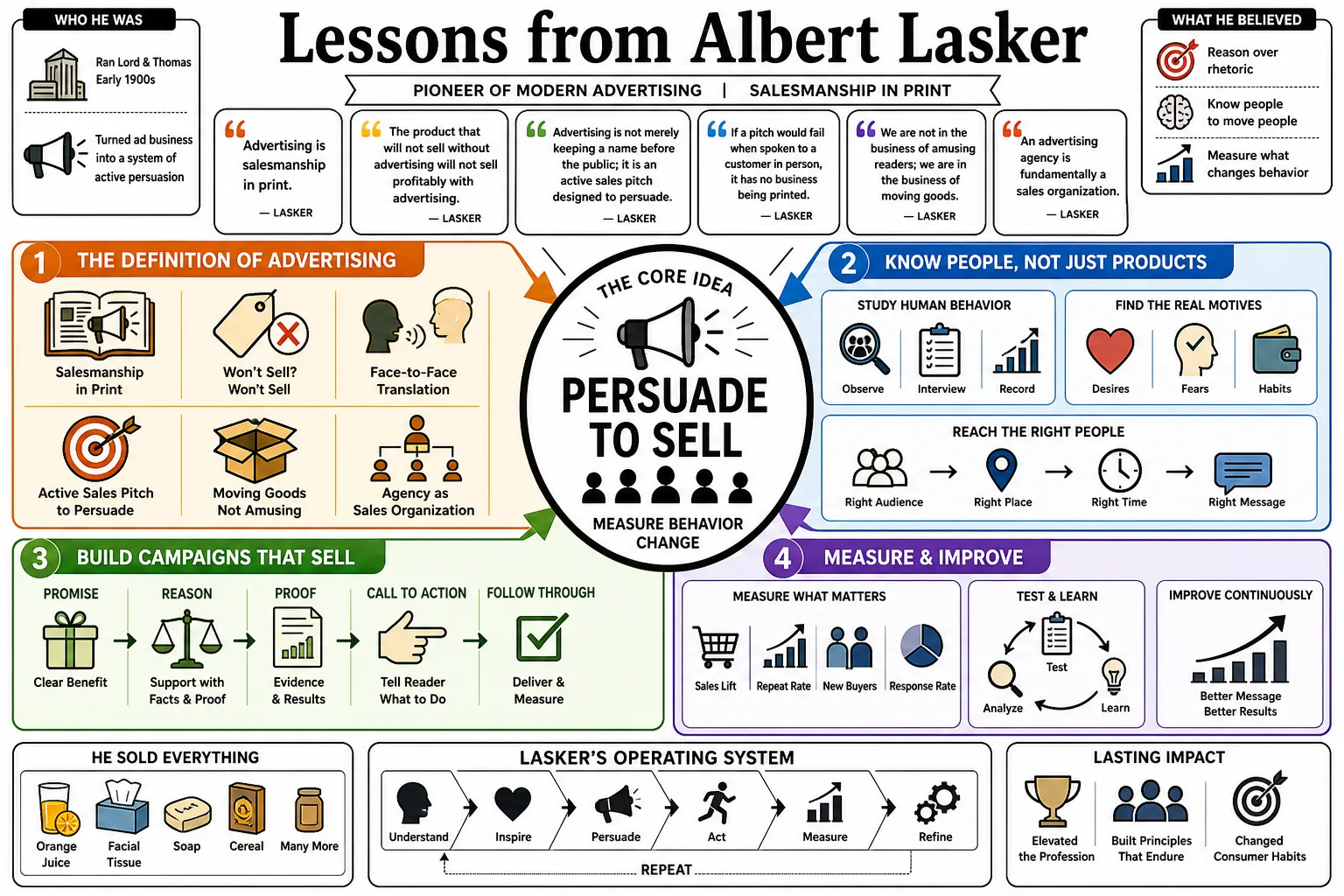
Lessons from Albert Lasker
Albert Lasker helped turn Lord & Thomas from a placement-focused agency into a copywriting-led business. In his own reminiscences, he credited John E. Kennedy and Claude Hopkins for much of the thinking and writing behind that change, and described judging campaigns against client response. — Albert Lasker: Personal Reminiscences.
Part 1: The Definition of Advertising
- Advertising as Salesmanship: Lasker credited John E. Kennedy, not himself, with defining advertising as salesmanship in print; he adopted that idea as a guiding approach to copy. — Lasker on John E. Kennedy.
- Products Must Justify the Advertising: Lasker's early Wilson account shows him linking improved copy to real customer response and to economics that worked for both client and agency. — Albert Lasker: Personal Reminiscences.
- More Than Keeping a Name Visible: Lasker contrasted salesmanship in print with the older notion of merely keeping a brand name before the public. — Albert Lasker: Personal Reminiscences.
- Judge Copy by Sales Response: On the Wilson account, Lasker proposed new copy with a time-limited results guarantee and later described a sharp rise in the client's advertising spend. — Albert Lasker: Personal Reminiscences.
Part 2: Reason-Why Copywriting
- Give Buyers a Reason Why: Lord & Thomas's period advertisement argued that readers need words that explain why a product merits attention, rather than an image alone. — Lord & Thomas: Pictures and Headlines.
- Explain a Concrete Process: Lasker recalled how Claude Hopkins built a Schlitz campaign around the brewery's steam-sterilizing process, turning a specific production detail into a selling point. — Albert Lasker: Personal Reminiscences.
- Make the Product's Difference Visible: For Quaker's puffed cereals, Lasker said Hopkins proposed showing the grain-shooting process to explain what made the food distinctive. — Albert Lasker: Personal Reminiscences.
- Make Words and Pictures Work Together: A contemporary Lord & Thomas advertisement said that illustrations should support the headline and the central selling message; the agency did not treat pictures as a substitute for explanation. — Lord & Thomas: Pictures and Headlines.
Part 3: Testing and Accountability
- Tie Agency Returns to Client Results: Lasker proposed a higher commission on the Wilson account only for advertisements using improved copy, subject to a results guarantee. — Albert Lasker: Personal Reminiscences.
- Use a Bounded Trial: Lasker offered the Wilson client a ninety-day test and promised to refund the increased commission if results did not improve. — Albert Lasker: Personal Reminiscences.
- Revise Campaign Ideas: Lasker said his agency tried several approaches for Lucky Strike before it found one that worked strongly; he did not describe a universal headline-testing formula. — Albert Lasker: Personal Reminiscences.
Part 4: Creating Consumer Habits
- Change How a Product Is Used: According to Lasker biographer Jeff Cruikshank, the Sunkist campaign promoted drinking oranges, which increased the number of oranges consumed per serving. — HBR: The Man Behind the Brands.
- Reduce Product Stigma: Harvard Business School credits Lasker with helping Kotex gain public acceptance. That is a narrower historical claim than the original invented quotation about making a product a household staple. — HBS: Albert D. Lasker.
- Education as Marketing: When Lord & Thomas took on Quaker's puffed cereals, Lasker argued that advertising needed to explain the new foods and their distinctive preparation to buyers rather than merely announce them. — Albert Lasker: Personal Reminiscences.
- Fund the Cost of Market Education: For the puffed cereals, Lasker said the original margin could not finance the campaign needed to explain the products. His team recommended a higher price, which Quaker adopted. — Albert Lasker: Personal Reminiscences.
- Pool Budgets Around a Shared Story: Rather than advertise Puffed Wheat and Puffed Rice separately with small budgets, Lasker said the agency combined their appropriations and explained the common puffing process. — Albert Lasker: Personal Reminiscences.
- Recognize the Harmful Side of Persuasion: In his reminiscences, Lasker described Lucky Strike campaigns that encouraged women to smoke publicly and made misleading claims about protecting voices and figures; this is historical evidence, not health advice. — Albert Lasker: Personal Reminiscences.
- Choose a Name That Explains the Product: Lasker recalled changing the name Wheat Berries to Puffed Wheat after deciding that the cereal's puffing process should be the campaign's focus. — Albert Lasker: Personal Reminiscences.
Part 5: Agency Operations
- Work with a Receptive Client: Before taking the Lucky Strike account, Lasker insisted on meeting the executive who would actually work with his agency and securing his cooperation. — Albert Lasker: Personal Reminiscences.
- Grow the Account by Improving Results: Lasker said the Wilson advertiser's spending rose from about $3,000 to $20,000 a month after the new copy, while the agency's commission increased from ten to fifteen percent. — Albert Lasker: Personal Reminiscences.
- Credit the People Behind the Work: Lasker said his role in the American Tobacco account included finding the right people and selecting ideas, while crediting the client for permitting the work. — Albert Lasker: Personal Reminiscences.
Part 6: Understanding Human Nature
- Choose Words the Audience Understands: Lasker said he changed George Washington Hill's 'bonbon' slogan to 'sweet' because more readers would understand the word and it covered a wider category. — Albert Lasker: Personal Reminiscences.
- Use Headlines to Win Attention: A period Lord & Thomas advertisement treated the headline as the element that first tells readers the message and gains attention, with the illustration sustaining it. — Lord & Thomas: Pictures and Headlines.
Part 7: Copywriters and Talent
- Build a Copywriting Bench: Lasker recalled expanding Lord & Thomas from one half-time copywriter to a group of ten under John E. Kennedy, whom he credited with teaching the craft. — Albert Lasker: Personal Reminiscences.
- Learn from Kennedy but Credit Him: Lasker described John E. Kennedy's teaching as pivotal to his understanding of advertising, rather than claiming Kennedy's definition as his own invention. — Albert Lasker: Personal Reminiscences.
- Recognize Hopkins's Contribution: Lasker called Claude Hopkins a remarkable advertising writer and teacher and described recruiting him to take over major copywriting work after Kennedy left. — Albert Lasker: Personal Reminiscences.
- Recruit for the Person's Motives: To bring Hopkins out of retirement, Lasker offered an electric automobile for Hopkins's wife instead of presenting the work simply as a fee negotiation. — Albert Lasker: Personal Reminiscences.
- Stay Open to a Good Idea: David Ogilvy later reported that Lasker valued humility when confronted with a strong idea; this is Ogilvy's recollection, not a quotation verified from Lasker's own record. — Ogilvy on Advertising.
- Technique Still Needs Imagination: Lasker said salesmanship-in-print offered repeatable techniques, but argued that a standout idea like the puffed cereal's 'food shot from guns' campaign required creative imagination beyond technique. — Albert Lasker: Personal Reminiscences.
Part 8: Philanthropy and Focus
- Success Did Not Prevent Illness: Lasker biographer Jeff Cruikshank, who reviewed Lasker's first-person transcripts, describes recurrent severe emotional breakdowns despite his professional success; the source does not establish a modern diagnosis. — HBR: The Man Behind the Brands.
- Advocate Public Research Funding: The Lasker Foundation records Albert Lasker's advice to Mary that medical progress required federal funding at a scale philanthropy alone could not provide. — Lasker Foundation: Research Funding.
- Build a Joint Health Legacy: Albert and Mary Lasker established a foundation supporting medical research and public advocacy; the Foundation credits both with that institutional legacy. — Lasker Foundation: Mission.
- Influence Beyond the Agency: Jeff Cruikshank's interview portrays Lasker's influence across advertising, politics, sports, and philanthropy, much of it outside public view; it does not verify the original first-person quote. — HBR: The Man Behind the Brands.