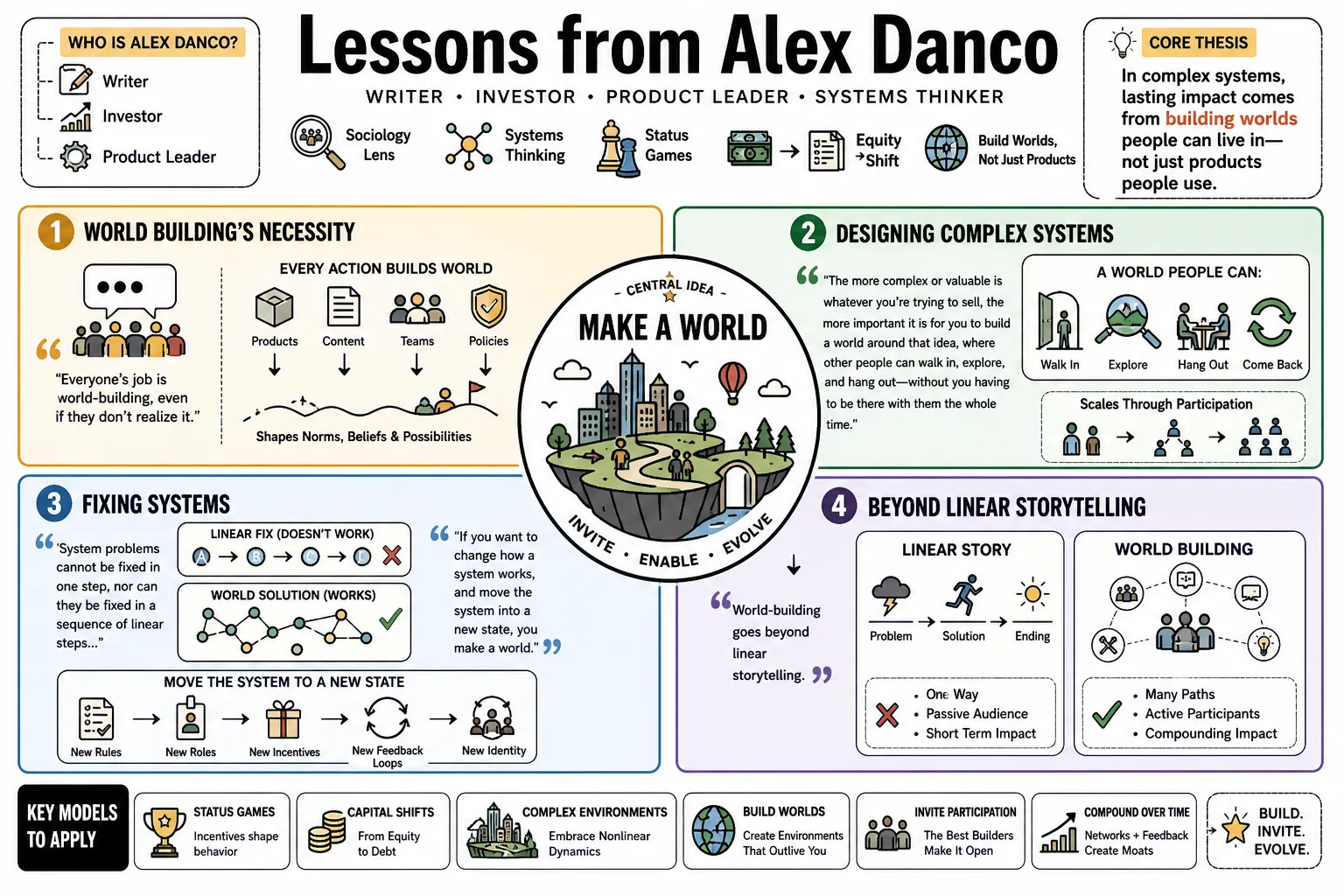
Alex Danco is a writer and product leader whose essays examine technology through systems, sociology, finance and commerce. His work on world-building, abundance, gift culture, capital and Shopify informs the directly sourced lessons below. — World Building.
Part 1: World Building
- On World Building's Necessity: Danco argues that even work outside fiction entails building a world: giving people a coherent purpose and a setting in which to act. — World Building.
- On Designing Complex Systems: The more complex an idea or product, the more useful it is to build a navigable world around it so others can understand and participate. — World Building.
- On Fixing Systems: Because a system cannot usually be changed through one linear intervention, Danco recommends creating a shared world that coordinates parallel effort toward a different state. — World Building.
- On Linear Storytelling: A world can continue to generate stories and actions after its originator leaves the room when participants understand its purpose and find their own roles. — World Building.
- On Selling Ideas: A clear, compelling world can help people orient around an idea that would otherwise feel complex and ambiguous. — World Building.
- On Purpose: The world needs a legible purpose: participants should see what they are trying to change and why. — World Building.
- On Creating Gravity: The world-builder highlights people and storylines that make the shared purpose coherent to newcomers. — World Building.
- On Leaving the Room: Danco says a well-built world gives people reasons to explore and spend time in it even when its creator is absent. — World Building.
- On Antifragility: Danco’s aim is not a perfectly scripted story but a purposeful environment in which participants can keep contributing without constant direction. — World Building.
- On Delegation: A world-builder gives others enough context and purpose to discover useful roles and carry the work forward. — World Building.
Part 2: Scarcity and Abundance
- On Defining Abundance: For Danco, abundance describes the consumer’s experience: choosing a product becomes easy enough that deliberation and switching friction recede. — Understanding Abundance, Part 1.
- On Defining Scarcity: A scarce choice forces buyers to weigh constraints and switching costs; the decision itself takes effort. — Understanding Abundance, Part 1.
- On Capitalism's Core: Danco frames much conventional capitalist value creation as giving customers access to something scarce. — Understanding Abundance: Introduction.
- On the Emergent Layers Cycle: In Danco’s emergent-layers model, abstraction makes an old scarce input abundant and exposes a new scarce resource at the next layer. — Emergent Layers, Chapter 1.
- On Value Capture: When an old constraint is abstracted away, value may migrate toward the new bottleneck rather than remain with the original supplier. — Emergent Layers, Chapter 1.
- On Business Models: Earning from a scarce input and earning from its abundant successor require different business models and positions in the stack. — Emergent Layers, Chapter 1.
- On Gaussian Outcomes: Danco suggests that high-friction choices may cluster around “maybe” outcomes; his Gaussian framing is an illustration, not a universal law. — Understanding Abundance, Part 1.
- On Power Laws: Low-friction abundance can let favored products compound quickly while eroding the pricing power of undifferentiated suppliers. — Understanding Abundance, Part 1.
- On Competing in Low-Friction Environments: In low-friction markets, Danco distinguishes sharply differentiated offers from scale-driven suppliers that can operate at thin margins. — Understanding Abundance, Part 1.
- On the Red Queen's Race: Using Netflix as an example, Danco describes a Red Queen dynamic: new abundance can intensify competition for scarce attention and position. — Netflix and the Red Queen’s Race.
Part 3: Debt, Equity, and Capital
- On the Equity Monopoly: Writing in 2020, Danco argued that venture equity was the default startup financing tool even for businesses with increasingly predictable revenue. — Debt Is Coming.
- On the Arrival of Debt: Danco predicted in 2020 that debt would become more important in technology financing; this is a forecast, not an established outcome. — Debt Is Coming.
- On Recurring Revenue Securitization: He proposed that packaging recurring revenue into investable fixed-income products could bring new institutional capital to some software businesses. — Debt Is Coming.
- On the Scale of Securitization: His 2020 securitization thesis predicted that access to debt markets could intensify competition for growth capital. — Debt Is Coming.
- On the Three Tech Industries: Danco distinguished speculative venture investment, mature technology companies and predictable-revenue software businesses as different financing cases. — Debt Is Coming.
- On Deployment Period Funding: At a large enough scale, Danco argued, data centers and other durable technology infrastructure can be financed with debt rather than only venture equity. — Debt Is Coming.
- On Speculative Investment: Danco used the installation/deployment framework to argue that speculative equity matters early in a technological wave, while more predictable deployment can attract other capital. — Debt Is Coming.
- On Irrational Financing: For predictable cash flows, debt may sometimes be cheaper than equity, but Danco warns it is not startup runway and can create refinancing or fundraising risk. — Debt Is Coming.
Part 4: Gift Culture and Social Dynamics
- On the Magic of Innovation: Danco presents gift culture as a way to coordinate people around uncertain creative projects. — Innovation Takes Magic.
- On Economic Work: In his account, gifts can solve coordination problems that a simple price or contract cannot settle in advance. — Innovation Takes Magic.
- On Adaptation to Abundance: Drawing explicitly on Eric S. Raymond’s gift-culture framework, Danco applies the idea of giving in an abundant environment to free knowledge shared online. — Homesteading the Twittersphere.
- On Earning Status: Danco quotes Eric S. Raymond’s distinction between status from controlling scarce goods and status from giving in a gift culture; he applies it to online writing. — Homesteading the Twittersphere.
- On the Value of Recontribution: A useful online contribution, in Danco’s account, gives a niche something new enough to matter but familiar enough for others to recognize and build on. — Homesteading the Twittersphere.
- On Solving Coordination Problems: Danco expects coordination skill—not just fast prototyping—to remain scarce as builders pursue promising goals whose path is not yet knowable. — Innovation Takes Magic.
- On Builder Rituals: He treats an internal Demo Day as a gift-exchange ritual: builders share work and invite colleagues into a collective project. — Innovation Takes Magic.
- On Crossing Thresholds: In conversation with Jackson Dahl, Danco connects gifts with crossing uncertain thresholds together, where the next step cannot be fully specified in advance. — Dialectic Interview with Alex Danco.
- On Homesteading: Danco calls his own Silicon Valley Social Contract topic a plot he is “homesteading”: repeated useful writing makes a writer recognizable for a niche. — Homesteading the Twittersphere.
- On TikTok's Social Economy: In a 2020 essay, Danco interpreted TikTok as combining an abundant creative feed with a scarce status economy; this is his dated reading of the platform. — Scarcity Status Versus Abundance Status.
Part 5: The Michael Scott Theory of Social Class
- On the Three Ladders: Danco discusses Michael Church’s three-ladder class framework—Labor, Educated Gentry and Elite—and applies it to status in The Office. — The Michael Scott Theory of Social Class.
- On the Labour Ladder: In the Church framework Danco adopts, the Labor ladder is comparatively legible: money and ownership signal advancement. — The Michael Scott Theory of Social Class.
- On the Elite Ladder: Danco describes Church’s Elite ladder as a competition for leverage, power and money rather than the Educated Gentry’s cultural standing. — The Michael Scott Theory of Social Class.
- On the Educated Gentry Ladder: In Danco’s presentation of Church’s framework, the Educated Gentry ladder rewards education, interestingness and costly tastes or virtues. — The Michael Scott Theory of Social Class.
- On Becoming Michael Scott: Danco’s distinctive claim is that climbing the Educated Gentry ladder can make a person resemble Michael Scott’s anxious performance of status. — The Michael Scott Theory of Social Class.
- On Constructed Reality: Danco contrasts the middle class’s constructed status reality with the more direct view of work and position he ascribes to the top and bottom of his typology. — The Three Aesthetics of the Creative Class.
- On Performance and Status Anxiety: He reads some middle-class performance as an appeal to be taken seriously, rooted in anxiety about status. — The Three Aesthetics of the Creative Class.
- On the Losers: Danco explicitly borrows Venkatesh Rao’s Gervais Principle when describing “losers” as workers whose effort is captured by others; it is Rao’s term, not a Danco coinage. — The Michael Scott Theory of Social Class.
- On the Dwight Schrute Aesthetic: Danco’s Dwight/Upper Prole figure signals pride in craft and competence rather than the middle-class need to prove cultural standing. — The Three Aesthetics of the Creative Class.
Part 6: Systems Thinking and Complexity
- On Shipping the Org Chart: Invoking Melvin Conway’s Law, Danco says team communication and power boundaries tend to show up in the architecture of what an organization ships. — Six Lessons from Six Months at Shopify.
- On Mystery and Margin: Danco argues that some mystery or surprise can protect a product’s appeal; he does not claim every transparent process inevitably has zero margin. — Infinite Loops: Finding Method in the Madness.
- On the S-Curve: Danco uses S-curves to discuss customer adoption and changing scarcity, rather than a rule that every technology or strategy follows one fixed curve. — Scarcity and Abundance in 2025.
- On Abstraction: Abstraction hides constraints at an underlying layer, allowing builders to focus on the new scarce problems above it. — Emergent Layers, Chapter 1.
- On Friction: Danco distinguishes wasteful checkout friction from valuable challenge or opt-in effort that can strengthen merchant-customer relationships. — What’s Behind the Shopify Effect.
- On the Bottleneck of Value: Danco argues that abundance in one part of a market can make a position elsewhere newly scarce; capturing value depends on the specific bottleneck, not an automatic claim to all margin. — Positional Scarcity.
- On Emergent Scarcity: When one input becomes abundant, Danco’s model expects a different scarce constraint to emerge at the next layer. — Emergent Layers, Chapter 1.
- On Code as Labor: Danco tentatively describes AI-era software as shifting from code treated as durable capital toward code treated more like labor; he acknowledges the analogy is flippant. — Scarcity and Abundance in 2025.
Part 7: Startups, Founders, and VCs
- On Status Monkeys: Danco argues that some angel investors receive social returns alongside financial ones, which can influence their willingness to write an early check. — The Social Subsidy of Angel Investing.
- On Founder Agency: Danco says investor writing can give founders language and legitimacy that help others understand their ambitions; his claim is about persuasion, not transferring legal control. — I’m Joining a16z.
- On the Venture Model: Danco questions financing every startup with the same equity template when business models and cash-flow predictability differ. — Debt Is Coming.
- On the Silicon Valley Social Contract: Danco describes a Silicon Valley social contract in which people treat one another as potential future founders and leave room for status to change. — Social Capital in Silicon Valley.
- On Angel Investing: For some angel investments, Danco says social recognition can subsidize a quick, riskier check, although he explicitly rejects treating every angel as a status seeker. — The Social Subsidy of Angel Investing.
- On Power Transfer: Danco frames clear writing as a way to lend founders persuasive language and social legitimacy for work that is not yet obvious to others. — I’m Joining a16z.
Part 8: The Shopify Effect and E-commerce
- On Modern Platforms: In a 2021 Shopify discussion, Danco explains how lowering the cost of starting and operating an online store can broaden the merchant market. — Business Breakdowns: Shopify.
- On the Shopify Model: Danco’s Shopify thesis is that shared tools and infrastructure let independent merchants access capabilities once practical mainly for larger retailers. — Shopify.
- On the E-commerce On-Ramp: Danco treats commerce software as an entry point to other merchant needs, including payments and financing, rather than only storefront creation. — Business Breakdowns: Shopify.
- On Merchant Financing: Shopify’s merchant data can inform financing and make access simpler, Danco says; it does not make underwriting frictionless or risk-free. — Business Breakdowns: Shopify.
- On Core vs Ecosystem: Danco describes a complement between Shopify Core, Merchant Services and a developer ecosystem; third-party apps can overlap with first-party products, so the boundary is not strict. — Business Breakdowns: Shopify.
- On the Shopify vs Apple Analogy: He compares Shopify’s developer ecosystem with Apple’s App Store as a way for external builders to serve merchants in many specialized niches. — Business Breakdowns: Shopify.
- On Empowering the Margins: Danco argues that differentiated, high-trust merchant relationships can thrive online instead of every seller competing as an undifferentiated catalog item. — What’s Behind the Shopify Effect.
- On Decentralized Commerce: Danco presents independent brands using shared commerce infrastructure as a promising counterweight to a single centralized retail marketplace, not a settled future of retail. — What’s Behind the Shopify Effect.
- On Financial Engineering: In a 2021 thesis, Danco explored platform-based revenue contracts and embedded financing as possible tools for businesses with observable cash flows. — Pipe It! Platforms and Funding.
Part 9: Writing, Media, and The Online Game
- On Writing as Power: Danco says writing can give readers and founders reusable words that make a new idea easier to recognize, discuss and legitimize. — I’m Joining a16z.
- On The Online Game: Danco calls online participation a predictive game: people try to understand and shape what happens next rather than only react to it. — Prediction: The Successor to Postmodernism.
- On the Social Subsidy of Writing: Danco observes that valuable free essays can create a recognizable niche and unexpected career or deal-flow returns for the writer; this is not a guaranteed network effect. — Homesteading the Twittersphere.
- On the Medium and the Message: Danco’s conversation with Dahl treats the medium as part of the message: audio, text and other formats invite different kinds of attention and participation. — Dialectic Interview with Alex Danco.
- On Creating a Scene: Danco describes a creative scene as peers who admire and validate one another while also competing for scarce recognition. — How Scenes Work.
- On Generosity in Media: Sharing strong ideas for free can be a gift-culture contribution that earns recognition and draws others into an intellectual niche. — Homesteading the Twittersphere.
- On Naming Things: Describing his own newsletter, Danco says he tries to name things as they are; the source does not establish a universal formula for every writer. — Building the World of Alex Danco’s Newsletter.
Part 10: Career Philosophy and Personal Agency
- On the Fair Value of a Secret: Danco proposes the fair value of a secret as its future net earnings discounted for time and risk, while stressing that those earnings and risks are extremely hard to estimate. — Secrets.
- On Mutual Love vs Rivalry: For Danco, creative and startup scenes run on a tension between affection for peers and rivalry with them; neither side alone explains the scene’s energy. — How Scenes Work.
- On Writing as Career Leverage: Danco says his free newsletter helped him secure every substantive job he had after graduate school, illustrating a concrete career return from sustained public writing. — Homesteading the Twittersphere.
- On Agency and Accountability: Danco distinguishes individual agency from system-level accountability: too many uncoordinated decision-makers can produce stalemate even when each has a powerful title. — Dialectic Interview with Alex Danco.