Alex Kracov is CEO and cofounder of Dock and was Lattice’s first marketing hire. He helped build Lattice’s early marketing organization before founding Dock, and writes about B2B demand generation, buyer enablement and how marketing and sales work together. — Pocus Interview with Alex Kracov.
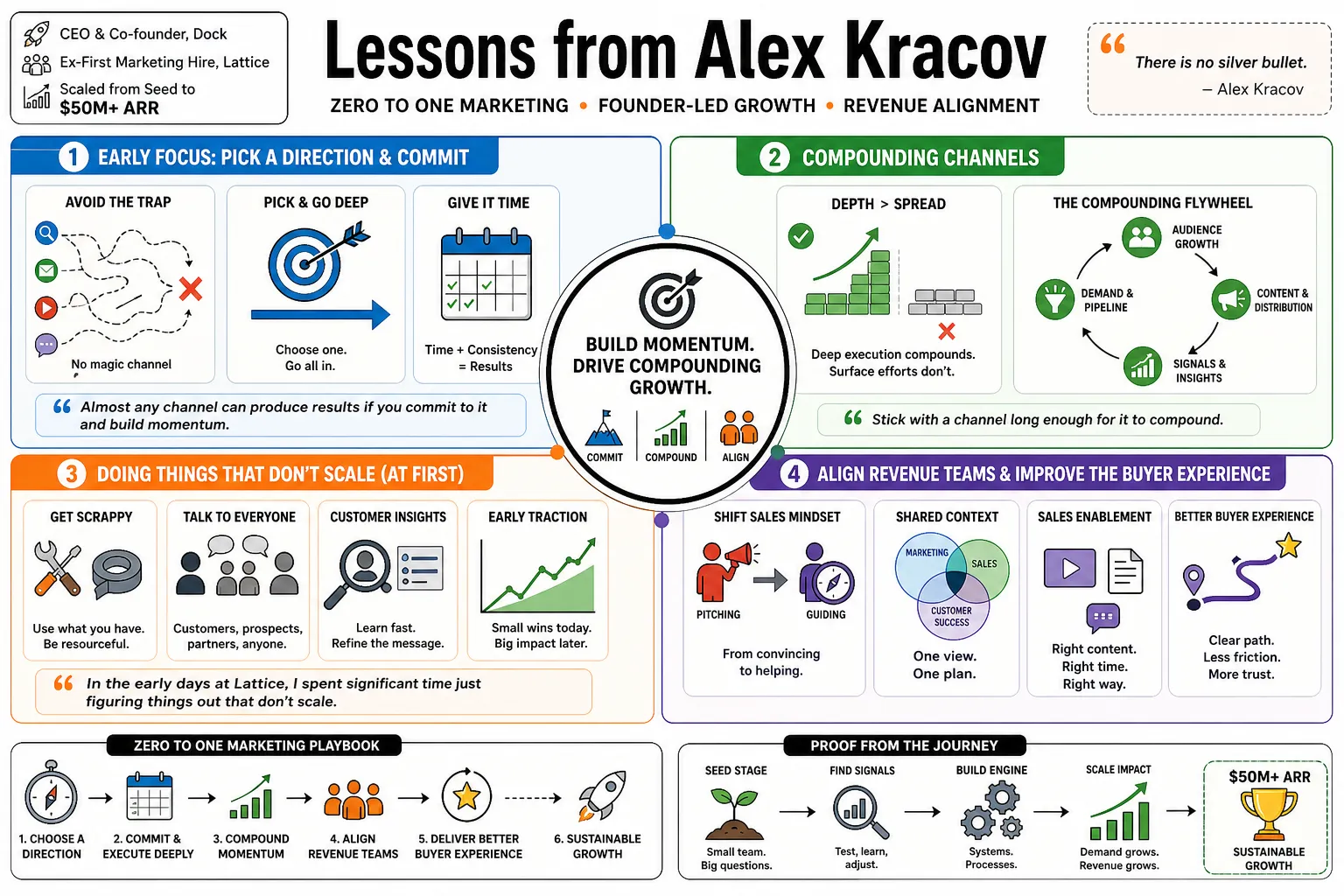
Part 1: The Zero to One Marketing Playbook
- Early Focus: After initial exploration, Kracov advises early teams to choose a few channels they can execute consistently rather than keep restarting in search of one magic source of growth. — First Round Review Interview.
- the Silver Bullet Myth: Kracov argues that SaaS growth has no universal silver bullet; most businesses need a mix of channels whose emphasis depends on the product and sales motion. — B2B SaaS Demand Generation Explained.
- Doing Things That Don't Scale: At Lattice, he began with manual experiments across the website, search ads, review sites, social ads and events to learn what generated useful leads. — First Round Podcast Transcript.
- Shadowing Sales Calls: An early marketer should draw out the founder’s customer insight and listen to sales calls before turning those observations into positioning and messaging. — First Round Review Interview.
- Event Marketing: Kracov treats in-person events as deliberate campaigns; the event itself works better when there is a plan for reaching the audience and following up. — First Round Review Interview.
- Defining Categories: He recommends defining the product category in terms buyers already understand, then explaining the distinctive value the product adds. — How to Build a B2B SaaS Brand.
- Being Scrappy: Kracov used a Webflow microsite as an early prototype for packaging sales resources so a buyer champion could share them internally. — Building Dock — Grow & Tell.
- Learning from Mentors: To grow with a fast-scaling company, he sought to learn new leadership skills as the marketing function and team changed around him. — Early Startup Employees and Company Growth.
- Learning in Public: Kracov uses his own writing and podcast appearances to share practical lessons from building Dock while also creating a recognizable founder voice. — Dock Content Strategy — Grow & Tell.
Part 2: Founder-Led Sales and Growth
- Founder-Led Sales: Founder-led selling in Dock’s early days doubled as product research: Kracov framed many conversations as feedback calls before a repeatable sales pitch existed. — How I’ve Approached Founder-Led Sales.
- Leveraging Personal Networks: He drew on relationships built before founding Dock to start early customer conversations, then used the feedback to shape product and positioning. — How I’ve Approached Founder-Led Sales.
- Product-Market Fit Validation: Early founder demos helped him learn what prospects cared about and adapt the product before hiring a separate sales organization. — How I’ve Approached Founder-Led Sales.
- Founder Authenticity: Founder involvement in early marketing is valuable because founders have direct customer and product context that a new marketer needs to translate into a company message. — First Round Review Interview.
- Founder Proximity: Kracov advises marketers to stay close to founder and customer conversations so the product message reflects how buyers actually describe the problem. — First Round Review Interview.
- Transitioning from Founder Sales: Kracov planned to add account executives only after founder-led conversations had clarified the product, its messaging and what resonated with buyers. — How I’ve Approached Founder-Led Sales.
- Building the GTM Engine: He models demand generation as a connected system of CRM, website, inbound programs, outbound, sales and customer advocacy rather than a collection of isolated hacks. — B2B SaaS Demand Generation Explained.
- the Limits of PLG: Dock’s team learned that a self-service product-led motion alone did not fit every buyer and began adding a more hands-on sales approach. — Building Dock — Grow & Tell.
- Hybrid Sales Motions: Kracov describes Dock’s shift toward a hybrid motion as a response to the larger buyers and use cases it was serving, not an inevitable rule for all SaaS companies. — Building Dock — Grow & Tell.
Part 3: Guiding the Modern Buyer
- the Goal of Sales: For Kracov, a good sale builds a durable relationship and value for both sides rather than treating signature as the only objective. — Stop Selling. Start Guiding..
- Salespeople as Guides: He compares the best salespeople to guides who help buyers navigate choices and reach a suitable destination. — Stop Selling. Start Guiding..
- Avoiding Pushy Tactics: He favors sellers who teach the tradeoffs honestly, including when another product is a better fit, over pressure tactics. — Stop Selling. Start Guiding..
- Dealing with Buying Teams: A buyer champion often has to explain a proposed purchase to executives, managers and other stakeholders; Kracov built Dock around helping that sharing process. — Building Dock — Grow & Tell.
- the Buyer Experience: The Dock idea grew from Kracov seeing Lattice reps struggle to find and share the right collateral across scattered email threads. — Building Dock — Grow & Tell.
- Empowering Internal Champions: His early microsite gathered case studies, pages and other proof in a private space a sales rep could tailor and a champion could circulate. — Building Dock — Grow & Tell.
- Digital Sales Rooms: A shared deal space can replace a fragmented attachment trail with one organized place for a buyer to revisit relevant materials and next steps. — Building Dock — Grow & Tell.
- Long-Term Relationships: Kracov extended the shared workspace idea beyond the sale so customer-success teams could see what had been shared and continue the relationship during onboarding. — Building Dock — Grow & Tell.
Part 4: Aligning Sales and Marketing
- Marketing and Sales Tension: Kracov begins sales-marketing alignment with a shared revenue plan and explicit assumptions about each team’s role in creating pipeline. — Nine Sales and Marketing Problems.
- Shared Tooling: Disagreements about lead volume and quality become easier to resolve when teams agree on the ideal customer profile, funnel definitions and follow-up responsibilities. — Nine Sales and Marketing Problems.
- Lead Quality Disputes: Instead of arguing over labels, he recommends giving both marketing and sales a common pipeline goal and examining what actually moves qualified buyers forward. — Nine Sales and Marketing Problems.
- Collaborative Campaigns: He asks marketing to brief sales before campaigns, provide usable follow-up materials afterward, and measure how leads advance through the funnel. — Nine Sales and Marketing Problems.
- Shared Collateral: A central, current collection of collateral helps reps find what marketing has created and share the right materials with buyers. — Building Dock — Grow & Tell.
- Organizational Silos: Kracov’s shared-workspace model aims to give customers and internal teams a coherent record of what was shared across sales and onboarding. — Building Dock — Grow & Tell.
- the Revenue Enablement Shift: He describes revenue enablement as extending beyond an internal content repository to the customer-facing buying and onboarding experience. — Building Dock — Grow & Tell.
- Eliminating Tribal Knowledge: As Lattice’s sales team grew, knowledge of which assets to share could no longer depend on a handful of experienced reps. — Building Dock — Grow & Tell.
- Connecting the Customer Lifecycle: A workspace that sales and customer success can both use can carry the deal context into onboarding and later customer interactions. — Building Dock — Grow & Tell.
Part 5: Content and Community Building
- Inbound Marketing: Kracov sees inbound content as a long-term investment that early B2B companies may neglect because its returns are slower than paid lead generation. — First Round Review Interview.
- Long-Term Investments: SEO and community content can take years to compound, which is why he argues for starting before the company urgently needs their pipeline contribution. — First Round Review Interview.
- Building Communities: At Lattice, Resources for Humans linked a Slack community, dinners, newsletter and editorial material around the needs of HR leaders. — First Round Review Interview.
- Founder-Led Content: He recommends extracting differentiated insight from founders and customers before writing content, so the message reflects the company’s real experience. — First Round Review Interview.
- the Role of SEO: Kracov started publishing search-oriented content early because SEO could take multiple years to become a meaningful channel. — First Round Review Interview.
- Content Distribution: He tries to reuse strong ideas across a podcast, articles, LinkedIn and sales materials so a small team gets several uses from one piece of research. — Dock Content Strategy — Grow & Tell.
- Authentic Brand Voice: A useful brand voice should reflect how customers describe their needs and the distinctive truth of the product, not generic corporate phrasing. — How to Build a B2B SaaS Brand.
- Using No-Code Tools: The Webflow proof of concept let Lattice reps assemble private sales pages for champions before Dock became a full software product. — Building Dock — Grow & Tell.
- Brand Awareness: Kracov sees brand building as helping self-educating buyers recognize a product’s value before they are ready to request a demo. — How to Build a B2B SaaS Brand.
- Standing Out: Lattice combined community dinners and account-based direct mail with other channels when a high-touch campaign warranted it, rather than relying on a small booth alone. — First Round Review Interview.
Part 6: Navigating the B2B SaaS GTM Motion
- the GTM Motion: Kracov’s demand-generation diagram makes the roles of marketing, sales and the website explicit so teams can repeat and improve a motion. — B2B SaaS Demand Generation Explained.
- Repeatability: Repeatability improves when teams agree on what counts as a qualified lead, how it moves through the funnel and who follows up. — Nine Sales and Marketing Problems.
- Scaling to $50M ARR: Kracov describes repeatedly changing his own role as Lattice grew from one marketer to a larger team, budget and customer base. — Early Startup Employees and Company Growth.
- Pricing Strategies: He treats pricing and packaging as parts of product positioning that communicate the product’s place in the market. — B2B SaaS Marketing Guide.
- the Shift to Enterprise: As Dock narrowed toward enablement teams at larger companies, its product, selling process and buyer support changed with that focus. — Building Dock — Grow & Tell.
- Sales Enablement Portals: The Webflow sales microsites at Lattice provided early evidence that a dedicated external-collaboration product might solve a repeated problem. — Building Dock — Grow & Tell.
- the Patchwork of Tools: Kracov’s shared workspace helps revenue teams see what was sent to a buyer and how that buyer engaged, alongside their internal CRM. — Building Dock — Grow & Tell.
- Measuring Success: He argues marketers should look beyond awareness counts to qualified conversations, pipeline and revenue outcomes. — Funnel Metrics for SaaS Marketers.
- Balancing Short and Long Term: Kracov distinguishes campaigns that can help near-term lead targets from SEO and other programs that may pay off much later; a revenue plan needs room for both. — Nine Sales and Marketing Problems.
Part 7: The Nuance of Demand Generation
- the Marketing Mix: Most SaaS teams need several channels and loops working together; the right mix depends on how customers buy the product. — B2B SaaS Demand Generation Explained.
- Defining Inbound vs Outbound: Kracov separates inbound programs that draw prospective buyers to a website from outbound activity that initiates contact with target accounts. — B2B SaaS Demand Generation Explained.
- the Reality of Outbound: When inbound leads are slow, he advises sales teams to cultivate relevant accounts and old prospects through outbound rather than only wait for marketing. — Nine Sales and Marketing Problems.
- Setting Realistic Expectations: Kracov cautions that a new channel rarely delivers meaningful results immediately and encourages teams to set expectations around the time required to compound. — First Round Review Interview.
- Budget Allocation: After early experimentation, he favors concentrating effort on a few channels the team can actually sustain while reserving capacity to test new ideas. — First Round Review Interview.
- Experimentation: His early channel work at Lattice involved running small tests, learning from lead quality and then committing more deeply to what worked. — First Round Review Interview.
- Brand Frequency: Kracov’s account of Lattice’s billboard campaign illustrates how broad brand efforts can create visibility whose full effect is harder to attribute than a direct-response ad. — What I Learned Buying Billboards for a Startup.
- Short-Term Lead Gen: Optimizing only this month’s leads can crowd out SEO and other slower investments that are meant to help a future pipeline. — Nine Sales and Marketing Problems.
- Analyzing the Funnel: He maps marketing measures to awareness, interest, consideration and intent so a team can find where prospects stop advancing. — Funnel Metrics for SaaS Marketers.
Part 8: Hiring and Marketing Leadership
- Making the First Hires: For many startups still finding product-market fit, Kracov recommends a digitally capable generalist as the first marketing hire rather than assuming a senior specialist is required. — Making Your First Marketing Hire.
- the Founder Mentality: He looks for entrepreneurial doers who can build a campaign or asset themselves, not only manage an outside agency. — Making Your First Marketing Hire.
- Growth Mindsets: An early employee’s responsibilities must evolve as headcount, budget and customer demand grow; the job does not stay fixed. — Early Startup Employees and Company Growth.
- Managing Up: Kracov describes setting priorities with Lattice’s founders and explicitly deciding which marketing projects would not be pursued. — First Round Review Interview.
- the Evolution of Roles: The skills that work when one person runs a function can differ from those needed to lead the same function at much greater scale. — Early Startup Employees and Company Growth.
- Hiring Specialists: As the marketing team and budget expand, the first broad hire can be complemented by specialists in functions that become too large for one generalist. — Making Your First Marketing Hire.
- Marketing Leadership: He treats marketing leadership as shared ownership of pipeline and revenue, in partnership with sales, rather than only campaign output. — Nine Sales and Marketing Problems.
- Interviewing Candidates: His button-clicker test asks whether a candidate can actually make and launch useful marketing work rather than only describe strategy. — First Round Review Interview.
- Career Growth: Kracov’s own path at Lattice illustrates how a growing startup can give an early employee the chance to expand skills and scope, if they adapt as the company changes. — Early Startup Employees and Company Growth.
- Leaving to Found a Company: After leaving Lattice to found Dock, Kracov became responsible not only for marketing but also for product choices, sales, hiring and the broader company. — Building Dock — Grow & Tell.