Alex Ross is a staff writer at The New Yorker and was its music critic from 1996 to 2026. His books include The Rest Is Noise, Listen to This and Wagnerism. His reporting and criticism connect composers, performances and recordings to the histories and audiences around them. — The New Yorker Biography.
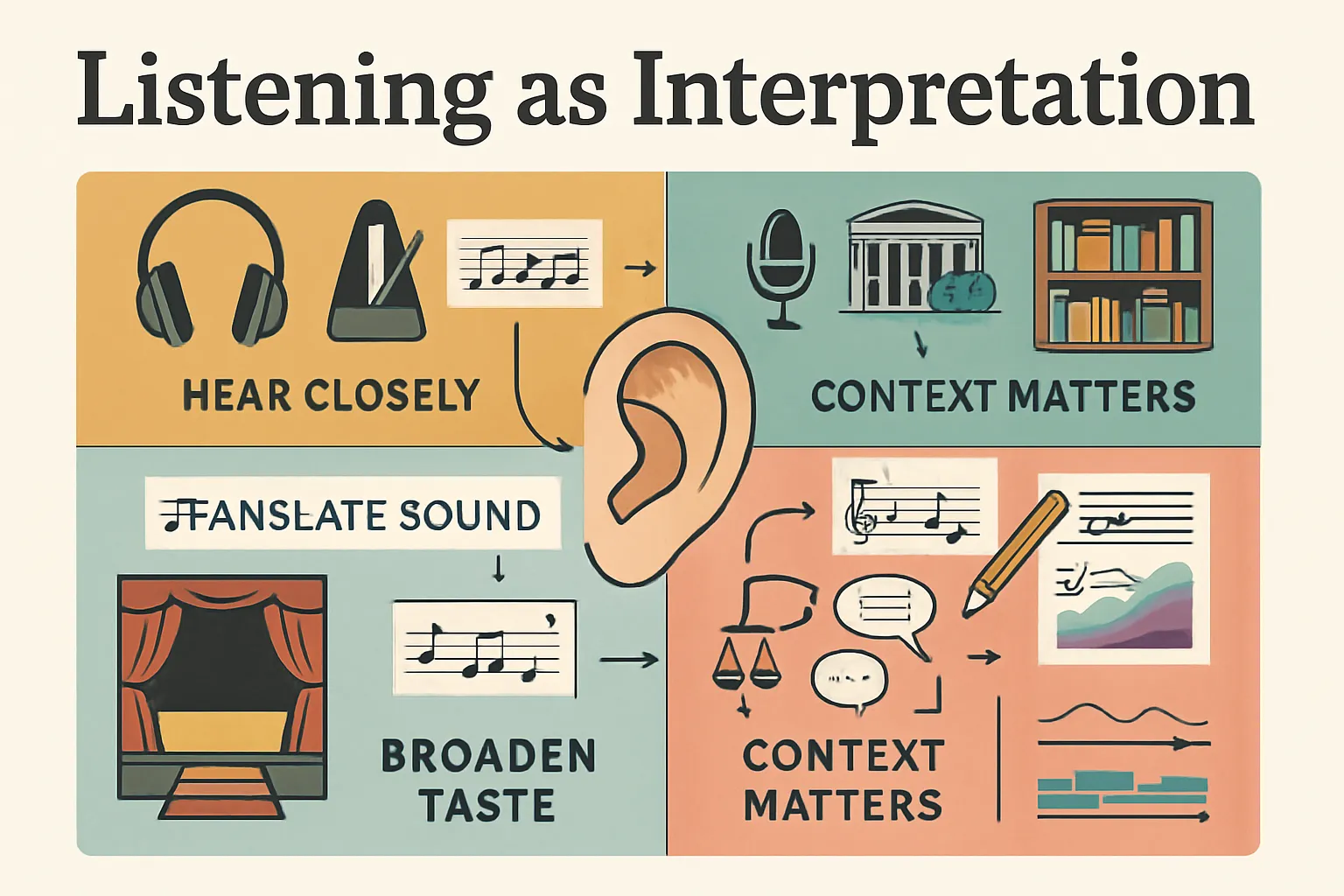
Part 1: The Nature of Criticism and Listening
- Criticism as reporting: Music criticism does more than rate a performance: Ross treats a review as reporting that describes an event and places it in context. — KQED Criticism Interview.
- Opera crosses art forms: To write about opera, a critic must consider literature, staging and theatre alongside the score. — Conversations with Tyler.
- Write for different levels of musical knowledge: Ross tries to interest both music specialists and readers with little background, explaining the work without assuming they share a technical vocabulary. — The Exchange.
- Resist absolute musical rankings: Music is too personal for a fixed hierarchy; Ross moves between Sibelius and Dylan according to what fully engages him at a given moment. — Listen to This.
- Cross the classical–popular border: Ross argues for discussing classical music with the liveliness given to pop and taking popular music seriously, instead of treating the genres as a hierarchy. — Listen to This.
- Hear with mind and body: Ross values Beethoven’s Eroica for joining intellectual design to bodily energy, rather than asking listeners to choose analysis or feeling. — Listen to This.
- Look beyond the cutting review: Ross says a critic sometimes needs to be harsh, but the richest judgment may come after revising an initial reaction instead of writing an extreme verdict. — KQED Criticism Interview.
- Place composers in their world: Ross frames twentieth-century music through the social and political conditions in which composers worked, while resisting a single progressive-versus-conservative story. — The Rest Is Noise: FAQ.
- Sight-read widely: Ross recalls piano training that emphasized reading a great deal of music rather than polishing only a few pieces for performance. — Ethan Iverson Interview.
Part 2: The Modernist Shock and the Twentieth Century
- Modernism was not one straight-line story: Ross gives modernist and more conservative twentieth-century composers room in the same history, looking for links rather than treating one camp as the whole century. — The Rest Is Noise: FAQ.
- Schoenberg as a conservator: Schoenberg later described twelve-tone writing as a way to preserve older practices of thematic development and counterpoint, even after abandoning conventional chords. — Whistling in the Dark.
- The Rite and its sources: Ross situates The Rite of Spring in Stravinsky’s Russian materials and the sophisticated Parisian artistic world that received it. — Prince Igor.
- Shostakovich under threat: The official denunciation of Lady Macbeth in 1936 shows the political peril in which Shostakovich had to keep composing; a universal code of secret meanings cannot be assumed. — Chapter 7: The Art of Fear.
- Copland’s open spaces had influences: Ross traces Copland’s open-interval sound partly to Stravinsky, complicating the idea that an American idiom simply discarded European modernism. — Copland and Wide Intervals.
- Strauss at the modernist boundary: Ross hears the grinding dissonance of Salome threatening tonal stability, not a composer who simply stayed outside musical modernism. — The Dissonant Howl of Salome.
- Cold War pressure on composers: Ross documents the political scrutiny Aaron Copland faced in the McCarthy era while cautioning against explaining every subsequent musical choice as a defensive political move. — Appalachian Autumn.
- The different roles of minimalists: Ross describes Terry Riley’s In C as launching repetitive minimalism, Steve Reich as developing its process and Philip Glass as popularizing it. — The Harmonist.
- Britten’s antiwar reach: Ross notes that Britten’s War Requiem became an international symbol of antiwar feeling; this is a specific example, not proof that all his music encoded pacifism. — Coronation.
Part 3: The Shadow of Richard Wagner
- Wagner’s reach beyond music: Ross argues that Wagner influenced not only composers but writers, visual artists, political movements and filmmakers across generations. — Wagnerism: Author Introduction.
- Bayreuth as a dedicated setting: The Bayreuth festival and theatre created a particular setting for Wagner’s work, with staging and acoustics part of the audience’s experience. — Wagner on Trial at Bayreuth.
- Wagner in film scoring: Ross traces Wagnerian dramatic motifs and orchestral ideas through later film music, including Hollywood scores. — How Wagner Shaped Hollywood.
- Artistic achievement and anti-Semitism: Ross asks readers to face Wagner’s artistic influence together with his anti-Semitism, without treating either aspect as an excuse to ignore the other. — Wagnerism: Author Introduction.
- Wagner in literary culture: Ross traces Wagner’s reception among writers including Proust, Joyce and Thomas Mann, without claiming that each used leitmotifs in the same structural way. — The Case for Wagner in Israel.
- Wagner after Nazism: Ross shows how Hitler’s embrace helped define Wagner’s later public image, while warning against simple causal stories that make a composer responsible for every later evil. — Wagnerism: Author Introduction.
- Feminist Wagner reception: Ross notes that feminists have been among Wagner’s admirers and reads Brünnhilde as the Ring’s central hero, while not calling Wagner a feminist in the modern sense. — Ten Bars of the Ring.
- Power in the Ring: Ross reads the Ring as a drama of power and morally compromised bargains, including the cost imposed on the builders of Valhalla. — Conversations with Tyler.
- The integrated work of art: Wagner’s idea of a total work of art brought music and drama together in an integrated theatrical experience; claims that he predicted virtual reality go beyond the inspected source. — Wagnerism: Author Introduction.
- Judge Wagner’s present influence proportionately: Ross argues that contemporary racism and inequality should not be simplistically traced to Wagner, even while his anti-Semitism remains part of the record. — Conversations with Tyler.
Part 4: Classical Performance and Tradition
- Performance in the present: The best classical performance, in Ross’s view, makes music vivid in the present instead of merely retreating into its past. — Listen to This.
- Love the past without rejecting the present: Ross criticizes classical advocates who join their affection for old works to hostility toward current musical life. — Listen to This.
- Concert etiquette has a history: Ross describes how audiences once applauded and expressed themselves more freely, while modern concert etiquette gradually became more restrained. — Listen to This.
- Beethoven and the canon: Beethoven’s later veneration helped reshape concert programs around repeat performances of older masterpieces, creating a high bar for successors. — Beethoven’s Bad Influence.
- Mozart beyond a single mask: Ross’s survey of Mozart resists a one-note image of effortless elegance, emphasizing the varied styles and emotions across his works. — The Storm of Style.
- Read late Schubert with care: Schubert’s final works can sound like farewells, but Ross cautions that their alternation of beauty, disruption and recovery had appeared earlier in his music too. — Great Soul.
- The conductor’s influence: Ross treats conducting as more than timekeeping: a conductor’s interpretive choices and relationship with players can change the character of a performance. — Maestro! Maestro!.
- Expression over flawlessness: Ross contrasts technically flawless performances with older recordings that can communicate more powerfully despite audible imperfections. — Conversations with Tyler.
- Early music changes the repertory: The early-music movement changed tuning, timbre and technique while also bringing neglected Baroque composers back into performance. — The Dizzying Democratization of Baroque Music.
- Directors can renew opera, or distort it: Ross welcomes a measured dose of unconventional staging when it makes opera feel alive, but criticizes concepts that overpower the score. — Shock Tactics.
- Design through sustained listening: Ross credits Frank Gehry’s concert-hall work partly to the time the architect had spent listening inside performance spaces. — Dudamel and Conlon Bid L.A. Goodbye.
- Hear old singing through imperfect records: Ross says early cylinders suggest different vocal habits from those familiar today, though the recording medium itself also shapes what we hear. — Conversations with Tyler.
- Conducting late in life: Ross notes conductors who continued to achieve remarkable results late in life, sometimes with little visible physical motion. — Conversations with Tyler.
- Beyond the maestro mystique: Ross looks past a conductor’s dramatic persona to the knowledge, conviction and musical choices that can move an orchestra. — Maestro! Maestro!.
Part 5: Broadening Horizons into Pop and Rock
- How the high–low divide arose: Ross traces the historical separation of classical and popular music rather than treating it as an eternal difference in musical worth. — Listen to This.
- The avant-garde reached the Beatles: Ross identifies Cage, Xenakis and Stockhausen among the experimental influences on later Beatles music. — Chapter 14: Beethoven Was Wrong.
- Björk crosses musical categories: Ross describes how Björk drew on classical training, punk, electronic sound and vocal experimentation without respecting a strict high–low boundary. — Björk’s Saga.
- Radiohead kept changing its sound: Ross follows Radiohead as it moved beyond a conventional guitar-band format through electronic sounds and studio experimentation. — Becoming Radiohead.
- Listen closely to Dylan’s voice: Ross hears the expressive force of Bob Dylan’s later work in the grain and phrasing of the voice as well as the words. — The Wanderer.
- Jazz stands on its own terms: Ross warns that jazz should not need a superficial European-classical makeover to be recognized as serious art. — Shall We Rock?.
- Film music can be central to the drama: Ross treats Bernard Herrmann’s score for Vertigo as an essential part of that film’s emotional design. — Bernard Herrmann’s Artistry.
- Hear what made Cobain distinctive: Ross’s account of Nirvana attends to Kurt Cobain’s unusual singing and the force of the band’s music, not just its generational symbolism. — Generation Exit.
- Borrowing needs understanding: Ross criticizes classical attempts to borrow jazz effects when they miss the music’s own character and tradition. — Shall We Rock?.
- The studio became an instrument: Ross describes how the Beatles and Beach Boys used recording to make soundscapes that could not simply be reproduced by a live band. — The Record Effect.
- Drop the guilty-pleasure label: Ross rejects the idea that liking music outside an approved genre should be treated as a guilty pleasure. — Conversations with Tyler.
- A particular Dylan favorite: Ross singles out the original New York sessions of Blood on the Tracks as an especially powerful pop recording in his own listening. — Conversations with Tyler.
Part 6: Technology and the Recorded Sound
- A technology finds a new purpose: Edison initially promoted the phonograph for business dictation; music became one of its defining uses later. — The Record Effect.
- Recording changed musical standards: Ross argues that recording fed back into performance itself, changing what listeners and performers expected to hear. — The Record Effect.
- Recorded models shape orchestras: Ross notes that recordings can encourage orchestras to converge on standardized sounds and interpretations. — Conversations with Tyler.
- Minimalism fed ambient music: Ross connects minimalist procedures to Brian Eno’s ambient work, one route by which concert-music ideas entered other sonic environments. — The Harmonist.
- Streaming changes context: Ross criticizes classical streaming interfaces for thin metadata and poor ordering while allowing that digital access can still yield intense musical encounters. — The Classical Cloud.
- New tools broaden the palette: Ross describes how synthesis, sampling and other technologies enlarged the range of sounds available to twenty-first-century composers. — The Sounds of Music in the Twenty-first Century.
- Microphones changed singing: Ross explains how microphones and recording helped make Bing Crosby’s intimate crooning possible as a mass-audience style. — The Record Effect.
- Tape made editing musical: Ross describes how magnetic tape let producers splice and correct performances and build new kinds of studio composition. — The Record Effect.
- Recorded abundance has a cost: Ross values access to recordings but asks what happens when listening to records displaces making music together. — The Record Effect.
Part 7: The Composer's Burden
- Sibelius built organic forms: Ross hears Sibelius’s late symphonies growing from small musical cells into forms with their own internal logic. — Apparition in the Woods.
- Mahler’s mixed sound world: Ross describes Mahler’s symphonies as bringing disparate sounds and moods into the same musical space. — Mahlermania.
- Debussy questioned inherited rules: Ross portrays Debussy as challenging why tonal harmony and established forms had to govern composition. — The Velvet Revolution of Claude Debussy.
- Ives made collisions audible: Ross describes Charles Ives layering hymns, marches and dissonance to capture competing sounds at once. — Charles Ives, Connoisseur of Chaos.
- Messiaen joined faith and sound: Ross traces Olivier Messiaen’s Catholic faith, birdsong and vivid harmonies in his musical imagination. — Stars and Snow.
- Ligeti’s textures can move listeners: Ross finds shifting rhythms and sonic clouds in Ligeti’s music without treating those experiments as emotionally cold. — Ligeti Split.
- Adams expanded minimalism: Ross describes John Adams bringing repetitive techniques into large-scale orchestral and dramatic forms. — The Harmonist.
- Pärt’s spare method: Ross explains Arvo Pärt’s tintinnabuli technique and why its restrained sound has offered listeners solace. — Consolations.
- The classical label can constrain the present: Ross argues that the label classical can make living composers seem like custodians of an old repertory instead of artists working now. — Listen to This.
- Cage framed ambient sound: Ross explains how John Cage’s 4′33″ invites listeners to attend to the sounds around a performance rather than hearing literal silence. — Searching for Silence.
Part 8: The Future of Music and Society
- A musical act of protest: Ross documents clarinetist Anthony McGill’s musical response after George Floyd’s murder as a concrete example of artists addressing a political moment. — Musicians and Composers Respond to a Chaotic Moment.
- Question the exclusions in the canon: Ross reports how Black scholars challenge racial exclusions in classical-music theory, institutions and repertory. — Black Scholars Confront White Supremacy in Classical Music.
- Music education needs access: Ross reports the decline of school music programs and the practical barriers that keep students from learning to play. — Learning the Score.
- The death story is old: Ross notes that predictions of classical music’s death recur even as performers and composers continue to make new work. — Listen to This.
- Try different performance spaces: Ross points to venues such as Le Poisson Rouge as complements to traditional concert halls, not a required replacement for them. — Ask the Author Live.
- China’s classical audiences are real: Ross documents broad participation in Western classical music in China while resisting the claim that China must become its sole future center. — Symphony of Millions.
- Funding and artistic focus both matter: Ross connects the financial crisis to falling donations and attendance but also asks institutions to rethink leadership and artistic priorities. — Flummoxed.
- Live music makes a community: Ross finds that livestreamed concerts can be absorbing yet cannot fully reproduce the purposeful community formed in a shared performance space. — Coronavirus Concerts.
- Audience habits can change: Ross recalls that attendance habits after September 11 did not simply return to their earlier pattern, a caution for venues rebuilding after another disruption. — Coronavirus Concerts.